







Deadlines are approaching fast: By 2028 and 2030, commercial buildings in the U.S. must meet strict zero-emission standards. Waiting to act could lead to higher costs, regulatory penalties, and reduced property value.
Why it matters now:
- Energy-efficient buildings outperform less efficient ones with 5% higher returns since 2021.
- 70% of tenants prefer sustainable properties, impacting rental income and occupancy rates.
- Delayed retrofits mean rising costs for equipment and labor.
What to do:
- Review your portfolio: Identify high-energy-consuming buildings and prioritize upgrades based on performance, regulatory deadlines, and investment timelines.
- Phase investments: Focus on critical retrofits (2026–2028) like heat pumps and insulation, then scale efforts (2028–2030) with renewables like solar.
- Calculate ROI: Use lifecycle cost analysis to balance upfront costs with long-term savings.
- Track progress: Use tools like Oxand Simeo™ for real-time monitoring and scenario planning.
Act now to spread costs, secure resources, and protect your assets from becoming financial risks.
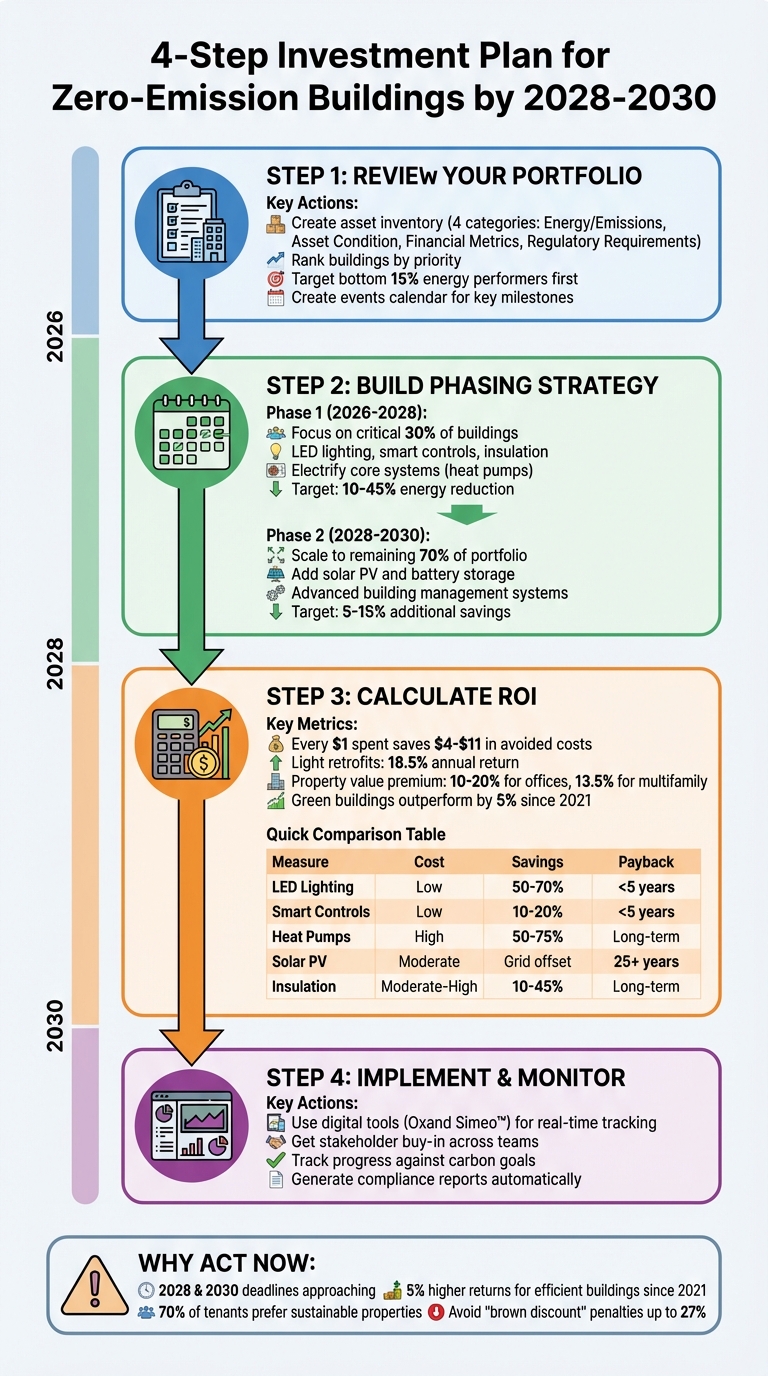
4-Step Zero-Emission Building Investment Plan for 2028-2030 Compliance
Step 1: Review Your Building Portfolio
Taking a close look at your building portfolio is the first step to building a solid, data-driven investment plan.
Organizations that adopt advanced asset investment planning can cut their total cost of ownership by up to 30%. Many also notice better cost efficiency and reliability within six to twelve months [4]. But to achieve these outcomes, you need an accurate, detailed understanding of your current assets.
Create an Asset Inventory
Start by consolidating all your building data into a single, centralized system. This eliminates fragmentation and ensures you have a clear overview.
Your inventory should cover four key categories:
- Energy and Emissions Data: Include baseline energy usage, Scope 1 emissions, and peak heating and cooling loads.
- Asset Condition: Record details like age, maintenance history, risk of failure, and electrical riser capacity.
- Financial and Strategic Metrics: Track factors such as hold periods, refinancing timelines, capital plans, and net operating income.
- Regulatory Requirements: Ensure compliance with local laws (e.g., NYC Local Law 97), energy codes, and note any available incentives [5].
"Wir brauchten ein Instrument, mit dem wir die fragmentierten Daten, die wir hatten, konsolidieren und auf eine Weise projizieren konnten, die unseren gewählten Vertretern, die die Entscheidungsträger sind, klar präsentiert werden konnte."
– Chief Executive Officer, The Meuse Department [4]
For example, The Meuse Department in France used Oxand Simeo™ to consolidate fragmented data into actionable insights for decision-makers. Similarly, In’li partnered with Oxand to move from reactive to predictive asset management, embedding energy performance goals into their investment planning [4].
Make sure to document both energy consumption and any technical infrastructure constraints, like electrical riser capacity or switchgear limits. This information helps you right-size equipment and control costs. Comparing actual peak heating and cooling loads against system capacity is another way to avoid overspending on oversized systems [5].
Create an events calendar to map out key milestones, such as equipment end-of-life dates, tenant turnovers, refinancing deadlines, and capital planning cycles. Aligning decarbonization efforts with these natural investment points can help you save money [5].
With a complete inventory in place, you can identify which buildings need immediate attention. This detailed view sets the stage for prioritizing retrofitting efforts that align with both carbon reduction goals and return on investment (ROI) targets.
Rank Your Buildings by Priority
Once your inventory is structured, rank your buildings to focus your investments where they matter most. It’s not practical – or cost-effective – to address every building at the same time.
Start with the bottom 15% of energy performers [7]. These are often classified as Class G properties and should be your first targets for improvement. For context, in the UK, only 11% of non-domestic properties have achieved an Energy Performance Certificate (EPC) rating of B or higher, a benchmark expected by 2030 [10].
Next, consider regulatory compliance deadlines. Non-residential and public buildings face stricter timelines. Under EU regulations, non-residential buildings must achieve Class E by 2027 and Class D by 2030, while residential buildings have until 2030 and 2033, respectively [7].
Building size and energy consumption are also important factors. Larger facilities with high energy use offer bigger opportunities for emissions reductions. For example, the Empire State Realty Trust’s retrofit of a 527,600 sq ft building at 250 West 57th Street in Manhattan is expected to cut annual natural gas consumption by 6,220 MMBTU (equivalent to about $80,000 in savings) and reduce carbon emissions by 300 tCO₂e per year [9].
Finally, take into account asset condition and investment horizon. A building you plan to hold for 10 years might justify a deeper investment than one you plan to sell in three years. Buildings with imminent equipment failures or tenant turnovers also present opportunities to combine decarbonization work with planned capital improvements [5][10].
"For groups with a 2030 target, they’ve started to realise that it’s honestly not that far away. It’s really only one investment cycle."
– Matt Clifford, Head of Sustainability & ESG, Cushman & Wakefield Asia Pacific [10]
Use EPC databases to pinpoint and rank the lowest-rated buildings in your portfolio [8]. If you lease properties, prioritize those with at least 75% occupancy and require new leases to include annual greenhouse gas and energy data reporting [6].
sbb-itb-5be7949
Step 2: Build a Risk-Based Phasing Strategy
Once your portfolio is prioritized, the next move is to develop a phased investment plan that balances urgency with budget constraints. Phased retrofits are a practical way to avoid financial strain and minimize operational disruptions.
A risk-based phasing strategy ensures resources are directed where they’ll have the most impact. This means aligning investments with regulatory deadlines, equipment lifecycles, and key events like lease expirations or end-of-life for critical systems. By spreading costs over time, you can stay on track to meet zero-emission goals for 2028 and 2030 without overwhelming financial resources. This approach builds on your portfolio review and creates a roadmap for well-timed upgrades.
Federal standards recommend completing deep retrofits on at least 30% of high-energy-consuming facilities by 2030 [6]. Breaking this into two phases – 2026–2028 and 2028–2030 – provides a manageable timeline.
Phase 1: 2026–2028 – Focus on High-Priority Retrofits
Start with the most critical 30% of your buildings. These are facilities with high regulatory risks, poor energy performance, or outdated equipment nearing the end of its lifecycle. Begin with upgrades that are both impactful and cost-efficient, such as LED lighting, smart controls, and sealing building envelopes. For instance, adding insulation and air-sealing to older buildings can reduce heating and cooling energy demand by 10% to 45% [3]. These energy savings also allow for smaller, more affordable HVAC systems.
Electrifying core systems should be a top priority. Replace combustion-based equipment with electric heat pumps and similar technologies. Predictive modeling can help you identify components likely to fail soon, allowing you to plan upgrades around scheduled events like lease renewals or equipment replacements, reducing costs and disruptions [2].
For example, a major retrofit project in New York achieved a 38% reduction in energy use and saved millions annually through targeted upgrades [3][11].
Phase 2: 2028–2030 – Scale Across Your Portfolio
After addressing the top-priority buildings, shift your focus to the remaining 70% of your portfolio. Apply the insights gained from Phase 1 to scale your efforts effectively. This phase should emphasize integrating renewable energy systems like solar photovoltaic (PV) panels and battery storage. These systems help manage peak energy demand, reduce reliance on the grid, and lower carbon emissions [6]. According to the updated EU Energy Performance of Buildings Directive, all new non-residential buildings must include solar systems by the end of 2026, and existing buildings should be designed to accommodate solar installations to avoid costly future retrofits [1].
Continue upgrading with measures like advanced building management systems, improved building envelopes, and ongoing commissioning to maintain efficiency. Smart sensors and regular system tuning can deliver an extra 5–15% in energy savings without requiring significant capital investment [3].
To keep your plan on track, monitor progress and spending in real time using digital tools. For instance, platforms like Oxand Simeo™ allow you to track capital expenditures, simulate scenarios, and adjust plans as conditions evolve. This kind of tracking ensures financial discipline and helps align your investments with long-term objectives [10].
Step 3: Calculate Lifecycle Costs and ROI
Once you’ve outlined your risk-based retrofitting stages, it’s time to dive into the numbers – calculating lifecycle costs and ROI. This step ensures your investments deliver lasting benefits. Instead of focusing solely on upfront expenses, a Lebenszykluskostenanalyse shifts the lens to long-term value. It accounts for operational savings and risk mitigation, helping you avoid the trap of choosing options that may seem cheaper now but cost more in the future.
A key part of this process is establishing a "Business as Usual" (BAU) baseline – essentially, what you’d spend anyway on maintenance and equipment replacement. By framing decarbonization as an incremental investment above this baseline, the financial case becomes much clearer. For instance, if your HVAC system is nearing the end of its life, you can evaluate whether to replace it with a fossil-fuel-based system or upgrade to an electric heat pump.
The financial benefits of this approach are compelling. Research shows that every $1 spent on climate mitigation can save between $4 and $11 through avoided losses and reduced operating costs [13]. Light energy retrofits, for example, boast an average annual return of 18.5%, often outperforming stock market investments [13]. Deeper retrofits can add a premium to property values – 13.5% for multifamily buildings and 10%–20% for office properties [13][3].
"What looks expensive in year one often becomes cost-neutral within a decade, and value-accretive soon after." – Nicolas Kosh, GRI Hub News [13]
Compare Electrification Options
Not all retrofit measures yield the same returns, so understanding their trade-offs is essential. Here’s a quick comparison of common electrification options based on upfront costs, energy savings, and ROI potential:
| Retrofit Option | Upfront Cost Impact | Energy / CO₂ Savings | Payback / ROI Potential |
|---|---|---|---|
| Insulation & Envelope | Moderate to High | 10%–45% energy reductions [3] | Long-term; boosts EPC rating [3] |
| Heat Pumps | High (Initial) | 50%–75% energy reductions [3] | 300%–450% efficiency [3] |
| Solar PV | Mäßig | Offsets grid draw [3] | Energy cost hedge (25+ years) [3] |
| Smart Controls/BMS | Niedrig | 10%–20% energy reductions [3] | Rapid; often < 5 years [3] |
| LED Lighting | Niedrig | 50%–70% energy reductions [3] | Quick win; high ROI [3] |
Nehmen Sie heat pumps, for example. While their upfront costs are higher, they deliver outstanding efficiency – providing 3 to 4.5 kWh of heat for every 1 kWh of electricity consumed [3]. This translates into significant energy savings and shields you from fluctuating fossil fuel prices. Similarly, solar PV systems act as a long-term hedge against rising electricity costs, with benefits extending for 25 years or more [3].
For quicker returns, focus on measures like LED lighting oder smart controls, which often pay back in under five years and generate immediate cash flow. Larger investments, such as heat pumps, can be bundled with planned capital upgrades like roof replacements or HVAC system overhauls to reduce incremental costs [12].
Align Costs with Carbon Reduction Goals
Financial planning and decarbonization don’t have to be at odds. Tools like Nettogegenwartswert (NPV) can provide a comprehensive view of long-term benefits, especially when factoring in utility rate increases over a 15-year period [12].
Conduct sensitivity analyses to test your assumptions. How would rising energy prices, carbon taxes, or shifts in equipment costs affect your ROI? This approach helps identify investments that remain viable even under less favorable conditions [12][14]. Tools wie Oxand Simeo™ can simulate various retrofit scenarios in real time, helping you pinpoint the best strategies.
Don’t forget to account for avoided costs. Failing to meet energy performance standards can lead to hefty fines, higher insurance premiums, or even asset devaluation. In Europe alone, approximately €1.5 trillion in real estate value is at risk without deep retrofits to meet stricter energy standards [3]. Proactively investing now can protect your assets from becoming "stranded" – unmarketable or non-compliant properties.
Lastly, document 12–24 months of utility bills and retrofit activities. This proof of savings can significantly boost property valuation. For example, demonstrating $1,000 in annual operational savings could translate to an additional $15,000–$20,000 in property value, based on common capitalization rates [15].
Step 4: Implement and Monitor Your Plan
It’s time to put your investment strategy into action. Success depends on having the right tools and ensuring everyone involved is on the same page.
Use Oxand Simeo™ for Planning and Tracking
Managing a long-term decarbonization plan across multiple buildings can get messy fast – spreadsheets just won’t cut it. That’s where Oxand Simeo™ comes in. This platform centralizes your asset data, offering simulations for aging, risk, costs, energy use, and carbon performance. Its Energy and Carbon Module goes a step further by calculating energy (kWh) and greenhouse gas savings for every maintenance or modernization project. Plus, the scenario simulator lets you test your budget against carbon goals in real time. For instance, you can see if postponing a heat pump installation by six months would derail your emissions targets. This kind of real-time insight is a game-changer when you need to show stakeholders the ROI and how your spending supports both financial and sustainability goals.
On the ground, field teams can use the Simeo™ Go Handy-Applikation to perform real-time inspections and capture energy data – no more slow, outdated paper processes. One public-sector portfolio used this system to reduce its maintenance backlog by 27% and save about $4.4 million in energy costs across 66 buildings in just one budget cycle [16]. And when it comes to compliance, the platform automatically generates reports aligned with ISO 55001 standards, cutting the time needed for audit-ready documentation by up to 70% [16].
With a system like this in place, you’ll be ready to rally your team around the shared goal of decarbonization.
Get Buy-In from Stakeholders
Even the best plan can fall apart without full support from your organization. Once you’ve set up tools for dynamic tracking, the next step is to ensure everyone – from facility managers to ESG leaders and finance teams – is aligned and working toward the same decarbonization goals.
Start by breaking down data silos. Use interactive dashboards and visual maps to turn complex asset data into clear, actionable insights. This way, everyone is literally on the same page. Equip your field teams with mobile tools for real-time data collection, making them feel like active participants in the process. When inspections directly impact investment decisions, operational staff become more engaged.
It’s also important to frame decarbonization as a smart investment rather than just a compliance requirement. As Adin Meir, Managing Director USA at Longevity Partners, aptly states:
"Decarbonization is only complex when it is separated from core real estate processes" [9].
To ease budget constraints, consider performance contracting. Many organizations fund renovations through future energy savings, reducing the need for large upfront investments. For example, the U.S. Federal Government is targeting a 50% reduction in building emissions by 2032 using similar strategies [6]. By aligning decarbonization goals with financial incentives, you can create a roadmap that ensures smooth implementation across investment, asset management, and operational teams.
Conclusion: Prepare Your Portfolio for the Future
The year 2030 might feel far off, but in investment terms, it’s just around the corner. Delaying action means facing higher costs, scrambling for scarce resources like heat pumps and contractors, and competing for limited grid capacity. Instead, take a proactive approach by leveraging your portfolio review, risk-based strategy, and cost analysis to put decarbonization plans into motion.
Buildings with strong energy efficiency aren’t just better for the environment – they’re better for your bottom line. These properties command rent premiums of 3%–4% and have outperformed less efficient ones by 5% in total returns since 2021 [2]. On the flip side, inefficient buildings face "brown discounts", with rental gaps reaching up to 27% compared to green-certified properties [10]. Taking early action safeguards your assets and positions your portfolio to benefit from these premiums.
Spreading investments over equipment lifecycles and lease breaks can help manage costs. Starting with a detailed portfolio assessment, crafting a risk-based investment plan, and weighing lifecycle costs against carbon reduction goals transforms decarbonization from a compliance challenge into a competitive edge. Tools like Oxand Simeo™ simplify this process by centralizing data, running real-time scenario simulations, and tracking both financial and sustainability outcomes across your portfolio.
The organizations that will lead the way aren’t just setting bold goals – they’re implementing them now. Start your phased investment strategy today to secure resources ahead of rising demand and prepare your portfolio for a zero-emission future.
FAQs
What qualifies as a “zero-emission” commercial building?
A “zero-emission” commercial building is designed to be highly energy-efficient, avoids on-site emissions from energy use, and relies entirely on clean energy sources for power. This approach aligns with national standards for operating emissions, aiming to minimize environmental impact without compromising energy performance.
How do I pick which buildings to retrofit first?
To begin, take a close look at the current state of your buildings, paying special attention to areas where energy is being wasted and emissions are high. Focus on properties that consume the most energy, have the largest emissions footprint, or show strong potential for upgrades. Use Lebenszykluskostenanalyse to weigh the costs and benefits, and explore technical solutions to pinpoint where retrofits will deliver the greatest impact and return on investment (ROI). Don’t forget to account for regulatory deadlines and available incentives – these can help you stay compliant while getting the most value out of your efforts.
What’s the fastest way to estimate retrofit ROI?
The fastest way to estimate the return on investment (ROI) for retrofits is to focus on upgrades that deliver immediate savings. Think of options like LED lighting, air sealing, insulation, und smart thermostats – these tend to pay for themselves quickly.
A smart strategy is to use a "bundle & sequence" approach: tackle these quick wins first, then plan for bigger upgrades during regular replacement cycles. To gauge the financial benefits, calculate the utility savings and include any applicable tax credits or rebates in your assessment. This method gives you a clear and fast snapshot of potential savings.
Verwandte Blogbeiträge
- Erreichen von Netto-Null in Immobilienportfolios: Von Zielen zu Investitionsplänen
- Gleichgewicht zwischen Risiko, Budget und Kohlenstoff: Ein praktischer Rahmen für die Kapitalplanung
- EPBD 2026: Was die Umsetzungsfrist am 29. Mai für Asset Owner bedeutet
- Nachhaltige Investitionsplanung 101: Wie man einen Fahrplan für die Dekarbonisierung des gesamten Portfolios erstellt