







Managing assets without a clear plan leads to higher costs and inefficiencies. Two key tools can help: Asset Management Plans (AMPs) and Asset Investment Plans (AIPs). Here’s how they differ:
- AMPs focus on daily operations and lifecycle management for individual assets, ensuring service levels are maintained efficiently.
- AIPs take a broader view, guiding long-term capital allocation across an entire portfolio to balance costs, risks, and performance.
Think of AMPs as tactical guides for maintaining assets and AIPs as strategic frameworks for deciding where to invest limited resources. Both work together to optimize asset performance and reduce unnecessary spending. Following asset investment planning best practices ensures these strategies deliver long-term value.
Quick Comparison
| Feature | Asset Management Plan (AMP) | Asset Investment Plan (AIP) |
|---|---|---|
| Focus | Day-to-day operations and maintenance | Long-term capital allocation |
| Approach | Bottom-up (individual asset focus) | Top-down (portfolio-level decisions) |
| Key Metrics | Service levels, lifecycle costs | ROI, risk reduction, budget impact |
| Time Horizon | 10+ years (lifecycle of assets) | 1–100 years (portfolio strategy) |
Both are essential for organizations managing large infrastructure or asset portfolios. Keep reading to learn how they complement each other.
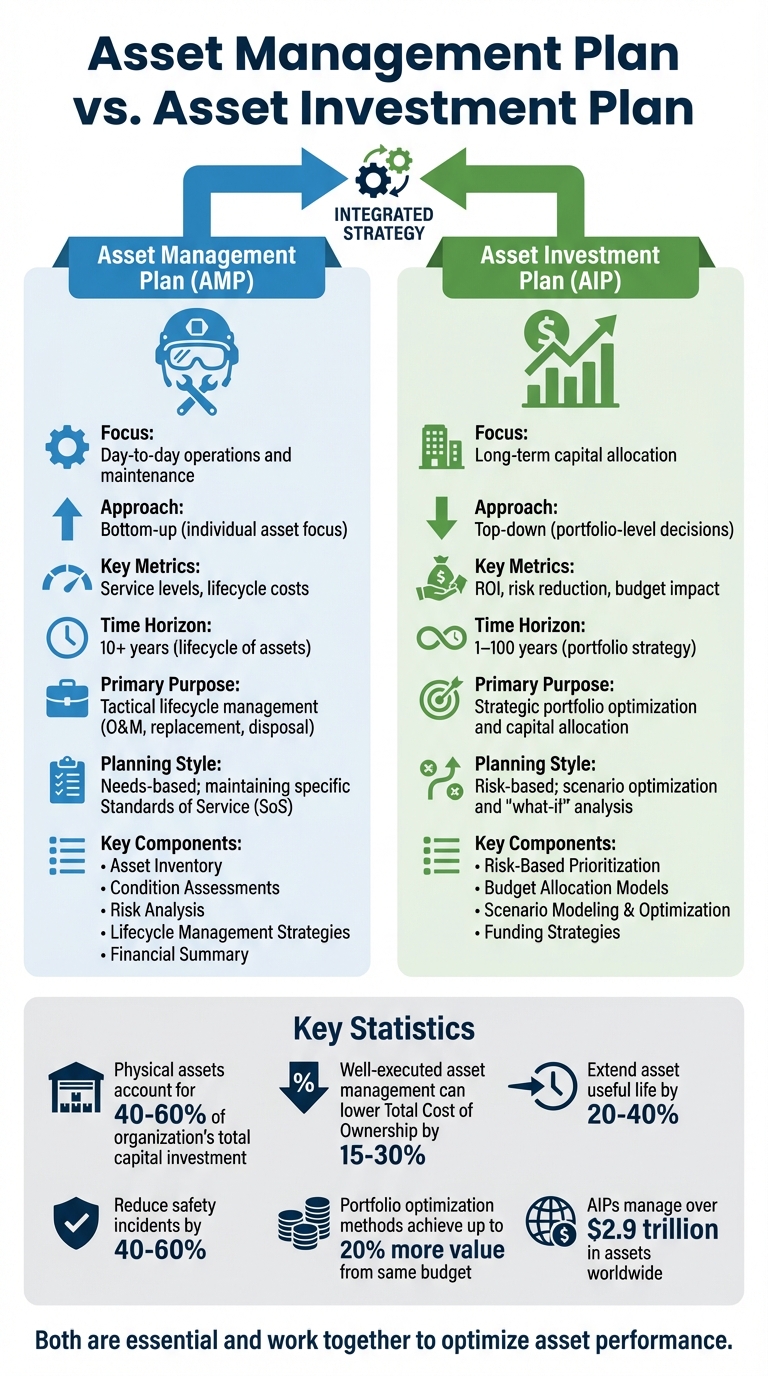
Asset Management Plan vs Asset Investment Plan: Key Differences Comparison
How To Tell Your Asset Investment Story
sbb-itb-5be7949
What is an Asset Management Plan?
An Asset Management Plan (AMP) is essentially a detailed guide that turns strategic goals into actionable steps. It outlines how an organization will handle its physical assets – everything from buildings and bridges to HVAC systems and electrical grids – on a daily basis [1][5].
This plan covers every stage of asset management: planning, acquisition, installation, operation, performance evaluation, maintenance, and eventual disposal. It ensures that all aspects of asset oversight are accounted for [8]. By doing so, it provides a clear framework for managing spending, assessing risks, and planning for the entire lifecycle of assets.
Purpose and Objectives
AMPs serve several key purposes. They help justify spending by offering transparency into the costs and benefits of various service levels. They also aim to minimize costs over the asset’s entire lifecycle – spanning operation, maintenance, and disposal [1]. Additionally, they play a critical role in identifying risks, such as potential failures that could disrupt services or compromise safety [7][8].
Physical assets typically account for 40% to 60% of an organization’s total capital investment [8]. Because of this, managing them effectively is essential. Well-executed asset management programs can lower the Total Cost of Ownership by 15% to 30%, extend an asset’s useful life by 20% to 40%, and reduce safety incidents by 40% to 60% [8]. Organizations that transition from reactive to proactive management often experience 30% to 50% lower unplanned maintenance costs and 35% to 60% less unplanned downtime [8].
Key Components
An AMP typically includes five main components:
- Asset Inventory: A comprehensive catalog of assets, including their identifiers, locations, ages, and levels of importance [5].
- Condition Assessments: Evaluations of each asset’s current state (e.g., good, fair, or poor) and estimated remaining lifespan [5].
- Risk Analysis: Identification of assets that pose the highest risk to operations if they were to fail [7][8].
- Lifecycle Management Strategies: Detailed plans for maintenance, renewal, and disposal schedules [7].
- Financial Summary: Projections of operating, maintenance, and capital costs, usually covering a period of one to five years or more [1][7].
Together, these components ensure that asset management aligns with long-term investment strategies. The World Road Association describes this as "the story of the organization in relation to its mission" [9], connecting corporate objectives with the infrastructure needed to achieve them.
When and Why to Use AMPs
AMPs are particularly useful for addressing aging infrastructure, meeting regulatory demands, and achieving sustainability goals. For example, organizations with aging assets use AMPs to avoid the escalating costs of deferred maintenance and emergency repairs. In regions like Ontario, Canada (since 2015) and Queensland, Australia (where 10-year plans are required), AMPs are essential for regulatory compliance [1]. Similarly, organizations focused on sustainability rely on AMPs to make better use of resources, extend asset lifespans, and cut down on waste [8][9].
"The AMP plays a key role in connecting the organization’s corporate strategic direction with implementation tools, ensuring that the organization can achieve its mission in the most cost-effective manner." – PIARC (World Road Association) [9]
AMPs also align with ISO 55001 standards, ensuring that tactical decisions are directly tied to the organization’s broader policies and strategic goals [6][7]. This connection makes AMPs an essential tool for complementing long-term asset investment strategies.
What is an Asset Investment Plan?
Expanding on the tactical focus of Asset Management Plans (AMPs), Asset Investment Plans (AIPs) take a broader, long-term approach to capital allocation.
An Asset Investment Plan (AIP) is a structured framework designed to guide organizations in deciding which projects to fund, when to fund them, and how much to invest over a multi-year period [4]. While AMPs focus on day-to-day asset operations, AIPs concentrate on strategic resource allocation. This involves creating multi-year plans for capital expenditures (CAPEX) and operating expenditures (OPEX) that balance competing priorities within real-world budget constraints [11].
AIPs treat investment decisions like portfolio optimization problems. They assess numerous potential projects across different asset types – like buildings, infrastructure, and equipment – to determine the combination that offers the most value while keeping lifecycle costs and risks as low as possible [10][11]. This approach replaces subjective, age-based asset replacement schedules with transparent, risk-based decision-making.
Purpose and Objectives
The main goal of an AIP is to maximize value by directing limited resources to the most impactful projects at the right time [4]. To do this, AIPs prioritize investments based on several factors, including:
- Risk (calculated as the likelihood of failure multiplied by the consequence of failure)
- Lifecycle costs (spanning acquisition, maintenance, and disposal)
- Return on investment (ROI)
- Sustainability goals, such as reducing carbon emissions and improving energy efficiency [4][11]
"Asset investment planning is the ongoing practice of deciding, over a medium to long-term horizon, how to allocate capital and resources to minimize total lifecycle costs and risks."
Many modern AIPs also integrate environmental, social, and governance (ESG) considerations. Organizations using portfolio optimization methods report achieving up to 20% more value from the same budget [10].
Key Components
AIPs are built around four essential elements that enable strategic decision-making:
Risk-Based Prioritization:
This involves quantifying risk by combining data on asset conditions, failure probabilities, and consequences. Factors like safety, reliability, and regulatory compliance are considered. Risk is evaluated as a financial cost, enabling it to be minimized alongside CAPEX and OPEX [4].
Budget Allocation Models:
These models create a unified framework that integrates CAPEX and OPEX, making it easier to compare replacement projects (CAPEX-heavy) with refurbishment options (OPEX-heavy). This ensures short-term decisions support long-term financial efficiency [4].
Scenario Modeling and Optimization:
AIPs use scenario modeling to explore how different budget levels impact asset portfolios. For example, one utility found that a 10% budget increase reduced total ownership costs by 22% due to fewer high-risk failures. Conversely, cutting the budget by 10% led to millions in additional costs from increased maintenance and emergency repairs [4].
Funding Strategies:
AIPs balance proactive spending (planned replacements and refurbishments) with reactive funds for emergencies. This ensures high service levels are maintained without overspending [4].
When and Why to Use AIPs
AIPs are especially useful for organizations dealing with tight budgets, aging infrastructure, or competing priorities. Here are two common scenarios where they shine:
Optimizing Limited Budgets and Managing Risks:
When resources are limited, AIPs help pinpoint the projects that provide the most value. By quantifying the risks of delaying critical projects, they shift discussions from "Can we afford this?" to "Can we afford not to do this?" Organizations adopting AIPs report a 50% reduction in planning time and a 10% boost in execution efficiency [10].
Achieving Carbon Reduction Goals:
For organizations with sustainability mandates, AIPs model energy performance and create carbon-aligned investment plans at a portfolio level. This ensures decarbonization goals are built into capital planning rather than treated as separate efforts [4][11].
"AIPM [Asset Investment Planning & Management] is one of the key processes in asset management, enabling organizations to leverage risk and value to make optimal and rigorous investment decisions with agility and high efficiency."
- Boudewijn Neijens, CMO, Copperleaf [10]
Currently, AIPs are used to manage over $2.9 trillion in assets worldwide [11].
Next, we’ll explore how these strategic differences influence asset management decisions.
Key Differences Between Asset Management Plans and Asset Investment Plans
AMPS and AIPs both play crucial roles in asset management, but their functions and objectives differ significantly. Recognizing these differences can help organizations sidestep pitfalls like stranded spend – where maintenance is performed on assets already planned for replacement – and ensure that infrastructure investments align with broader, long-term objectives [2]. This clarity prevents unnecessary expenditures on assets nearing the end of their lifecycle.
Scope and Purpose
The main difference between AMPs and AIPs lies in their planning approach. AMPs adopt a bottom-up method, leveraging data on asset age and condition to prioritize lifecycle decisions. In contrast, AIPs take a top-down perspective, weighing technical requirements against budget and resource constraints to set funding priorities [10].
| Feature | Asset Management Plan (AMP) | Asset Investment Plan (AIP) |
|---|---|---|
| Primary Focus | Tactical lifecycle management (O&M, replacement, disposal) [1] | Strategic portfolio optimization and capital allocation [3] |
| Planning Approach | Needs-based; focused on maintaining specific Standards of Service (SoS) [1] | Risk-based; focused on scenario optimization and "what-if" analysis [4] |
| Lifecycle Focus | Whole-life cost optimization (technical and financial) [1] | Focuses on minimizing long-term costs and risks [4] |
| ISO 55001 Alignment | Core tactical document for managing asset systems [1] | Supports strategic investment decision-making and risk management [4] |
| Key Metric | Standard of Service (SoS) and Condition Grade (CG) [1] | Value-based ROI, risk mitigation, and strategic alignment [3] |
These differences also shape the timeframes and operational priorities of each plan.
Time Horizon and Focus Areas
AMPs typically span at least 10 years, often extending to match the lifespan of the longest-lived assets in a system [1]. Their focus is on maintaining specific performance standards. For instance, ensuring a pump station consistently processes 12 cubic meters per second or keeping infrastructure like walls at a Condition Grade 3 or better.
AIPs, on the other hand, cover medium- to long-term planning horizons, ranging from 1 to 100 years [3]. Unlike AMPs, which focus on individual assets, AIPs emphasize value-driven decision-making across entire portfolios. This approach enables organizations to explore various budget scenarios and make tradeoffs clear to stakeholders. For example, increasing the budget by 10% could cut overall costs by more than 20%, while a similar budget reduction might result in millions of dollars in additional expenses [4].
These contrasting priorities are evident in real-world applications.
Examples
The Tennessee Valley Authority (TVA) provides a clear example of how AMPs and AIPs can work together effectively. As of August 2022, TVA used Copperleaf’s Asset Investment Planning solution to manage its capital portfolio while also implementing an asset management program. According to Senior Program Manager Paul Barnett, the AIP approach enabled TVA to develop defensible plans for capital sustainment [3]. In this case, the AMP handled the management of specific assets, while the AIP focused on determining where and when to allocate capital across the portfolio, illustrating how these two strategies complement each other [4].
In flood risk management, an AMP might dictate that flood defense walls be maintained at a minimum Condition Grade 3 to protect urban areas [1]. Meanwhile, the corresponding AIP would weigh this requirement against other priorities, such as bridge repairs or water treatment upgrades, to decide on the best timing and funding levels based on risk, cost, and overall strategic value [3].
How Oxand Simeo™ Supports Asset Management and Investment Planning

Oxand Simeo™ offers a comprehensive solution that seamlessly combines tactical asset management with strategic investment planning. By integrating Asset Management Plans (AMPs) and Asset Investment Plans (AIPs) into one platform, it transforms how organizations manage their assets and plan for the future.
This platform consolidates data from inspections, financial systems, and energy records into a centralized knowledge base. Using predictive models and actionable recommendations, it delivers multi-year CAPEX planning models. This shift helps organizations move from reactive, spreadsheet-based budgeting to proactive, risk-driven decision-making. Let’s explore how Oxand Simeo™ addresses both operational and strategic planning needs.
Features for Asset Management Plans
Simeo Inventory serves as the backbone of AMPs, creating a unified database for all sites, buildings, and systems. It ensures data accuracy through completeness checks and detailed audit trails, simplifying compliance with ISO 55001 standards [13]. The Simeo Go mobile app further streamlines operations by enabling guided, offline field inspections, cutting data collection time in half compared to traditional paper-based methods [15]. Additionally, the platform generates ISO 55000-compliant documentation automatically, reducing audit preparation time by 70% [15].
Here’s what industry leaders have to say:
"As asset leader, I’m aware of the need to challenge our practices and be at the top level of operation and maintenance practices. Within this context, we want as a first step to perform a Maturity Assessment of our Asset Management practices, in order in the future to get the ISO 55001 – Asset Management – Certification." (CTO, LaGuardia Airport) [12][13][14]
Features for Asset Investment Plans
For strategic planning, Simeo’s scenario simulator enables organizations to evaluate budget scenarios, balancing risk, service levels, and carbon impact in a single view [13]. By integrating inventory data, inspection results, and lifecycle models, it delivers multi-year CAPEX and OPEX roadmaps in just 6 to 12 weeks [13].
The benefits are clear:
"We needed a tool that would allow us to consolidate the fragmented data we had and present clear projections to elected decision-makers." (CEO, The Meuse Department) [12][13]
Organizations using Oxand Simeo™ have reported significant outcomes, including a 25% to 30% reduction in Total Cost of Ownership through optimized intervention timing [12][13]. One public sector portfolio reduced its maintenance backlog by 27% and achieved $4.3 million in energy savings across 66 buildings in its first budget cycle [15].
Benefits for Different Stakeholders
Oxand Simeo™ aligns operational insights with strategic goals, providing tailored advantages for various stakeholders in the asset lifecycle:
- Facility managers benefit from clear visibility into asset conditions and lifecycle forecasts, enabling predictive maintenance [12].
- ESG and sustainability leaders can leverage carbon-aware planning tools to model decarbonization pathways while meeting CSRD and ESRS requirements [12][13].
- Executive leadership and compliance officers receive board-ready dashboards that quantify risks and trade-offs, making budget proposals more data-driven and defensible [12][13].
As one user highlighted:
"We turned to Oxand because we needed a tool that would provide us with a predictive – not just corrective – view and help us manage our investments more effectively. Oxand stood out for its risk management capabilities." (Head of Budget and Asset Valuation Department, In’li) [12][13]
Most organizations see measurable improvements in reliability and cost efficiency within just 6 to 8 months [12].
Conclusion
Asset Management Plans (AMPs) and Asset Investment Plans (AIPs) are not competing tools – they work hand in hand to connect long-term strategies with actionable steps. AMPs offer a comprehensive, lifecycle perspective of your asset portfolio [16][17], while AIPs focus on turning strategic objectives into practical, funded actions [4]. When used together, these plans help close oversight gaps and ensure resources are allocated effectively, especially when dealing with aging infrastructure investment and maintaining reliability [4].
This combined approach paves the way for a cohesive planning framework. Aligning both AMPs and AIPs with ISO 55001 principles is key to breaking down barriers between engineering, finance, and operations teams [4][14]. This alignment shifts organizations from reactive, age-based replacements to proactive, risk-focused decision-making. The result? A structured framework with clear audit trails, transparent governance, and a clear understanding of the costs associated with delaying critical investments [4][14].
Sustainability is no longer just a goal – it’s a necessity. By evaluating how asset failures affect environmental outcomes and incorporating carbon-conscious planning into both AMPs and AIPs, organizations can chart decarbonization strategies while reducing total lifecycle costs. This includes addressing often-overlooked "end-of-life risks", which can lead to significant unexpected expenses [4]. Weaving sustainability into risk-based planning directly supports the broader objective of optimizing asset performance.
To bring these strategies to life, Oxand Simeo™ provides a unified platform that integrates asset data, condition assessments, and predictive modeling. It simplifies ISO 55001-compliant documentation, generates multi-year CAPEX and OPEX plans in just weeks, and offers scenario simulations to balance risk, service levels, and carbon impact – all in one place [13][14].
FAQs
Do I need an AMP, an AIP, or both?
Whether your organization requires an Asset Management Plan (AMP), an Asset Investment Plan (AIP), or both depends on your specific goals.
An AMP lays out a long-term strategy for managing the lifecycle of assets in a way that’s efficient and sustainable. On the other hand, an AIP zeroes in on prioritizing and funding specific capital investments, considering factors like risk, return on investment (ROI), and organizational objectives.
For many organizations, combining the two works best. The AMP provides the overarching framework, while the AIP ensures that investments are aligned with priorities and deliver measurable outcomes.
What data do I need to build an AIP from my AMP?
To develop an Asset Investment Plan (AIP) from your Asset Management Plan (AMP), you’ll need a variety of detailed data. Start with information on your asset inventory, including valuation, lifecycle costs, asset condition, and performance metrics. Financial details like budgets and funding strategies are also essential. Additionally, outline planned actions such as maintenance schedules and upgrades.
By incorporating this data, your AIP can effectively prioritize investments based on factors like risk, return on investment (ROI), and long-term stability. This approach ensures your investment decisions align with your broader asset management strategy.
How do I include carbon and ESG goals in my investment decisions?
To integrate carbon and ESG (Environmental, Social, and Governance) goals into investment strategies, start by aligning your asset investment plans with established sustainability frameworks such as ISO 55001. Define specific carbon reduction targets and ESG benchmarks to guide your decisions. Prioritize investments that align with these sustainability objectives and ensure stakeholder involvement to promote openness and accountability. A structured approach that carefully considers risks, budgets, and carbon impacts can help achieve informed, sustainable investment choices that support long-term environmental and social priorities.
Related Blog Posts
- Infrastructure Asset Management: A Risk-Based Approach for Multi-Year CAPEX Planning
- Asset Investment Planning 101: How to Decide What to Invest in, When and How Much
- How to Build a Lifecycle Audit for a Multi-Site Portfolio
- 90 Days to Your First Asset Investment Plan: A Step-by-Step Implementation Guide