








AI is transforming how building portfolios manage decarbonization investments. By replacing outdated tools like spreadsheets with predictive simulations, AI helps cut energy costs by 20–40% and reduces planning time by up to 95%. With over 30 U.S. cities enforcing building performance standards, AI enables smarter capital allocation by identifying high-impact upgrades and ensuring compliance with regulations.
Key takeaways:
- Energy Efficiency: AI optimizes HVAC, lighting, and other systems, reducing waste by up to 30%.
- Data Integration: Centralized platforms unify energy, maintenance, and asset data for informed decisions.
- Predictive Modeling: Simulates long-term energy performance, guiding cost-effective retrofits.
- Compliance: Automates reporting to meet strict regulations, avoiding fines and penalties.
- Financial Impact: AI reduces costs, shortens payback periods, and aligns investments with carbon reduction goals.
AI tools like Oxand Simeo™ streamline planning, simulate scenarios, and ensure every dollar spent contributes to decarbonization efforts. With the right data and systems in place, portfolio managers can achieve net-zero targets while maximizing financial returns.
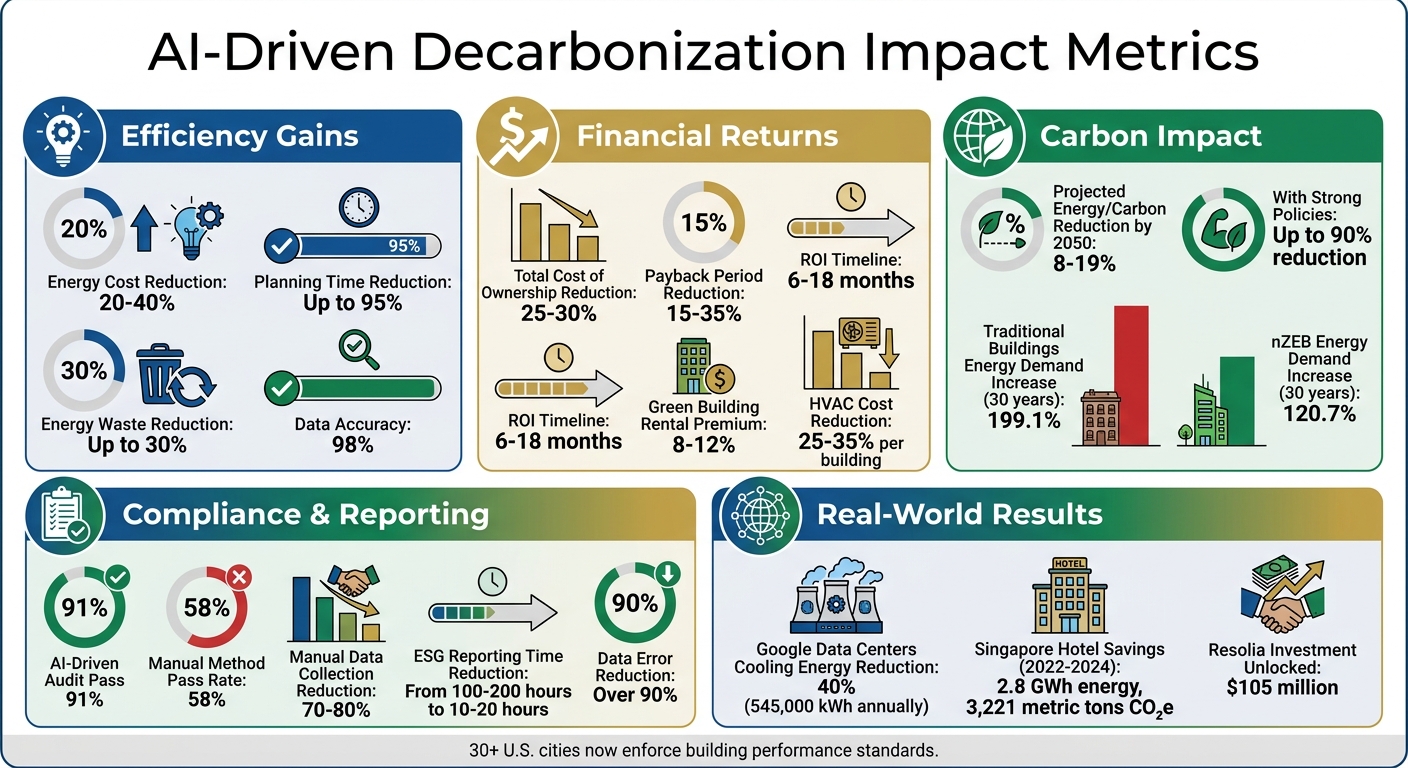
AI-Driven Decarbonization: Key Impact Metrics for Building Portfolios
From Data to Decisions: How AI Is Powering the Sustainable Building Revolution
sbb-itb-5be7949
Creating a Data Foundation for AI-Driven Planning
AI thrives on reliable and centralized data. The real challenge, however, isn’t just gathering information – it’s about connecting systems that often operate in isolation. For instance, energy data might live in one system, while maintenance records and asset conditions are tucked away in separate spreadsheets. Without integration, the potential of AI to deliver actionable insights remains untapped.
"The volume of data involved, from equipment performance to occupancy patterns, is simply too great for humans to process on their own."
– Stephen Zetarski, President of Nuvolo, Trane Technologies [4]
Transitioning from isolated systems to a comprehensive, building-wide intelligence approach is critical. When systems like HVAC, lighting, and occupancy sensors operate independently, inefficiencies can occur – such as heating and cooling running simultaneously, leading to 20% to 30% energy waste [2]. An Integrated Workplace Management System (IWMS) can bridge these gaps by unifying diverse data streams. For example, a laboratory organization managing over 20 locations adopted Nuvolo’s IWMS platform to centralize critical assets like HVAC, electrical, and elevators. This digital shift streamlined maintenance workflows and improved asset performance visibility, enabling better predictive maintenance and environmental controls across their portfolio [4].
Centralized Asset Inventories and Condition Data
A detailed asset inventory is more than just a list – it’s a comprehensive database. It includes physical condition, remaining service life, energy metrics like Energy Use Intensity, occupancy patterns, and compliance risks such as exposure to Building Performance Standards [5][6][2]. This unified data enables AI to make informed decisions, such as whether to repair aging equipment or replace it with energy-efficient alternatives – choices that directly affect both carbon reduction efforts and financial planning [4].
Belgian consulting firm Resolia offers a striking example. Since 2023, they’ve used the Urbio AI platform to replace manual spreadsheets with centralized building energy data. With this unified approach and generative AI for network designs, Resolia achieved 98% data accuracy while cutting planning time by 95%. This transformation unlocked over $105 million in investments for low-carbon heating solutions [3]. Such centralized data systems clearly accelerate decarbonization efforts and portfolio-wide carbon reductions.
Data Quality and Governance
For AI models to deliver accurate predictions, they need high-quality historical data – typically 3 to 6 months’ worth. Advanced platforms can flag sensor anomalies, reducing errors by over 90% [7]. This level of precision is crucial for avoiding inaccuracies in financial or ESG filings. Start with a 12-month baseline assessment to audit energy use, water consumption, waste output, and carbon emissions across your portfolio [7].
Older buildings (15–25 years old) often present challenges, but integration middleware or protocol translators can help ensure smooth data flow to AI platforms [8][7]. If sensor coverage is lacking, plan to allocate 20% to 30% of project costs for infrastructure upgrades. Retrofitting older buildings with IoT sensors and cloud-based BMS overlays typically costs between $0.50 and $2.00 per square foot [7]. Strong data governance like this forms the backbone for AI’s predictive capabilities in energy and carbon forecasting.
AI Applications in Energy and Carbon Forecasting
Once a strong data foundation is in place, AI can deliver precise forecasts for future performance. This goes beyond analyzing past trends – AI predicts how buildings will perform years, or even decades, into the future. Such forecasting is key for planning investments aimed at reducing carbon emissions. These predictions also enable detailed simulations of asset performance and help identify where efficiency improvements are most needed.
Rather than relying on assumptions, AI employs hybrid ensemble frameworks that combine algorithms like ANN, RF, XGBoost, and LSTM. This approach captures the complex, non-linear relationships between factors such as climate conditions, building features, and occupant behavior [9][10]. The result? A multi-model framework that significantly outperforms single-algorithm methods.
In the building sector, AI is expected to cut energy use and carbon emissions by 8% to 19% by 2050 [10]. With robust energy policies in place, reductions could soar to 90%, compared to business-as-usual scenarios [10]. For office buildings – which account for about 20% of electricity consumption among U.S. commercial properties – this translates to major cost savings and reduced carbon footprints [10].
Probabilistic Modeling and Asset Aging Simulations
Expanding on predictive techniques, AI now enables simulations of long-term asset performance under changing climate conditions. It is particularly effective at modeling how buildings age and how their energy performance evolves over time. Traditional buildings, for instance, are 1.65 times more sensitive to climate-driven energy demand changes compared to nZEBs (nearly Zero Energy Buildings) [9]. Over a 30-year span, energy demand is projected to rise by 199.1% for traditional buildings, while nZEBs will see a smaller increase of 120.7% [9]. This gap in climate resilience highlights which assets require immediate upgrades.
LSTM models shine in these long-term predictions, offering reliable energy and carbon projections through 2050 [9]. Unlike older, rule-based algorithms, these AI systems adapt by learning from operational data and incorporating live updates to improve performance [10]. They can seamlessly integrate high-frequency data from modern sensors with limited historical data from older buildings, ensuring consistent accuracy across diverse property portfolios [9].
"A hybrid ensemble framework, which leverages the strengths of multiple models, offers a promising solution to enhance predictive accuracy and reliability." – Springer Nature [9]
Energy Efficiency and Carbon Reduction Scenarios
AI helps identify decarbonization opportunities across four key areas: equipment efficiency, occupancy influence, control and operation, and design/construction [10]. Through scenario simulations, it compares "business-as-usual" paths with various intervention strategies, such as upgrading HVAC systems, retrofitting lighting, or improving building envelopes. These simulations reveal which measures offer the best carbon reduction for the investment.
One example is a commercial hotel in Singapore that used a hybrid LSTM-XGBoost framework between 2022 and 2024. During this period, the property saved 2.8 GWh of energy and cut emissions by 3,221 metric tons CO₂e, achieving a root mean square error of just 4.7% [11]. Another case is Google’s application of DeepMind AI in its data centers, which dynamically optimized cooling systems based on predictive models. This effort reduced cooling energy use by 40%, reclaiming over 545,000 kWh annually [11].
These analyses not only estimate carbon reductions but also assess economic impacts. AI demonstrates how automated design and operational optimizations can lower the cost premiums of high-efficiency retrofits, making net-zero goals more achievable for large-scale portfolios [10]. By aligning retrofits with risk and maximizing both carbon and cost savings, AI-driven scenarios offer a strategic roadmap for sustainable investments.
Optimizing Capital Allocation with Multi-Criteria AI Models
Once reliable forecasts are in place, the focus shifts to allocating capital in ways that align with decarbonization goals. AI models are instrumental in helping decision-makers balance budgets, carbon targets, and financial returns. These tools simulate a variety of renovation scenarios to pinpoint cost-effective strategies that meet both environmental and financial objectives [12][13].
Traditional methods often rely on individual building audits, which are not only time-intensive but can also overlook opportunities across an entire portfolio. AI-driven "Real Estate Decision Intelligence" (REDI) changes this by centralizing data and modeling the impact of interventions – like upgrading HVAC systems, adding solar panels, or improving insulation – across portfolios. This approach translates complex technical data into financial terms that are essential for capital planning, ensuring that sustainability, finance, and management teams are on the same page [12][13].
AI enables multi-criteria prioritization, allowing decision-makers to rank assets based on factors like ROI, carbon reduction potential, compliance with Building Performance Standards (BPS), and marginal abatement costs [6][5]. Risk management is another key component, with AI assessing "stranding risk" through CRREM-based climate scenario analysis. This involves comparing "do-nothing" scenarios against planned interventions to evaluate long-term risks [1]. Advanced energy modeling tools, trained on over 950,000 unique energy simulations, enhance predictive accuracy, enabling detailed scenario planning to guide investment decisions [6].
Scenario Simulations for Investment Prioritization
AI makes it possible to run "what-if" simulations that compare different investment scenarios side by side. These systems can evaluate millions of renovation or build sequences to identify the most cost-effective options [15][13]. For instance, AI can determine whether upgrading HVAC systems now or waiting until they reach the end of their service life will yield better financial and carbon outcomes. This ensures that capital allocation aligns with both the physical condition of buildings and their decarbonization potential [6].
Digital twins are a critical tool in these simulations. They allow managers to test the impact of specific upgrades – like adding solar panels or improving insulation – before committing funds [13]. With this capability, portfolio managers can visualize the outcomes of renovations across multiple properties at once, ensuring that investments maximize decarbonization impact.
"By combining carbon, cost, and constructability analysis under one roof, Adaptis saves us money on every project, and we deliver a higher quality of service." – David Leonard, Managing Principal, METAFOR [12]
Once these simulations are complete, the next step is to align financial returns with sustainability goals and regulatory requirements.
Balancing ROI, Carbon Goals, and Regulatory Compliance
Effective capital planning requires a careful balance between financial returns, carbon reduction, and compliance with regulations. AI models incorporate factors like carbon pricing, energy price volatility, regulatory mandates (such as the EU Renovation Wave), and available grants or incentives [12][13]. They also evaluate the "brown discount", which reflects the value loss of non-sustainable assets, against the potential value gains from retrofits [12].
AI-driven strategies can reduce payback periods for decarbonization investments by 15–35% [3]. With data accuracy in energy targeting reaching up to 98%, these models significantly lower the chances of misallocating funds [3]. Additionally, by modeling "do-nothing" scenarios, AI highlights the risks of asset stranding and regulatory penalties, making it clear why inaction can be costly [1]. This enables decision-makers to focus on buildings with the highest energy intensity and stranding risk, ensuring capital is directed where it will have the greatest impact at the lowest cost [1][5].
For example, a major US Port Authority collaborated with KPMG to create a decarbonization strategy aligned with its customers’ net-zero goals. Using specialized tools, the port established emissions baselines and modeled various scenarios, ultimately setting a formal 2040 net-zero target. This plan included a detailed asset replacement strategy integrated into its broader capital program [14].
AI for Regulatory Compliance and Decarbonization Reporting
AI is now playing a crucial role in securing portfolio investments by ensuring they meet regulatory standards and deliver accurate decarbonization reports. This builds on its ability to optimize capital allocation, adding another layer of strategic value.
Hitting decarbonization targets is only part of the equation – proving compliance to regulators and auditors is just as critical. AI platforms simplify this by automating the creation of transparent, regulation-compliant documentation. These systems keep track of building assets, occupancy trends, and equipment performance, mapping them against constantly changing compliance requirements. As new laws emerge, AI systems update their regulatory libraries automatically, ensuring businesses stay audit-ready and meet federal, state, and local standards [16].
Generating Audit-Ready Documentation
AI takes the stress out of audits by compiling inspection records, maintenance logs, photos, and certifications into ready-to-use audit packages with just one click [16]. This is especially valuable given the high stakes – failing a compliance inspection in commercial buildings can lead to an average fine and remediation cost of $42,000 [16].
Buildings using AI-driven compliance tools boast a 91% audit pass rate, compared to only 58% for those relying on manual methods [16]. AI doesn’t just react to compliance needs; it predicts them. By analyzing maintenance data, sensor inputs, and regulatory schedules, these platforms calculate live risk scores – ranging from Low to Critical – and provide 6–8 weeks of advance warning before potential issues escalate [16]. Since 73% of compliance violations in commercial buildings could be prevented with earlier detection, AI’s proactive monitoring can save businesses from costly penalties while supporting continuous decarbonization efforts [16].
Meeting Decarbonization Targets and Reporting Requirements
AI goes beyond compliance by continuously tracking performance metrics to identify opportunities for sustainable upgrades. Using Optical Character Recognition (OCR) and APIs, these platforms automatically process utility bills, energy audits, and property management data, eliminating manual entry errors [19][20]. This automation reduces manual data collection by 70%–80% and cuts framework submission times from 100–200 hours down to just 10–20 hours [19].
A standout example comes from the University of Maryland’s Center for Environmental Energy Engineering. In March 2026, the center reported that its AI-powered Rapid Energy Auditor (REA) software is managing 45 million square feet of state-owned buildings. This tool predicts energy usage and carbon emissions, helping buildings over 35,000 square feet comply with the Climate Solutions Now Act of 2022. This legislation mandates net-zero emissions by 2040, with penalties starting in 2030 [17].
"REA also calculates the cost of inaction, the fee building owners will pay if they don’t make any upgrades" – Aditya Ramnarayan, Ph.D. candidate at UMD [17]
AI platforms also support compliance with asset management standards like ISO 55001. By integrating Integrated Workplace Management Systems (IWMS) with building automation tools, they track asset lifecycles and optimize replacement schedules [4]. This ensures investment plans are not only financially sound but also meet international standards for transparency and traceability [18][19].
Oxand Simeo™: AI-Powered Decarbonization Planning for Building Portfolios

Oxand Simeo™ combines predictive modeling, risk-based prioritization, and sustainability analytics to align financial strategies with carbon reduction goals. With access to a library of over 10,000 predictive models addressing asset degradation, failure trends, and lifecycle behavior – paired with more than 30,000 recommended maintenance and renewal actions – the platform standardizes decision-making across vast building portfolios [21].
Simeo™ takes decarbonization planning to the next level by simulating investment scenarios that balance budgets, risks, service levels, and carbon impacts – all within a single interface. This allows portfolio managers to evaluate the trade-offs between financial performance and sustainability objectives in real time, avoiding the inefficiencies of juggling multiple spreadsheets over several months.
"We turned to Oxand because we needed a tool that would provide us with a predictive – not just corrective – view and help us manage our investments more effectively. Oxand stood out for its risk management capabilities." – Head of Budget and Asset Valuation Department, In’li [21]
The platform’s Simeo AIP (Asset Investment Planning) module accelerates the creation of multi-year CAPEX and OPEX roadmaps, delivering actionable plans in hours rather than months. Most clients see their first comprehensive investment strategy within 6 to 12 weeks of implementation [21]. Meanwhile, the Simeo Inventory module acts as a central data repository, integrating digital inspections and audit trails to ensure all investment decisions are based on reliable, well-governed data. Together, these tools streamline the process from raw data collection to actionable investment plans.
Key Features for Decarbonization Planning
Simeo™ embeds sustainability into its investment planning process through three primary capabilities:
- The Scenario Simulator models CO2 impacts alongside CAPEX for each investment scenario, helping users align financial and environmental priorities.
- Predictive models anticipate asset aging and degradation, enabling energy-efficient retrofits to be scheduled proactively – avoiding costly and reactive upgrades.
- The ESG Analytics module links capital allocation to measurable energy performance and emissions reductions, ensuring every investment supports long-term carbon reduction goals. This module also provides verifiable documentation for compliance with standards like ISO 55001, CSRD, and ESRS.
By prioritizing critical energy-consuming systems – such as HVAC units, boilers, and building envelopes – Simeo™ helps prevent both operational disruptions and the carbon inefficiencies tied to emergency replacements. The platform’s Energy Transition modules further support compliance with evolving regulations and internal sustainability targets. Integration with ERP, CMMS, and GIS systems ensures real-time operational data is incorporated into scenario modeling for more precise planning.
Portfolio-Scale Outcomes: Cost and Carbon Reduction
Organizations that use Oxand Simeo™ typically see a 25% to 30% reduction in Total Cost of Ownership (TCO), thanks to optimized timing and prioritization of interventions [21]. By identifying the most cost-effective moments for maintenance or replacements, the platform extends asset lifespans and minimizes the expense of emergency repairs.
In addition to financial benefits, Simeo™ drives measurable carbon reductions by ensuring every dollar spent on building improvements contributes to decarbonization goals. For instance, the Meuse Department in France used Simeo™ to unify scattered asset data and create investment scenarios that were clearly presented to elected officials. This transparency helped secure funding for energy-efficient upgrades that balanced fiscal responsibility with climate commitments [21].
"We needed a tool that would allow us to consolidate the fragmented data we had and project it in a way that could be clearly presented to our elected officials, who are the decision-makers." – Chief Executive Officer, Meuse Department [21]
Simeo™’s ability to generate plans in hours – not months – empowers portfolio managers to adapt quickly to changing regulations or budget constraints. This agility is crucial as decarbonization regulations evolve at federal, state, and local levels across the United States, requiring building owners to demonstrate consistent progress toward net-zero targets with increasing precision and frequency.
Conclusion
AI is revolutionizing decarbonization investment planning, turning what was once a months-long, spreadsheet-heavy process into a real-time, data-focused strategy. This shift can slash planning time by up to 95% [3], reduce total cost of ownership by as much as 30%, and deliver measurable emissions reductions. By automating data collection, AI also cuts the time for feasibility studies and ESG reporting from weeks to just hours.
To achieve these outcomes, a phased approach works best. Start with a baseline assessment of your portfolio’s energy, water, and carbon usage. Install IoT sensors to gather a 12-month baseline for AI training. Then, pilot the technology on one or two properties, focusing first on HVAC optimization before moving to autonomous control. Once results are validated, expand the program across your portfolio, leveraging transferable patterns and proven strategies.
However, as industry leaders emphasize, technology alone isn’t enough. Ramya Ravichandar, Vice-President of Product Management for Smart Buildings & IoT, highlights:
"The technology is here – now we need to integrate it into processes and equip people to unlock its full potential" [22]
This means rethinking building workflows to align with an AI-driven model. AI should be embedded into every level of the organization, not treated as just another tech upgrade.
The financial returns are compelling. Real-world examples show AI can cut energy use by 20% to 40% [7], with smart HVAC optimization alone reducing heating and cooling costs by 25% to 35% per building [7]. Properties with verified AI-driven sustainability programs often command rental premiums of 8% to 12% over non-green buildings [7]. Automated ESG reporting reduces data errors by over 90% [7], and most AI platforms pay for themselves within 6 to 18 months [2].
AI also helps navigate the increasingly strict regulatory landscape in the U.S. By providing continuous operational intelligence, it ensures organizations can demonstrate steady progress toward net-zero goals with the precision required by evolving regulations. By targeting key energy systems like HVAC units, boilers, and building envelopes, AI minimizes emergency repairs that could otherwise spike carbon emissions, ensuring each investment contributes to long-term decarbonization efforts.
FAQs
What data do I need to start using AI for decarbonization planning?
To integrate AI into decarbonization planning, you’ll need a solid foundation of data. This includes details about energy consumption, emissions levels, and operational metrics. On top of that, real-time data from sensors and smart technologies is crucial. With this information, AI tools can analyze your building portfolio and identify ways to reduce carbon emissions while improving energy efficiency.
How does AI decide which retrofits to fund first across a portfolio?
AI helps decide which retrofits to tackle first by examining factors like excessive energy consumption and emissions. Using CRREM-based methods, it ranks buildings to ensure the greatest impact on reducing carbon emissions. Through simulations, it provides actionable retrofit recommendations, helping optimize investments for meaningful carbon reduction.
How can AI simplify building performance compliance and reporting?
AI makes building performance compliance easier by automating time-consuming tasks like report generation, deadline tracking, and maintaining records ready for audits. This approach minimizes mistakes, boosts efficiency, and helps ensure regulations are met on time. On top of that, AI keeps an eye on energy usage, emissions, and other key metrics, automatically tweaking workflows to stay aligned with changing standards. This not only simplifies reporting but also improves clarity and reduces the workload for facility managers and building operators.