







Making smart asset decisions starts with high-quality data. Poor data leads to costly maintenance, safety risks, and wasted resources. Yet, 75% of executives admit they don’t trust their own data.
If you want to avoid equipment failures and unplanned expenses, focus on these key principles:
- Collect only what matters: Tie data collection to specific goals like risk-based CAPEX planning, extending asset life, or meeting compliance standards.
- Avoid scattered systems: Disconnected data creates blind spots and slows decision-making. Centralize and standardize your data.
- Use automation: Tools like sensors and drones can speed up data collection and improve accuracy.
- Keep data clean: Follow the "5Cs" – Complete, Correct, Current, Consistent, and Comprehensive – to ensure reliability.
- Track sustainability metrics: Include energy use, emissions, and efficiency data to align with modern asset planning needs.
The bottom line? Reliable, goal-focused data ensures smarter investments, fewer disruptions, and better long-term outcomes.
Asset Data Collection
sbb-itb-5be7949
The Cost of Poor Data Collection in Asset Management
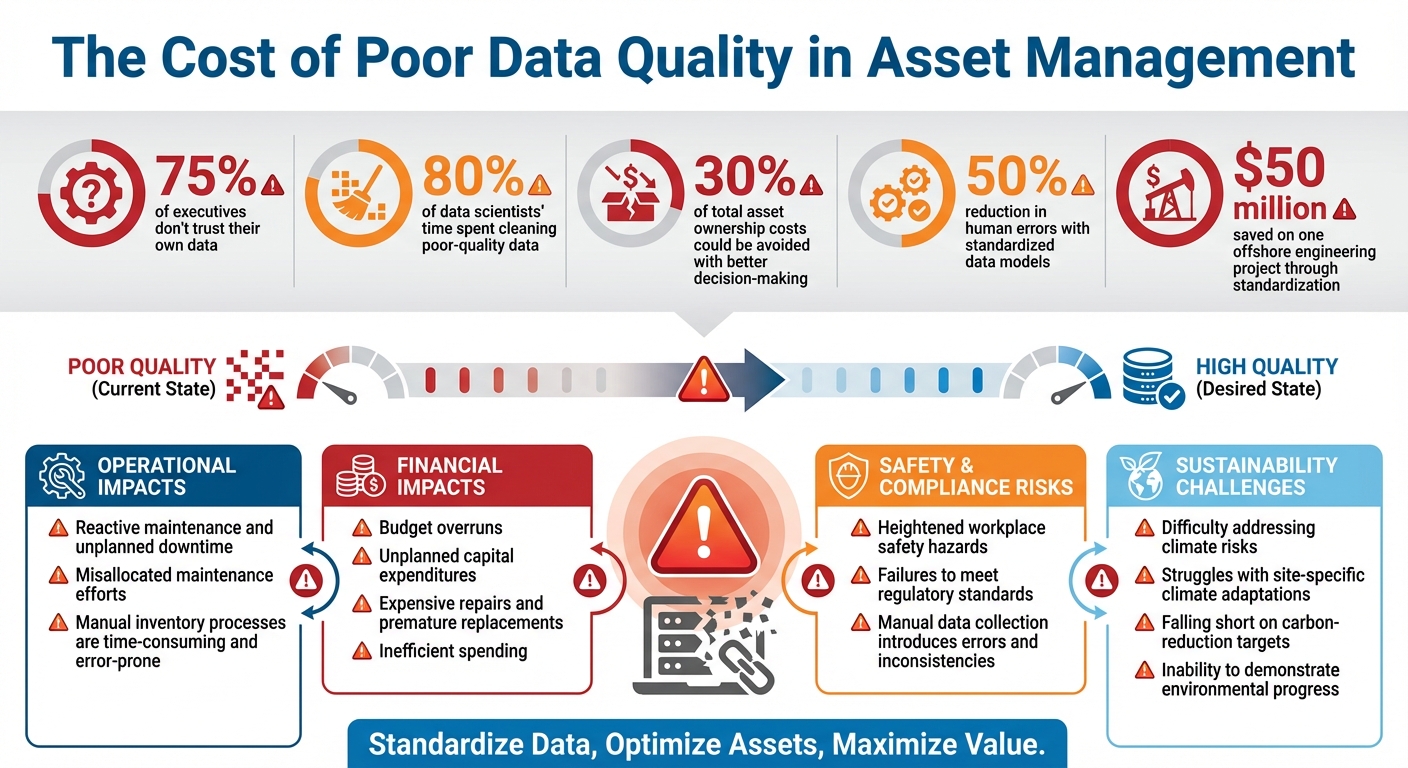
The Cost of Poor Data Quality in Asset Management
Incomplete or inaccurate asset data can lead to serious financial and operational setbacks. Data scientists reportedly spend 80% of their time cleaning and fixing poor-quality data instead of analyzing it for actionable insights [7]. This inefficiency isn’t just about lost time – it drains resources that could be better used to make informed decisions, creating a ripple effect of operational challenges.
One of the most immediate consequences is predictive maintenance ROI to avoid reactive maintenance and unplanned downtime. When data about asset condition and usage is unreliable, maintenance teams often misallocate their efforts. Critical equipment may be overlooked, while resources are wasted on less pressing issues. This imbalance frequently results in unexpected equipment failures and costly disruptions [2][7]. For instance, in high-rise buildings, manual inventory processes are not only time-consuming but also prone to errors [2].
The financial toll extends beyond operational inefficiencies. Poor data quality often leads to budget overruns, as organizations face unplanned capital expenditures for replacing failed assets or repairing damage caused by those failures [7][8]. Mismanaged data forces companies into expensive repairs, premature replacements, and inefficient spending [1][4]. The impact is substantial: up to 30% of an asset’s total ownership cost could be avoided with better decision-making during design, procurement, and renewal phases [7]. These overruns distort risk-based asset planning by obscuring the true performance and cost of assets.
In addition to financial and operational issues, safety and compliance risks increase. Inaccurate records can lead to heightened workplace safety hazards and failures to meet regulatory standards [7]. Manual or paper-based data collection adds another layer of complexity, requiring digital transcription that often introduces errors and inconsistencies [4].
Sustainability goals also take a hit when data is unreliable. Gaps in accurate data make it difficult to address climate risks, plan for transitions, or conduct scenario analyses [5]. Without detailed, localized hazard data, asset managers struggle to implement site-specific climate adaptations or negotiate effectively with insurers on resilience measures [5]. This lack of reliable data means organizations fall short on carbon-reduction targets and fail to demonstrate progress in environmental initiatives. Accurate data is essential for making risk-based decisions that align with both long-term asset management and environmental objectives.
Do: Build a Clear Data Collection Strategy Tied to Your Goals
Getting data collection right starts with a simple but critical question: Why are we collecting this data? Before diving in, organizations need to clarify the decisions they aim to make and the results they want to achieve. Without this focus, it’s easy to fall into the trap of gathering excessive, unused data – or worse, missing the key pieces needed for crucial decisions. A clear purpose ensures your data is directly tied to investment outcomes.
"The primary objective should be to collect only data that will measure progress toward the defined goals and help organizations make decisions." – PIARC (World Road Association) [3]
To refine your approach, use these four guiding questions:
- What decisions need to be made?
- What data is required for those decisions?
- Can your organization afford to collect this data?
- Can its integrity be maintained over time?
If you can’t confidently answer all four, that data point likely doesn’t belong in your strategy. This disciplined approach ensures every piece of data supports your business goals.
Connect Data Collection to Investment Results
Once you’ve defined your purpose, the next step is to align your data collection with measurable outcomes. Each data point should tie back to specific investment results – whether it’s lowering lifecycle costs, reducing risks, or meeting sustainability goals. Focus on attributes that directly impact financial and operational results. For example:
- Asset age and useful life help forecast future budget needs and pinpoint periods of high capital spending.
- Condition and criticality data enable smarter prioritization of maintenance projects [4].
By linking data attributes to specific decisions, you can justify the cost of collection and ensure every effort adds value.
Organizations that adopt a risk-based approach often see better returns. Assets that are low-risk or require minimal investment don’t need frequent updates [3]. Instead, prioritize high-risk, high-value assets – those that significantly affect operations, safety, or finances.
Collect Only Data That Supports Decisions
When it comes to data, less is often more. The goal isn’t to build the largest database possible but to focus on gathering accurate, actionable information. Collecting unused data wastes resources [4]. To avoid this, zero in on core attributes that drive asset management decisions. For many organizations, seven key attributes form the foundation:
- Material/Type
- Location
- Condition
- Age
- Criticality
- Useful Life
- Economic Value [4]
To ensure your data is useful, it must meet the "5Cs" standard:
- Complete: Covers all targeted assets.
- Comprehensive: Includes all necessary attributes.
- Consistent: Uses standardized naming conventions.
- Correct: Features accurate IDs and descriptions.
- Current: Clearly marks active vs. inactive status [2].
Consider this: a typical high-rise office building contains around 1,000 maintainable assets, ranging from electrical systems to air handling units [2]. Using manual methods, a reliability engineer can inspect and record details for only 60–75 assets per day [2]. This limitation makes it even more vital to focus on data that truly matters – you simply don’t have the time or resources to collect information you’ll never use.
Don’t: Use Fragmented or Disconnected Data Sources
When asset data is scattered across multiple disconnected systems – like spreadsheets in one place, a CMMS tool in another, and financial records stored elsewhere – organizations run into major challenges. This fragmentation hides critical risks and creates blind spots in your asset portfolio, making it nearly impossible to identify safety issues or compliance risks before they escalate into costly problems [6].
The impact on decision-making is both immediate and expensive. Disconnected data sources slow down reporting, result in inconsistent analytics, and lead to poor prioritization. This often causes budget overruns and missed opportunities [6]. As Deloitte aptly states, businesses today are "drowning in data but starving for insights" [7]. This perfectly sums up the chaos that arises when vital information is trapped in silos. Such fragmented practices pave the way for inefficient and costly decisions.
"When condition data is inconsistent, delayed, or scattered across tools, teams default to intuition – and that’s where budget blowouts, safety risks, and missed opportunities start." – Asseti [6]
The financial toll is hard to ignore. Fragmented data often leads to unexpected capital expenditures, especially when asset failures catch teams off guard. It also inflates maintenance costs because teams are stuck in a reactive mode instead of planning proactively [7]. Manual processes only make matters worse: when data is collected on paper, it typically doubles the workload, as someone has to manually enter it into digital systems. This process, which can take months, is prone to errors that further compound the problem [4].
Beyond the financial strain, fragmented data also poses serious risks to safety and compliance. It creates work health and safety hazards and increases the chances of failing to meet statutory requirements [7]. Without easy access to key information – like an asset’s condition or maintenance history – field teams are forced to make decisions without a complete understanding of the situation.
Do: Standardize and Centralize Your Data
Fixing fragmented data isn’t about gathering more of it – it’s about creating a single source of truth with consistent standards across your organization. When asset data is structured uniformly, teams can compare performance, consolidate costs, and make informed decisions about maintenance priorities and replacements [10]. This approach lays the groundwork for clear and comparable data models.
Create Consistent Data Models and Asset Hierarchies
Using industry-standard taxonomies is key to avoiding confusion. Frameworks like Uniclass, RICS NRM 3, and SFG20 provide classification codes that ensure everyone – from field teams to finance departments – is aligned when describing assets [10]. The importance of this unity became clear when the UK Government Property Function analyzed over 300,000 public sector properties. They found that standardized asset hierarchies were crucial for managing maintenance and ensuring contract compliance [10].
A top-down data model is a practical starting point: Parent Organization > Site > Building/Block > Floor > Space/Room > Asset [10]. Every asset record should include essential fields like a unique Asset ID, Classification Code, Criticality rating, and Operational Status. Without these, planning becomes chaotic. Organizations that adopted Information Modeling Frameworks (IMF) reported a 50% drop in human errors during manual updates [11]. On one offshore engineering project, this standardization saved approximately $50 million [11].
Use a Central System for Master Data Management
Master Data Management (MDM) is what IBM refers to as the "hidden enabler" of smart decision-making [12]. It ensures consistent identifiers and reference tables for assets, sites, and suppliers across departments. The goal isn’t to mandate a single software solution but to apply consistent business logic across systems to produce reliable, auditable outputs [12]. Accurate master data is the backbone of risk-based, sustainable decisions.
In daily operations, centralized systems with automated quality checks can flag missing or unusual data immediately. A "monthly close" process can help: freeze data entries on a set date each month, validate everything automatically, and address issues before proceeding [12]. This prevents mid-month updates that disrupt comparability and make trend analysis impossible.
"A uniform data model is necessary to get a full view of combined systems with information flowing across the ecosystem." – Marc Hoppenbrouwers and Biren Gandhi, IBM [9]
To maintain control, secure asset data ownership contractually – even when third-party suppliers manage it [10]. This ensures real-time access for decision-making and avoids vendor lock-in. By using standard formats like COBie files, you can make data portable between systems, reducing the risk of loss during contract changes and ensuring smooth investment planning [10].
Don’t: Ignore Data Governance and Ownership
If data ownership and governance aren’t clearly defined, asset information can quickly lose its reliability, leading to poor investment decisions. The 2024 ISO 55001 revision highlights that data forms the foundation of decision-making [13]. Yet, many organizations still treat data as a byproduct of operations rather than recognizing it as a strategic asset with its own lifecycle and value.
To truly benefit from your data, implement strong governance practices and assign clear ownership. Each key dataset – such as asset registers, condition assessments, maintenance histories, and financial records – should have a dedicated data owner. This ensures data remains accurate, updated, and consistent throughout its lifecycle [3]. Without accountability, data can drift, resulting in missing fields or conflicting records. For instance, a US utility that implemented advanced analytics with clear data governance in 2022 achieved 20–25% savings in operating expenses and 40–60% savings in capital expenditure by focusing on high-risk assets and optimizing maintenance schedules [15].
"Effective asset management is reliant on the effective use of data to support decision making." – ISO 55013:2024 [14]
This quote drives home the importance of governance protocols in protecting and maximizing the value of data.
Unlike physical assets, data can degrade much faster. For example, while a pump might last 15 years, condition data from the previous year can become outdated in just a few months due to environmental changes [14]. To combat this, implement date stamps, set update schedules, and define clear policies for disposing of obsolete data [3]. Treat your data like the strategic asset it is – modern standards like ISO 55013:2024 stress that data holds both operational and marketplace value, deserving the same level of protection and security as physical infrastructure [14].
Strict access rights and security protocols are essential. These measures ensure decision-makers have real-time access while preventing unauthorized changes [3]. Establish a governance board with representatives from facilities management, data teams, and suppliers to monitor data quality and address issues as they arise [10]. Use documented change control processes to manage additions, modifications, or removals of asset records effectively.
Do: Use Automation for Data Collection and Quality Control
To ensure smart asset investments, automation plays a critical role in creating a reliable data foundation. Manual data entry, while common, often slows processes and introduces errors that can undermine investment decisions. For example, errors in recording complex equipment specifications are a frequent issue with manual transcription [2]. By automating data collection, organizations can improve both the speed and accuracy of their data processes, enabling better decision-making.
Automation not only speeds up data capture but also validates it in real time. Over the past decade, sensor costs have dropped by 75%, making automated condition monitoring more accessible to businesses of all sizes [16]. However, despite this affordability, 75% of executives report a lack of trust in their own data [1]. This disconnect arises from issues with data quality. Automation addresses this by not only collecting data but also standardizing and flagging inconsistencies, ensuring decision-makers have reliable information.
Automate Data Entry and Validation
Technologies like Optical Character Recognition (OCR) and Content-Based Image Retrieval (CBIR) have revolutionized data entry. Mobile apps now use these tools to scan asset nameplates and identify equipment types directly from images, eliminating errors associated with manual input. This approach ensures "5C-quality data" – data that is Complete, Comprehensive, Consistent, Correct, and Current [2].
For infrastructure inspections, advanced tools like Rapid Ultrasonic Gridding (RUG) leverage robotic systems with built-in encoders. These robots collect high-density thickness data at speeds 10 times faster than traditional methods while delivering 1,000 times more data [1]. In hazardous or hard-to-reach areas, drones equipped with LIDAR or photogrammetry provide high-density data without endangering personnel [16].
However, collecting accurate data is only part of the equation. Maintaining its integrity over time requires robust quality control mechanisms.
Build Quality Checks into Data Pipelines
Effective automation strategies incorporate early error detection, often referred to as "shift-left" testing, which identifies problems before they impact production dashboards or AI systems [17]. For example, automated deployment gates can enforce validation rules, ensuring critical fields like asset_id maintain non-null rates above 99.9% or that row counts stay within acceptable statistical ranges [17].
"Data is high quality when it is fit for its intended use and it reliably stays that way as pipelines evolve." – Coalesce [17]
Automated profiling tools monitor for schema drift, null spikes, and anomalies in data volume directly within pipelines. This reduces "data downtime", a term experts use to describe periods when flawed data disrupts operations [17]. By embedding these quality checks into workflows, rather than treating them as separate clean-up tasks, you can ensure that asset registers, condition assessments, and maintenance histories remain dependable over time. This approach reinforces the 5C-quality data standard, supporting informed, risk-based decisions throughout the asset investment lifecycle.
Do: Include Sustainability Metrics in Your Data Collection
When managing assets, it’s crucial to factor in energy performance and carbon impact metrics. These metrics aren’t just about meeting regulatory requirements – they also address investor expectations, rising energy costs, and the need to align with decarbonization goals. Without them, it becomes harder to show progress toward sustainability commitments or to integrate these goals into long-term asset management plans.
Adding sustainability metrics to your data collection enhances decision-making. Begin by tracking energy usage and demand, such as electricity (measured in kWh for usage and kW for demand), natural gas (therms), heating oil (gallons), and district steam (lbs.) [18][20]. For water and wastewater facilities – which often consume 30% to 40% of annual municipal energy budgets – monitor electricity consumption per million gallons (kWh/MG). This allows for performance comparisons across different assets [20]. Additionally, document greenhouse gas emissions across all scopes: Scope 1 (direct emissions), Scope 2 (indirect emissions from purchased energy), and Scope 3 (value chain emissions) [18].
It’s also important to track operational factors like degree days, occupancy, operating hours, and production levels. These variables help you identify whether changes in energy use stem from efficiency improvements or simply reflect shifts in operational activity [18][19]. For instance, a rise in energy use might indicate expanded operations rather than reduced asset efficiency. Don’t forget to monitor on-site renewable energy generation and power purchase agreement volumes, as these metrics reveal progress toward cleaner energy sources [18][20].
"Systems and data are not an IT side project. They are the infrastructure that makes emissions measurable, initiatives verifiable, and claims defensible." – Umbrex [12]
For investment planning, gather data on expected carbon savings, required investments, and cost avoidance for each efficiency project. This allows you to prioritize projects based on their carbon return on investment (ROI) [18][19]. Tools like Energy Information Systems, which capture data at hourly or 15-minute intervals, can deliver a median 4% savings in whole-building energy use. Similarly, Fault Detection and Diagnostic tools can achieve a median 9% energy savings by identifying system faults early [19].
Conclusion: Building a Data Foundation That Lasts
Gathering the right data is the cornerstone of effective asset investment planning. The key practices outlined here – tying data collection to specific goals, standardizing methods, leveraging automation, and incorporating sustainability metrics – lay the groundwork for smarter, long-term decision-making.
When done right, high-quality data transforms operations. It enables predictive maintenance, shifts processes from reactive to proactive, prolongs the lifespan of assets, and mitigates risks [1]. By eliminating guesswork, it prevents costly failures and downtime. Plus, it supports sustainability efforts by optimizing resource use and reducing waste from premature replacements [1].
"Algorithms cannot differentiate between good and bad data. Instead, it works on logic, learning from patterns in the provided data." – Gecko Robotics [1]
Despite these advantages, many organizations face challenges. While 89% of executives recognize the importance of high-quality data, 75% admit they lack confidence in their own [1]. Skipping clear goals, relying on fragmented sources, or prioritizing speed over accuracy can derail even the best intentions. By adhering to the 5Cs of data quality – Complete, Comprehensive, Consistent, Correct, and Current – you can ensure every piece of data contributes to better outcomes [2].
The choices you make today shape the success of your asset management strategy tomorrow. Document standards, follow implementation best practices to minimize errors, centralize data to break down silos, and always align your data with the decisions it supports. With a strong data foundation, every investment – whether routine maintenance or major projects – becomes more informed, justifiable, and impactful.
FAQs
What’s the smallest set of asset data I should collect first?
Start by gathering the most critical data that aids in making well-informed decisions without straining resources. Focus on three key areas: asset identification details, condition assessments, and performance indicators. This streamlined dataset provides the essentials for assessing asset health, setting priorities, and making decisions about maintenance and lifecycle planning. By concentrating on this core information, you create a reliable basis for risk-based asset management while keeping efforts efficient and cost-effective.
How do I merge spreadsheets, CMMS, and finance data into one source of truth?
To build a single, reliable source of truth, it’s essential to take a step-by-step approach:
- Identify all data sources: Gather information from every relevant system, such as spreadsheets, CMMS, and finance platforms.
- Plan your integration: Ensure consistency by standardizing formats, attributes, and other key elements.
- Validate and clean the data: Eliminate duplicates and correct inaccuracies to ensure the data is trustworthy.
- Leverage automation tools: Where possible, use automation to simplify and speed up the process.
- Review and update regularly: Keep the integrated data accurate and dependable by making routine updates, ensuring it continues to support well-informed decisions.
Which sustainability metrics matter most for asset investment decisions?
Key metrics to consider when making asset investment decisions with a focus on sustainability include carbon reduction, environmental impact, and climate-related risk factors. These factors help create a dependable framework for tracking carbon emissions and guide investment strategies aimed at long-term sustainability.
Related Blog Posts
- Building an ISO 55001-Compliant Asset Register: What Data Really Matters
- ISO 55001 for the Public Sector: Improving Transparency and Accountability
- Lessons Learned from ISO 55001 Implementations: What Successful Organisations Do Differently
- Scaling Asset Investment Planning Across Multiple Sites and Regions