







Want your carbon investment plan to resonate? Start by telling a story. Numbers alone won’t win over stakeholders – what matters is how you connect those numbers to their priorities and concerns. This guide breaks down how to:
- Understand what your stakeholders care about (e.g., returns, compliance, operational stability).
- Map stakeholders using tools like the Power/Interest Grid or Salience Model.
- Tailor your message to address specific concerns, from EBITDA growth for CFOs to regulatory compliance for policymakers.
- Use clear visuals and relatable data to highlight risks of inaction and benefits of change.
- Show the financial case with metrics like Net Present Value (NPV) and scenario comparisons (e.g., baseline vs. carbon-aligned strategies).
- Handle resistance through direct involvement, clear communication, and addressing root concerns.
Stakeholder Engagement for Carbon Capture and Storage
sbb-itb-5be7949
Know Your Stakeholders: Who They Are and What They Want
Stakeholder Communication Strategy: Matching Messages to Key Groups
Understanding your stakeholders is essential. Investors focus on returns, regulators demand compliance, and plant managers care about keeping operations running smoothly. By identifying their priorities, you can craft messages that hit the mark. With that in mind, let’s dive into techniques to map stakeholder priorities effectively.
How to Map Your Stakeholders
Stakeholder mapping starts with assessing their power and interest. The Power/Interest Grid is a practical tool that divides stakeholders into four categories: those you manage closely (high power, high interest), those you keep satisfied (high power, low interest), those you keep informed (low power, high interest), and those you monitor (low power, low interest) [5][7].
For more complex scenarios, the Salience Model introduces urgency as an additional factor. This model helps you identify key stakeholders who combine power, legitimacy, and time-sensitive concerns. For example, Rwanda’s Ministry of Finance and Economic Planning applied this model to its NDC implementation plan, using regular contact schedules and standardized data templates to stay on track [5][6].
Another approach, Multi-Dimensional Mapping, evaluates stakeholders based on six attributes: Influence, Interest, Impact, Criticality, Position, and Engagement Effort [5]. This method highlights stakeholders with significant influence who might oppose your project, allowing you to focus on building trust where it’s needed most.
"Stakeholder mapping is the process of placing your project stakeholders’ attributes onto a chart to visualize the data, compare the position of different stakeholders, and analyze your stakeholders based on the attributes shown."
Stakeholder maps aren’t static. As your project progresses, priorities and positions can change. Regular updates are vital. For instance, Kenya’s NDC investment plan used workshops and training sessions to maintain engagement with government ministries and private sector players [6].
Match Your Message to Each Group
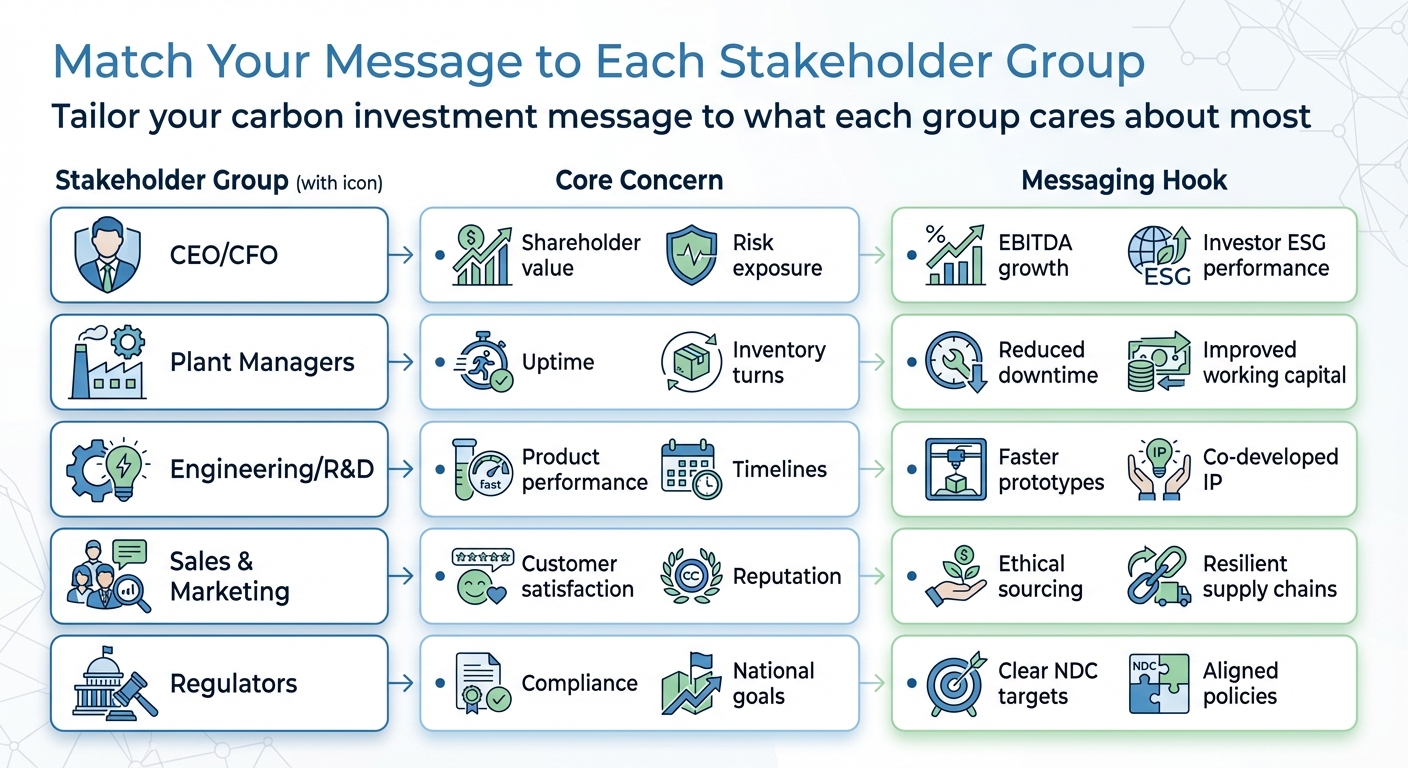
Once stakeholders are mapped, tailor your communication to their specific concerns. For example, CFOs care about EBITDA growth, plant managers want operational stability, and regulators focus on meeting NDC targets.
| Stakeholder Group | Core Concern | Messaging Hook |
|---|---|---|
| CEO/CFO | Shareholder value, risk exposure | EBITDA growth, investor ESG performance [2] |
| Plant Managers | Uptime, inventory turns | Reduced downtime, improved working capital [2] |
| Engineering/R&D | Product performance, timelines | Faster prototypes, co-developed IP [2] |
| Sales & Marketing | Customer satisfaction, reputation | Ethical sourcing, resilient supply chains [2] |
| Regulators | Compliance, national goals | Clear NDC targets, aligned policies [6] |
To unify your team, establish a "North-Star KPI." For instance, aim for something like: "Unlock $150 million in value and reduce Scope 3 emissions by 25% by FY28." Break this down into actionable metrics for internal teams, such as daily energy savings or CO₂e reductions for specific shifts or plants.
"Numbers rarely move people; stories do. After analytics reveals the opportunity and digital tools automate the heavy lifting, success still hinges on hearts and minds."
When resistance surfaces, treat it as a learning opportunity. Use approaches like the "Five Whys" to uncover the root cause of pushback – whether it’s about autonomy, job security, or technical concerns [2]. Effective stakeholder mapping and tailored messaging can turn carbon investment plans into compelling action stories.
Turn Your Carbon Investment Plan into a Story
Numbers alone won’t win hearts and minds. To truly engage stakeholders, you need a story – one that links your carbon investment plan to real-world outcomes. A well-crafted narrative not only clarifies tough decisions but also inspires action by showing what’s at stake and what’s possible.
A strong story faces challenges head-on. It highlights the “pain” of inaction – like shrinking profit margins, reputation risks, or looming regulations – while offering a clear vision of a better future. This balance between urgency and optimism keeps your audience focused and motivated. By framing your plan as a relatable story, you can align technical details with the priorities that matter most to your stakeholders.
Create a Clear Beginning, Middle, and End
To turn your plan into a story, structure it with a clear beginning, middle, and end. The SCQA framework – Situation, Complication, Question, and Answer – can help guide this process.
- Beginning (Situation): Start by explaining the current state. For example, rising carbon costs, regulatory pressures, or supply chain vulnerabilities might be cutting into profits. Inflation and sourcing challenges could be making it harder to stay competitive.
- Middle (Complication): Next, outline the challenges of staying on the current path. Use tools like Oxand Simeo™ scenarios to model different investment options, comparing a “Business as Usual” approach with carbon-aligned alternatives. Show how scenario testing uncovers which strategies perform best under fluctuating energy prices and carbon costs.
- End (Answer): Finally, paint a picture of success. What does the future look like with measurable results? Reduced risks, stronger margins, and alignment with sustainability goals. For example, you might set a clear target like: "Reduce Scope 3 emissions by 25% by FY28." This gives your team a tangible goal to rally around.
Use Visuals to Show Impact
Visuals can transform complex data into insights that resonate. Here are some ways to make your story visually compelling:
- Risk heat-maps: Highlight vulnerabilities like single-source suppliers or regulatory gaps that could lead to financial penalties.
- Before-and-after charts: Show improvements such as reduced downtime or lower energy costs after adopting carbon-focused strategies.
- Animated data stories: Use dynamic visuals to illustrate key points, like how specific actions turn “red bars green.” For instance, a graph showing price variance can demonstrate the financial impact of carbon-reduction measures.
- Equivalency narratives: Make data relatable. Instead of saying “20% reduction in emissions,” explain it as “equal to taking 10,000 cars off the road.” This approach humanizes the numbers and makes them easier to understand.
- Scenario graphs: Compare investment options side-by-side. Tools like Oxand Simeo™ can show how low-carbon strategies perform under different conditions, helping stakeholders see the value beyond just the upfront costs.
"Telling a great story is actually part of strategy – an expertly executed plan for connecting the dots from strategic plans and tactics to how they’ll create shareholder value."
Keep your visuals simple and impactful. Start with three key facts, and save detailed data for appendix slides. Use mobile-friendly formats so stakeholders can easily review charts on their phones. The goal? Make your carbon investment plan so clear and compelling that everyone – from the CFO to the plant manager – can see why action is essential. This storytelling approach lays the groundwork for discussions about ROI, risk reduction, and carbon savings.
Show the Numbers: ROI, Risk Reduction, and Carbon Savings
When it comes to convincing stakeholders, stories can only go so far. What truly seals the deal are the numbers – clear, measurable data on costs, returns, and risks. These figures prove that carbon-aligned investments go beyond compliance. They help protect profit margins, avoid penalties, and build enduring value.
Put Numbers to the Benefits
To make the financial case, calculate the Net Present Value (NPV) by factoring in four key variables: Retrofit Costs, Avoided Costs, Avoided Risks, and Added Value. This approach shifts the focus from upfront expenses to the potential losses of doing nothing.
Take McLaren Racing’s partnership with UNDO in 2026 as an example. Their commitment to reaching net-zero by 2040 through enhanced rock weathering wasn’t just about emissions reduction. They also quantified co-benefits like improved soil health, making the case more compelling for stakeholders [10]. Tools like Oxand Simeo™ are especially useful here, as they can model asset aging, maintenance needs, and external risks like carbon taxes or flooding. These forecasts help identify avoided losses and opportunities before they become costly problems.
Don’t overlook co-benefits that often fly under the radar. For example, better occupant health, lower insurance premiums, and extended asset lifespans all translate into tangible financial gains. A study of a New York City office building highlighted this: designing for future electrification flexibility proved more profitable than sticking with a natural gas system in 99% of 10,000 simulated scenarios [11].
Finally, compare the outcomes of a Business-as-Usual (BAU) approach with those of a carbon-aligned strategy. This comparison makes the advantages of carbon alignment crystal clear.
Compare Baseline vs. Carbon-Aligned Scenarios
Side-by-side comparisons can vividly illustrate the financial benefits of a carbon-aligned approach. While BAU might appear less expensive initially, it leaves you vulnerable to rising carbon costs, regulatory penalties, and asset devaluation. In contrast, a carbon-aligned strategy may require higher upfront spending but delivers lower operating expenses, reduced compliance risks, and access to greener financing options over time.
| Metric | Baseline (BAU) | Carbon-Aligned |
|---|---|---|
| Upfront CAPEX | Lower initial investment | Higher initial investment |
| Long-term OPEX | Rising energy and maintenance costs | Lower energy costs and reduced maintenance |
| Regulatory Risk | High exposure to fines and carbon pricing | Minimal compliance risk |
| Asset Valuation | Risk of stranding and declining yields | Improved valuation and green lease premiums |
| Access to Capital | Standard debt terms | Access to cheaper green debt and incentives |
This kind of analysis clearly shows why investing in a carbon-aligned strategy, though initially more expensive, pays off significantly in the long run.
To further strengthen your case, incorporate shadow carbon pricing into your evaluations. This assigns a hypothetical cost to emissions, helping to reveal the financial risks tied to high-carbon assets as regulations tighten [3]. Also, run stress tests under scenarios like volatile energy markets, stricter carbon standards, or delayed infrastructure projects to ensure your strategy holds up under pressure.
Make sure to present these findings in a way that’s easy to digest – simple charts, clear tables, and mobile-friendly visuals can make all the difference. By tying your narrative to these financial metrics, you’ll not only make your case stronger but also win over stakeholders with the numbers they need to see.
Handle Pushback and Get Everyone Aligned
Even with a solid financial plan and a compelling narrative, managing internal resistance is crucial to gaining stakeholder commitment. A great financial case can falter if stakeholders resist due to fears of losing expertise, feeling overwhelmed, or doubting long-term outcomes. Addressing these concerns not only eases resistance but also strengthens your case for carbon investments.
Stakeholders often fall into one of four resistance categories: the Expert Skeptic, who worries about losing their specialized knowledge; the Overloaded Operator, burdened by competing priorities; the Protective Manager, concerned about budget or staffing cuts; and the Silent Bystander, who hesitates to act until results are clear [2]. Instead of treating all objections the same way, dig into the root causes. Tools like "Stakeholder Heat-mapping" can help identify who is most affected. Follow up with individual conversations to uncover concerns about autonomy, job security, or other fears [2][4].
"People change when the pain of staying the same exceeds the pain of changing." – Umbrex Category Management Handbook [2]
Once you understand these concerns, create a Burning Platform by quantifying the risks of staying the course. Highlight costs like potential carbon taxes, regulatory penalties, or asset devaluation under a "business-as-usual" approach [2]. This reframes the discussion from "Why should we do this?" to "Can we afford not to?"
Involve Stakeholders in the Planning Process
One of the quickest ways to reduce resistance is to involve stakeholders directly in the planning process. When people help design the plan, they’re far more likely to support it. A great example is King County Metro, a U.S. transit agency working to transition to a 100% zero-emissions fleet by 2035. In 2026, they used a structured decision-making framework to align 13 divisions. This effort led to 91% of staff reporting a better understanding of their colleagues’ priorities and uncovered $40 million in savings by delaying an unnecessary infrastructure project [12].
"Creating and launching a decision-making strategy can impact how power is shared within an organization. It helps make decision-making more inclusive, clear, and accountable. This shift can also reduce resistance to change." – Martha Geoghegan, Internal Communications, Change and Transformation Specialist, King County Metro [12]
Use tools like Oxand Simeo™ to simulate scenarios and explore varied outcomes. Instead of presenting a single "right answer", show how different variables – such as energy price spikes, stricter carbon standards, or infrastructure delays – affect the plan [3]. This approach helps stakeholders see the trade-offs and test their assumptions in real time [13].
Turn skeptics into allies by involving them in testing and design. For instance, engage the Expert Skeptic by emphasizing advanced features that align with their expertise. For the Overloaded Operator, streamline workflows and prioritize only the most critical changes [2]. Establishing a Champion Network of respected peers can amplify your message. Equip these champions with resources like playbooks and recognize their efforts through digital badges or public shout-outs during meetings [2][4].
When stakeholders are actively involved, it becomes easier to address their lingering concerns.
Answer Common Concerns
When budget constraints or long-term returns become sticking points, use data-driven "what-if" scenarios and targeted training sessions to address these challenges. For example, applying shadow carbon pricing can assign a hypothetical cost to emissions, making the financial risks of high-carbon assets clearer as regulations tighten [3]. Stress tests can also show how your plan performs under different conditions, such as fluctuating energy markets or delayed grid connections.
For managers worried about budget or staffing cuts, align new carbon KPIs with incentive structures like bonuses [2]. To engage the Silent Bystander, use peer success stories and adoption leaderboards to demonstrate that others are already benefiting from the initiative [2].
Don’t dismiss naysayers. Host listening sessions and use pulse surveys to identify and address resistance quickly [2][9]. In the King County Metro project, 82% of participants said they planned to apply the new decision-making strategy in their roles – proving that inclusive processes can lead to lasting commitment [12].
"The benefit of experimentation is you can learn what sticks and what works, and then build on those smaller successes." – Wendy Cho-Ripp, Utilities & Resiliency Strategist, King County Metro [12]
Conclusion: Move from Planning to Implementation
Turning a carbon-aligned plan into reality takes more than just data – it requires bold, strategic moves. Success hinges on engaging the right stakeholders, crafting a narrative grounded in data, and addressing resistance head-on. By transforming technical details into a story that resonates, you lay the groundwork for decisive action. The framework shared here – ranging from identifying key concerns to involving skeptics in planning – offers a clear path to building consensus and driving momentum. It connects technical insights with practical strategies.
The key to effective implementation lies in balancing urgency with optimism. Highlight the "burning platform" by quantifying the costs of inaction, such as potential carbon taxes, regulatory fines, or asset devaluation under a business-as-usual approach [2][3]. At the same time, showcase the benefits: LEED-certified buildings command rent premiums of 3%–4%, energy-efficient properties have outperformed less efficient ones by 5% in total returns since 2021, and nearly 70% of office tenants would avoid or discount buildings without sustainable features [14]. Reframe decarbonization as an incremental investment that safeguards future opportunities and mitigates stranding risks [3][8].
"Decarbonization succeeds or fails in the finance function. Ambition becomes real only when it is translated into investment appraisals, capital budgets, operating plans, and portfolio choices." – Umbrex Decarbonization Playbook [3]
Tools like Oxand Simeo™ help bridge the gap between strategy and action by allowing you to model scenarios, test real-time assumptions, and weigh trade-offs between investment options. This approach demonstrates how integrated planning can drive meaningful outcomes. Aligning deep decarbonization with natural asset replacement cycles minimizes disruption while improving financial feasibility [3][14]. Embedding carbon-focused KPIs into performance goals and incentive structures ensures that motivation is built into the system [2][4]. These steps create a foundation for swift and effective action.
Kick off 90-day sprints to achieve early wins – like renegotiating index-linked contracts – and make the program’s value immediately visible. Build a network of champions from respected peers to mentor others and share success stories [2]. Address stakeholder concerns within 48 hours to maintain trust during transitions, as silence can quickly undermine confidence [4]. By combining data, compelling storytelling, and active collaboration, you can turn ambition into results – delivering lasting value for future generations.
FAQs
Which stakeholders should I prioritize first?
To get your carbon investment plan off the ground, begin by focusing on the stakeholders who have the most influence or are directly affected. Start with employees and investors – they’re key to building internal support and ensuring financial backing. Once you’ve secured their buy-in, shift your attention to regulators and community members. This step helps ensure your plan meets compliance requirements while fostering trust and goodwill.
By prioritizing these groups, you create a solid foundation for meaningful engagement and align your efforts with broader environmental and societal objectives.
How do I prove the ROI of a carbon-aligned plan?
To demonstrate ROI, create a solid business case that outlines both the financial and strategic advantages of decarbonization. Start by calculating potential long-term savings from energy efficiency measures, reduced risks, and available incentives. Incorporate emissions metrics into project assessments and capital allocation decisions, leveraging tools like internal carbon pricing to provide a clear framework. Emphasize how these efforts add value, minimize risks, and safeguard investments for the future. Clear communication of these benefits is key to securing stakeholder buy-in and proving the financial feasibility of the plan.
What’s the fastest way to handle internal pushback?
The quickest way to tackle resistance to carbon-related initiatives within an organization is to clearly communicate both the urgency and the strategic importance of the change. Position it as a business opportunity rather than solely a moral obligation. Emphasize the potential costs of doing nothing, the risks involved, and the advantages, such as improved ROI and reduced risk exposure. Engaging stakeholders early, being transparent about goals and challenges, and showcasing quick, tangible successes can help create alignment and support while tying the efforts to broader organizational objectives.
Related Blog Posts
- Achieving Net-Zero in Real Estate Portfolios: From Targets to Investment Plans
- Carbon-Aligned Investment Planning: How to Prioritise Projects by CO₂ Reduced per Euro
- Storytelling with Numbers: How to Present Your Asset Investment Plan to the Board
- Financing the Green Transition: How to Use Your Investment Plan to Access Sustainable Funding