







Should you retrofit or build new to meet sustainability goals? Here’s the bottom line: retrofits are usually cheaper upfront, faster to implement, and emit far less carbon than new builds. New construction, however, offers design flexibility and long-term energy savings but comes with higher costs and a significant carbon footprint.
Key Takeaways:
- Retrofits cost less upfront: $123/sq ft vs. $169/sq ft for new builds.
- Lower carbon emissions: Retrofits reuse materials, cutting embodied carbon by 50–75%.
- Energy efficiency: Retrofitted buildings use 9% less energy than new green builds.
- Federal incentives: Retrofits qualify for up to $3,200 annually in tax credits.
- New builds: Higher embodied carbon but allow for advanced designs and materials.
Quick Comparison
| Factor | Green Retrofit | New Build |
|---|---|---|
| Upfront Cost | $123/sq ft | $169/sq ft |
| Carbon Emissions | 50–75% lower | High upfront carbon |
| Energy Use | 6.64 kWh/m² monthly | 7.34 kWh/m² monthly |
| Flexibility | Limited by existing structure | Full design control |
| Incentives | Up to $3,200 annually | Generally not eligible |
Conclusion: Retrofits are ideal for cutting costs and emissions in existing buildings, while new builds suit projects requiring full customization or advanced systems. Choose based on your budget, carbon goals, and building condition.
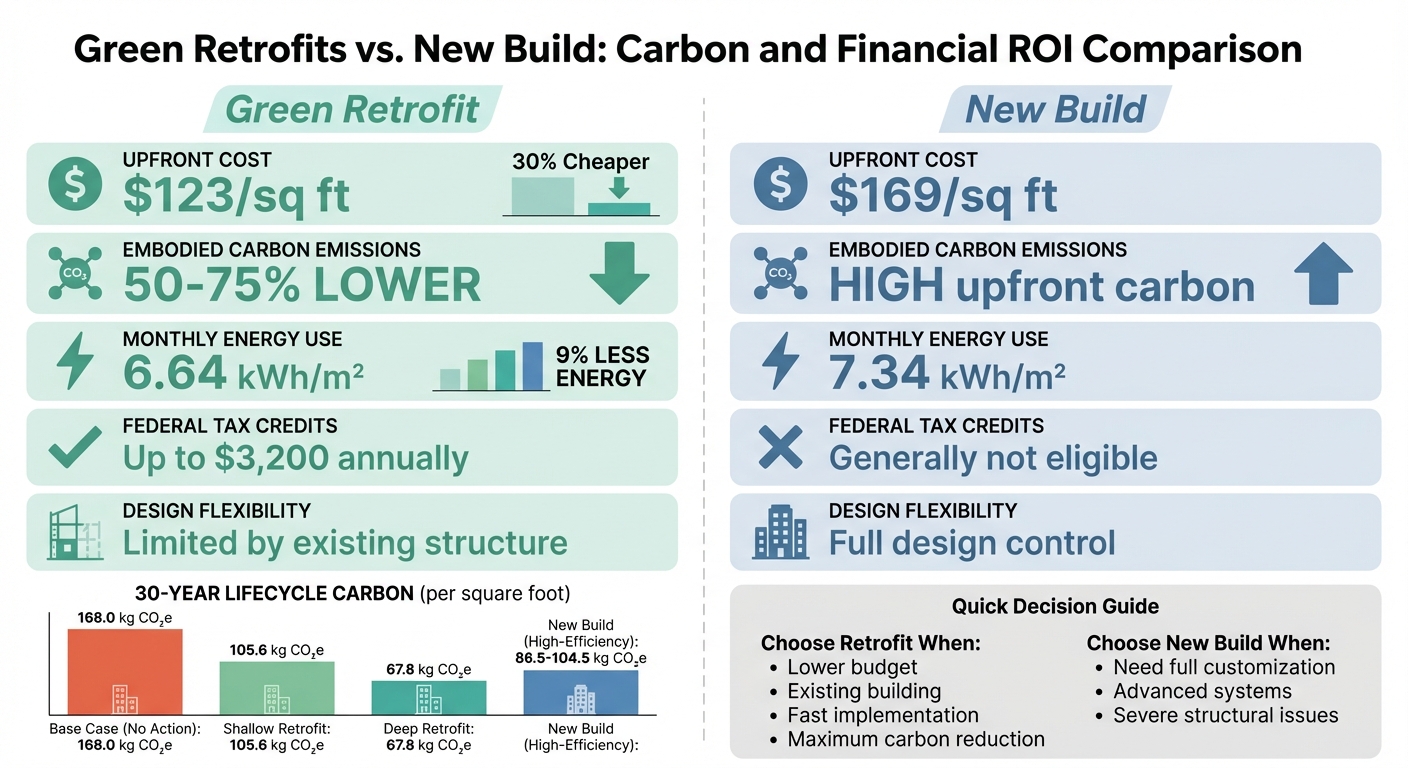
Green Retrofits vs New Build: Cost, Carbon & Energy Comparison
Energy Retrofit vs New Home Build – What’s More Cost Effective? | Ask Casey Grey
sbb-itb-5be7949
Carbon Footprint and Lifecycle Emissions
When analyzing a building’s carbon footprint, it’s essential to consider its entire lifecycle, which includes three key phases: embodied carbon (materials and construction), operational emissions (energy use over time), and end-of-life impacts (demolition and disposal). These stages collectively determine the overall environmental impact of a structure.
One striking difference emerges when comparing new construction to renovation. Embodied emissions for new buildings are 5 to 6 times higher than those for renovation projects [9]. This disparity stems from the fact that retrofits typically reuse major structural elements, avoiding the hefty carbon costs associated with producing materials like concrete and steel.
Renovation projects, particularly adaptive reuse, offer impressive environmental benefits. Studies show they can achieve a 53% to 75% reduction in environmental impacts compared to new construction [9]. This reduction accounts for the emissions tied to added materials during renovations and selective demolition.
A critical factor in retrofitting projects is the role of mechanical, electrical, and plumbing (MEP) systems, which contribute to 70% or more of total embodied carbon [8]. Upgrading systems such as HVAC, lighting, and controls often forms the core of deep energy retrofits. Ghina Annan, Decarbonization Business Lead at Stantec, highlights the importance of thoughtful planning in this area:
"Reducing embodied carbon and optimizing MEP systems demands clear system planning, defined targets, and robust financial analysis" [8].
The following table illustrates the carbon implications of different scenarios, factoring in both embodied and operational emissions over a 30-year period:
| Scenario (per square foot) | Embodied Carbon (kg CO₂e) | Operational Emissions (30-yr, kg CO₂e) | Total Lifecycle Carbon (30-yr, kg CO₂e) |
|---|---|---|---|
| Base Case (No Action) | 0 (sunk cost) | 168.0 | 168.0 |
| Shallow Retrofit | 1.6 | 104.0 | 105.6 |
| Deep Retrofit | 9.3 | 58.5 | 67.8 |
| New Build (High-Efficiency) | 45.5–54.5 | 41.0–50.0 | 86.5–104.5 |
The data underscores a key takeaway: while high-efficiency new builds boast the lowest operational emissions, their upfront carbon debt is significant. It can take 10 to 15 years of energy savings to offset this initial impact [9]. On the other hand, deep retrofits offer a balanced approach – substantially lower embodied carbon with operational emissions nearing those of new construction.
Financial ROI and Lifecycle Costs
When it comes to financial performance, retrofitting projects clearly outshine new builds.
Green retrofits cost significantly less upfront, averaging $123.0 per square foot, compared to $169.0 per square foot for new construction [2]. If you exclude land acquisition, the cost drops even further to $68.2 per square foot, which is a 49% reduction [2]. This is largely due to savings in areas like substructure costs (which are 72.9% lower since foundations are rarely replaced) and professional service fees (which are 76.1% lower) [2]. Beyond these initial savings, retrofits also deliver ongoing operational and incentive-based benefits.
From an energy efficiency standpoint, retrofitted green homes outperform newly built green homes, using 9% less energy on average – 6.64 kWh/m² monthly versus 7.34 kWh/m². This translates to lower utility bills and a faster return on investment [2]. Research by Dong Zhao and Yunjeong Mo reveals that retrofit projects yield 83% to 86% more cost-benefit value than new builds when land costs are included. Without land costs, this figure jumps to an impressive 141.6% more value [2].
Federal incentives further tip the scales in favor of retrofits. Programs like the Energy Efficient Home Improvement Credit (Section 25C) provide up to $3,200 annually for upgrades to existing homes, while new builds are generally not eligible [12]. Homeowners can strategically phase improvements over several years to maximize these benefits, as the credit has no lifetime cap, only annual limits [12]. Additional incentives include $150 for home energy audits, $250 per exterior door (up to $500), and $600 each for windows and central air systems [12].
Here’s a breakdown of how these factors compare over a 30-year period:
| Financial Metric | Green Retrofit | New Green Build | Difference |
|---|---|---|---|
| Upfront Cost (with land) | $123.0/ft² | $169.0/ft² | Retrofit is 30% cheaper |
| Upfront Cost (excluding land) | $68.2/ft² | $134.4/ft² | Retrofit is 49% cheaper |
| Monthly Energy Use | 6.64 kWh/m² | 7.34 kWh/m² | Retrofit saves 9% more |
| Annual Federal Tax Credits | Up to $3,200 | Generally ineligible | Retrofit advantage |
| Cost-Benefit Value | 83%–86% higher | Baseline | Retrofit generates more value |
One critical consideration: land acquisition costs make up 35% of total retrofit expenses, which is six times higher than for new builds [2]. This reflects the premium for properties in established areas. To make sound decisions, stakeholders should look beyond energy savings and consider what RMI refers to as "Deep Retrofit Value" – a holistic view that includes benefits like improved indoor air quality, better occupant health, and increased productivity [13].
1. Green Retrofits
Carbon Footprint
Green retrofits play a crucial role in reducing carbon emissions by reusing existing building structures. Here’s why that’s so impactful: while embodied carbon – the emissions tied to manufacturing and construction – accounts for about 20% of a typical building’s lifecycle emissions, this number can skyrocket to 45% in high-efficiency buildings and even hit 90% in extreme cases [7]. Retrofits sidestep much of this upfront carbon cost by preserving key elements like foundations, framing, and other structural components.
The concept of Time Value of Carbon (TVC) adds even more weight to this approach. Carbon reductions achieved today through retrofitting have a greater climate benefit than identical reductions made years later [7]. This is especially relevant given that 64.5% of U.S. residential buildings were built before 1980, lacking modern energy-efficient features. These older homes represent a massive opportunity for immediate carbon savings, which also pave the way for better lifecycle cost outcomes [7].
Lifecycle Costs
When evaluating retrofits, it’s not just about energy savings. A lifecycle cost analysis takes into account several factors: the initial investment, ongoing energy savings, future equipment replacement costs, residual values, and even tax deductions [7]. For example:
- Air sealing a 1,500-square-foot home can cost between $600 and $2,300.
- Comprehensive retrofits for a ~2,400-square-foot home may cost around $7,500.
- Residential solar PV installations average $2.65 per watt [7].
Adding a price on carbon makes retrofits even more financially appealing. By assigning a cost to carbon emissions, many energy efficiency projects that once seemed too costly suddenly become worthwhile investments, thanks to improved rates of return [1]. This shift highlights the growing economic case for retrofits, particularly when carbon pricing is factored into the equation.
Sustainability Impact
Beyond cost and carbon savings, green retrofits also deliver meaningful sustainability benefits. Upgrades to a building’s envelope – like improved insulation, better windows, and air sealing – offer the highest carbon reduction per dollar in areas where electricity grids rely heavily on fossil fuels [7]. However, as utility grids transition to cleaner energy sources, electrification upgrades grow in effectiveness, while the relative impact of renewable energy installations diminishes [7].
The challenge, though, remains steep. A study of 1,739 residential energy upgrade projects across 15 states found that fewer than 10% achieved energy savings greater than 50% [10]. This underscores the need for thorough planning and what RMI refers to as "Deep Retrofit Value" – a holistic measure of the net present value of all energy and sustainability benefits from upgrading existing buildings, beyond just lowering utility bills [13].
2. New Build
When it comes to new construction, the focus shifts from reusing old structures to building with efficiency in mind right from the start. This approach opens up opportunities to incorporate cutting-edge designs and materials that prioritize sustainability.
Carbon Footprint
New construction comes with a hefty carbon cost. Typically, embodied carbon – emissions tied to building materials and construction – makes up about 20% of a building’s lifecycle emissions. But in high-efficiency designs, this figure can climb to as much as 45% or even 90% [7].
That said, starting from scratch has its perks. As Joshua D. Kneifel, an economist at NIST, explains:
"It is easier and less costly to increase energy efficiency in new buildings than in existing buildings, making new construction a key target for efficiency improvements" [1].
By focusing on smart designs from the outset – like harnessing solar orientation and passive cooling strategies – new builds can significantly cut down on energy needs right from day one [6][14].
Material selection plays a huge role in reducing emissions. For example:
- Switching to mass timber instead of reinforced concrete slashes structural emissions by 26% [6].
- Replacing cement with slag or fly ash reduces embodied carbon by 14–33%, all without adding extra costs [6].
- These changes can lead to a 74% drop in embodied energy and a 30% cost savings [6].
So, while the upfront carbon footprint of new builds may be high, the long-term benefits can make a big difference.
Financial ROI
Building green isn’t just about the environment – it’s also a smart financial move. Although green new builds carry a 3–8% higher construction cost compared to traditional buildings [15], the returns more than make up for it. Here’s how:
- Higher rental yields: Green buildings bring in 14.2% more annual net rental income [15].
- Faster appreciation: These properties see 21% quicker capital growth over five years [15].
- Lower operating costs: Running a green building costs $56 per square foot, compared to $83 per square foot for conventional buildings – a savings of 33–35% [15].
Solar systems are another area where new builds shine. Installing solar during construction is far more efficient – 30–40% faster than retrofitting – because there’s no need for structural upgrades or rewiring [14]. This efficiency translates to quicker payback periods: 6–10 years for new builds versus 8–12 years for retrofits [14]. Plus, green mortgages can sweeten the deal with 0.15–0.35% lower interest rates [15].
Where does the extra cost go? About 35% is spent on better insulation, while 28% covers high-efficiency HVAC systems and renewable energy solutions [15]. On average, new green residential projects in the U.S. cost $169.0 per square foot [2].
These financial benefits make green construction a compelling choice for developers and homeowners alike.
Sustainability Impact
New builds are a blank slate, allowing architects and engineers to incorporate sustainable strategies from the ground up. This is particularly important because reducing carbon emissions today has a greater impact than the same reductions made later [7] – a concept known as the Time Value of Carbon.
One of the biggest challenges is balancing operational efficiency with embodied carbon. As buildings get more energy-efficient, the emissions from materials and construction become a larger piece of the puzzle. Currently, buildings are responsible for 39% of global energy-related carbon emissions – with 28% coming from operations and 11% tied to materials and construction [3]. This makes thoughtful material choices and construction methods essential.
Innovative approaches like design-for-disassembly are gaining traction. By planning for the recovery of materials at the end of a building’s life, architects can cut emissions during deconstruction by up to 40% [6]. Meanwhile, new urban building codes are pushing for solar-ready designs, such as reinforced roofs and pre-installed conduits, which make future upgrades easier and more affordable [14]. These strategies align perfectly with the broader goal of decarbonization, especially as electricity grids shift to cleaner energy [7].
All in all, new builds offer a unique chance to create structures that are not only efficient but also future-proof. They’re a powerful tool for driving sustainability while delivering strong financial returns.
Pros and Cons
Building on the lifecycle assessments mentioned earlier, let’s break down the key trade-offs between green retrofits and new builds.
Green retrofits shine when it comes to cost savings. They usually cost much less than new construction, both in total and when land costs are excluded[2]. Retrofitted green homes also achieve about 9% more energy savings than newly built green homes[2]. Plus, deep retrofits can slash carbon emissions by 50–75% compared to starting from scratch[3][6].
New builds, on the other hand, provide unmatched design flexibility and control over systems. Starting from zero allows for better integration of systems and optimization of all building components. This approach avoids many of the limitations retrofits face, such as dealing with outdated foundations or ductwork[2]. While new builds come with higher costs, their benefits in terms of customization and long-term efficiency may outweigh those expenses.
That said, retrofits come with their own set of challenges. These include disruptions to occupants, the need for specialized expertise, and land costs that can take up as much as 35% of the budget[2]. Meanwhile, new builds often have a higher upfront carbon footprint – sometimes contributing 45% to 90% of lifecycle emissions in highly efficient designs[7]. They also tend to take longer due to site preparation and obtaining necessary approvals[4].
Here’s a side-by-side look at the major factors:
| Factor | Green Retrofit | New Build |
|---|---|---|
| Cost Efficiency | 30% lower total cost; 49% lower when excluding land[2] | Requires a higher initial investment |
| Implementation Speed | Faster with phased construction that allows continued operations[4] | Slower due to site prep and approvals[4] |
| Carbon Impact | 50–75% lower embodied carbon; 9% more energy savings[2][3] | Higher upfront embodied carbon |
| Scalability | High potential using existing buildings, though structural limitations may arise[3][4] | Limited by land availability and stricter carbon regulations[4] |
| Structural Control | Limited by existing systems and retrofit challenges[2] | Full control over design and systems[2] |
This comparison highlights the core trade-offs, balancing operational benefits with financial and environmental considerations.
Conclusion
Make decisions based on your carbon reduction goals, budget, and the specific needs of your project. Retrofits often come with lower upfront costs and carbon emissions, making them a smart choice for older buildings. However, new construction might be the better route if you need full design flexibility, are dealing with a severely deteriorated structure, or face programmatic requirements that retrofitting can’t accommodate.
Consider local conditions carefully. In regions with high-emission electricity grids, focusing on envelope improvements – like better insulation and air sealing – provides the greatest carbon reduction for your investment[7]. On the other hand, areas with cleaner grids make technologies like heat pumps and renewable energy systems more cost-effective. Energy modeling tools, such as EnergyPlus, can help pinpoint the strategies that will have the most impact for your building and location[11].
Don’t overlook embodied carbon. New construction comes with a significant "carbon debt", which can take years to offset through operational savings. For highly efficient buildings, embodied carbon can account for over 90% of total lifecycle emissions[5]. This often makes retrofits the quicker path to achieving climate goals.
Think systemically when planning upgrades. Improving the building envelope first allows for smaller, more affordable HVAC systems. A thorough 30-year lifecycle cost analysis – including energy savings, maintenance expenses, and residual values – provides a complete financial picture. When you factor in carbon pricing, either through regulations or internal accounting, many efficiency projects that initially seem marginal can become financially attractive.
To sum up, retrofits are typically the faster and more economical way to cut carbon emissions, especially for older buildings. For structures built before 1980, a well-executed retrofit usually delivers better carbon and financial returns. Save new construction for cases where retrofitting is not feasible due to structural issues, site constraints, or specific design needs.
FAQs
What are the financial advantages of choosing a green retrofit instead of building new?
Green retrofits often make more financial sense than starting from scratch with new construction. Why? For starters, retrofitting can cost 30% less per square foot than building a green structure from the ground up. Plus, it skips hefty expenses like land purchases and development fees. The result? A cost-benefit ratio that’s up to 86% higher, giving you more bang for your buck.
But the savings don’t stop there. Retrofitted buildings often see lower energy bills and reduced maintenance costs, which means a quicker return on your investment. On top of that, energy-efficient upgrades can boost tenant satisfaction, increase property values, and make your building stand out in a competitive market. Throw in potential incentives for sustainable projects, and it’s clear why green retrofits are a smart move for property owners looking to save and grow.
What’s the long-term carbon impact of retrofits compared to new construction?
Retrofits tend to leave a smaller lifecycle carbon footprint compared to building new structures. Why? They make use of existing buildings, cutting down on the substantial carbon emissions tied to producing and transporting new materials.
What’s more, retrofits can deliver energy savings on par with – or even better than – new construction. This is particularly true when you consider the time value of carbon and the gradual shift toward a cleaner energy grid. By giving older buildings a second life, retrofits also promote smarter, long-term use of resources.
What should I consider when choosing between retrofitting and building new for sustainability goals?
When choosing between a green retrofit and starting fresh with new construction, it’s essential to weigh both the environmental and financial impacts to make the right decision.
Environmental factors: Retrofits tend to have a smaller carbon footprint because they reuse existing structures, cutting down on the emissions tied to producing and transporting new materials. Plus, retrofitting allows you to upgrade systems like insulation, HVAC, and lighting, which can slash operational emissions. On the other hand, new buildings offer the chance to incorporate cutting-edge, low-carbon materials and energy-efficient designs right from the start.
Financial considerations: Retrofits usually come with a lower upfront price tag compared to new construction. However, they may require phased investments and careful planning to avoid disruptions. New builds, while more expensive due to land and development costs, often allow energy-saving features to be integrated more efficiently during the design phase. Conducting a life-cycle cost analysis can help you weigh the long-term savings against the initial investment.
Other elements, such as the building’s age, location, climate, and available regulatory incentives, should also factor into your decision. By considering all these aspects, you can find the best way to align your sustainability goals with a smart investment strategy.
Related Blog Posts
- Achieving Net-Zero in Real Estate Portfolios: From Targets to Investment Plans
- Carbon-Aligned Investment Planning: How to Prioritise Projects by CO₂ Reduced per Euro
- CAPEX vs. OPEX: How Asset Investment Planning Helps You Optimise Both
- Quick Wins for Sustainability: Low-Capex Actions That Prepare Your Portfolio for Bigger Moves