







Historic buildings need structured investment plans to preserve their integrity, manage costs, and prevent deterioration. Without a clear roadmap, maintenance costs can escalate, risking both the building’s condition and its historical value. Here’s how to create an effective lifecycle plan:
- Start with Assessments: Conduct detailed inspections of the building’s condition, from structural systems to historic features, ensuring no damage is overlooked.
- Prioritize Repairs: Focus on protecting and maintaining key features. Repair materials when possible and replace only when absolutely necessary.
- Plan for the Long Term: Use multi-year investment scenarios, balancing immediate needs with future upgrades. Incorporate cost analysis to manage expenses effectively.
- Use Tax Credits and Grants: Leverage federal and state programs like the Federal Historic Preservation Tax Incentives to reduce financial burdens.
- Incorporate Energy Efficiency: Retrofit systems to improve energy performance while preserving the building’s character. Simple actions like adding storm windows or maintaining gutters can make a big difference.
- Monitor and Update: Treat your plan as a living document, regularly revisiting it to address new challenges and track progress.
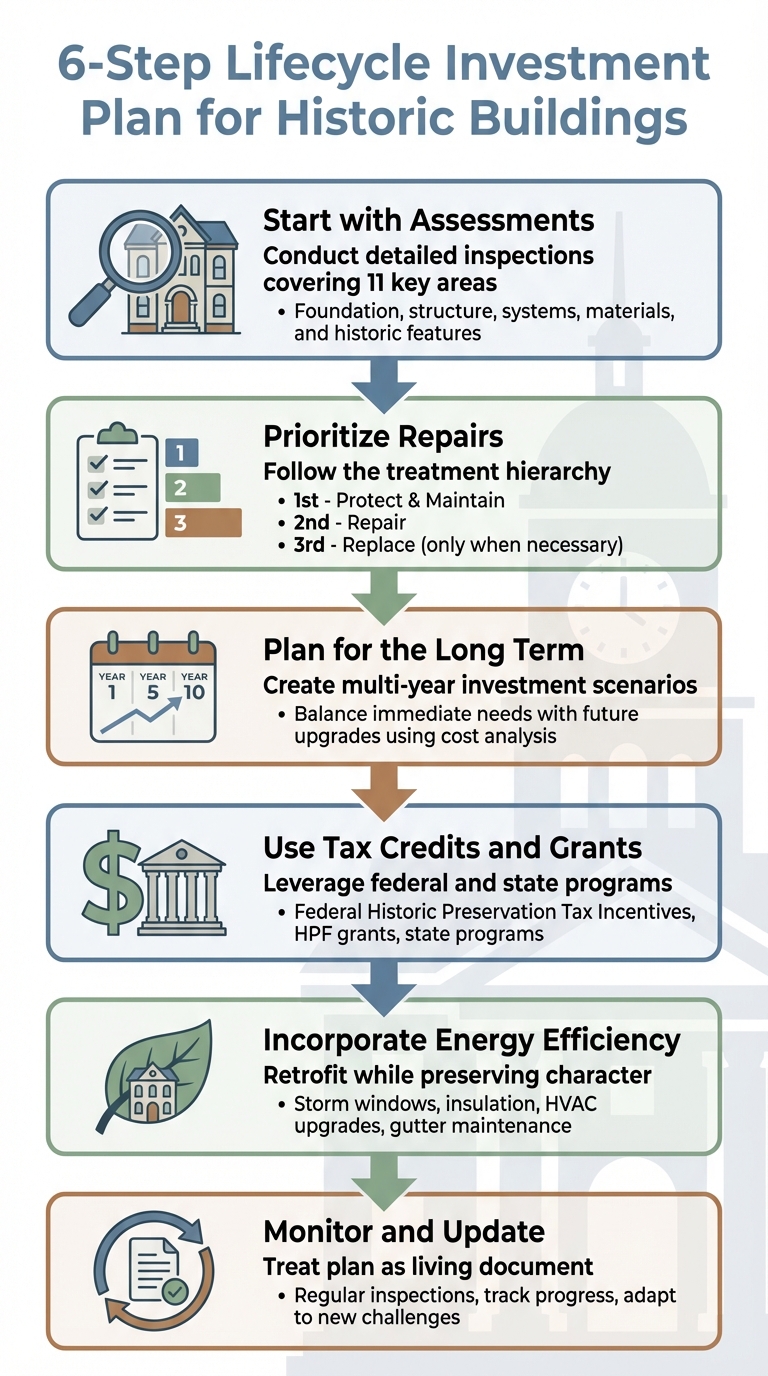
6-Step Lifecycle Investment Plan for Historic Buildings
Historic Structure Reports: Resources for Stewardship
Assessing Asset Condition and Setting Preservation Priorities
The foundation of a strong investment plan lies in accurately evaluating the condition of your assets. For historic buildings, this means more than a quick look around – you need a detailed and systematic assessment that captures both the physical condition and the importance of key features.
How to Conduct Asset Condition Assessments
A proper condition assessment starts with a thorough visual inspection of accessible areas like roofs, attics, basements, crawlspaces, and behind device covers [3]. The primary goal here is to document the structure without harming its historic materials.
The Georgia Department of Community Affairs describes this process as follows:
A Conditions Assessment Report is a preservation and rehabilitation tool that identifies, describes, and generally evaluates the existing condition of a historic structure, typically a historic building, and its associated environment [3].
To ensure a comprehensive evaluation, follow a structured approach that covers 11 key areas:
- Basic property details, including ownership, historic registry listings, and a brief history
- Summary of the building’s current condition
- Exterior inspection, focusing on the foundation, siding, masonry, windows, doors, and roof
- Room-by-room documentation of interior finishes and signs of deterioration
- Material assessments for masonry, mortar, wood, and plaster
- Evaluation of building systems like electrical, plumbing, HVAC, and fire protection
- Analysis of the root causes of decay
- Identification of repair challenges
- Treatment recommendations aligned with the Secretary of the Interior’s Standards
- Recordkeeping, including photos and floor plans
- Technical reports on structural integrity, lead paint, asbestos, and ADA compliance [3]
It’s crucial to involve preservation professionals with expertise in historic restoration to ensure accuracy and adherence to best practices [2].
This detailed assessment helps rank risks and prioritize investments, ensuring every action aligns with both preservation goals and budget constraints.
Ranking Assets by Risk and Historical Value
Since it’s rarely possible to address everything at once, you need a clear system for prioritizing efforts. The National Park Service offers useful guidance:
Rehabilitation guidance in each section begins with protection and maintenance, that work which should be maximized in every project to enhance overall preservation goals [2].
When determining the treatment approach, consider the following options:
- Preservation: Focuses on maintaining and repairing existing materials and spaces when they remain largely intact.
- Rehabilitation: Suitable when extensive repairs or alterations are needed for a new use while retaining historic character.
- Restoration: Aims to depict the property as it appeared during a specific historical period, removing features from other eras.
- Reconstruction: Involves recreating missing or non-surviving structures using new materials [5].
Once you’ve chosen a treatment path, prioritize work in this order: first, protect and maintain the defining features of the building; second, repair historic materials; and third, replace features only when repair is impossible due to severe deterioration [2]. This method minimizes unnecessary interventions and focuses on preserving the building’s historical integrity. Additionally, decisions should consider factors like economic feasibility, technical challenges, and compliance with building codes and regulations [5].
Creating a Centralized Asset Register
After ranking risks and historical values, compile all the data into a centralized register to guide future investment decisions. This register should include a detailed inventory of the building’s structural systems, finishes (both interior and exterior), architectural details, and essential systems like HVAC, electrical, and plumbing [3].
Document interior features room by room, using as-built plans and photographs [3]. Include specialized reports such as structural evaluations, paint analyses, hazardous material testing (e.g., lead and asbestos), and ADA compliance audits [3].
Make sure to highlight "character-defining" features – those architectural elements and materials that are essential to the building’s historic identity. These must be preserved during any future repairs or adaptations [2]. The database should be user-friendly, even for those without preservation expertise, and structured to emphasize protection and maintenance tasks as the first priority [3][2].
This centralized asset register becomes your go-to resource for balancing preservation efforts with financial and sustainability goals. It serves as a single source of truth, ensuring informed and consistent decision-making for the building’s future.
Developing Multi-Year Investment Scenarios
After documenting your asset conditions and ranking priorities, the next step is creating a practical, long-term investment plan. This involves estimating costs, testing different scenarios, and identifying funding sources to make sure your preservation efforts are financially sound. Essentially, this step connects your condition assessments with actionable financial strategies. Begin by quantifying your priorities, factoring in both initial and long-term costs.
Projecting CAPEX and OPEX for Historic Buildings
Use Life Cycle Costing (LCC) analysis [7] to evaluate the long-term economic performance of your preservation efforts. This includes investments in energy efficiency, water conservation, and resilience. When estimating costs, follow the National Park Service’s treatment hierarchy [2].
Your projections should also address compliance requirements. For projects seeking Federal Historic Preservation Tax Incentives, adhering to the Secretary of the Interior’s Standards for Rehabilitation (36 CFR 67) is mandatory [4]. Bringing in experts – like architects, historians, or archaeologists – early in the planning process can help identify "character-defining" features that must be preserved, avoiding expensive changes mid-project [2].
Plan your work in phases, starting with minimal interventions and progressing to high-CAPEX upgrades [1]. This phased approach keeps initial costs manageable while addressing urgent preservation needs first.
Testing Different Budget and Compliance Scenarios
Before committing funds, simulate various investment options to balance costs, risks, and sustainability. According to the National Park Service, "The Standards will be applied taking into consideration the economic and technical feasibility of each project" [5]. Start by determining the appropriate treatment standard for your project – Preservation, Rehabilitation, Restoration, or Reconstruction. Rehabilitation is often the go-to choice for buildings needing modern use and alterations [5].
For tight budgets, focus on "Protection and Maintenance" tasks such as rust removal, caulking, and gutter cleaning. These smaller efforts can prevent more expensive repairs down the road [2][8]. Use a "Recommended vs. Not Recommended" framework to evaluate technical approaches, ensuring that cost-saving measures don’t compromise the building’s historic character [8].
If your project includes expansions, ensure that new work is distinct from the historic structure to preserve its defining features [8].
Once internal costs are evaluated, explore external funding options to strengthen your financial plan.
Using Federal and State Tax Credits and Funding
To enhance your multi-year investment plan, take advantage of federal and state funding programs. The Federal Historic Preservation Tax Incentives Program, managed by the National Park Service in partnership with State Historic Preservation Offices (SHPOs), supports the rehabilitation of income-generating historic buildings [10][4]. To qualify, the project must align with the historic character of the structure and its district as determined by the Secretary of the Interior [4].
Grants from the Historic Preservation Fund (HPF) can help support work on registered properties and ensure that proposed projects align with preservation standards [4]. Additionally, the Historic Surplus Property Program allows state and local governments to acquire and repurpose surplus Federal historic properties [10].
Many states and local governments rely on the Secretary of the Interior’s Standards for Rehabilitation to evaluate both federal and non-federal proposals, often as a basis for state-level tax credits or funding [4]. Engage your SHPO early in the process to confirm eligibility [2].
Focus on protection and maintenance first. Repair only when necessary, and replace only as a last resort [2][8]. For example, when replacing windows or making structural changes, document the existing conditions thoroughly. This documentation is critical to meet tax incentive program requirements [9] and to prove that your project complies with the Standards for Rehabilitation, ensuring eligibility for federal tax benefits.
sbb-itb-5be7949
Adding Sustainability and Carbon Reduction to Your Plan
After outlining your multi-year investment scenarios, it’s time to weave energy efficiency into your plan. This step not only extends the life of your assets but also aligns with decarbonization goals. By focusing on retrofits that lower operational carbon while preserving embodied carbon, you can achieve both sustainability and preservation goals. As the National Park Service puts it, "historic preservation is inherently a sustainable practice" [11]. This ensures that your environmental efforts work hand-in-hand with your broader investment strategies.
Evaluating Energy Performance and Retrofit Options
Start by assessing your building’s current energy use. Establishing this baseline is crucial for identifying upgrades that offer the best return on investment. A step-by-step approach works best: begin with simple, non-invasive measures before tackling more complex changes. The National Park Service emphasizes this in their guidance:
The guidance that follows begins with the most basic and least invasive approaches that will help the project achieve the desired goal, before considering work that may involve more change and potentially greater impact on the historic character of the building [1].
Tasks like caulking, weather-stripping, and maintaining gutters are excellent first steps. These small actions can prevent bigger problems down the line without altering the building’s appearance. For more advanced upgrades – like HVAC system improvements or window treatments – it’s wise to involve preservation professionals early. For instance, instead of replacing original wooden windows, consider adding storm windows. This approach boosts thermal performance while keeping the building’s historic character intact.
To make informed decisions, use simulation tools like REVIVEcalc with EnergyPlus. These tools provide detailed analyses of lifecycle costs, energy savings, and how retrofits will perform under different conditions. With this data in hand, you can balance the need for lower emissions with the goal of preserving heritage features.
Managing Embodied Carbon vs. Operational Carbon
Historic buildings hold a large amount of embodied carbon, which is essentially the energy used to produce their materials [12]. Preserving these materials avoids the emissions tied to manufacturing and disposing of replacements. The Secretary of the Interior’s Standards for Rehabilitation support this approach by prioritizing repair over replacement. When features are too deteriorated to repair, replacements should use the same materials whenever possible [4].
This preservation-first mindset should guide your retrofit choices. For example, when upgrading insulation, look for methods that keep original plaster or woodwork intact. Similarly, when cleaning or treating historic surfaces, opt for gentler methods to minimize damage and prevent long-term deterioration [4].
Emerging standards like Phius REVIVE 2024 now emphasize not just energy efficiency but also thermal resilience – the ability of a building to stay livable during power outages. Tools like the Annualized Decarbonization of Retrofitted Building (ADORB) metric allow you to evaluate the environmental impact of different retrofit strategies over time [13].
Prioritizing Investments Using Energy and Carbon Data
Comprehensive energy and carbon data can help you prioritize investments that deliver the most environmental benefits while staying true to preservation standards. Life Cycle Cost Analysis (LCCA) is a valuable tool for comparing the economic and environmental performance of each retrofit option [7]. This method combines measurable outcomes – like energy savings and CO₂ reductions – with the overarching goal of preserving historic elements.
One key principle is to focus on "avoided impacts", which means recognizing the carbon already stored in your building’s materials. For example, repairing historic windows instead of replacing them often results in lower overall carbon emissions. As the saying goes, the greenest building is the one that’s already built [12].
To ensure your sustainability measures don’t compromise the building’s character, consult the National Park Service’s "Recommended vs. Not Recommended" guidelines [1]. If your project involves Federal Historic Preservation Tax Incentives, energy-related additions must be clearly distinguishable from the historic structure and align with its scale and proportions [4]. Resources like NPS Preservation Brief 3 (on energy efficiency) and Brief 13 (on window treatments) provide additional guidance.
Finally, centralize your energy and carbon data in an asset register. Platforms like Oxand Simeo™ can help you model energy performance and carbon reduction pathways for your entire portfolio. This ensures your decisions are backed by solid data and align with both preservation standards and decarbonization goals. With these tools and strategies in place, you can set up governance structures and monitoring systems to track your progress over time.
Implementing and Monitoring Your Investment Plan
Once you’ve mapped out scenarios and integrated sustainability considerations, it’s time to put your plan into action. This involves setting up a solid governance structure, keeping an eye on performance, and ensuring transparency through detailed reporting.
Setting Up Governance and Stakeholder Roles
Getting the right team in place is the first step to successful implementation. You’ll need preservation experts like architects, historians, and archaeologists on board early. They can help navigate the unique challenges of historic buildings, such as hidden structural issues or intricate regulatory requirements [2][5].
Your governance structure should clearly outline decision-making responsibilities at every stage. A well-defined hierarchy ensures that protection and maintenance come first, followed by repairs to historic materials, and replacements only when absolutely necessary due to severe deterioration. This approach aligns with the Secretary of the Interior’s Standards, which emphasize maintaining the historic character of buildings. The National Park Service underscores this priority:
Rehabilitation guidance in each section begins with protection and maintenance [2].
Make sure your preservation plan is well-documented and easy to understand for everyone involved – whether it’s board members, investors, or facility managers [3][14]. When incorporating new features or modifications, aim for reversibility. This means designing changes so they can be undone in the future without compromising the original form or integrity of the property [4].
With governance in place, the next focus is on consistent monitoring to ensure the plan stays on track.
Monitoring Performance and Updating the Plan
Think of your plan as a living document that evolves over time. Regular monitoring is key to keeping it relevant and effective. Start with a Conditions Assessment Report (CAR), which provides a snapshot of the building’s materials, structural systems, and overall condition at a specific point in time [3]. This report serves as your baseline for measuring future changes.
Create a schedule that balances short-term maintenance tasks with long-term projects like roof replacements or masonry repairs. Inspections of areas like attics, crawlspaces, and roofs are critical for spotting early signs of deterioration [3][14]. It’s also important to monitor how the building’s current use – whether by occupants or visitors – affects its structural and historical integrity [14].
The Georgia Department of Community Affairs highlights the importance of flexibility:
A Preservation Plan is not a static document, but one that should be regularly revised and updated as information and circumstances allow and should be the means by which preservation and other work to the resource are determined, developed, and recorded [14].
Consider using tools like Oxand Simeo™ to centralize your data and track whether the project is meeting its original goals. When unexpected challenges arise, such as hidden structural damage or environmental hazards, a phased approach allows you to adapt without throwing the entire plan off course [6].
Documenting these adjustments will make stakeholder reporting more effective and transparent.
Reporting Results to Stakeholders
Keeping stakeholders informed through clear, evidence-based reporting builds trust and reinforces confidence in your decisions. Share measurable results like costs, preserved square footage, energy savings, and carbon reductions. Use visual dashboards to make progress against multi-year targets easy to understand.
For projects aiming to secure Federal Historic Preservation Tax Incentives, your documentation must show compliance with the Secretary of the Interior’s Standards for Rehabilitation, as outlined in 36 CFR 67 [4][5]. This includes detailing not just the work completed but also how it preserved key features and upheld the building’s historical integrity.
Pair your sustainability metrics with preservation achievements to showcase how both goals work hand in hand. For example, explain how energy-efficient upgrades have reduced operational expenses while respecting the building’s embodied carbon. Use Life Cycle Cost Analysis (LCCA) to highlight the long-term financial and environmental benefits of prioritizing preservation [7]. Tailor your reports to suit your audience – offer technical details for experts and concise summaries for community members and regulators. This approach fosters trust and sets the stage for future investment opportunities.
Conclusion: Building a Sustainable Future for Historic Buildings
A lifecycle investment plan acts as a strategic guide to protect both the heritage and financial value of historic properties. It starts with detailed condition assessments, focuses on risk-based interventions, and relies on well-maintained asset registers. This kind of planning strikes a balance between preserving history and addressing practical limitations, laying the groundwork for blending sustainability with preservation.
When it comes to sustainability, the greenest building is often the one that’s already built. Preserving historic structures capitalizes on the embodied carbon they already contain, making it a smart and impactful climate strategy. This connection between embodied carbon and preservation underscores why maintaining historic buildings is not only a historical priority but also an environmental one.
As the National Park Service wisely notes, "Achieving greater resilience must likewise be balanced with economic and technical feasibility while minimizing the impacts to the historic character of the building" [15]. Through continuous monitoring, property owners can ensure that preservation and sustainability goals remain on track. This proactive approach helps identify early signs of damage, adapt to changing conditions, and provide clear updates to stakeholders about costs, energy savings, and carbon reductions.
The best starting point is always the least invasive option – prioritizing maintenance and repairs before considering larger changes. This method supports preservation efforts while promoting long-term sustainability. It also aligns with funding opportunities and tax credit requirements. By combining data-driven planning with respect for the historic character of buildings, these efforts ensure that these valuable assets continue to benefit communities for years to come.
FAQs
How can I create an effective lifecycle investment plan for historic buildings?
To craft an effective lifecycle investment plan for historic buildings, the process begins with a detailed condition assessment. This step involves thoroughly examining the building’s current state – its materials, systems, and distinctive architectural elements. The goal is to pinpoint immediate repair needs and outline long-term maintenance requirements, forming a solid foundation for future decisions.
The next step is creating a well-structured preservation plan. This plan should pull together essential details like condition assessments, maintenance records, and historic structure reports. It should prioritize projects based on urgency, align with goals such as reducing carbon emissions, and provide cost estimates for repairs, replacements, and ongoing maintenance over the building’s lifetime. Following established preservation guidelines ensures the building’s historic integrity is respected while incorporating modern sustainability practices.
Lastly, the plan must include a schedule for routine inspections and updates. Regular evaluations help address evolving conditions and comply with new regulations. This forward-thinking approach ensures the building is preserved responsibly, remains environmentally conscious, and stays financially manageable over the years.
How can owners of historic buildings use tax credits and grants to fund preservation projects?
Owners of historic buildings have access to financial tools like tax credits and grants to help manage the costs of preservation while keeping the property’s historic charm intact. One key resource is the Historic Preservation Tax Incentives program, which offers federal tax credits for approved rehabilitation projects. To qualify, these projects must align with the Secretary of the Interior’s Standards for Rehabilitation, ensuring that the building’s historical and architectural character is preserved.
Beyond tax credits, grants from government agencies can further support preservation efforts. For instance, programs funded by the Department of the Interior provide resources to help property owners focus their investments and handle expenses more efficiently. These options not only make preservation more affordable but also encourage adherence to conservation guidelines, ensuring that historic buildings remain protected for generations to come.
How can you improve energy efficiency in historic buildings without compromising their character?
Improving energy efficiency in historic buildings while maintaining their charm calls for thoughtful planning and precise execution. A good starting point is following established guidelines like the Secretary of the Interior’s Standards for Rehabilitation. These standards advocate for upgrades that are reversible and avoid damaging or hiding historic features. For instance, retrofitting existing windows with energy-efficient solutions can help maintain their original look while boosting performance.
It’s wise to focus on upgrades that leave the building’s original materials largely untouched. Enhancements like better insulation, weatherproofing doors and windows, or upgrading HVAC systems can significantly improve energy efficiency without compromising the building’s character. Additionally, modern solutions – such as green roofs or daylighting systems – can be integrated, provided they align with preservation standards.
The key is finding a balance between sustainability and preservation. Aim for improvements that respect the building’s historical essence while achieving energy efficiency goals.
Related Blog Posts
- Achieving Net-Zero in Real Estate Portfolios: From Targets to Investment Plans
- Quick Wins for Sustainability: Low-Capex Actions That Prepare Your Portfolio for Bigger Moves
- Financing the Green Transition: How to Use Your Investment Plan to Access Sustainable Funding
- Climate Change Adaptation for Aging Assets: Where to Invest First