







Predictive maintenance is a game-changer for building owners aiming to cut costs and reduce emissions. By using IoT sensors and AI to predict equipment failures before they occur, this proactive approach delivers measurable benefits, including:
- Lower maintenance costs: A predictive vs reactive maintenance cost analysis shows predictive costs of $2.00–$2.80 per sq ft annually, compared to $4.50–$6.00 for reactive maintenance.
- Energy savings: Properly maintained systems can reduce energy use by 15–25%.
- Fewer emergencies: Emergency repairs cost 4.8x more than planned fixes.
- Extended equipment life: Assets last 15–30% longer with predictive strategies.
For example, a 2.8 million sq ft property portfolio saved 35% in maintenance costs and cut energy use by 22% within a year. A single predictive repair saved $43,800 compared to emergency costs.
Start small with a 90-day pilot on critical systems like HVAC or chillers, then scale gradually. By focusing on high-impact equipment, you’ll see immediate ROI while moving closer to zero-emission goals.
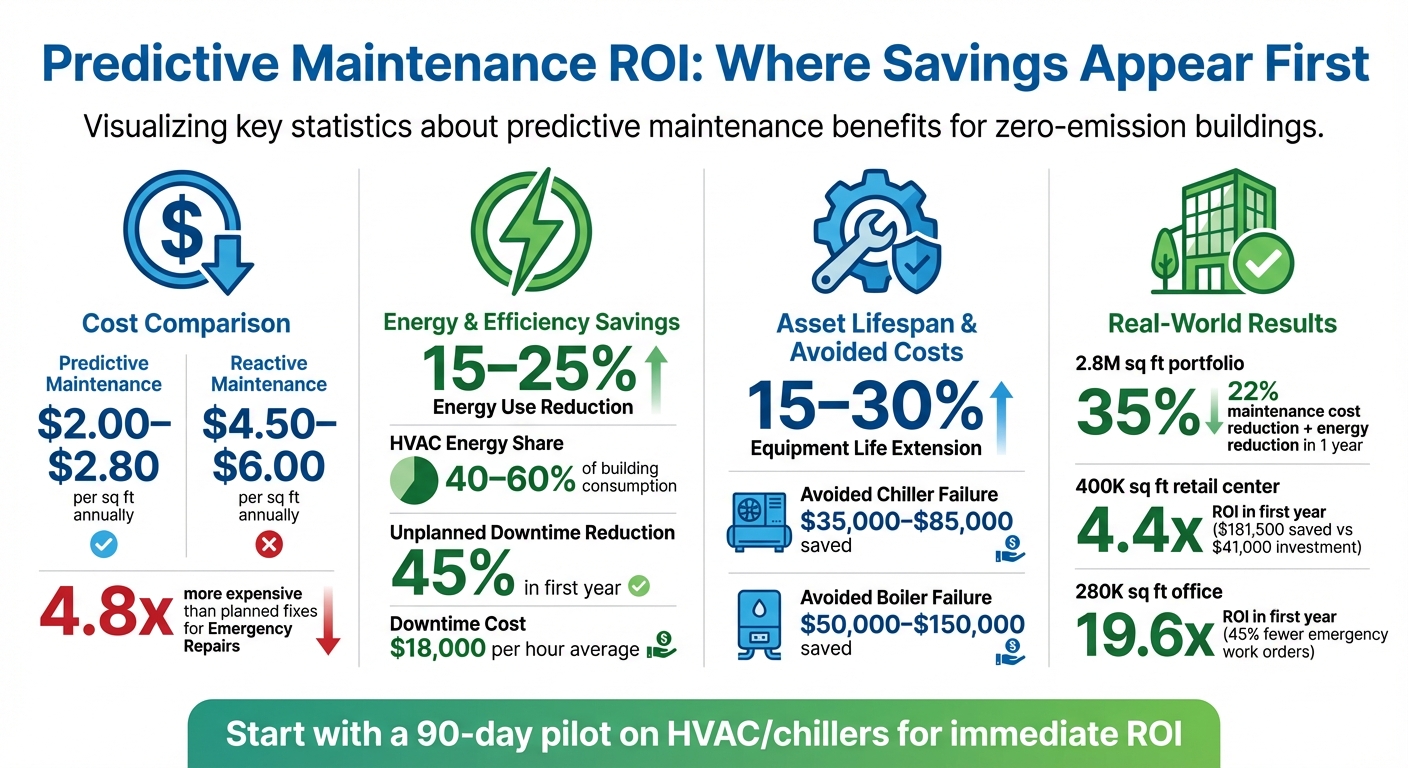
Predictive Maintenance ROI: Cost Savings and Energy Reduction Statistics
Where ROI Appears First
Immediate Cost Savings
Predictive maintenance creates measurable financial benefits through four key avenues, helping businesses save money while aligning with zero-emission goals. The first and most obvious savings come from avoiding emergency repair premiums. For example, fixing a chiller bearing on a Saturday night might cost $1,900, but scheduling the same repair for a Tuesday morning could cost just $400 [9]. Emergency call-out rates for specialists are, on average, 4.8 times higher than standard scheduled rates [3]. Additionally, unplanned failures often cost 5–10 times more than scheduled maintenance due to overnight fees and expedited parts [5].
The second way savings are realized is through improved energy efficiency. Predictive systems can pinpoint issues like fouled coils, refrigerant leaks, or malfunctioning sensors, which can increase energy use by 15–25% [3]. A facility director overseeing an 800,000 sq ft commercial campus shared:
"We cut our energy spend by 22% in the first year after implementing structured preventive maintenance through a CMMS. The biggest surprise was how many small issues – stuck dampers, drifted sensors, forgotten overrides – were silently costing us thousands per month" [1].
Addressing these issues often requires minimal investment but results in significant monthly reductions in utility bills.
The third channel involves reducing downtime. Predictive monitoring can cut unplanned downtime by 45% in the first year [3]. Considering that downtime in commercial buildings costs an average of $18,000 per hour [3], this reduction is substantial. For instance, a 400,000 sq ft retail center equipped with 218 IoT sensors avoided four rooftop unit failures, slashing emergency repair costs from $94,000 to $18,500 over 12 months. This effort delivered a 4.4x ROI in the first year, saving $181,500 against an implementation cost of $41,000 [7].
Finally, predictive maintenance extends the lifespan of assets. Condition-based strategies can increase equipment life by 15–30%. Avoiding a single chiller failure can save between $35,000 and $85,000, while preventing a boiler breakdown can save $50,000–$150,000 [5]. For high-value equipment like chillers, boilers, and main distribution pumps, the savings from even one avoided failure can offset the entire cost of sensor deployment [5].
Together, these savings channels build a compelling case for ROI across entire building portfolios.
Measuring ROI in Building Portfolios
These savings not only cut immediate costs but also provide a solid framework for calculating ROI across multiple properties. Older buildings with aging equipment often see payback within 3–6 months, while newer, better-maintained properties might take 12–18 months to achieve returns [5]. For example, a 280,000 sq ft Class A office building reduced emergency work orders by 45% in one year, saving $180,000 in maintenance costs. With an implementation cost of $9,200, this resulted in a first-year ROI of 19.6x. HVAC monitoring alone saved $89,000 by avoiding after-hours calls [8].
On a larger scale, a 45-property residential portfolio with 3,200 units reduced annual capital expenditures from $4.1 million to $2.8 million over 12 months ending in March 2026. By shifting from 58% reactive maintenance to 82% planned maintenance, the portfolio avoided special assessments and saved $1.3 million through better timing and fewer failures [6]. Full deployment of IoT and CMMS platforms has been shown to deliver an average ROI of 3.2x within 18 months [9].
The financial impact of predictive maintenance depends on factors like building type and maintenance history. Shifting even 40% of reactive work to preventive scheduling can cut total maintenance costs by 25–40% [9]. Emergency repairs could drop by 60–80%, translating to an overall maintenance cost reduction of 40–55% [5]. For a 200,000 sq ft property, pilot investments usually range between $15,000 and $35,000, with wireless sensors priced at $150–$500 per monitoring point and cloud analytics platforms costing $50–$200 per month per site [5].
To measure ROI accurately, it’s essential to establish cost baselines using historical data for labor, parts, and downtime linked to specific failure modes [10]. CMMS platforms can automate savings tracking by logging avoided costs whenever a prediction leads to planned maintenance instead of emergency repairs [10]. Prioritizing assets using a "Failure Cost × Failure Probability" matrix ensures resources are allocated to areas with the highest financial return [5].
sbb-itb-5be7949
Energy Savings and Carbon Reduction
How Energy Efficiency Drives ROI
Predictive maintenance plays a key role in cutting energy waste by identifying problems that lead to excessive power use. For instance, HVAC systems account for 40–60% of a building’s energy consumption [11], making them a prime focus for boosting efficiency. AI-powered analytics can pinpoint issues like coil fouling, refrigerant leaks, and sensor drift – problems that often go unnoticed but significantly waste energy [11][7].
The numbers paint a clear picture. A mere 1mm fouling layer on condenser coils can increase compressor energy use by 15–25%, and a 10% rise in static pressure can drive fan energy consumption up by 33% [4]. By monitoring factors such as approach temperature and coil delta-T, maintenance teams can restore equipment to its optimal efficiency, addressing an "efficiency gap" that can reach as high as 23% in reactive maintenance scenarios [7][5].
Energy optimization efforts can slash HVAC consumption by 15–25% [11]. Take this example: a retail store cut post-close HVAC runtime by over three hours daily by aligning operation schedules with actual occupancy patterns [7]. Instead of using rigid, pre-set schedules, predictive systems dynamically adjust runtimes based on real building usage, reducing unnecessary operation during off-hours [7].
Keeping equipment running efficiently doesn’t just mean lower utility bills – it also means cutting carbon emissions. For example, boilers benefit from continuous monitoring of O₂ levels, CO output, and stack temperatures, allowing teams to fine-tune burners weeks before efficiency starts to drop noticeably [5]. Similarly, tracking chiller efficiency in kW/ton can help detect issues like fouling or refrigerant leaks 48–72 hours before they escalate [5]. These proactive measures save energy and contribute to meaningful carbon reductions.
Carbon Reductions for ESG Reporting
Improving energy efficiency doesn’t just save money – it also slashes carbon emissions, which is critical for ESG reporting and meeting regulatory standards. Predictive maintenance can cut carbon emissions by 25–35% and maintenance-related waste by 40–60%, leading to an overall environmental impact reduction of 50–70% [12]. Monitoring systems alone prevent 40–60% of maintenance-related carbon output [12].
Refrigerant management is another area with a big payoff. R-410A refrigerant, for example, has a Global Warming Potential (GWP) of 2,088, meaning a single 5-pound leak equates to 10,440 pounds of CO₂ [4]. By detecting leaks early and using GWP-weighted emission reporting, organizations can tackle Scope 1 emissions effectively. At the same time, improving HVAC efficiency directly reduces Scope 2 emissions tied to purchased electricity [4].
Predictive platforms make ESG reporting easier and more accurate by automating the collection of detailed energy and emissions data. This automation supports compliance with regulations like the EU CSRD or SEC climate rules, delivering 95–99% data accuracy and cutting compliance efforts by 60–75% [12]. Companies adopting predictive maintenance for ESG purposes often see a 35–50% improvement in sustainability KPI performance [12].
"Every equipment failure you prevent is carbon emissions avoided, waste eliminated, and ESG targets protected." – Oxmaint [12]
Is Preventive Maintenance Worth It? (We Did the Math)
Which Assets to Target First
Once you’ve outlined the financial and operational perks of predictive maintenance, the next step is figuring out which assets will deliver the best return on investment (ROI).
Evaluating Asset Criticality
Start by focusing on building systems that use the most energy and pose the highest failure risks. HVAC systems and chillers should be your top priority, as they account for 40–60% of a building’s energy consumption and are a major factor in carbon emissions. In fact, HVAC systems are responsible for 40% of global CO₂ emissions from building operations [4][13][15].
To rank assets, use the "Failure Cost × Failure Probability" formula [5]. Begin with high-cost equipment like chillers and boilers. For example, emergency chiller repairs can cost anywhere from $12,000 to $45,000 per event, while predictive monitoring might only cost $285 per month [13]. Boilers are equally important – catastrophic failures can lead to expenses between $50,000 and $150,000, not to mention operational downtime [5][3].
Electrical distribution and switchgear are also critical, as they contribute to 13% of commercial fires [3]. Pumps and water infrastructure serving multiple areas should follow, especially since issues like vibration can be addressed with affordable planned maintenance rather than costly emergency replacements [5][3]. Don’t overlook refrigerant management either – a 5-pound leak of R-410A releases an alarming 10,440 pounds of CO₂ [4].
By targeting these high-impact systems, you can set the stage for maximizing ROI.
How to Prioritize Assets
Once you’ve assessed criticality, focus on assets with clear and measurable performance indicators. Rotating equipment – such as centrifugal chillers, screw compressors, large Air Handling Unit (AHU) fans, and cooling tower motors – should take precedence. These systems tend to degrade predictably and offer measurable warning signs weeks before failure [11]. If monitoring resources are limited, start by tracking the condenser approach temperature, which is a reliable indicator of efficiency and can detect issues like fouling or flow problems early [13].
Adopt a phased approach to implementation. Begin with a pilot program: install sensors on 2–3 critical assets (like a main chiller or boiler) during the first 1–3 months to establish performance baselines [5]. Expand monitoring to include all chillers, boilers, main pumps, and electrical switchgear by months 4–9 [5]. In months 10–18, extend the program to secondary systems like AHUs, exhaust fans, and elevator motors [5]. This gradual rollout allows you to demonstrate ROI before scaling across your entire facility.
A well-maintained HVAC system can cut energy use by 15–30% without requiring any capital investment [4]. Predictive maintenance can also extend the lifespan of HVAC equipment by 5–10 years [14][15]. Considering that 67% of developing equipment failures occur between traditional scheduled inspections [15], continuous monitoring bridges the gaps left by calendar-based maintenance. The trick is to start with assets where failures are both costly and preventable – this is where you’ll see the biggest ROI right away.
Implementation Roadmap
Phased Deployment Approach
You don’t need to overhaul your entire operation to start with predictive maintenance. A phased rollout allows you to test the waters, prove the return on investment (ROI), and then scale up gradually.
Start with a 90-day foundation phase. Begin by auditing your CMMS (Computerized Maintenance Management System) records from the last two years. Talk to your operators to uncover "micro-stoppages" that might not be logged in the system, and calculate the actual cost of downtime per hour [19].
Weeks 5–8: Pilot critical assets. Select 10–20 key assets and equip them with IoT sensors, such as vibration sensors ($200–$500 per unit) or temperature sensors ($100–$300 per point). These sensors should connect via standard protocols like MQTT or BACnet [17]. During this phase, confirm that data is flowing correctly. For context, a typical pilot for 15–20 assets might cost between $15,000 and $40,000 for the first year [17]. For example, a healthcare manufacturer in 2026 monitored 234 assets over four months, avoided 30 hours of unplanned downtime, and saved $405,500 – including $200,000 from fixing a misaligned motor drive shaft [19].
Weeks 9–12: Train your AI models. Use 4–8 weeks of operational data to create a digital fingerprint for each asset. This baseline helps the system detect anomalies and set precise alert thresholds to reduce false positives. By week 13, activate real-time monitoring. Configure the system to auto-generate work orders with technician assignments and parts lists when thresholds are breached [17]. This approach often delivers an ROI of 10:1, with most facilities seeing tangible results within 12–18 months [16].
After proving ROI with the pilot, scale up. Between months 4–9, focus on core equipment like chillers, boilers, main pumps, and electrical switchgear. By months 10–18, extend to secondary systems such as air handling units (AHUs) and exhaust fans [5]. By 2026, it’s expected that 85% of large facilities will have IoT sensors installed on their core assets [17].
Once the deployment is underway, the next critical step is ensuring smooth integration with your existing systems.
Connecting with Existing Systems
As you roll out your IoT sensors, integrating the data with your current systems is key. Without seamless integration, sensor readings risk becoming isolated, limiting their effectiveness in driving actionable maintenance. The difference between preventing failures and merely reacting to them lies in bridging the gap between monitoring and action [17].
Ensure that sensor data connects directly to your CMMS using standard industrial protocols like MQTT, OPC-UA, BACnet, or Modbus [17][18]. For older facilities with legacy equipment, wireless retrofits using technologies like LoRaWAN or cellular connectivity can bypass the cost of installing new data cables [5]. These wireless IoT sensors can be deployed without interrupting operations or requiring equipment replacements [18]. If your building uses multiple protocols – such as BACnet for HVAC, Modbus for older pumps, or M-Bus for meters – universal gateways can consolidate all data into a unified, cloud-based platform [17].
Integration doesn’t stop there. Connecting with property management software like Yardi, MRI, or AppFolio ensures that maintenance data feeds into financial and capital planning workflows [6]. For instance, sensor alerts can trigger work orders, completed repairs can update asset condition scores, and this data can inform long-term CAPEX planning. Facilities that integrate IoT with CMMS systems report a 30–47% reduction in unplanned downtime [17].
"Facilities management tech stacks will reach a new level of maturity as facility managers integrate CMMS platforms, building automation systems, IoT sensors and asset data into a single system. Rather than collecting data for reporting’s sake, they’ll be using it to guide capital planning, staffing and risk mitigation."
Start small, prove the value, and expand systematically. You don’t need to replace your entire tech stack – just connect the pieces you already have.
Conclusion
Predictive maintenance offers a smart way to save money while reducing emissions. The numbers speak for themselves: emergency repairs can cost up to 4.8 times more than planned maintenance[3]. Predictive systems, however, can cut overall maintenance costs by 40–55% and reduce emergency repairs by 60–80%[5]. Many facilities recover their investment in just 2.5 to 6 months, with some reporting a 19.6× return in the first year[8].
Improving asset care is a key step toward achieving zero-emission buildings. Since HVAC systems alone account for 39% of energy use in commercial buildings[3], addressing issues like coil fouling or refrigerant leaks early can boost efficiency and lower energy use by 15–25%[3]. For example, a 400,000-square-foot retail center cut its HVAC energy costs by 28%, saving $106,000 annually, while reducing Scope 1 and Scope 2 emissions by 19% in just one year[7].
To get started, try a focused 90-day pilot program on critical assets like a main chiller or boiler. Use your CMMS to track performance, and then expand gradually to include HVAC and secondary systems[5].
FAQs
What’s the fastest way to prove ROI with a 90-day pilot?
To demonstrate ROI within 90 days, start with a proof of value assessment early in the pilot phase – don’t wait until the end. Prioritize measurable KPIs such as cutting unplanned downtime, lowering maintenance costs, and boosting asset performance. Leverage real-time data and sensor monitoring to track progress effectively. Then, compile the verified savings and operational improvements into clear, concise reports that are ready to present to stakeholders during the pilot.
Which assets should I monitor first in my buildings?
To make a real difference in energy efficiency and reliability, begin by keeping a close eye on essential assets like HVAC systems, chillers, and boilers. These systems play a major role in energy consumption and overall performance. Implementing predictive maintenance for them can help you avoid unexpected breakdowns, extend their operational lifespan, and cut down on running costs. Focusing on these areas not only delivers measurable ROI but also aligns with efforts to meet zero-emission targets.
How do I calculate ROI across a whole property portfolio?
Calculating ROI for a property portfolio means focusing on measurable outcomes. Key areas to examine include reduced maintenance costs, which can drop by 25–40%, and improved technician productivity, which often sees a boost of around 35%. Additionally, extending asset lifespans by up to 21% can significantly contribute to long-term savings.
Predictive maintenance plays a big role here, slashing reactive expenses by 64% and helping to avoid those expensive, last-minute emergency repairs. To get a clear picture, start by establishing baseline costs. Then, track savings over time and leverage financial dashboards to measure improvements in both reliability and efficiency across your portfolio.
Related Blog Posts
- Predictive Maintenance for Asset Management (Infrastructure and Real Estate) is critical – use the web site the web site:https://theiam.org
- Predictive Maintenance & ROI
- Energy Savings and Emissions Reduction: The Hidden ROI of Predictive Maintenance
- How Predictive Maintenance Improves Service Levels for Occupants and Users