







Start saving energy and cutting costs today – no big budget required. Commercial buildings waste up to 84% of their energy, but small, low-cost changes can reduce energy use by 15-40%. These savings can fund larger upgrades later, making it easier to meet energy goals.
Here’s how:
- Build a central asset database: Track energy use to spot inefficiencies.
- Conduct energy audits: Identify quick fixes like LED lighting or HVAC adjustments.
- Make operational changes: Sync systems with occupancy and train staff on energy-saving habits.
- Test retrofits: Use simulations to prioritize upgrades with the best ROI.
- Track progress: Monitor savings to prove success and secure funding for bigger projects.
Even simple steps – like adding occupancy sensors or sealing air leaks – can deliver immediate results while setting the stage for long-term improvements.
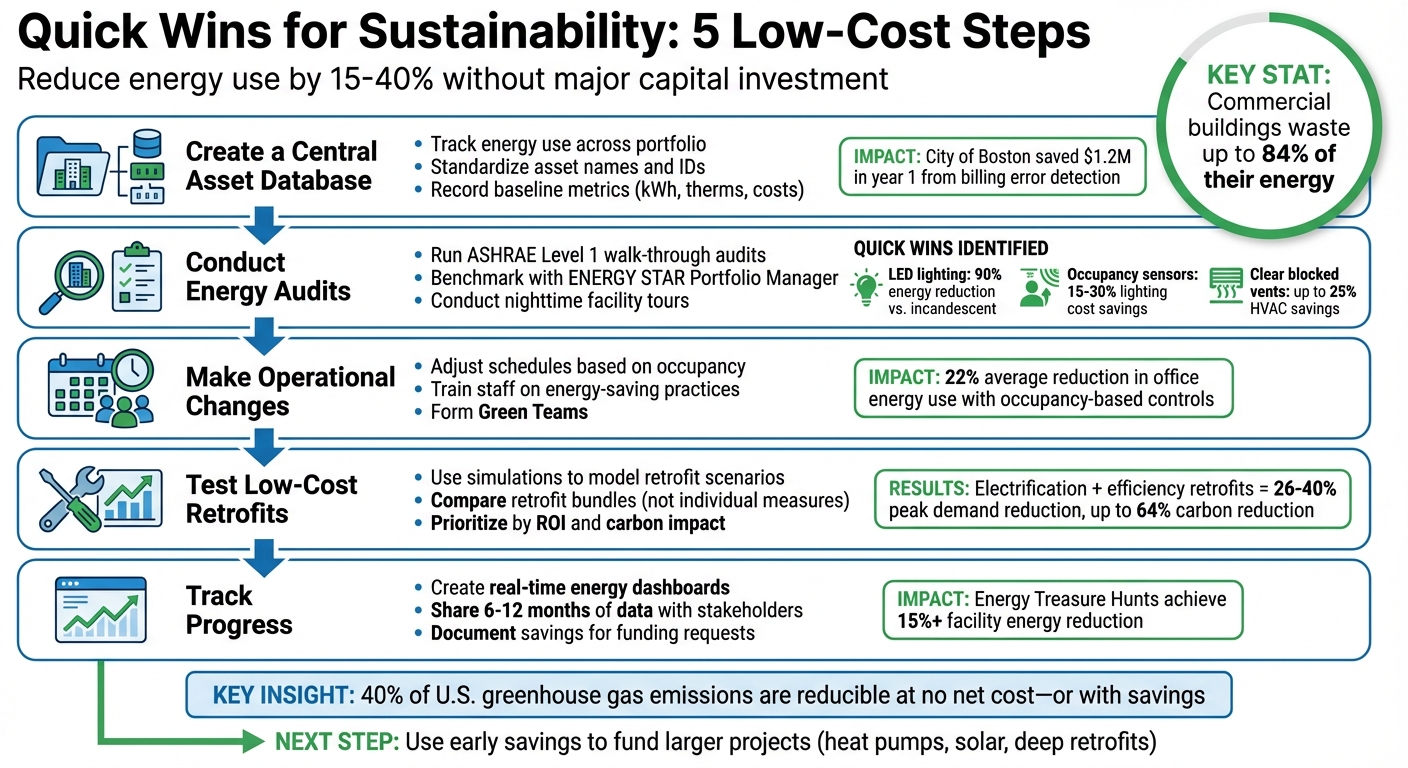
5-Step Process for Low-Cost Building Energy Efficiency Improvements
Retrofitting Your Commercial Building Benefits from Demand-side Management
Step 1: Create a Central Asset Database
If you can’t measure it, you can’t improve it – and that’s especially true when it comes to energy efficiency and sustainability. Building a central asset database is the first step toward creating the solid data foundation you need to identify opportunities, monitor performance, and make smarter investment decisions across your portfolio using risk-based CAPEX planning.
A centralized database gives you detailed insights into how each asset performs in terms of energy use. It helps you uncover underperforming buildings, catch billing errors, and focus your sustainability efforts where they’ll have the most impact. For example, the City of Boston saved over $1.2 million in its first year by identifying utility billing errors through centralized bill verification [5].
"A central energy database is vital to data-driven energy management. It provides greater visibility into the energy performance of individual assets across your organization’s portfolio."
Simplify Asset Management with Simeo Inventory
Managing asset data can be overwhelming, especially when dealing with scattered spreadsheets and inconsistent records. That’s where Simeo Inventory comes in. This platform makes it easy to build a clean, organized asset register that you can rely on.
Simeo Inventory ensures consistency by standardizing asset names, assigning unique IDs, and recording essential details like square footage, year built, HVAC type, operating hours, and occupancy. This level of organization eliminates costly errors and ensures every dollar spent on energy is properly accounted for.
Establish Baseline Energy Use and Emissions
With your asset database in place, the next step is to record baseline energy and carbon data. This means gathering key metrics such as electricity consumption (kWh), natural gas usage (therms), peak demand charges (kW), and total costs for each billing period.
This baseline serves as your starting point for tracking progress. For larger assets or those with high energy-saving potential, monitor consumption monthly. For smaller or leased spaces, annual tracking may be sufficient. The idea is to get a clear picture of your current energy use so you can plan effectively for future improvements.
Having this data in hand sets the stage for the targeted efficiency audits that follow in the next step.
Step 2: Find Quick Efficiency Improvements Through Audits
Now that you’ve organized your asset database, it’s time to dig into the data and pinpoint where energy is slipping through the cracks. Energy audits are a fast and cost-effective way to identify inefficiencies. Even a simple walk-through can uncover savings that pay off in months rather than years. These audits lay the groundwork for targeted actions that drive meaningful progress.
Run Energy Audits with Existing Data
You don’t need to start from scratch. Tools like Oxand Simeo™ make it possible to use your current inspection data and models to detect system performance issues. By analyzing existing asset condition records, the platform predicts where performance is declining, helping you address potential problems before they escalate into expensive repairs.
For a broader perspective, benchmark your buildings using tools like ENERGY STAR Portfolio Manager. This establishes a baseline Energy Use Intensity (EUI), allowing you to compare your property’s performance against similar buildings. From there, a straightforward ASHRAE Level 1 audit – a basic walk-through – can highlight actionable steps for quick savings. As a rule of thumb, the cost of an energy audit shouldn’t exceed 10% of your building’s annual utility expenses.
"A Level 1 actually requires the highest level of knowledge and experience because the recommendations are made based solely on that experience instead of analysis."
- Jim Kelsey, Primary Author of ASHRAE’s 2011 audit publication[6]
Nighttime audits are especially revealing. Touring your facility after hours can expose equipment, lighting, or electronics running unnecessarily. This simple step helps you zero in on areas where immediate changes can make a big difference.
Target High-Impact Areas First
Focus on areas where small adjustments can result in big savings. Lighting is often the easiest place to start. Switching to LEDs can slash energy use by up to 90% compared to incandescent bulbs, and they last 35 to 50 times longer. Adding occupancy sensors in low-traffic spaces like restrooms or storage rooms can cut lighting costs by 15% to 30%. Even removing excess lamps in over-lit areas can trim expenses by 10% to 40%.
HVAC systems are another prime opportunity. Something as simple as clearing blocked vents can reduce energy use by up to 25%. Check to make sure furniture or boxes aren’t obstructing airflow. Regular maintenance, like cleaning or replacing filters monthly during peak seasons and keeping evaporator and condenser coils clean, ensures your system runs efficiently. Adjusting thermostats during evenings or unoccupied periods is a no-cost change that delivers immediate results.
Don’t forget about your building’s envelope. Sealing air leaks around doors and windows with weather stripping or caulking helps prevent energy loss and reduces strain on your HVAC system.
Finally, tackle plug loads. Office equipment and data centers often consume a significant chunk of energy. Smart power strips can cut power to devices when they’re not in use, and enabling sleep settings on printers, copiers, and other devices can further reduce energy consumption. Consolidating shared devices – like aiming for one multifunction printer per 10 users – can cut both energy and maintenance costs by 30% to 40%.
These straightforward fixes not only save energy but also free up funds for more ambitious sustainability projects down the line.
Step 3: Make Behavioral and Operational Changes
Tackling inefficiencies doesn’t always require costly upgrades. By focusing on daily habits and how your building operates, you can unlock significant energy savings. Often overlooked, these behavioral and operational adjustments can be just as impactful as pricey retrofits. The key? Getting your team involved and making smart, everyday changes.
Adjust Schedules Based on Occupancy
Using insights from your energy audit, fine-tune operating schedules to match actual occupancy patterns. Energy often gets wasted when systems like HVAC and lighting run during unoccupied hours. By syncing schedules with real usage, you ensure equipment only operates when necessary. According to ENERGY STAR, improved scheduling offers nearly immediate payback[7].
Take a closer look at after-hours operations. Are lights, printers, or HVAC systems running when no one’s around? Adjusting these schedules can lead to immediate savings. For instance, if your building is empty on weekends, there’s no reason to keep systems running at full capacity.
Another idea: shift janitorial services to the daytime. This reduces the hours lights and HVAC systems need to stay on overnight[1]. For workplaces with hybrid schedules or varying occupancy, occupancy-based controls can cut office energy use and carbon emissions by an average of 22%[8].
Train Staff on Energy-Saving Practices
Your team has the power to make or break your energy-saving efforts. Small actions like turning off lights, closing exterior doors, or activating sleep settings on computers can make a big difference. For example, turning off lights when they’re not needed – or when daylight is sufficient – can lower lighting costs by 10% to 40%[1].
Consider forming "Green Teams" – groups of employees dedicated to spotting energy waste and promoting efficient practices. Some organizations even host "Energy Treasure Hunts", where staff walk through facilities to identify quick fixes. These efforts have led to energy use reductions of 15% or more[4].
Make it easy for employees to get involved. Use stickers or posters near light switches and equipment to encourage good habits. Promptly address maintenance issues like leaking faucets, damaged insulation, or window air leaks. Even small rewards, like a pizza party or public recognition for meeting energy goals, can encourage participation[1].
Practical adjustments can also go a long way. Ensure vents aren’t blocked by furniture or boxes – this simple step can reduce HVAC energy use by up to 25%[1]. Enable power-saving settings on office equipment so devices like computers and printers enter low-power mode when idle. Consolidating shared devices to one multifunction printer per 10 users could save 30% to 40% on electricity and maintenance costs[1].
These straightforward changes not only save energy but also lay the groundwork for a culture of sustainability. By embracing these habits, you create a solid base for future efficiency improvements.
sbb-itb-5be7949
Step 4: Rank Low-Cost Retrofits Using Scenario Testing
After optimizing operations, the next step is identifying physical upgrades that deliver the biggest bang for your buck. With roughly 80% of North American buildings over 15 years old – many lagging behind modern energy codes – there’s a lot of untapped potential for improvement[9]. The tricky part? Deciding which upgrades to prioritize when working with a limited budget.
That’s where scenario testing comes into play. Instead of guessing, you can use simulation tools to compare different retrofit options side by side. By analyzing "retrofit bundles" – groups of upgrades designed to work together – you can estimate energy savings, upfront costs, and long-term operating expenses before committing any funds[9]. This method helps refine your priorities and ensures your investments align with your overall strategy.
Using centralized asset data, these simulations also confirm which retrofits will complement the operational changes you’ve already made.
Test Retrofit Options with Simulations
Simulation tools like Oxand Simeo™ make it possible to model various retrofit scenarios and predict how they’ll perform in real-world conditions. For instance, you can test whether upgrading to smart HVAC controls will save more energy than installing low-flow fixtures. By running both scenarios, you’ll have clear data to guide your decision.
Take the example of a study conducted in April 2023 by researchers at Lawrence Berkeley National Laboratory (LBNL). They simulated 54 commercial buildings in San Francisco’s Fisherman’s Wharf and Design District to compare simple electrification against electrification combined with efficiency retrofits. Simple electrification cut site energy use by 15% to 17% and reduced carbon emissions by 37% to 46%. But when paired with efficiency upgrades, the results were even more impressive: a 26% to 40% reduction in peak demand and up to 64% carbon reduction[11].
"Coupling electrification with energy efficiency upgrades is an effective strategy to decarbonize buildings while maintaining or reducing the peak electric demand." – Lawrence Berkeley National Laboratory[11]
Focusing on bundled retrofits rather than individual measures often yields better results. For example, while lighting replacements might offer the quickest payback, envelope improvements can deliver greater overall energy savings in the long run[9]. Simulations allow you to rank options based on metrics like cost per unit of energy saved, life cycle costs, and how well they align with your carbon reduction goals. This way, you avoid the common mistake of choosing upgrades that seem affordable upfront but cost more to maintain or operate over time.
Connect Retrofits to Long-Term Carbon Goals
Smaller retrofits can pave the way for larger, more impactful upgrades by reducing energy loads and enabling the use of right-sized HVAC systems, which are more efficient and cost-effective[2][10]. For instance, improving your building’s envelope and fine-tuning its controls now can make it possible to install a smaller, high-efficiency heat pump later when it’s time to replace your aging boiler.
"Reducing building loads early in the process will allow for better sized (and often smaller) HVAC systems, which will save energy and money." – ENERGY STAR[2]
Scenario testing also helps you plan retrofits in phases. Start with measures that reduce energy loads, like upgrading the building envelope and optimizing controls. Next, move on to heat recovery systems that capture and reuse wasted energy. Finally, transition to electrification solutions, such as heat pumps and thermal storage, to hit your zero-emission targets[10]. By connecting today’s low-cost retrofits to your long-term decarbonization goals, you ensure every dollar spent now supports your future objectives.
Additionally, tools with Net Present Value (NPV) analysis can quantify the risks of inaction. They consider avoided costs like routine maintenance, equipment replacements, regulatory penalties, and stranded assets, giving you a solid business case for taking action now rather than later[10]. With about 40% of U.S. greenhouse gas emissions currently reducible at no additional net cost – or even with savings[12] – the financial argument for smart retrofits has never been stronger. These insights can guide ongoing investments and help you track progress toward your goals.
Step 5: Track and Improve Results Over Time
Tracking your low-cost improvements is essential if you want to prove their success. Without proper monitoring, you risk losing evidence of savings and miss the opportunity to secure funding for bigger upgrades. By keeping a close eye on your progress, those quick wins can evolve into documented success stories – opening the door to larger projects like heat pumps, solar panels, or deep energy retrofits.
Organizations that adopt structured tracking methods, such as "Energy Treasure Hunts", often see impressive results. Many have reported reducing facility energy use by 15% or more[4]. Documenting these achievements not only validates your efforts but also builds a strong case for future investments.
Once you’ve gathered data, the next step is making it actionable.
Create Dashboards for Ongoing Tracking
Real-time dashboards are a powerful way to visualize energy and carbon savings. Tools like Oxand Simeo™ provide continuous updates on kilowatt-hour (kWh) reductions and carbon dioxide (CO₂) savings across your facilities. They show the immediate effects of operational changes, such as tweaking HVAC schedules or installing occupancy sensors.
Sharing 6 to 12 months of energy data – whether through reports or displays in high-traffic areas – keeps everyone engaged in your sustainability goals. When staff and occupants see tangible results, they’re more likely to stick with energy-saving habits. For example, turning off lights when daylight is sufficient can cut lighting costs by 10% to 40%, while occupancy sensors can save between 15% and 30% on lighting expenses[1]. Dashboards not only verify these savings but also alert you when systems start slipping back into inefficiency.
Use Results to Support Larger Investment Requests
Tracking results doesn’t just confirm success – it also helps you secure funding for bigger projects. Demonstrating measurable cost savings from early initiatives creates a strong case for more ambitious upgrades down the line.
"Use these early savings to develop a sustainable finance mechanism for your organization and invest in bigger projects later." – ENERGY STAR[2]
Documented savings help justify future investments, enabling smarter equipment choices that align with your long-term carbon reduction goals. Plus, tracking supports growing needs for ESG reporting and benchmarking. Centralized data platforms simplify the documentation required for green financing and regulatory compliance, making it easier to attract funding for large-scale sustainability efforts[3].
With nearly 40% of U.S. greenhouse gas emissions reducible at no net cost – or even with savings[12] – the financial and environmental benefits of sustainability have never been more compelling. By consistently tracking your progress, you turn small wins into a foundation for meaningful, ongoing improvements.
Conclusion
Sustainability doesn’t have to start with hefty investments. By following the five steps outlined here – creating a centralized asset database, conducting focused audits, improving operations, experimenting with affordable retrofits, and monitoring progress – businesses can achieve immediate savings while laying the groundwork for larger projects. Simple actions like switching to LED lighting or fine-tuning HVAC systems can cut costs right away, freeing up funds for more ambitious upgrades like heat pumps or solar panels. These small steps not only lower energy expenses but also create a financial framework to support long-term decarbonization goals[2].
Oxand Simeo™ simplifies this process by centralizing asset information, modeling retrofit options, and offering real-time dashboards to track savings and guide future investments.
The starting point is straightforward: focus on what’s within reach today, and let these early wins pave the way for meaningful, lasting change.
FAQs
How does a central asset database help improve energy efficiency in commercial buildings?
A central asset database serves as a dependable hub for all records related to equipment, utility meters, and building systems across your portfolio. By organizing and standardizing financial, operational, and energy-related data, it becomes easier to spot energy-performance patterns, uncover inefficiencies, and prioritize upgrades that deliver fast returns on investment.
Having consistent data at your fingertips allows teams to leverage analytics tools to benchmark property performance, identify underperforming systems, and estimate potential cost savings. This not only speeds up decision-making but also simplifies investment planning and eliminates the need for costly, one-off data collection projects. Over time, the database transforms raw data into practical insights, driving measurable energy-efficiency improvements across your portfolio.
What are some quick, low-cost ways to save energy in buildings?
Reducing energy use in buildings doesn’t have to be complicated or expensive. Here are a few practical steps you can implement right away:
- Conduct a nighttime audit: Check after hours to ensure that all unnecessary equipment is turned off.
- Maintain and fine-tune equipment: Regular inspections can optimize performance. Adjust start-up and shutdown schedules to match actual usage needs.
- Switch to daytime cleaning: This simple change can cut lighting usage during off-hours.
Other impactful measures include inspecting and repairing insulation on ducts and pipes to prevent energy loss. You can also request a free energy audit from your utility provider to identify opportunities for savings. Upgrading to energy-efficient lighting or adding basic lighting controls can further reduce consumption.
These small adjustments not only lower energy costs but also improve efficiency, paving the way for more ambitious sustainability initiatives.
How does scenario testing help prioritize energy-efficient building upgrades?
Scenario testing gives property owners a practical way to assess different upgrade options by comparing how each one affects energy consumption, costs, and carbon emissions against a baseline. This method helps pinpoint which upgrades offer the greatest improvements in energy efficiency and the best return on investment (ROI), making it easier to focus on projects that deliver the most value.
By modeling various scenarios, property owners can make informed, data-backed decisions, ensuring their investments align with both their financial goals and sustainability priorities.