







Want to cut costs and improve your asset management? Asset Investment Planning (AIP) helps teams make better decisions by focusing on risk-based infrastructure asset management instead of reactive fixes. Here’s why and how to make it a daily practice:
- Save money: Every $1 deferred in maintenance can lead to $4 in future costs. AIP reduces lifecycle expenses by up to 30%.
- Extend asset life: Proactive planning can increase asset lifecycles by 40%.
- Improve efficiency: Shift from short-term fixes to long-term planning (10–30 years) and reduce emergency repairs.
Steps to Make AIP a Habit:
- Assess skills and tools: Identify gaps in your team’s processes and expertise.
- Train effectively: Tailor training for roles like field teams, managers, and executives.
- Use the right tools: Platforms like Oxand Simeo™ simplify planning and reporting.
- Integrate daily routines: Implement a Plan-Do-Check-Act cycle for continuous improvement.
- Track and measure progress: Monitor metrics like maintenance ratios, cost savings, and reliability.
Key takeaway: By embedding AIP into daily workflows, you can lower costs, reduce risks, and ensure your team is always prepared for the future.
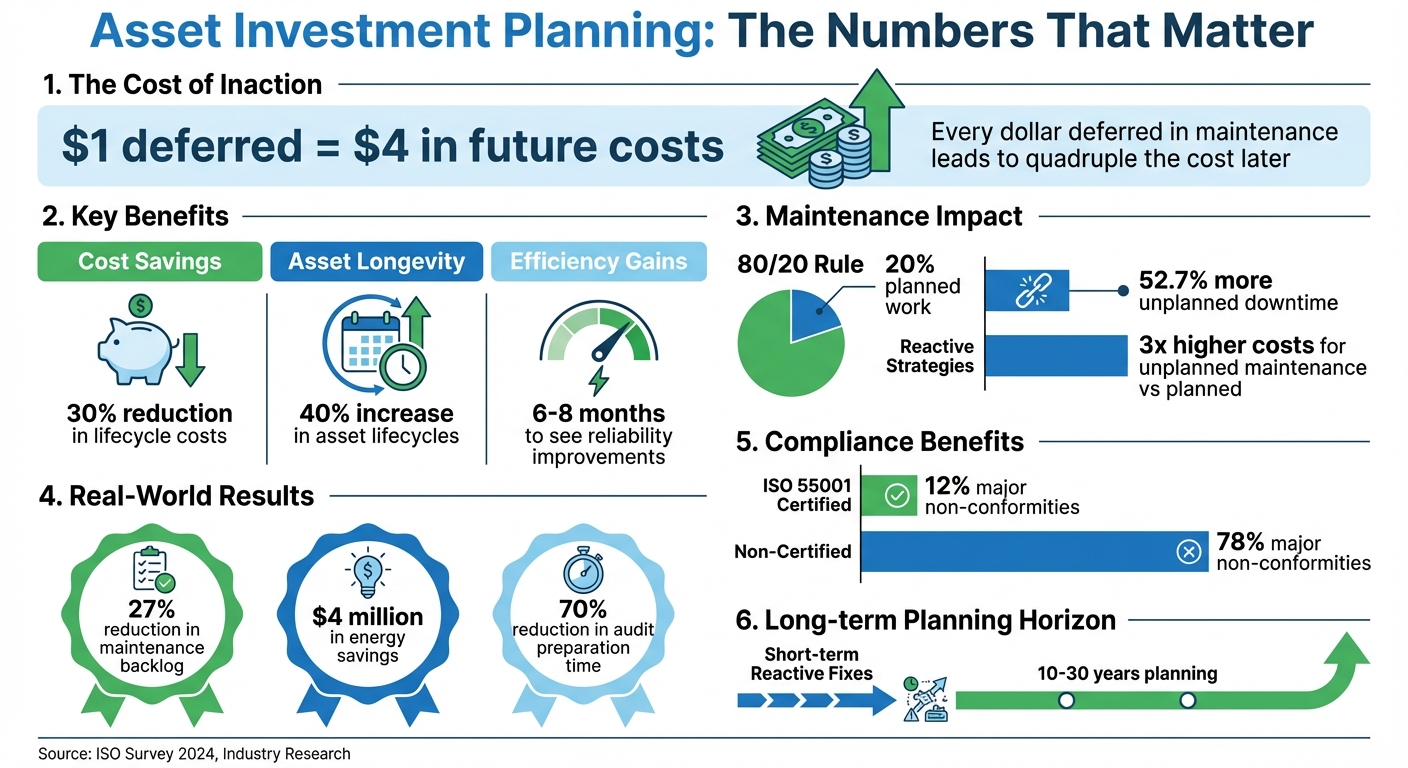
Asset Investment Planning ROI: Key Statistics and Benefits
Step 1: Review Your Team’s Current Skills and Processes
To create an effective daily asset investment plan, you need to start by understanding your team’s current capabilities and workflows. This involves taking stock of their skills, the tools they use, and the processes they follow. By documenting these details, you can establish a baseline that helps identify gaps and allows for better planning. This foundation is critical for making informed, risk-aware decisions that align with long-term goals.
Map Your Current Processes and Tools
Take a close look at the tools and workflows your team relies on every day. Many organizations stick to basic tools like Microsoft Excel for tracking asset information, such as identifiers, purchase dates, costs, and replacement schedules [3]. While spreadsheets can handle simple tasks, they often fall short when it comes to supporting complex, risk-based planning or long-term strategies.
To get a clearer picture, document your workflows and establish a regular review schedule. For example:
- Daily checks: Focus on immediate operational needs.
- Monthly or quarterly reviews: Evaluate your asset portfolio at a broader level.
- Yearly assessments: Conduct a deep dive to refine your overall strategy [5].
This structured approach helps pinpoint where processes are breaking down or becoming inconsistent. Be sure to audit both manual and automated workflows – like maintenance schedules or budget planning – to ensure they align with your investment goals [5][6].
To classify assets effectively, consider using the "Three L’s" framework:
- Label: Classify assets by type and category.
- Liquidity: Assess how easily resources can be reallocated or capital accessed.
- Longevity: Determine the lifecycle and time horizon for each asset [3].
Once you’ve mapped out the processes and tools, the next step is to evaluate your team’s skill set.
Find Skill Gaps in Your Team
With your processes documented, shift your focus to whether your team has the expertise to execute them effectively. The Global Forum on Maintenance & Asset Management (GFMAM) suggests measuring your team’s maturity against ISO 55000 standards [8].
"The Global Forum on Maintenance & Asset Management (GFMAM) has recognised that, with accelerating interest in Asset Management and adoption of the ISO55000 standards, some organisations (and people) would value more guidance on Asset Management Maturity." – GFMAM [8]
Assess the consistency of your workflows. Can they be carried out reliably by anyone on the team, or do they depend on the knowledge of a few key individuals? [8] Also, evaluate whether your team understands critical risk factors, such as asset age, operational impact, and regulatory requirements [7]. Avoid relying too heavily on recent events – use historical data and long-term trends to guide decisions instead [4].
Finally, conduct a maturity audit using frameworks like the GFMAM Guidelines. This will help you identify areas where your team may need additional training, whether it’s in multi-year planning, ISO 55000 compliance, or advanced risk assessment methods [8].
sbb-itb-5be7949
Step 2: Build Training Programs That Work
Once you’ve identified skill gaps, the next step is crafting training programs that align day-to-day tasks with long-term investment objectives. This ensures every team member understands not just how to perform their role, but also why their work impacts the organization’s financial goals and sustainability priorities. By setting clear skill targets, these programs empower each role to drive meaningful progress.
Tailor Training to Different Team Roles
Each role in your team has unique responsibilities, so their training should reflect that. Here’s how to approach it:
- Field Teams: Equip them to use tools like the Simeo Go app for standardized data collection. This app can cut data gathering time by 50% compared to traditional paper methods [9]. Teach them to collect key information – like condition scores, photos, and asset IDs – that feeds directly into long-term planning.
- Facility and Asset Managers: Focus on breaking down data silos and leveraging predictive models to schedule interventions. Training should highlight developing multi-year investment plans to tackle maintenance backlogs. For instance, one public sector portfolio reduced maintenance backlogs by 27% and saved $4 million in energy costs across 66 buildings in just one budget cycle [9].
- Sustainability and ESG Leads: Train them to model CO₂ reduction paths and use energy performance tools to calculate kWh and greenhouse gas savings. This ensures carbon reduction goals are integrated into investment decisions from the outset [9].
- Compliance and Quality Assurance Teams: Teach them to generate automated audit trails and track regulatory KPIs. Using ISO 55000 checklists and automated reporting can slash audit prep time by up to 70%, freeing up resources for strategic tasks [9].
- Executives and Sponsors: Their training should focus on interpreting high-level analytics, comparing investment scenarios, and preparing board-ready reports with clear ROI projections. Tools like the Dynamic Planner allow them to adjust project timelines and budgets easily, instantly showing the impact on overall strategy [9].
| Role | Training Focus | Key Oxand Simeo™ Feature |
|---|---|---|
| Field Teams | Data accuracy, mobile inspections, real-time syncing | Simeo Go Mobile App |
| Asset Managers | Lifecycle planning, maintenance strategy, budget defense | Science-driven forecasts & AI Laws |
| Sustainability Leads | Carbon reduction, energy savings modeling | Energy & Carbon Module |
| Compliance Officers | ISO 55000 alignment, audit trail generation | Analytics Dashboards & Compliance Reports |
| Executives | Capital allocation, ROI scenarios, board reporting | Scenario Simulator & Dynamic Planner |
Use Oxand Simeo™ for Hands-On Practice

Theoretical knowledge is important, but hands-on practice makes training stick. Integrate practical simulations into your sessions using Oxand Simeo™. For example, managers can use the Scenario Simulator to test different investment plans in a risk-free sandbox environment. They can experiment with budget limits and carbon targets without affecting real-world operations [9].
Make the training even more relevant by using your organization’s actual asset data as case studies. This approach not only reinforces learning but also demonstrates immediate ROI [11]. For example, executives can practice defending multi-year investment plans by presenting evidence-based forecasts using Simeo’s analytics dashboards [9][10].
"We needed a tool that would allow us to consolidate the fragmented data we had and project it in a way that could be clearly presented to our elected officials, who are the decision-makers." – Chief Executive Officer (General Director of Services) [10]
Field staff can practice converting physical inspections into standardized digital formats using the Simeo Go app. This bridges the gap between on-the-ground realities and strategic planning [9]. Organizations that adopt predictive maintenance for infrastructure often see noticeable improvements in reliability and cost reductions within 6 to 8 months [10].
To ensure training has a lasting impact, incorporate microlearning – short, focused lessons delivered digitally. This allows team members to reinforce their skills on the job and immediately apply what they’ve learned [11]. The goal is to make Oxand Simeo™ an integral part of daily workflows, simplifying asset planning rather than adding complexity. This hands-on, practical approach accelerates adoption and drives consistent results across the organization.
Step 3: Add Asset Investment Planning to Daily Work
Training only matters if teams actively apply what they’ve learned. The real challenge lies in weaving asset investment planning into daily routines, making it a natural part of the workflow rather than an additional chore. This shift requires moving away from annual planning and adopting a continuous approach, where decisions are guided by real-time data on asset condition, risk, and lifecycle value.
Set Up a Plan-Do-Check-Act Cycle
The Plan-Do-Check-Act (PDCA) cycle offers a practical structure to integrate asset investment planning into everyday operations. Instead of treating planning as a yearly event, implement a rolling 12- to 18-month cycle, updated quarterly based on actual performance data. Here’s how this cycle works:
- Plan: Use tools like Oxand Simeo™ to set 12- to 18-month targets.
- Do: Carry out work orders and interventions according to a prioritized schedule.
- Check: Review failure history, maintenance expenses, and asset performance against benchmarks each quarter.
- Act: Update investment models with real-world data to refine future decisions.
This approach connects capital investment planning with day-to-day maintenance activities. Maintenance teams can measure success by increasing planned work and cutting down on emergency repairs, while operations gain consistency through outage-aware scheduling [1].
To get started, apply the 80/20 rule: focus on the factors that influence 80% of asset performance. If detailed inspection data isn’t available, use simple proxies like installation dates for initial assessments. The idea is to establish a habit of continuous planning, not to achieve perfection immediately.
Once the PDCA cycle is in place, shift attention to prioritizing daily tasks using a multi-criteria evaluation framework.
Prioritize Tasks Using Multiple Criteria
Building on the PDCA cycle, task prioritization should rely on clear, objective metrics. A multidimensional framework helps teams evaluate tasks based on risk, lifecycle costs, compliance needs, and broader impacts.
Start with the Criticality Score to assess risk [12]. This score considers factors like safety, environmental impact, operational disruptions, financial costs, and reputational risks. For example, assets scoring between 16 and 25 on a 1–25 scale are categorized as "Critical" and require continuous monitoring and prioritized capital renewal. Lower-scoring assets may only need basic maintenance.
| Criticality Level | Score Range | Daily Actions |
|---|---|---|
| Critical | 16–25 | Continuous monitoring, predictive maintenance, capital renewal priority |
| High | 10–15 | Regular condition monitoring, prioritized resources, risk treatment |
| Medium | 5–9 | Scheduled preventive maintenance, standard operating procedures |
| Low | 1–4 | Run-to-failure acceptable, reactive maintenance, basic inspection |
Beyond risk, calculate the Benefit-to-Cost Ratio (BCR) to ensure every dollar spent delivers measurable value [13]. For example, when deciding whether to repair an old unit or replace it with a more efficient model, compare the Total Cost of Ownership (TCO) over the asset’s full lifecycle [12].
"The cheapest choice on a three-year budget horizon can be the worst when viewed over a 15-year lifecycle, especially once carbon and regulatory risks are taken into account."
- Nextbitt [2]
For instance, targeted refurbishments of high-risk units can lower TCO by 22% over the long term compared to flat-budget replacement strategies. On the flip side, delaying replacements could add $4.3 million in costs over five years [1]. By quantifying the "cost of deferral", teams can justify resource allocation and align decisions with long-term goals.
Finally, use tools like Oxand Simeo™ to set automatic triggers for asset reviews. For example, flag any asset with a residual risk score above 15 for immediate evaluation. This ensures teams consistently prioritize the most critical work at the right time [12].
Step 4: Turn Asset Investment Planning into a Lasting Habit
Once planning becomes part of daily operations, the next challenge is ensuring it sticks. For asset investment planning to become second nature, it needs to evolve into a routine. Research indicates that about 40% of daily activities are driven by habits [14]. The goal? Build systems that reinforce these behaviors until they become automatic.
Build Positive Feedback Loops
Positive feedback loops are powerful motivators, showing teams the tangible results of their efforts. For example, when technicians consistently log work orders and provide timely updates on asset conditions, it directly improves the accuracy of risk assessments. Similarly, when finance teams see clear connections between operating expenses and capital expenditures, they’re more likely to stay engaged in the process.
Clear, role-specific outcomes are essential to keeping everyone on board:
- C-Suite: Needs a defensible, logical framework for prioritizing capital investments.
- Finance Teams: Require clear links between operating expenses and capital investments.
- Maintenance Teams: Benefit from transitioning to more planned work.
- Operations Teams: Gain from predictable service levels and outage-aware schedules.
When every team member understands how their efforts contribute to long-term asset strategies, their commitment strengthens. To drive this point home, consider launching a small-scale pilot – say, within the HVAC department – to showcase immediate, measurable results. By quantifying these outcomes, you make the benefits clear and reinforce the new habits.
Keep the planning process dynamic by updating portfolios quarterly with real-world data, like failures, work history, costs, and resource availability [1]. This rolling 12-to-18-month planning window gives teams visibility into how their input shapes future models. For example, when technicians log detailed work orders and performance feedback, they directly influence upcoming decisions [1].
Promote Collaboration Through Shared Objectives
Once daily practices are refined, the next step is fostering cross-department collaboration. Asset investment planning loses its effectiveness when engineering, finance, and operations work in silos, using separate tools and chasing conflicting priorities. A shared decision-making framework can bridge these gaps, ensuring everyone relies on the same data-driven logic [1].
Centralizing asset data is key. By establishing quarterly cross-department reviews, you can eliminate silos and align goals around service reliability, safety, and financial performance [1]. For instance, when maintenance logs a repair, finance can immediately track the cost against the asset’s lifecycle budget, while operations adjusts schedules based on updated availability.
Tools like Oxand Simeo™ can help by running "what-if" scenarios, such as comparing an unconstrained budget to one with a 10% cut. These visualizations make tradeoffs clearer and support collaborative decision-making.
Finally, tailor technical data to resonate with each stakeholder. Engineers focus on failure risks, finance prioritizes cash flow and exposure, and operations zeroes in on service levels. Translating engineering insights into financial terms – like "cost of deferral" or "risk exposure" – helps financial leaders better understand capital needs [1]. This shared understanding keeps everyone aligned and ensures the planning process remains a long-term priority.
Step 5: Maintain Compliance and Audit Readiness
Once daily practices for asset investment planning are in place, the next step is ensuring compliance and maintaining audit readiness. This involves creating a robust system for documentation that not only meets regulatory requirements but also ties asset decisions to broader strategic goals. ISO 55001, for instance, mandates an Asset Management System that reflects leadership commitment, risk-based planning, and processes that can be audited. To meet these standards, every decision, risk evaluation, and performance review must have a clear and verifiable record. By aligning daily operations with meticulous documentation, organizations can meet compliance requirements while strengthening their investment strategies.
Organizations that implement ISO 55001-compliant practices report impressive results: a 20–25% reduction in asset lifecycle costs and a 15% improvement in regulatory compliance. On the flip side, 78% of audited firms without ISO 55001 documentation faced major non-conformities, compared to just 12% for certified organizations (ISO Survey 2024).
Create Clear Documentation Trails
Every decision, risk analysis, and budget adjustment should be documented in real time. Include timestamps, the reasoning behind decisions, and the team members involved. This level of detail not only satisfies ISO 55001 clause 7.5 on documented information but also ensures a reliable audit trail.
To make this process seamless, integrate documentation into daily workflows. For example, when maintenance logs a repair, that information should automatically update the asset’s lifecycle budget. Similarly, any capital plan adjustments by the finance team should include a record of the business rationale. Scheduling weekly Plan-Do-Check-Act reviews can help keep documentation up to date and aligned with ISO 55001 performance evaluation requirements.
Organizations that use specialized asset investment planning software can cut audit preparation time by as much as 70% by automating evidence collection. This proactive approach not only simplifies compliance checks but also supports automated reporting, saving significant time and effort.
Generate Compliance Reports with Oxand Simeo™
Oxand Simeo™ streamlines compliance reporting by integrating ISO 55000 checklists directly into your workflows. With this platform, you can generate ISO 55001-aligned reports with just one click, eliminating the need to scramble for spreadsheets or missing records.
The system tracks every update – whether it’s a field inspection or a board-level report – using timestamped, standardized data that meets audit requirements. Additionally, all information is stored securely on ISO 27001-certified infrastructure with AES-256 encryption, ensuring the integrity of your audit trails.
Real-time dashboards provide constant monitoring of key regulatory indicators, ensuring you’re always prepared for compliance checks. The platform also updates investment plans automatically to reflect current conditions, keeping your documentation accurate and aligned with ISO 55001 standards. This ongoing approach ensures you’re not just audit-ready but also well-positioned to maintain certification over time.
Track Progress: Measure Habit Adoption and Results
Once your teams begin incorporating asset investment planning into their daily routines, it’s crucial to measure whether these habits are driving results. By tracking outcome metrics, leading indicators, and financial performance, you can gain actionable insights into your current progress and make adjustments as needed.
Key Metrics to Monitor
To confirm that asset investment planning has become a regular practice, focus on measurable progress through specific metrics.
Start with reliability metrics like Mean Time Between Failures (MTBF) and Mean Time to Repair (MTTR). An increase in MTBF means assets are breaking down less often, while a decrease in MTTR shows faster response times. Together, these metrics reveal if your daily planning habits are improving both equipment reliability and operational efficiency.
Next, examine the ratio of planned versus unplanned maintenance. A well-established program typically aims for 80% planned work and 20% unplanned work. If your numbers are closer to a 50-50 split, it’s a sign that proactive habits haven’t fully taken hold yet. Additionally, track preventive maintenance (PM) completion rates and schedule compliance to ensure tasks are being executed as planned.
Financial indicators are just as critical. Look for trends in Total Cost of Ownership (TCO), which should decrease as proactive maintenance takes root. Another key metric is the cost of deferral, which quantifies the financial impact of delaying necessary investments. Research shows that organizations relying on reactive strategies experience 52.7% more unplanned downtime, and unplanned maintenance typically costs three times more than planned work.
Don’t ignore risk and condition metrics like the Facility Condition Index (FCI), remaining useful life trends, and risk profiles (likelihood of failure multiplied by the consequence of failure). These metrics help prioritize spending based on urgency. For instance, addressing issues during the "rehabilitation" stage (Condition 3) is far less expensive than waiting for a critical failure (Condition 1), which can cost 3 to 5 times more.
Finally, assess workflow efficiency through metrics like maintenance backlog (measured in weeks of work), work order completion rates, and craft utilization. A growing backlog may suggest that planning isn’t keeping up with demand, while high completion rates indicate that effective daily habits are becoming ingrained.
"A metric that answers ‘how does this affect production?’ or ‘what does this cost us?’ earns consideration. A metric that answers ‘how many tasks did we complete?’ often doesn’t." – Alex Vedan, Director, Tractian [15]
By keeping an eye on these metrics, your team can quickly adapt and refine their strategies.
Refine Processes Using Feedback
Metrics are only useful if they drive action. Set up a quarterly review cycle to compare actual performance, such as failures and work history, against your original plans. A rolling 12- to 18-month planning horizon helps ensure your investment strategies stay aligned with current conditions instead of outdated assumptions.
Encourage technicians to log their work and provide real-time feedback using mobile tools. If repairs take longer than expected, document the reasons – whether it’s delayed parts or unclear instructions. This kind of feedback can reveal bottlenecks that raw data might miss. Periodic studies of work samples can also help identify delays and improve workflows or training programs.
Follow the 70/30 rule: dedicate 70% of resources to established maintenance practices (like inspections and calibrations) and 30% to testing new approaches, such as adjusting PM intervals based on condition data or experimenting with predictive tools. This balance supports ongoing improvement while maintaining operational stability.
When reporting to executive leadership, translate technical metrics into business terms. For example, instead of saying "MTBF increased by 15%", explain, "We recovered 120 production hours this quarter" or "We protected $340,000 in revenue." Business-focused results are more likely to secure leadership support for continued investments in tools like Oxand Simeo™, which simplifies audit preparation by automating evidence collection and performance tracking.
Conclusion: Build a Culture of Daily Asset Investment Planning
Daily asset investment planning takes dedication, teamwork, and a forward-thinking mindset. Shifting from reactive, age-based fixes to predictive, risk-focused strategies delivers real results. In fact, proactive planning can cut lifecycle costs by up to 30% and improve asset reliability in as little as 6 to 8 months [9][10]. These outcomes highlight why weaving asset investment planning (AIP) into daily routines is so important for long-term success.
To break down silos, teams need a shared source of truth. Tools like Oxand Simeo™ help by centralizing scattered data, automating audit trails, and enabling scenario simulations that tie together financial, risk, and sustainability goals.
"Simeo reduced our maintenance backlog by 27% and enabled us to achieve €4 million in energy savings across 66 buildings during the first budget cycle." – Asset Director, Public Sector Portfolio [9]
Strong data integration lays the foundation, but practical tools make daily operations even smoother. Equip field teams with mobile tools that capture real-time information, ensuring investment plans stay up-to-date. Compliance shouldn’t feel like an extra task – it should naturally flow from daily processes. Automated compliance reporting not only keeps audits stress-free but also allows teams to focus on smart, sustainable investment decisions every day [9].
FAQs
What’s the fastest way to get started with AIP using limited data?
To jump into Asset Investment Planning (AIP) with limited data, leverage the asset and facilities information already available in systems like your CMMS. Begin with smaller, high-impact projects – think predictive maintenance pilots or basic investment scenarios. These "quick wins" not only help transition teams from reactive to proactive management but also showcase tangible results, building momentum for larger initiatives down the line.
How do we choose the right AIP metrics for our teams?
To choose the best Asset Investment Planning (AIP) metrics, focus on ones that directly reflect your organization’s strategic goals and encourage informed decision-making. Look for KPIs that provide actionable insights, track asset performance effectively, and help manage both CAPEX and OPEX efficiently. Having a solid data foundation and using risk-based methods ensures these metrics remain meaningful. This approach allows teams to assess performance, understand financial impacts, and evaluate risks, all while driving ongoing improvement and supporting long-term success.
How can we prove AIP ROI to leadership quickly?
To show leadership the ROI of Asset Investment Planning (AIP) effectively, focus on tangible financial and operational benefits. Emphasize areas like cost savings, reduced risks, and enhanced long-term asset performance, backing up your points with clear, measurable data. Use scenario analyses to compare different investment levels, demonstrating potential savings and risk mitigation. Pair these insights with real-life examples to give leadership a straightforward, data-backed view of AIP’s immediate impact.
Related Blog Posts
- Infrastructure Asset Management: A Risk-Based Approach for Multi-Year CAPEX Planning
- Asset Investment Planning 101: How to Decide What to Invest in, When and How Much
- 90 Days to Your First Asset Investment Plan: A Step-by-Step Implementation Guide
- Scaling Asset Investment Planning Across Multiple Sites and Regions