








AI is transforming asset management by replacing outdated schedules with smarter, data-driven decisions. Here’s how it delivers results:
- Ahorro de costes: Reduces maintenance costs by 25–40%, unplanned downtime by up to 50%, and extends asset life by 18–30%.
- Early Warnings: Predicts failures 6–12 weeks in advance, avoiding costly emergencies.
- Inversiones basadas en el riesgo: Uses risk scores to prioritize spending, cutting unplanned capital costs by 15–22%.
- Sostenibilidad: Identifies energy-intensive assets, integrates carbon reduction into financial planning, and improves regulatory compliance.
For example, AI can pinpoint minor issues before they escalate, saving millions in repair and replacement costs. Tools like Oxand Simeo™ combine predictive models, risk scoring, and lifecycle cost analysis to optimize investments and align with ESG goals. The key? Clean, centralized data that powers accurate AI insights.
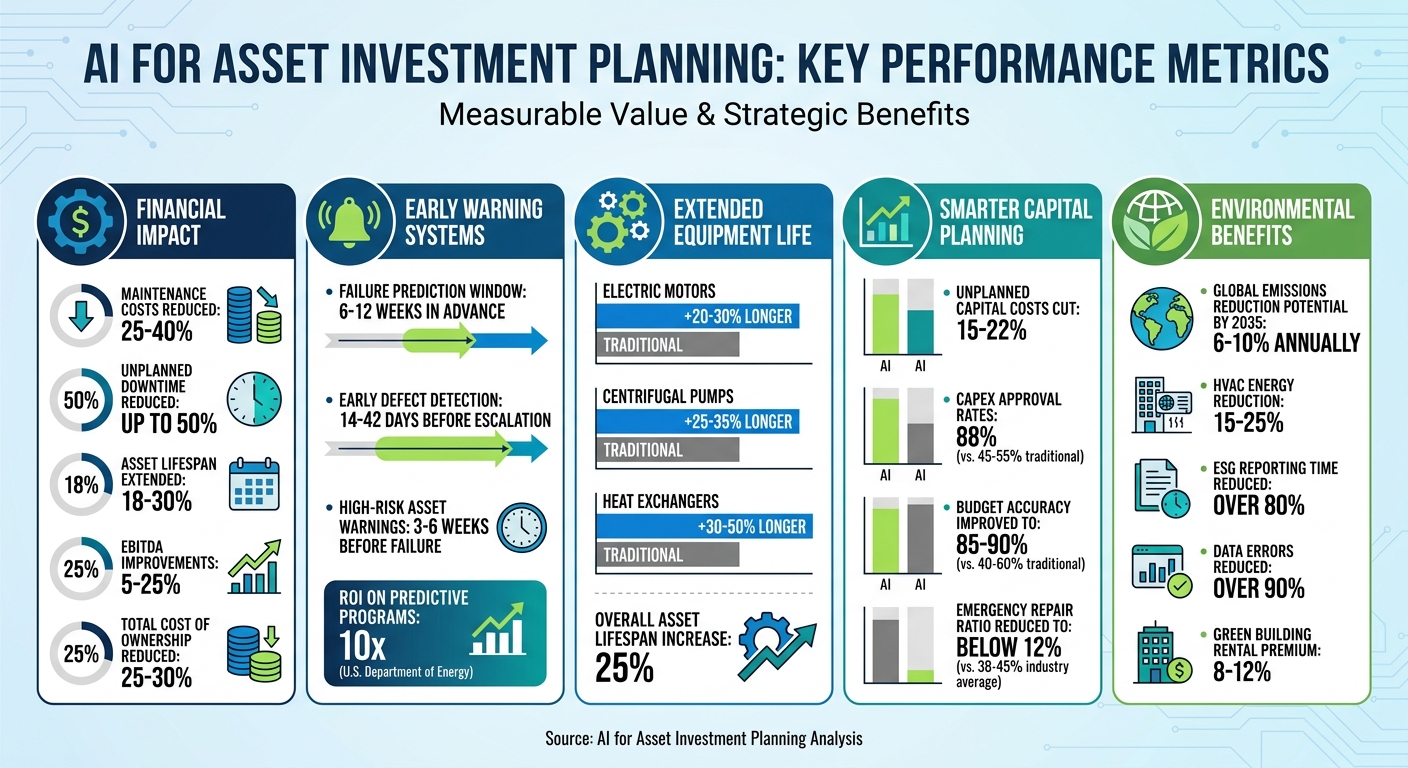
AI Asset Investment Planning: Key Performance Metrics and Cost Savings
The Evolving Role of AI in Asset Management
sbb-itb-5be7949
AI-Powered Predictive Maintenance: Reducing Costs and Risks
Instead of waiting for equipment failures or sticking to rigid maintenance schedules, AI uses asset condition analysis to schedule targeted maintenance. This shift to condition-based maintenance has led to impressive financial results – companies using AI for predictive maintenance report EBITDA improvements between 5% and 25% [3].
The financial benefits become especially clear when considering how small issues can snowball. For instance, ignoring a $400 bearing fix can turn into a $6,000 emergency repair, with additional costs of $4,200 for the shaft and $1,800 for the seal [4]. AI can identify these problems 14–42 days before they escalate, transforming costly emergencies into manageable, scheduled repairs [4]. The sections below illustrate how this proactive approach saves money and extends the life of assets.
How Aging Models Predict Asset Deterioration
Oxand Simeo™ uses more than 10,000 proprietary aging models, built from over two decades of data on infrastructure and buildings, to simulate asset deterioration under various conditions. These models take into account operating environments, maintenance histories, and other factors, using predictive maintenance without IoT by leveraging existing inspection data and selective monitoring inputs.
The platform integrates multiple data streams to create a comprehensive view of asset health. For example, it uses vibration and thermal data for rotating equipment, efficiency and flow rates for process parameters, oil analysis for gearboxes, and acoustic emissions for compressors [4]. Each asset is assigned a dynamic health score that updates with new data, enabling managers to spot early-stage defects long before they become critical. For instance, a cooling water pump marked for replacement due to age might receive a health score of 74/100, revealing that only a specific bearing needs attention rather than the entire unit [4].
This approach avoids two costly maintenance errors: servicing assets prematurely, which can cause unnecessary wear, and delaying maintenance, which can lead to catastrophic failures affecting multiple components. By monitoring performance metrics, AI can detect subtle signs of wear – such as efficiency drops – before traditional methods like vibration or thermal analysis would catch them [4]. These health scores pave the way for measurable cost savings and smarter maintenance decisions.
Quantifying Cost Savings and Longer Asset Lifespans
Organizations report 10–25% reductions in maintenance costs for targeted components [4], while the Departamento de Energía de EE.UU. has documented a 10x return on investment for such programs [4]. By switching from reactive or fixed-interval maintenance to condition-based programs, assets typically see a 25% increase in lifespan [4].
The savings come from several sources. Cutting unnecessary maintenance reduces service waste by 20–40% [4]. Early issue detection helps avoid costly chain-reaction failures. For example, electric motors can last 20–30% longer, centrifugal pumps 25–35% longer, and heat exchangers 30–50% longer [4]. Deferring capital replacements also creates significant value. Extending the life of a portfolio of 20 critical assets by just a few years can delay replacement costs ranging from $50,000 to $2,000,000 per asset [4]. These savings allow for better allocation of resources and more strategic asset investments.
In 2025, a Reliability Engineering Manager at a chemical processing plant used condition-based analysis to assess a 14-year-old cooling water pump slated for replacement. Although the capital plan identified it as end-of-life, AI health scoring assigned it a 74/100, pinpointing a single bearing defect. Instead of replacing the pump, the plant opted for a $380 bearing repair. Six months later, the pump’s health score improved to 82, and it continued operating into its 17th year, freeing up the capital budget for other priorities [4].
Failure Modeling and Risk-Based Investment Prioritization
Predictive maintenance is great for spotting early warning signs, but failure modeling takes it a step further by quantifying asset risk. This helps businesses allocate investments where they’ll make the most impact. Instead of relying on subjective judgment, AI assigns a multi-dimensional risk score (on a scale of 0–100) based on factors like asset age, repair history, sensor data, and operational context [5][6]. The result? planificación de CAPEX y OPEX basada en el riesgo that are grounded in data and align with ISO 55001 standards. Vague budget requests are replaced by well-supported investment proposals.
The financial benefits of this approach are undeniable. Take the example of a 28-property commercial portfolio in Chicago. During a single winter season in February 2026, they faced 23 emergency HVAC failures, racking up $1.42 million in costs. A post-event analysis showed that 19 of these failures displayed warning signs 4–14 weeks before they occurred. If AI-based risk scoring had been in place, planned repairs could have addressed these issues for just $310,000 – saving roughly $1.1 million [5]. Reactive repairs are significantly more expensive, costing 4.8 to 10 times more than planned interventions [5][7].
Prioritizing Investments Using Multiple Criteria
AI doesn’t just detect problems; it prioritizes them. Tools like Oxand Simeo™ evaluate assets based on six key factors: age, repair history, tenant impact, failure costs, cascade risks, and compliance challenges [5][6]. By applying impact multipliers, the platform assigns higher priority to assets that affect revenue, safety, or critical operations – think research labs or high-value tenant spaces [6]. This ensures that maintenance budgets focus on the 8–12% of assets responsible for over 80% of potential failures [6].
Armed with knowledge of over 30,000 maintenance laws and compliance rules, the platform assigns risk scores and suggests actions tailored to the organization’s priorities. For instance, assets tied to high-revenue tenants or safety-critical areas receive higher scores, ensuring resources are allocated wisely [5][6]. One notable example involves a 34-building Class A office portfolio that reduced its annual maintenance costs from $6.2 million to $4.1 million. Within a year of implementing AI risk scoring, the portfolio also increased planned maintenance work to 81% [5]. Facilities using AI-driven reliability analytics have also seen CAPEX approval rates soar to 88%, compared to just 45–55% with traditional budget submissions [7][8].
"Risk scoring transforms capital requests from ‘we need $2M for chillers because they are old’ into ‘these 5 specific chillers have risk scores above 78 with 72–85% failure probability within 24 months.’"
– Oxmaint University Facilities Guide [6]
These risk scores are the foundation for creating strong, data-supported investment plans.
Creating Resilient Asset Investment Plans
Risk-based prioritization zeroes in on high-risk, high-impact assets, helping reduce surprise breakdowns. AI models can warn maintenance teams 3–6 weeks before a high-risk asset is likely to fail [6]. This early warning system allows repairs to be scheduled during regular maintenance windows instead of during emergencies. For example, a residential portfolio with 45 properties and 3,200 units cut its annual CAPEX from $4.1 million to $2.8 million – a $1.3 million savings – by shifting from 58% reactive replacements to 82% planned replacements [8].
The platform also includes Replace-vs-Repair simulations, which compare ongoing maintenance costs with the potential benefits of replacing an asset. These simulations factor in energy savings and reduced failure risks [6]. This kind of analysis provides the data required for ISO 55001-compliant capital planning [6][7]. With AI-driven condition scoring, budget accuracy for capital forecasting improves to 85–90%, compared to a 40–60% variance with older methods [8]. High-reliability facilities have reduced emergency repair ratios to below 12%, a stark contrast to the industry average of 38–45% [7]. This frees up funds for strategic investments instead of constant crisis management.
Lifecycle Cost Optimization Through Scenario Planning
Building on risk-based investment prioritization, scenario planning takes decision-making to the next level by focusing on lifecycle cost optimization. While risk scoring pinpoints what’s broken or at risk, scenario planning forecasts the outcomes of different investment strategies. Using AI-powered simulators, asset owners can evaluate multiple strategies side by side – assessing how budget cuts, service level adjustments, or carbon reduction goals might impact their portfolio over 5, 10, or even 30 years. This method allows decision-makers to weigh trade-offs before committing any funds [9].
What used to take months with spreadsheets can now be achieved in hours. Organizations can develop data-backed plans within 6 to 12 weeks. By replacing disconnected Excel models with a unified simulation platform, budget proposals are now presented with board-ready evidence, not rough estimates [9].
Testing Investment Scenarios for Better Decisions
AI tools like Oxand Simeo™ bring together asset inventory, condition data, predictive modeling, and financial constraints into a single, cohesive view. The platform’s extensive library – featuring over 10,000 predictive models and 30,000 recommended actions – standardizes decision-making across entire asset portfolios [9].
The financial benefits are undeniable. By optimizing intervention timing and prioritization through AI-powered scenario planning, organizations can reduce Total Cost of Ownership (TCO) by 25% to 30%. For instance, the Departamento del Mosa in France sought a solution to consolidate fragmented asset data and make it accessible for decision-makers. Their Chief Executive Officer explained:
"Necesitábamos una herramienta que nos permitiera consolidar los datos fragmentados que teníamos y proyectarlos de forma que pudieran presentarse claramente a nuestros cargos electos, que son los que toman las decisiones"." [9].
This approach ensures that trade-offs – like the effect of budget cuts on risk levels and service quality – are fully understood before finalizing funding decisions. It also enables organizations to balance financial considerations with environmental goals in a single, comprehensive analysis [9].
Aligning Financial and Environmental Priorities
Traditional capital planning primarily focuses on CAPEX and OPEX. AI-driven scenario planning, however, integrates a third critical factor: carbon impact. Every investment decision can now be linked to measurable outcomes in energy efficiency and emissions reduction. This is particularly crucial for organizations aiming to meet ESG reporting standards and decarbonization targets without exceeding their budgets.
A great example comes from In'li, a French social housing provider. They turned to Oxand for a solution that could offer a predictive, rather than merely reactive, approach. Their Head of Budget and Asset Valuation Department shared:
"Recurrimos a Oxand porque necesitábamos una herramienta que nos proporcionara una visión predictiva -no sólo correctiva- y nos ayudara a gestionar nuestras inversiones con mayor eficacia. Oxand destacó por sus capacidades de gestión de riesgos" [9].
The platform empowered them to evaluate scenarios that balanced financial performance, asset resilience, and sustainability within a single analysis. This made carbon reduction a central part of their investment strategy, aligning environmental and financial priorities seamlessly [9].
Carbon-Aligned Investment Planning and Decarbonization
Aligning investments with decarbonization goals is the next big step in integrated scenario planning.
The commercial real estate and infrastructure sectors are responsible for about 40% del consumo mundial de energía and nearly 30% of greenhouse gas emissions [14][15]. AI is reshaping how decarbonization is approached by embedding carbon impact as a key factor in investment decisions, alongside financial performance and risk.
Traditional capital planning focuses on CAPEX and OPEX, but AI introduces carbon outcomes as a vital third dimension. With this approach, investment scenarios can be evaluated for their effects on energy efficiency, emissions reductions, and compliance with regulations. This is increasingly critical as municipalities enforce building performance standards like Ley local 97 de Nueva York y DC BEPS, which impose financial penalties on properties that fail to meet energy targets [13].
Modeling Energy Performance and CO₂ Reduction
AI enables a more dynamic evaluation of energy performance by analyzing high-frequency IoT sensor data, local weather forecasts, and occupancy patterns to generate real-time energy benchmarks, moving beyond static historical averages [11]. Advanced hybrid models, such as LSTM, XGBoost, and Random Forest, capture the complex relationships between climate variables and building features. These models have achieved predictive accuracy with a Root Mean Square Error (RMSE) as low as 4.7% under operational conditions [11].
By running "what-if" simulations, AI can identify effective decarbonization strategies. For instance, predictive HVAC optimization can eliminate simultaneous heating and cooling, cutting HVAC energy use by 15-25% [13]. Additionally, tools like intelligent equipment staging and grid-interactive demand response shift energy loads to times when renewable energy availability is higher. Real-time carbon tracking systems also calculate Scope 1 and Scope 2 emissions, ensuring alignment with ESG frameworks such as GRESB, CDP, en TCFD [13].
One standout example is a retrofitted commercial hotel in Singapore that adopted an AI-powered Energy Conservation Calculation (ECC) framework using a hybrid LSTM–XGBoost model. Between 2022 and 2024, the project reduced emissions by 3,221 metric tons of CO₂ and improved energy use intensity (EUI) by over 60%. The AI model maintained an RMSE of 4.7%, providing reliable data for the Singapore Green Mark certification system [11].
These AI-driven tools not only enhance energy performance but also help organizations hit ambitious ESG and decarbonization goals.
Meeting Decarbonization and ESG Reporting Requirements
AI platforms help track building performance against regulatory standards, flagging properties at risk of non-compliance and suggesting operational adjustments to avoid penalties [13]. Automated ESG reporting significantly reduces compliance preparation time – from weeks to just hours – while cutting data errors by over 90% [14]. Machine learning models can also detect data anomalies that might otherwise result in inaccurate filings or fines.
Por ejemplo, Walmart implemented AI-driven HVAC optimization across 4,700 U.S. stores, reducing energy consumption by 12–15% and saving over $100 million annually. The system uses weather forecasts and occupancy data to fine-tune rooftop unit operations while ensuring food safety [12][13]. Similarly, Google’s DeepMind AI reduced cooling energy use by 40% in its global data centers by analyzing thousands of sensor readings every five minutes to optimize cooling [12].
"AI platforms track building performance against these regulatory targets, identifying properties at risk of non-compliance and recommending specific operational changes to achieve compliance before penalty thresholds are reached." – The AI Consulting Network [13]
AI-driven sustainability programs also enhance property value. Properties with verified green initiatives often see rental premiums of 8% to 12% over non-green buildings [14]. By combining energy savings with improved ESG compliance, AI energy management becomes a strategy that boosts both Net Operating Income (NOI) and property appeal [13].
Adopting these AI-powered decarbonization strategies strengthens sustainable investments by delivering measurable energy savings and ensuring regulatory compliance.
Measured Results: What Oxand Simeo™ Delivers

Oxand Simeo™ takes AI-driven strategies to the next level, delivering measurable improvements in cost management, energy efficiency, and operational performance.
By shifting from reactive maintenance to risk-based, multi-year investment planning, the platform consistently achieves a 10–25% cost reduction on targeted maintenance components. This approach extends the lifespan of assets and showcases the power of AI in asset investment planning.
Cost savings are just the beginning. Clients also see notable reductions in CO₂ emissions and energy use across their portfolios. With its carbon-aligned investment planning tools, Oxand Simeo™ enables organizations to model energy performance and decarbonization strategies alongside financial outcomes. Importantly, it achieves this without relying on dense IoT networks, instead leveraging decades of data to simulate asset deterioration and energy consumption.
For infrastructure concession holders, the platform helps optimize tender offers and cut maintenance-related expenses by 10–15% during operational phases. Fully implemented investment plans can lead to a 30% reduction in total cost of ownership, thanks to better prioritization, improved asset availability, and reduced risks.
Oxand Simeo™ also ensures compliance with ISO 55001 and European energy regulations. It generates audit-ready documentation directly from the scenarios used in decision-making, making it easier for organizations to present clear, data-backed investment decisions to boards, investors, regulators, and even the public.
What sets Oxand apart is its combination of software and consulting services. Oxand’s consultants help establish data models, governance frameworks, and decision rules, while the platform itself runs simulations that transform asset, condition, and energy data into actionable multi-year CAPEX and OPEX plans. This integrated approach ensures that investment plans are not only technically and financially sound but also embraced by stakeholders.
Building the Data Foundation for AI-Driven Planning
AI models rely heavily on the quality of the data they process. Without clean, well-structured information, even the most advanced algorithms can generate unreliable results. For organizations aiming to implement AI responsibly, investing in datos precisos y fiables is critical to achieving trustworthy outcomes [2].
The struggle is clear: gestores de activos often dedicate 60% to 80% of their technology budgets to maintaining outdated systems and fragmented data, leaving just 20% a 40% for AI-driven innovations [1]. This imbalance highlights why establishing a strong data foundation is not just helpful – it’s essential for meaningful AI-powered asset investment planning. A key part of this foundation is creating a centralized asset register, which we’ll explore next.
Creación de un registro centralizado de activos
A centralized asset register serves as a fuente única de la verdad, consolidating data that is often scattered across inventory, inspection, finance, and energy systems [9]. Without this integration, AI models lack the consistency needed to provide accurate risk analyses and investment advice for complex portfolios involving thousands of buildings or infrastructure assets.
Inventario Simeo offers a streamlined solution by standardizing asset structures and attributes across entire portfolios. This ensures that AI models can make consistent, "apples-to-apples" comparisons when prioritizing investments. The platform also includes governance features like ownership checks, completeness validation, and audit trails to maintain data integrity and eliminate duplicate entries [9].
"Necesitábamos una herramienta que nos permitiera consolidar los datos fragmentados que teníamos y proyectarlos de forma que pudieran presentarse claramente a nuestros cargos electos, que son los que toman las decisiones." - Director General del Departamento de Mosa [9]
Switching from manual spreadsheets to a centralized platform reduces errors and enables AI to identify patterns more effectively over time. With a library of over 10,000 predictive models, the platform helps standardize decisions across portfolios. Organizations adopting this approach have reported a Reducción del coste total de propiedad de 25% a 30% by optimizing intervention timing [9].
Once this foundation is established, digital inspections play a crucial role in keeping the asset register up-to-date.
Using Digital Inspections to Improve Data Quality
Consistently updated data is vital for accurate risk assessments and informed investment decisions. Even the best centralized register can become outdated without regular updates from the field. Digital inspections bridge this gap by feeding real-time, on-the-ground data into the asset register, ensuring that AI models are based on current asset conditions rather than outdated assumptions [9].
Simeo GO empowers field teams to collect precise data on-site, replacing static PDF reports with structured, real-time inputs. Inspectors can record condition ratings, installation dates, and service histories, all geo-tagged to specific assets. This process eliminates the manual transcription phase, which is prone to errors and data loss [16].
The benefits are striking. Digital tools can cut the time needed to create a complete property condition report from 2–3 days down to just 18 minutes [16]. This structured data seamlessly updates the centralized register, ensuring that investment plans reflect the latest asset conditions and improving the accuracy of AI models [9].
"Recurrimos a Oxand porque necesitábamos una herramienta que nos proporcionara una visión predictiva -no sólo correctiva- y nos ayudara a gestionar nuestras inversiones con mayor eficacia." - Jefe del Departamento de Presupuestos y Valoración de Activos, In'li [9]
This integration of field data into planning processes represents a major shift in asset management. Digital inspections are no longer just compliance tasks – they are now a continuous source of valuable data that enhances AI model performance and improves decision-making quality.
Conclusion: Where AI Creates Measurable Value in Asset Investment Planning
AI is reshaping asset investment planning, delivering EBITDA improvements of 5–25% and cutting total cost bases by 25–40% [3][1]. By shifting from reactive maintenance to proactive, risk-based, multi-year planning, organizations managing extensive asset portfolios are seeing tangible, measurable results.
The benefits are clear: AI provides real-time insights, identifies inefficiencies that might otherwise go unnoticed, and enables scenario modeling for variables like interest rates and demand changes. For example, companies that use centralized asset registers and digital inspection workflows have reported up to 30% savings in total cost of ownership by optimizing maintenance schedules. These operational gains also create opportunities to achieve broader sustainability goals.
Sustainability is a key factor in AI’s growing importance. Across infrastructure sectors, AI applications are expected to cut global emissions by 6% to 10% annually by 2035 [18]. Automated reporting tools further enhance efficiency, slashing the time required for regulatory disclosures by over 80% [17]. This combination of cost-effectiveness and environmental responsibility makes AI especially appealing for infrastructure and building asset owners who must balance tight budgets with decarbonization targets.
Industry feedback underscores AI’s value:
"92% of PE professionals recognize the positive impact of AI on portfolio valuation, with predictive analytics being the top driver." – Lumenalta [10]
At the heart of these advancements lies clean, structured data. Reliable predictive models depend on this foundation, enabling precise investment decisions that align with financial constraints, energy efficiency goals, and carbon reduction commitments. Without high-quality data, the transformative potential of AI cannot be fully realized.
Preguntas frecuentes
What data do I need to start using AI for asset investment planning?
To start incorporating AI into asset investment planning, the first step is gathering relevant data. This includes information like asset condition scores, historial de mantenimiento, failure records, en operational performance metrics. Real-time sensor data is also crucial for a more dynamic understanding of asset performance.
By integrating tools such as accounting software y registros de mantenimiento, you can enable predictive models that forecast potential failures. This approach not only helps minimize unexpected breakdowns but also allows for smarter decisions about lifecycle costs and risk management. With a well-rounded dataset, you can make more informed, efficient, and forward-thinking investment choices.
How does AI decide whether to repair or replace an asset?
AI leverages análisis predictivo y failure forecasting to determine whether it’s better to repair or replace an asset. By examining data points like equipment health scores y mean time between failures (MTBF), it can estimate how much useful life an asset has left. If it spots major signs of wear – like unusual vibrations or a drop in efficiency – AI steps in with recommendations for proactive repairs or replacements. This approach helps keep assets running longer, minimizes downtime, and keeps maintenance costs in check.
How can AI tie CAPEX plans to carbon and ESG targets?
AI brings a new level of precision to CAPEX planning by enabling decisions based on data, while also aligning with carbon reduction and ESG (Environmental, Social, and Governance) goals. It helps optimize lifecycle costs, predict failures, and schedule maintenance more effectively, which not only reduces expenses but also extends the lifespan of assets.
Additionally, AI makes scenario analysis easier, allowing businesses to prioritize projects that boost energy efficiency and cut emissions. This ensures that investments are not only financially viable but also support sustainability and ESG commitments.
Entradas de blog relacionadas
- Gestión de activos de infraestructura: Un enfoque basado en el riesgo para la planificación plurianual de CAPEX
- Planificación de la inversión de activos 101: Cómo decidir en qué invertir, cuándo y cuánto
- De los datos a las decisiones: Convertir el análisis de activos en ahorro de CAPEX
- Ampliación de la planificación de inversiones en activos a múltiples centros y regiones