







Building owners face tough choices balancing lower emissions, cost control, and tenant comfort. Here’s the challenge: cutting carbon often raises costs, while cheaper solutions might compromise comfort. And delaying action risks fines or missed "green premiums."
The solution? Use risk-based tools like Oxand Simeo™ to evaluate long-term investments. This platform models carbon reduction, predicts costs, and measures tenant satisfaction, ensuring smarter decisions. Traditional methods, focused on short-term payback, miss these key factors.
Principales conclusiones:
- Carbon Reduction: Plan upgrades aligning with emissions goals and regulations.
- Cost Management: Compare scenarios to balance upfront costs with long-term savings.
- Tenant Comfort: Prioritize systems that maintain indoor quality and reliability.
Advanced tools provide clarity in uncertain markets, helping you make decisions that cut emissions, save money, and keep tenants happy.
The Business Case for Decarbonization – Why It Matters Now
sbb-itb-5be7949
1. Oxand Simeo™
Oxand Simeo™ is an asset investment planning platform designed to predict building performance over a span of 5 to 30 years. It leverages over 10,000 proprietary aging and performance models alongside 30,000 maintenance laws, all developed over two decades. With this tool, you can anticipate component wear and tear, energy usage, and maintenance needs before committing to an investment. Essentially, it turns complex risk-based decisions into clear, actionable strategies for long-term investments.
Carbon Reduction Alignment
The platform includes specialized modules for sustainability and energy transition, enabling you to model carbon reduction strategies across your portfolio. It allows you to test various retrofit options, like upgrading HVAC systems or switching to heat pumps, to identify the most cost-effective way to cut emissions. This ensures your investment plans align with regulatory carbon goals while maintaining financial viability. Beyond emissions tracking, the platform also delivers detailed cost analysis to support informed decision-making.
Optimización de costes
With Oxand Simeo™, you can run multi-year CAPEX and OPEX simulations to get a full picture of ownership costs. It lets you compare scenarios side-by-side, such as choosing between a low-cost, short-term fix and a more expensive upfront investment that lowers operating costs over the long run. By shifting from reactive repairs to risk-based planning, clients often achieve 10–25% savings on targeted maintenance components. The platform also accounts for anticipated changes in energy prices and carbon-related financial impacts, helping you stay ahead of market shifts.
Occupant Comfort Metrics
In addition to its focus on carbon and cost, the platform prioritizes tenant satisfaction. It uses a multi-criteria process to incorporate service levels and performance targets tied to occupant comfort. You can evaluate how upgrades, like enhancing HVAC systems or improving building envelopes, impact indoor temperatures, air quality, and system reliability. This ensures that cost-saving measures don’t come at the expense of tenant comfort, helping you maintain high occupancy rates while achieving sustainability objectives.
2. Traditional Building Investment Planning Methods
Traditional building investment planning often leans on straightforward financial metrics, which can fail to capture the broader, long-term value of sustainability-focused projects. Building owners and portfolio managers frequently rely on tools like simple payback periods, Internal Rate of Return (IRR), and Return on Investment (ROI). While these metrics work well for basic capital projects, they fall short when applied to the complexities of sustainability investments, which require a more nuanced approach [1].
Carbon Reduction Alignment
In these traditional methods, carbon reduction is often seen as a bonus rather than a core objective. The main focus typically revolves around reducing utility bills to improve Net Operating Income (NOI) and, by extension, asset value. This approach sidelines the importance of direct carbon accounting, making it harder for portfolio managers to navigate increasingly strict energy regulations while staying within budget [1]. Without frameworks that integrate Life-Cycle Cost (LCC) with Life-Cycle Carbon Emissions (LCCE), aligning financial goals with carbon reduction targets becomes a significant challenge [3].
Optimización de costes
Traditional financial tools are not equipped to handle the complexities of modern building investments. For instance, simple payback calculations overlook the long-term cash flow benefits of an asset, and fixed-scenario forecasting ignores variables like future carbon penalties, fluctuating energy prices, and the potential for green premiums. These limitations make it difficult to account for the uncertainties that come with sustainability-focused investments.
Occupant Comfort Metrics
Another major shortfall of traditional models is their inability to factor in occupant comfort and tenant satisfaction. Comfort is often treated as an intangible, non-energy-related benefit, despite its measurable impact on property performance [1]. High-performing buildings that prioritize both efficiency and occupant well-being tend to attract higher rental rates and achieve better occupancy levels compared to standard properties [1]. However, without tools to quantify these benefits in financial terms – such as dollars per square foot – it becomes challenging to justify investments that improve both tenant experience and the property’s bottom line.
Advantages and Disadvantages
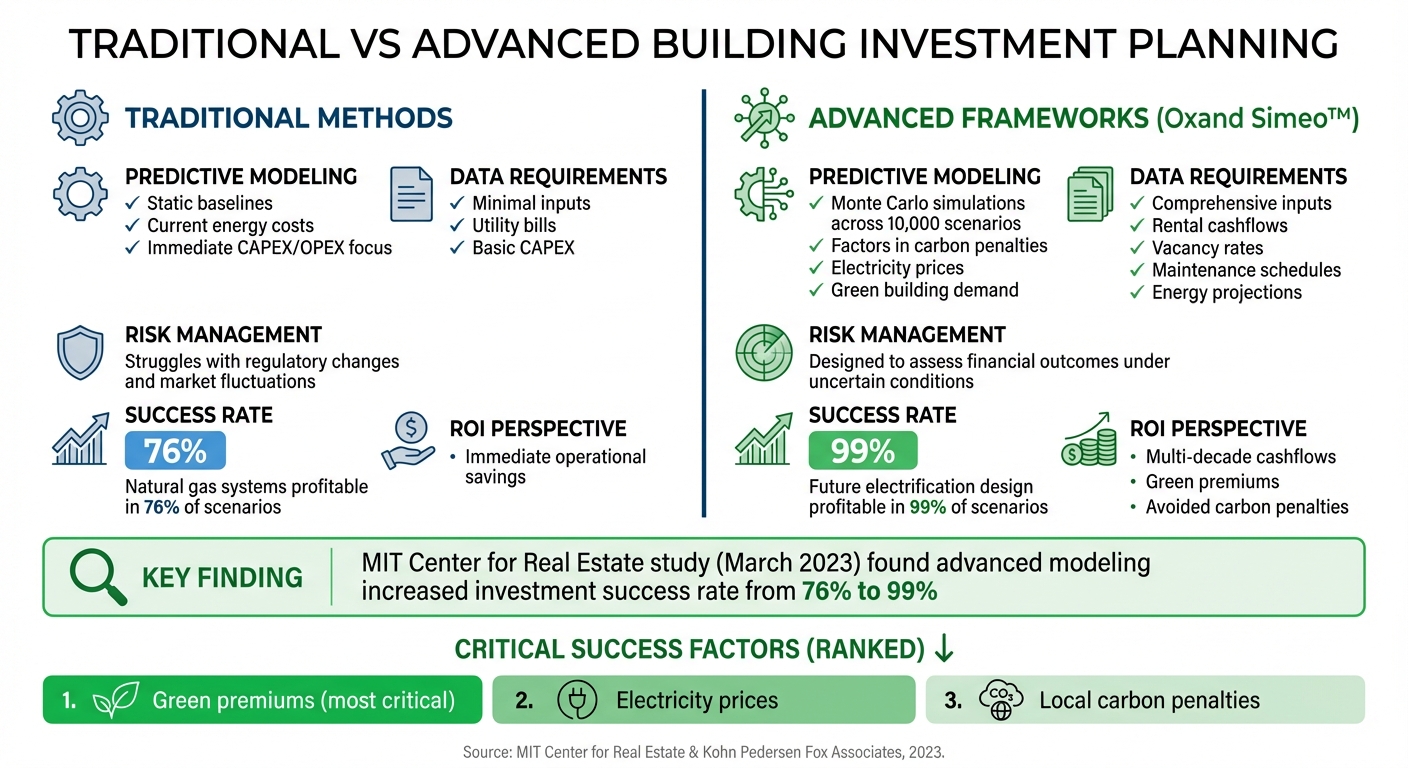
Traditional vs Advanced Building Investment Planning: Key Differences
When deciding between traditional planning methods and advanced frameworks, the differences in predictive modeling and data requirements stand out. Traditional methods rely on static baselines, focusing on current energy costs and immediate CAPEX/OPEX. In contrast, advanced frameworks, such as Oxand Simeo™, utilize Monte Carlo simulations across 10,000 scenarios. These simulations take into account factors like future carbon penalties, fluctuating electricity prices, and the growing demand for green buildings [2].
The data demands for each approach also vary significantly. Traditional methods require minimal inputs, such as current utility bills and basic CAPEX figures. Advanced frameworks, on the other hand, need a broader range of data, including rental cashflows, vacancy rates, maintenance schedules, and energy cost projections [2]. While this increased input can seem daunting, it provides a much deeper understanding of long-term financial performance. This difference in data requirements naturally influences how risks are evaluated.
Risk management is another key differentiator. Traditional planning often struggles to adapt to regulatory changes and market fluctuations. Advanced frameworks, however, are designed to assess financial outcomes under uncertain conditions. This gives building owners a clearer picture of how their investments might perform over time. For example, a March 2023 study by researchers from the MIT Center for Real Estate y Kohn Pedersen Fox Associates – including Siqi Zheng and Carlos Cerezo – found that while natural gas systems seemed more profitable in 76% of scenarios under traditional analysis, a design allowing for future electrification proved more profitable in 99% of scenarios when advanced modeling was used [2].
The study also highlighted the importance of green premiums – the added market value tied to sustainable investments – as the most critical factor for investment success. Electricity prices and local carbon penalties followed closely behind [2]. The researchers noted:
"The assessment of returns associated with those investments tend to be challenged by ongoing changes in regulatory environments and market conditions that hinders the ability of property owners to forecast the ultimate impact of decarbonizing investments on future energy costs, carbon emissions penalties or rental premiums" [2].
Finally, the return on investment (ROI) perspective differs greatly between these approaches. Traditional methods prioritize immediate operational savings. In contrast, advanced frameworks take a broader view, evaluating multi-decade cashflows, green premiums, and avoided carbon penalties. This longer-term perspective aligns more closely with the lifespan of building systems and the dynamic nature of sustainability regulations.
Conclusión
Reducing energy demand achieves a trifecta: cutting carbon emissions, saving money, and enhancing occupant comfort. As Guy Grainger, Global Head of Sustainability Services at JLL, afirma acertadamente:
"Low‐carbon buildings are simply cheaper to run" [4].
Light to medium retrofits can deliver energy savings of 10–40%, which translates to annual savings between $2.9 billion and $11.4 billion across 14 major markets [4].
It’s time to think beyond short-term fixes. Advanced tools like Oxand Simeo™ offer risk-based modeling and scenario analysis, helping building owners evaluate long-term investments. By factoring in carbon penalties, fluctuating electricity prices, and potential green premiums, these tools guide strategies that remain profitable even in uncertain conditions. This underscores the importance of adopting a cohesive, forward-thinking approach over fragmented, short-term measures.
The first step? Focus on reducing energy demand. Mechanical, electrical, and plumbing retrofits can yield immediate energy savings. For example, laboratory retrofits save approximately $4.75 per square foot [4]. Once these efficiencies are in place, benchmarking tools can help track progress against regulatory requirements and corporate net-zero goals. With a projected 70% shortfall in low-carbon buildings by 2030 [4], early adopters stand to benefit from higher rental and sale values while avoiding the risk of stranded assets. The urgency of these retrofits grows as regulations continue to evolve.
The regulatory environment is tightening fast. Over 40 U.S. cities have enacted Building Performance Standards, and in the EU, 16% of the worst-performing buildings must be renovated by 2030, increasing to 26% by 2033 [4]. Tools like Oxand Simeo™ provide clarity on what to invest in, when to act, and how to balance budgets with energy and carbon goals.
Aligning risk-based strategies with shifting regulations transforms retrofitting from a daunting expense into a strategic opportunity. The retrofit challenge may carry a $3 trillion price tag across 17 major countries [4], but as Grainger reminds us:
"What’s good for the planet is equally good for their bottom line" [4].
Preguntas frecuentes
What data do I need to run risk-based building investment models?
To create risk-based building investment models, you’ll need reliable data on energy performance, life-cycle costs, en life-cycle carbon emissions. Having this information enables you to combine energy, cost, and carbon evaluations, making it easier to make informed decisions.
How do I weigh upfront retrofit costs against future carbon fines and energy prices?
To manage the upfront costs of retrofits while preparing for potential carbon fines and fluctuating energy prices, it’s crucial to take a thorough approach to investment analysis. This means looking beyond the immediate expenses and considering long-term factors like penalties and energy costs. Tools like life-cycle cost (LCC) y life-cycle carbon emissions (LCCE) assessments can be invaluable here. By incorporating these frameworks, you can focus on investments that not only meet sustainability targets and regulatory requirements but also deliver a solid return on investment over time. This risk-aware strategy ensures smarter, future-proof decision-making.
How can tenant comfort be measured and tied to ROI?
Tenant comfort is often gauged through metrics like occupant satisfaction, retention rates, y el perceived quality of amenities. These factors are closely linked to ROI because greater comfort tends to attract and retain tenants, boosting occupancy rates and rental income. A better tenant experience can have a direct, positive impact on the financial success of building investments.
Entradas de blog relacionadas
- Conseguir un balance neto cero en las carteras inmobiliarias: De los objetivos a los planes de inversión
- Planificación de inversiones alineadas con el carbono: Cómo priorizar los proyectos en función del CO₂ reducido por euro
- Edificios con emisiones cero 2028 y 2030: cómo escalonar ya su plan de inversión
- Edificios con peores resultados: Cómo identificar, clasificar y escalonar las inversiones de una cartera