







The 2028 deadline for mandatory life-cycle carbon assessments is approaching fast. Starting January 1, 2028, new buildings over 10,764 sq ft in the EU must disclose their life-cycle Global Warming Potential (GWP) on energy performance certificates. Public buildings face even stricter standards, requiring zero on-site fossil fuel emissions by the same date. By 2030, these rules will apply to all new buildings, regardless of size.
Asset owners need to act now to avoid costly delays, reduced valuations, and market penalties. Key steps include:
- Understanding life-cycle carbon: This includes both embodied carbon (materials and construction) and operational carbon (energy use during a building’s life).
- Meeting regulations: The EU’s Directiva sobre eficiencia energética de los edificios (EPBD) mandates GWP calculations and compliance with Zero-Emission Building (ZEB) standards.
- Reducing emissions: Use low-carbon materials, renewable energy systems, and predictive tools to align investments with carbon and cost goals.
Delaying action risks non-compliance penalties and financial losses. Early planning and accurate carbon data are critical to meeting these requirements and staying competitive in a carbon-conscious market.
Decarbonizing Buildings: A Whole Life Cycle Approach
sbb-itb-5be7949
Regulations and Targets Driving Building Decarbonization
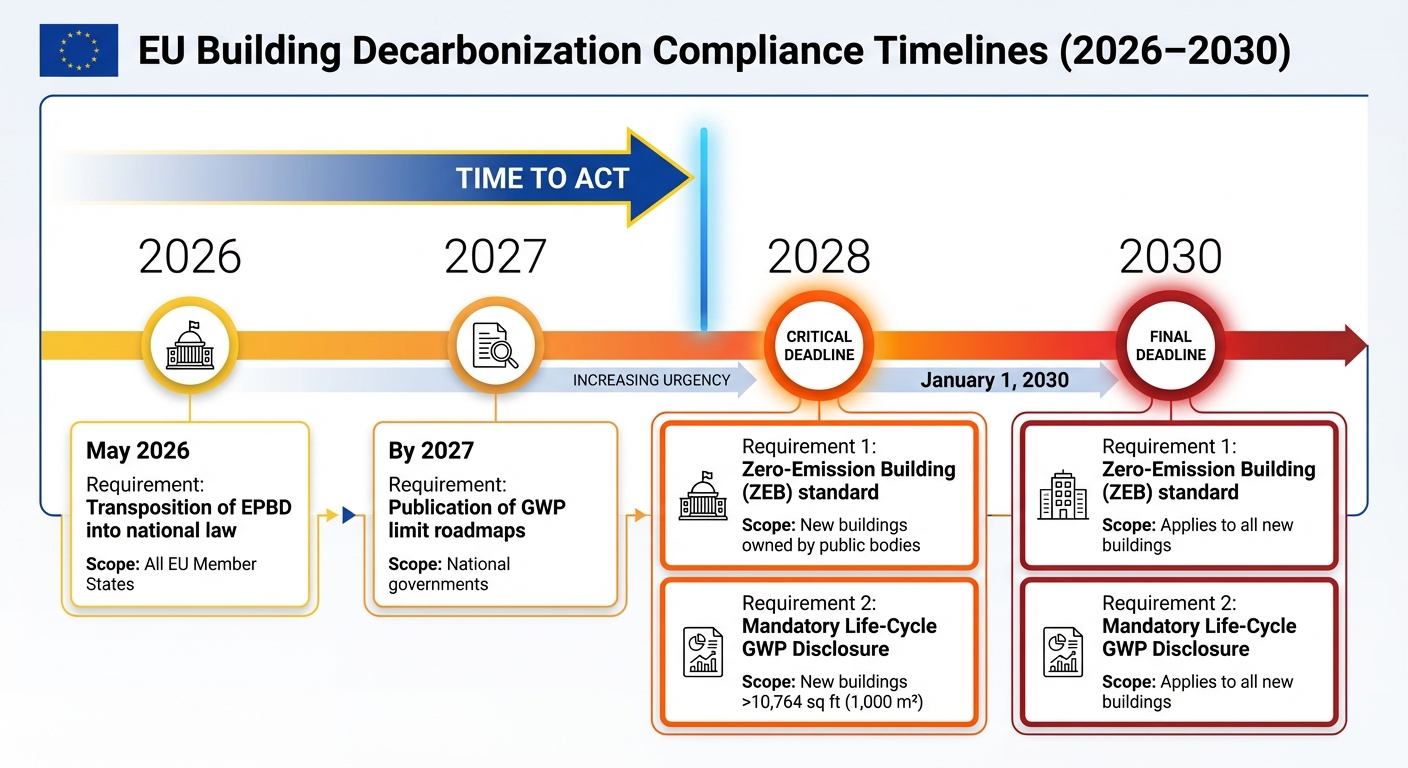
EU Building Decarbonization Compliance Deadlines 2026-2030
The shift toward integrating life-cycle carbon metrics into investment planning is being driven by a series of EU directives. One of the most impactful is the Energy Performance of Buildings Directive (EPBD) Recast (EU 2024/1275), which broadens the focus from operational energy use to include whole-life carbon. This means accounting for emissions not just during a building’s use but also from materials, construction, and other phases of its life cycle [3]. A key part of this directive is the Zero-Emission Building (ZEB) standard, which mandates that, starting January 1, 2028, all new public buildings must eliminate on-site fossil fuel emissions [3][1].
Further supporting this transition, the Delegated Regulation (C/2025/8723), adopted in December 2025, introduces a standardized method for calculating life-cycle Global Warming Potential (GWP) across the EU. This regulation requires a 50-year study period and mandates that GWP figures appear on Energy Performance Certificates (EPCs), making carbon performance more transparent for lenders and investors [4]. It also establishes a data hierarchy, prioritizing verified Environmental Product Declarations (EPDs) over generic data. Using generic or default values can inflate a building’s reported GWP, potentially harming its market value and financing prospects. This incentivizes asset owners to rely on high-quality, manufacturer-specific data [4].
National GWP Limits and Reduction Benchmarks
While the EU provides the overarching framework, it’s up to individual member states to set specific GWP limits. By 2027, all EU countries must publish roadmaps outlining their national GWP limits and reduction targets. These roadmaps will shift the focus from carbon disclosure to enforceable performance standards [4].
The EU’s broader climate agenda, outlined in the "Fit for 55" package, aims for a 55% reduction in greenhouse gas emissions by 2030 compared to 1990 levels [3]. Buildings play a critical role in this effort, as they account for about 40% of the EU’s total energy use and more than a third of energy-related greenhouse gas emissions. Additionally, construction and demolition waste makes up roughly 40% of the EU’s total waste stream [4]. As member states incorporate the revised EPBD into their national laws by May 2026, asset owners can expect variations in how GWP limits are implemented and enforced. These benchmarks will serve as the foundation for compliance deadlines outlined below.
Compliance Deadlines and Risks of Non-Compliance
The regulatory timelines are tight, and missing these deadlines could lead to serious financial and reputational consequences. Below is a summary of the key deadlines and requirements:
| Plazo | Requisito | Scope |
|---|---|---|
| May 2026 | Transposition of EPBD into national law | All EU Member States |
| By 2027 | Publication of GWP limit roadmaps | National governments |
| 1 de enero de 2028 | Zero-Emission Building (ZEB) standard | New buildings owned by public bodies |
| 1 de enero de 2028 | Mandatory Life-Cycle GWP Disclosure | New buildings >10,764 sq ft (1,000 m²) |
| 1 de enero de 2030 | Zero-Emission Building (ZEB) standard | Applies to all new buildings |
| 1 de enero de 2030 | Mandatory Life-Cycle GWP Disclosure | Applies to all new buildings |
Failing to meet these requirements can lead to delays in permitting, increased financing costs, and diminished market competitiveness. Lenders are increasingly factoring in EPCs during risk assessments, and buildings with poor carbon performance may lose out to greener alternatives.
"If a competitor has current, third-party-verified EPDs and you do not, you are asking the team to accept pessimistic assumptions. That gets products sidelined before price even enters the chat."
- EPD Guide [4]
The financial implications are significant. Properties that meet or exceed these carbon standards are commanding higher valuations, while those that fall short risk steep "brown discounts", which can severely impact asset value. For asset owners, the 2028 deadline is not some far-off milestone – it’s an imminent challenge that demands immediate attention in today’s investment planning.
Carbon Emissions Across the Building Lifecycle
For asset owners planning investments before 2028, understanding emissions at every stage of a building’s lifecycle is essential. Life-cycle GWP (Global Warming Potential) breaks down emissions from the extraction of materials all the way to disposal. Below, we’ll explore emissions tied to construction, building operation, and the demolition phase.
Construction and Embodied Carbon (Modules A1–A5)
Embodied carbon refers to the emissions locked into a building before it even becomes operational. These emissions stem from material production, transportation, and on-site construction. This phase includes everything from material extraction and manufacturing to delivery and assembly. To reduce embodied carbon, selecting materials wisely is key. Options like clean steel, low-carbon cement, and bio-based materials such as timber can significantly lower emissions. Timber, in particular, is gaining popularity because it can store CO₂.
Additionally, practices like reusing structural elements or incorporating recycled content play a crucial role in cutting emissions. For accurate reporting, asset owners should rely on Environmental Product Declarations (EPDs) from specific manufacturers instead of generic data. Using inaccurate or inflated figures could affect market value and financing opportunities [1].
Operational Carbon (Module B6)
Operational carbon includes emissions from energy consumption during a building’s use – think heating, cooling, lighting, and powering equipment. While energy efficiency improvements have helped reduce these emissions over time, they still represent a large share of a building’s total carbon footprint.
The Zero-Emission Building (ZEB) standard, effective for all new buildings by January 1, 2030, requires high energy efficiency and mandates that any remaining energy needs come from renewable sources. New buildings should be designed to accommodate solar technologies, such as photovoltaic panels or solar thermal systems, and include automation systems to monitor and optimize energy use.
Regulations also aim to reduce residential energy use by 16% by 2030 and between 20–22% by 2035. Meanwhile, at least 16% of the least energy-efficient non-residential buildings must undergo renovations by 2030 [2]. These measures directly affect long-term asset performance and regulatory compliance.
End-of-Life Carbon (Modules C1–C4)
End-of-life carbon refers to emissions generated during demolition, waste processing, transportation, and disposal. The concept of the "emissions backpack" highlights that embodied emissions remain part of a building’s carbon footprint until fully depreciated. If a building is demolished before these emissions are written off, the remaining carbon debt, along with emissions from deconstruction, transfers to the replacement structure [5].
To address this, asset owners can design buildings for disassembly and reuse, ensuring materials are recovered instead of ending up in landfills [6]. Modular construction and prefabricated components can make material recovery easier for future projects. Denmark’s 2025 national roadmap is a strong example of this approach. It introduces phased strategies, including mandatory whole-life carbon limits, supported by over 600 industry stakeholders [6].
For asset owners, the takeaway is clear: evaluate the emissions backpack carefully before opting for demolition. Renovation often proves to be a smarter choice – both environmentally and financially [5].
How to Reduce Life-Cycle Carbon in Building Portfolios
With the regulatory framework in place, asset owners now need to take meaningful steps to cut life-cycle carbon emissions. Below are practical strategies to reduce emissions across the construction, operation, and end-of-life phases, ensuring compliance with 2028 targets.
Using Low-Carbon Materials and Circular Design
The materials used in construction largely determine a building’s carbon footprint before it even becomes operational. Opting for clean steel y low-carbon cement can significantly cut embodied emissions, while wood-based construction offers the added advantage of storing carbon. New regulations require accurate reporting of life-cycle global warming potential (GWP) for new buildings, making material transparency a priority.
To meet these requirements, asset owners should focus on sourcing materials backed by verified carbon data. The Construction Products Regulation (CPR) and Ecodesign legislation mandate that manufacturers provide this data, ensuring compliance and avoiding inflated emissions from generic figures. Additionally, designing for disassembly – planning how materials can be recovered, transported, and reused at the end of a building’s life – turns the concept of circular construction into a practical approach.
Adding Renewable Energy and Improving Energy Efficiency
Operational emissions remain a significant challenge, especially as efficiency standards become stricter. By 2030, all new buildings must be "solar ready", meaning they should be designed to accommodate photovoltaic or solar thermal systems. For existing non-residential buildings, solar installations will be required wherever technically and economically feasible. These measures align with upcoming regulations that aim to phase out fossil fuel reliance [2].
En Zero-Emission Building (ZEB) standard will apply to new public buildings starting in January 2028 and to all new buildings by 2030. This standard requires high energy efficiency and renewable energy sourcing for any remaining energy needs. Asset owners should also focus on renovating the lowest-performing 16% of their non-residential properties by 2030 to meet energy reduction goals [2]. Building automation and control systems can play a crucial role here, enabling real-time monitoring and optimization of energy use to improve both performance and regulatory compliance.
"2030 sounds far away, but it’s not. With the changes required across the industry, we need to act now to build the literacy, data, and design capacity for whole-life carbon compliance." – Paul Astle, Building Decarbonisation Lead, Ramboll [2]
Using Predictive Tools for Carbon Reduction
Beyond material and energy improvements, predictive tools are revolutionizing how asset owners plan investments for carbon reduction. These tools enable accurate modeling and scenario analysis, which are essential for effective carbon management. For example, Oxand Simeo™ integrates data on assets, conditions, and energy use into multi-year CAPEX and maintenance plans. This allows asset owners to evaluate how different investment levels impact emissions, risks, and costs over a 5-to-10-year period [7].
A real-world example comes from In'li, a French real estate organization that adopted Oxand Simeo to align energy performance goals with investment strategies. By transitioning from a reactive to a predictive approach, the organization’s Head of Budget and Asset Valuation Department leveraged the platform’s risk management features to optimize investments and meet decarbonization objectives [7]. Similarly, the Meuse Department in France used Simeo to consolidate fragmented data and create clear scenarios for public building investments, helping elected officials make informed decisions [7].
"Recurrimos a Oxand porque necesitábamos una herramienta que nos proporcionara una visión predictiva -no sólo correctiva- y nos ayudara a gestionar nuestras inversiones con mayor eficacia. Oxand destacó por sus capacidades de gestión de riesgos". - Jefe del Departamento de Presupuestos y Valoración de Activos, In'li [7]
Organizations using predictive tools like these have reported a 25% to 30% reduction in Total Cost of Ownership (TCO) by optimizing the timing of interventions [7]. The platform can generate multi-year investment plans in hours, compared to the months it would take using manual spreadsheets [7]. These tools not only help forecast emissions but also guide asset owners in developing resilient, forward-thinking investment strategies – critical for meeting 2028 deadlines with confidence.
Adding Carbon Metrics to Risk-Based Asset Investment Planning
Asset owners are increasingly incorporating carbon metrics into both CAPEX and OPEX planning to align their investments with environmental goals. Building on the use of predictive tools, integrating carbon considerations helps create a cohesive strategy that ties sustainability to risk management. By combining carbon data with risk and performance metrics, sustainability becomes a key financial factor, enabling asset owners to prioritize projects that achieve both strong financial outcomes and measurable emissions reductions.
Including Life-Cycle GWP in Investment Scenarios
Adding life-cycle global warming potential (GWP) as a key decision-making factor, alongside scenario simulators, allows asset owners to evaluate how different investment levels impact emissions, risk, and costs. For instance, Oxand Simeo™ integrates carbon metrics by combining asset inventories, condition data, and energy performance into a single platform. Its predictive modeling uses advanced algorithms to forecast when interventions are needed, while also factoring in carbon impacts for each scenario. Decisions like replacing outdated HVAC systems can then be timed to maximize energy efficiency and reduce embodied carbon, providing clear justification for investments [7].
Data-Driven Risk and Sustainability Planning
Accurate carbon planning relies on a centralized system that consolidates data from various sources, such as asset inventories, inspections, energy usage, and environmental product declarations. With comprehensive data feeding into predictive models, organizations can identify assets with high financial and operational risks while also tracking their carbon footprints.
An example of this approach comes from the Meuse Department in France, which unified fragmented asset data to create clear, actionable scenarios for decision-makers. The department’s Chief Executive Officer explained:
"Necesitábamos una herramienta que nos permitiera consolidar los datos fragmentados que teníamos y proyectarlos de forma que pudieran presentarse claramente a nuestros cargos electos, que son los que toman las decisiones"."
By integrating energy performance targets into asset management, the department aligned renovation priorities with decarbonization goals, cutting total ownership costs by 25–30% through optimized intervention timing [7]. This comprehensive data approach not only guides investment decisions but also ensures compliance with strict audit requirements.
Meeting Compliance and Audit Requirements
To meet regulatory demands, asset owners must document tangible carbon reductions. Platforms designed to align with ISO 55001 y CSRD/ESRS standards can generate audit-ready reports directly from investment planning data. Aeropuerto LaGuardia’s Chief Technical Officer highlighted this structured approach:
"Within this context, we want as a first step to perform a Maturity Assessment of our Asset Management practices, in order in the future to get the ISO 55001 – Asset Management – Certification."
This method ensures that investment plans not only meet compliance standards but also provide transparency for audits. Aligning reports with ISO 55001 and CSRD/ESRS supports the development of a resilient, low-carbon asset portfolio. Advanced platforms can even streamline the process, generating a multi-year investment plan in hours – a task that might otherwise take months with manual spreadsheet analysis. Initial plans are typically completed within 6–12 weeks, depending on the availability of data [7].
Conclusion: Getting Ready for a Low-Carbon Future
The 2028 deadline for mandatory life-cycle assessments is approaching fast. Waiting until the last minute will likely lead to rushed compliance, fewer design options, and increased costs.
Now is the time to act. Start building the systems and expertise needed to collect Environmental Product Declarations (EPDs), streamline procurement processes, and incorporate carbon metrics into investment planning. The earlier you take action – particularly during the planning and schematic design stages – the more flexibility you’ll have to make impactful carbon reductions. At this stage, structural systems and material choices are still adaptable, making it the best time to address carbon goals. If you wait until the detailed design phase, life-cycle assessments become little more than a confirmation exercise, offering limited opportunities for meaningful change [8][2].
Technology is a game-changer here. Platforms that integrate asset inventories, condition data, and predictive modeling allow asset owners to assess carbon impacts alongside financial and operational risks. These tools can produce detailed investment plans in hours rather than months, all while aligning with ISO 55001 and CSRD/ESRS standards. This approach turns compliance into a strategic advantage, rather than just another regulatory hurdle.
By embedding carbon metrics into investment workflows, you can ensure compliance while safeguarding the long-term value of your assets. Starting in January 2028, life-cycle assessments will be mandatory for new public buildings, with a broader application set for January 2030. Japan is also introducing similar requirements for larger buildings (over 53,820 sq ft or 5,000 m²) beginning in 2028 [8]. These regulations come with real stakes, including the risk of being excluded from sustainable investment categories and facing challenges in corporate reporting.
The choice is clear: act now to meet these deadlines and position yourself as a leader in a carbon-conscious market – or risk falling behind. The time to prepare is now.
Preguntas frecuentes
What data do I need to calculate life-cycle GWP correctly?
To calculate life-cycle GWP (Global Warming Potential) effectively, you need to collect emissions data from every stage of a building’s life cycle: manufacturing, transportation, construction, operation, and end-of-life. Rely on verified, product-specific data and stick to standardized methodologies such as EN 15978. Make sure your process complies with regulatory standards and meets sustainability benchmarks to ensure precise and reliable outcomes.
How do I decide between renovating and demolishing to cut carbon?
To make an informed decision, weigh the carbono incorporado from demolition and new construction against the combined embodied and operational carbon savings that come with renovation. Renovation typically helps lower emissions by prolonging a building’s lifespan. Leverage lifecycle assessment tools to analyze energy use, costs, and carbon impacts, while factoring in elements like heritage restrictions or the building’s current performance. The goal should be to achieve ecological payback and cut emissions throughout the building’s entire lifecycle.
What should I change in CAPEX planning to be ready for 2028?
To get ready for 2028, it’s essential to include life-cycle carbon considerations in your capital expenditure (CAPEX) planning. This means looking beyond energy efficiency and focusing on strategies to reduce carbono incorporado during construction. Choosing materials with a lower carbon footprint and adopting methods that cut down on operational emissions are key steps.
Shifting the focus to low-carbon technologies and approaches can make a big difference. By using risk-based modeling, you can strike a balance between reducing carbon emissions, managing costs, and maintaining tenant comfort – all while staying in line with regulations and decarbonization goals. Integrating life-cycle assessments (LCAs) into your process will help ensure you’re addressing the entire carbon footprint of a building, from construction to operation.
Entradas de blog relacionadas
- Conseguir un balance neto cero en las carteras inmobiliarias: De los objetivos a los planes de inversión
- Taxonomía de la UE, EPBD y Decretos Verdes: Qué significan para su plan de inversión de activos
- Cómo le ayuda la norma ISO 55001 a cumplir la normativa de la UE sobre infraestructuras y construcción
- EPBD 2026: Qué significa para los propietarios de activos la fecha límite de transposición del 29 de mayo