








Het verwaarlozen van infrastructuuronderhoud is niet alleen maar een ongemak - het is een financiële en veiligheidscrisis. Overal in de V.S. begeven verouderde systemen zoals wegen, bruggen en waterleidingen het onder de druk van de leeftijd en de toegenomen vraag. Dit is waarom het belangrijk is:
- Uitgestelde onderhoudskosten Meer: Een reparatie van $100.000 vandaag kan oplopen tot $762.000 over 30 jaar.
- Economisch effect: Verslechterende wegen alleen al kosten de Amerikaanse economie jaarlijks $200 miljard aan verloren tijd en brandstof.
- Veiligheidsrisico's: Storingen zoals het instorten van bruggen en het breken van dammen brengen levens in gevaar en ontwrichten gemeenschappen.
- Financieringstekorten: Ondanks federale investeringen staat de VS voor een financieringstekort van $3,6 biljoen aan infrastructuur in de komende tien jaar.
De oplossing? Op risico's gebaseerde planning en preventief onderhoud. Door problemen vroegtijdig aan te pakken, kunnen overheden tot 40% aan kosten besparen, de levensduur van bedrijfsmiddelen verlengen en de openbare veiligheid verbeteren. Nu investeren voorkomt noodsituaties later.
Financiële risico's: Hoe uitgesteld onderhoud de kosten verhoogt
Hoe uitgesteld onderhoud de reparatiekosten vermenigvuldigt
Door onderhoud uit te stellen, worden de kosten niet alleen uitgesteld, maar zelfs opgedreven. Volgens Oxmaint onderzoek, een reparatie die aanvankelijk $100,000 kan groeien tot $197.000 in tien jaar, $386.000 in twintig jaar, en een oogstrelende $762.000 in dertig jaar [2]. Dit gebeurt door wat deskundigen noemen "progressieve achteruitgang." Zodra beschermende systemen falen, breidt de schade zich uit, waardoor het probleem en de kosten toenemen.
Neem bijvoorbeeld een lekkend dak. Op het eerste gezicht lijkt het misschien onschuldig, maar dat kleine probleem kan leiden tot waterschade aan HVAC-systemen, elektrische panelen en structurele onderdelen. Wat een $5.000 reparatie dak verandert in een $28.000 tot $45.000 revisie van meerdere systemen binnen slechts vijf jaar [2].
Voorbeelden uit de echte wereld maken dit duidelijk. Tussen 2019 en 2023 ontdekte een middelgrote county in het westen van de VS dat ze een $41 miljoen achterstallig onderhoud, meer dan het dubbele van hun oorspronkelijke schatting van $18 miljoen. Door een geautomatiseerd onderhoudsbeheersysteem in te voeren en over te schakelen op preventief vs. reactief onderhoud, Ze verlaagden de uitgaven voor noodreparaties van 44% tot 11% van hun budget en bespaarde $14,6 miljoen meer dan vier jaar [2].
"Elke begrotingscyclus waarin een onderhoudspost wordt uitgesteld, is geen besparing. Het is een samengestelde investering in een toekomstige noodsituatie." - Taylor, Oxmaint [2]
Hetzelfde principe geldt voor wegenonderhoud. Een wegdek onderhouden met een PCI (Pavement Condition Index) van 70 kost slechts $0,08 per vierkante voet. Maar als u het laat degraderen tot een PCI van 40, stijgen de saneringskosten tot $0,55 per vierkante voet - bijna zeven keer hoger [2]. Zodra de infrastructuur kritieke schadedrempels overschrijdt, kunnen de kosten stijgen met 300-400% [2].
Deze uit de pan rijzende kosten zetten niet alleen de begrotingen onder druk - ze wegen ook zwaar op de lokale economieën en belastingbetalers.
Economische gevolgen voor gemeenschappen en belastingbetalers
De gevolgen van uitgesteld onderhoud reiken veel verder dan reparatierekeningen. Verouderde infrastructuur belemmert de economische productiviteit en het welzijn van de gemeenschap. Verkeersopstoppingen veroorzaakt door verslechterende wegen kosten de Amerikaanse economie bijvoorbeeld meer dan $200 miljard per jaar in verspilde tijd en brandstof [1]. Op een bredere schaal kan een slechte infrastructuur tot wel 3% van BBP [1].
Uitgesteld onderhoud veroorzaakt ook een fenomeen dat bekend staat als "kapitaalverplaatsing." Wanneer noodreparaties geld opslokken, worden geplande investeringen in nieuwe projecten of upgrades geannuleerd of uitgesteld. Dit creëert een vicieuze cirkel waarbij overheden moeite hebben om de status-quo te handhaven, laat staan om diensten te verbeteren of uit te breiden. [2]. In de hele V.S. heeft het achterstallig onderhoud bij staats- en lokale overheden nu een geschatte $5.2 biljoen [2].
De stijgende kosten maken de situatie nog erger. Sinds 2020 zijn de kosten voor de aanleg van snelwegen gestegen met 70%, terwijl uitgesteld onderhoud groeit met 7% per jaar. Gecombineerd met 4-6% materiaal opblazen, Uitgestelde projecten kunnen de kosten zien stijgen met meer dan 12% elk jaar [3] [2].
Personeelstekorten voegen nog een extra kostenlaag toe. Onderzoek van Universiteit van Yale toont aan dat infrastructuurprojecten die worden beheerd door ervaren interne ingenieurs ruwweg 14% minder dan die van externe consultants [3]. Naarmate ervaren ingenieurs echter met pensioen gaan of de openbare dienst verlaten, verliezen agentschappen dit kostenbesparende voordeel. Zelfs een 1% verlies aan ervaren ingenieurs kan de projectkosten verhogen met 4.3% [3].
"Als het aankomt op de bekwame ingenieurs die grote infrastructuurprojecten beheren, betalen de kwantiteit en kwaliteit van ambtenaren zichzelf vele malen terug... Als een van deze fases slecht wordt uitgevoerd door de overheid, kunnen de kosten de pan uit rijzen." - Zach Liscow, onderzoeker, Yale University [3]
Organisaties die prioriteit geven aan preventief onderhoud slagen er daarentegen in om de cumulatieve kosten binnen 0,8-1,2 keer de oorspronkelijke schatting en nooduitgaven beperken tot minder dan 8% van hun budgetten [2].
sbb-itb-5be7949
Operationele en veiligheidsrisico's van verouderde activa
Hogere storingspercentages en dienstonderbrekingen
Oude infrastructuur kost niet alleen meer om te onderhouden - het gaat ook vaker kapot. Uit een onderzoek bleek dat 65% van storingen in de infrastructuur tussen 2025 en 2026 verband hielden met activa die na hun geplande levensduur in bedrijf waren [8]. Deze systemen waren niet alleen aan het verouderen; ze werden tot ver boven hun oorspronkelijke capaciteit gebruikt.
De impact is wijdverspreid en ontwrichtend. In 2025 zal meer dan 2 miljoen inwoners van de V.S. storingen in het watersysteem [8], terwijl storingen in het elektriciteitsnet leidden tot $150 miljard in economische verliezen [8]. Aan de andere kant van de Atlantische Oceaan heeft het Verenigd Koninkrijk te maken met dagelijkse waterverliezen van 3 miljard liter door lekken in verouderde leidingen uit het Victoriaanse tijdperk [1][5]. Deze storingen benadrukken de druk op verouderde systemen.
Erger nog, uitgesteld onderhoud verandert geïsoleerde storingen vaak in cascade-rampen. Elektrische systemen, HVAC-eenheden en structurele onderdelen die op elkaar steunen, kunnen tegelijkertijd defect raken, waardoor een "kapitaalklif" ontstaat - een scenario waarbij meerdere dure storingen tegelijk optreden. [6].
"Voortzetting van de activiteiten is niet langer een betrouwbare indicator dat het kapitaalrisico binnen de perken blijft. Het maskeert verslechtering." - Leider Milieu+Energie [6]
De operationele storingen die het gevolg zijn van verouderde infrastructuur leiden onvermijdelijk tot ernstige risico's voor de openbare veiligheid en een grotere aansprakelijkheid.
Openbare veiligheid en aansprakelijkheidsrisico's
De menselijke tol van verwaarloosde infrastructuur is duizelingwekkend. Neem de instorting van de I-35W brug in Minneapolis in 2007: hierbij kwamen 13 personen en gewond 145 anderen [10]. Snel vooruit naar 2021, toen er een kritieke scheur werd ontdekt in een zesbaansbrug over de Mississippi. De brug werd drie maanden lang gesloten, waardoor de scheepvaart tussen de staten werd verstoord. Schokkend genoeg was de scheur zichtbaar geweest op dronebeelden die gemaakt waren twee jaar eerder maar was onopgemerkt gebleven voor inspecteurs [11].
Dammen vormen een nog groter gevaar. Bijna 17.000 Amerikaanse dammen zijn aangemerkt als potentieel zeer gevaarlijk, wat betekent dat een storing kan leiden tot verlies van mensenlevens [9]. De cijfers zijn alarmerend: dambreuken en noodinterventies zijn gestegen van 3 per jaar tussen 1994 en 2003 naar 76 per jaar tussen 2014 en 2023 [9]. Een voorbeeld hiervan is het falen van de Edenville Dam in Michigan in mei 2020. Na hevige regenval brak de dam, waardoor de Sanford Dam overspoelde en 11.000 inwoners te evacueren. De ramp beschadigde meer dan 2.500 structuren en veroorzaakte $200 miljoen in economische verliezen [9].
Verouderde infrastructuur bedreigt ook de volksgezondheid. Lood lekt uit in het drinkwater via oude leidingen en falende rioleringssystemen overstromen tijdens stormen, waardoor onbehandeld afval in buurten terechtkomt. Ook locaties voor gevaarlijk afval zijn kwetsbaar. Tijdens orkaan Harvey in 2017 brak het water door aarden containers in de San Jacinto River Waste Pits in Texas, waardoor giftig afval in het riviersysteem terechtkwam. [10].
"Als u een lek in uw dak hebt, gaat u erheen, vindt u het, vervangt u de dakspanen, brengt u er een beetje teer op aan. Als je het laat gaan, wordt het geen kleine reparatie: het wordt een vervanging." - Maria Lehman, voorzitter, ASCE [10]
De last van deze mislukkingen komt het hardst aan in gemeenschappen met een laag inkomen. Deze gebieden hebben vaak te maken met langere hersteltijden en zwaardere economische gevolgen. [8]. Terwijl rijkere buurten alternatieven hebben wanneer een waterleiding breekt of een brug dichtgaat, hebben armere gemeenschappen beperkte of helemaal geen opties.
Risicogebaseerde investeringsplanning: Een preventieve aanpak
Voorspellende modellen gebruiken om onderhoud te plannen
Voorspellende modellen transformeren de manier waarop infrastructuur wordt beheerd en verschuiven de focus van reactieve oplossingen naar proactieve oplossingen. Door gebruik te maken van een risicoscore - die rekening houdt met de waarschijnlijkheid en de gevolgen van een storing - helpen deze modellen om prioriteit te geven aan de financiering van bedrijfsmiddelen voordat problemen escaleren. In plaats van te wachten tot een brug barst of een waterleiding barst, bepalen deze tools het ideale moment om in te grijpen, vaak wanneer een bedrijfsmiddel nog in "redelijke" staat verkeert. Deze timing voorkomt dat de kosten exponentieel stijgen naarmate de toestand verslechtert. [12].
Neem Oxand Simeo™ als voorbeeld. Dit platform maakt gebruik van verouderingsmodellen en onderhoudswetten om te simuleren hoe componenten na verloop van tijd verslechteren. Door gegevens van inspecties, conditiebeoordelingen en activadossiers te integreren, voorspelt het storingen in een vroeg stadium - ruim voordat ze de steile kostencurve van vergevorderde slijtage bereiken.
Financieringsbeslissingen worden gestuurd door vier belangrijke dimensies: veiligheid en aansprakelijkheid, cascadeschadesnelheid, cumulatieve kostenstijgingen en kritieke service [2]. Het verhelpen van een daklekkage kan bijvoorbeeld voorrang krijgen op het aanpakken van een cosmetisch probleem, omdat waterschade kan leiden tot schade aan HVAC-units en elektrische systemen eronder. De financiële impact van dergelijke schade kan jaarlijks met 12-18% toenemen. [2]. Deze aanpak identificeert niet alleen dringende behoeften, maar levert ook meetbare besparingen op.
Een geweldig voorbeeld komt van een middelgrote county in het westen van de V.S. die tussen 2019 en 2023 een achterstand van $41 miljoen aan uitgesteld onderhoud in 87 faciliteiten heeft aangepakt. Door gebruik te maken van een CMMS (Computerized Maintenance Management System) voor preventieve planning, kon de county de achterstand terugbrengen tot $31 miljoen. Ze rechtvaardigden projecten zoals een HVAC-vervanging van $2,4 miljoen voor een gerechtsgebouw met behulp van kostenmodellen, die lieten zien hoe het uitstellen van de vervanging zou leiden tot $5,1 miljoen aan gecombineerde reparatie- en vervangingskosten binnen vijf jaar. Deze verschuiving bracht ook de uitgaven voor noodreparaties terug van 44% naar 11% van de begroting, wat een besparing van $14,6 miljoen opleverde. [2].
"Toen we lieten zien dat het nog eens vijf jaar uitstellen van de HVAC-vervanging van het gerechtsgebouw ter waarde van $2,4 miljoen $3,9 miljoen zou kosten in dollars van 2028 plus $1,2 miljoen aan cumulatieve reparatiekosten om het gebouw draaiende te houden, veranderde de berekening."
- Directeur Facilitaire Zaken, Kantoor Openbare Werken, Western U.S. County [2]
Voordelen van risicogebaseerde planning
Het kwantificeren van risico's maakt het moeilijk om de financiële argumenten voor preventief onderhoud te negeren. Voor elke $1 die aan preventief onderhoud wordt besteed, vermijden instanties $4 tot $8 aan toekomstige correctieve reparatiekosten. Bovendien kunnen conditiegebaseerde strategieën ongeveer 40% aan kapitaaluitgaven besparen in vergelijking met traditionele vervangingen op basis van leeftijd. [2] [4] [12]. Deze aanpak zorgt ervoor dat bedrijfsmiddelen optimaal worden benut, terwijl de 3-5× kostenvermenigvuldiger die met noodreparaties gepaard gaan, wordt vermeden. [12].
Wanneer ze via een CMMS worden beheerd, verlengen preventieve programma's de levensduur van bedrijfsmiddelen tot 90-110% van hun ontwerplevensduur, vergeleken met slechts 55-70% voor bedrijfsmiddelen in scenario's van uitgesteld onderhoud. [2]. Deze lange levensduur vermindert de frequentie van vervangingen en minimaliseert dure onderbrekingen. Gepland onderhoud egaliseert ook budgetten, waarbij onvoorspelbare uitgaven voor noodgevallen worden vervangen door voorspelbare uitgavencycli.
In een stad met 120.000 inwoners gebruikte de directeur Engineering conditiebeoordelingsgegevens om een $4,2 miljoen kostend straatbeeldproject te herprioriteren ten gunste van een $3,1 miljoen kostende vervanging van de waterleiding. De gegevens onthulden een faalkans van 73% voor de leidingen binnen 24 maanden. Door snel te handelen voorkwam de stad catastrofale leidingbreuken tijdens een vorstperiode slechts drie maanden later, waardoor een ROI van 3,4× werd behaald binnen het eerste jaar. [12].
"Conditiebeoordeling vertelt u wat u moet repareren, risicobeoordeling vertelt u wat u eerst moet repareren."
- Taylor, Oxmaint [12]
Op risico gebaseerde planning pakt ook een kritiek probleem aan: niet-lineaire kapitaalkoppeling, waarbij verwaarlozing van één systeem dure, gesynchroniseerde reparaties aan meerdere verbonden systemen tot gevolg heeft [4]. Door deze onderlinge afhankelijkheden vroegtijdig te identificeren, kunnen agentschappen gecoördineerde vernieuwingen plannen, kosten besparen en noodgevallen voorkomen. Deze aanpak garandeert de openbare veiligheid en bevordert de financiële stabiliteit op lange termijn.
Infrastructuurinvesteringen afstemmen op CO2-reductiedoelstellingen
Energie- en CO₂-reductie combineren met activaplanning
Infrastructuur is verantwoordelijk voor maar liefst 80% van de wereldwijde uitstoot van broeikasgassen, omvat zowel operationele emissies als de koolstof die is opgenomen in materialen [13]. Dit betekent dat elke beslissing over het onderhoud van infrastructuur gevolgen heeft voor het klimaat. Wanneer agentschappen de vernieuwing van hun activa plannen, staan ze voor een cruciale keuze: verouderde systemen vervangen door vergelijkbare onderdelen of de kans grijpen om te upgraden naar koolstofarme, zeer efficiënte alternatieven.
De onderling verbonden aard van infrastructuursystemen biedt vaak een kans om koolstofreducerende maatregelen op te nemen tijdens vernieuwingen. Neem bijvoorbeeld een HVAC-systeem dat aan het einde van zijn levenscyclus is. Om het te vervangen zijn vaak updates van elektrische systemen en veiligheidscontroles nodig. [4]. Deze onderlinge afhankelijkheid creëert een ideaal moment om meerdere systemen af te stemmen op CO2-reductiedoelstellingen in één gecoördineerde inspanning. In plaats van energie-retrofits te behandelen als op zichzelf staande projecten, kunnen agentschappen ze integreren in geplande vernieuwingen, waardoor dubbele mobilisatiekosten bespaard worden en de uitvaltijd geminimaliseerd wordt.
Voorspellend onderhoud speelt een sleutelrol in dit proces door het beste moment voor interventie te bepalen. Het helpt noodreparaties te voorkomen en verlengt tegelijkertijd de levensduur van bedrijfsmiddelen. Voorspellende modellen voorspellen niet alleen de onderhoudsbehoeften, maar begeleiden ook de overgang naar koolstofarme alternatieven. Tools zoals Oxand Simeo™ simuleren hoe componenten in de loop van de tijd verouderen en energie verbruiken, zodat instanties verschillende vernieuwingsscenario's kunnen evalueren. Hoewel hoogrendabele vervangingen misschien een grotere initiële investering vereisen, leveren de energiebesparingen op lange termijn en de lagere koolstofuitstoot vaak een sterk rendement op. Bovendien is het aanpakken van koolstofuitstoot - die deel uitmaakt van 18% van infrastructuur CO₂-uitstoot - door bij vernieuwingen voorrang te geven aan koolstofarme materialen kan de impact op het milieu verder worden verminderd [13][14]. Deze geïntegreerde aanpak zorgt ervoor dat de vernieuwing van bedrijfsmiddelen in lijn is met zowel financiële als milieudoelstellingen.
De ROI van koolstofgerelateerde investeringen meten
Proactieve planning voor koolstofarme upgrades ondersteunt niet alleen de duurzaamheidsdoelstellingen, maar is ook financieel zinvol. Voor elke $1 van uitgesteld onderhoud, kunnen toekomstige vernieuwingskosten stijgen met naar schatting $4 [4]. Voeg daar indirecte kosten aan toe, zoals noodaankopen, stilstand en hogere verzekeringspremies, en die vermenigvuldigingsfactor kan hoger zijn dan 10x [4]. Door op tijd te handelen, kunnen agentschappen deze stijgende kosten vermijden en tegelijkertijd het energieverbruik en de uitstoot verlagen.
Een belangrijke factor om rekening mee te houden is Infrastructuur gereedheid. Upgrades op gebouwniveau, zoals elektrificatie-retrofits, volgen bijvoorbeeld vaak kortere tijdlijnen, terwijl verbeteringen aan het onderliggende elektriciteitsnet of de waterinfrastructuur jaren kunnen duren. [15]. Deze slechte timing kan leiden tot "gestrand vermogen", waarbij nieuw geïnstalleerde hoogrendabele systemen niet op volle capaciteit kunnen werken door vertragingen in de ondersteunende infrastructuur. Om dit te voorkomen, moeten agentschappen decarbonisatieprojecten testen aan de hand van verschillende capaciteitsscenario's en nagaan of het nutsbedrijf er klaar voor is, voordat ze fondsen toezeggen. [15].
"Rendementen op assetniveau gaan vaak uit van systeemcapaciteit die er nog niet is - waardoor organisaties gedwongen worden vertragingen en risico's op gebouwniveau op te vangen in plaats van waar de beperking zich werkelijk bevindt."
– Boston Consulting Group [15]
Deze kwestie heeft ook financiële gevolgen. Moody's beoordelingen is begonnen met het koppelen van de betrouwbaarheid van de infrastructuur en tijdschema's voor modernisering aan kredietvooruitzichten, waarbij erkend wordt dat onzekerheden over de capaciteit langetermijnrisico's voor de kasstroom kunnen vormen [15]. Door verbeteringen op gebouwniveau te coördineren met voorbereidingen voor het elektriciteitsnet en gebruik te maken van voorspellende modellen om de upgrades in de juiste volgorde te plaatsen, kunnen agentschappen kostenbesparingen realiseren, emissies verminderen en de financiële stabiliteit verbeteren. Deze aanpak ondersteunt niet alleen de milieudoelstellingen, maar versterkt ook de fiscale basis voor toekomstige projecten.
Uitgesteld onderhoud wordt een kapitaalrisico
Reactief onderhoud vs. risicogebaseerde planning: Een vergelijking
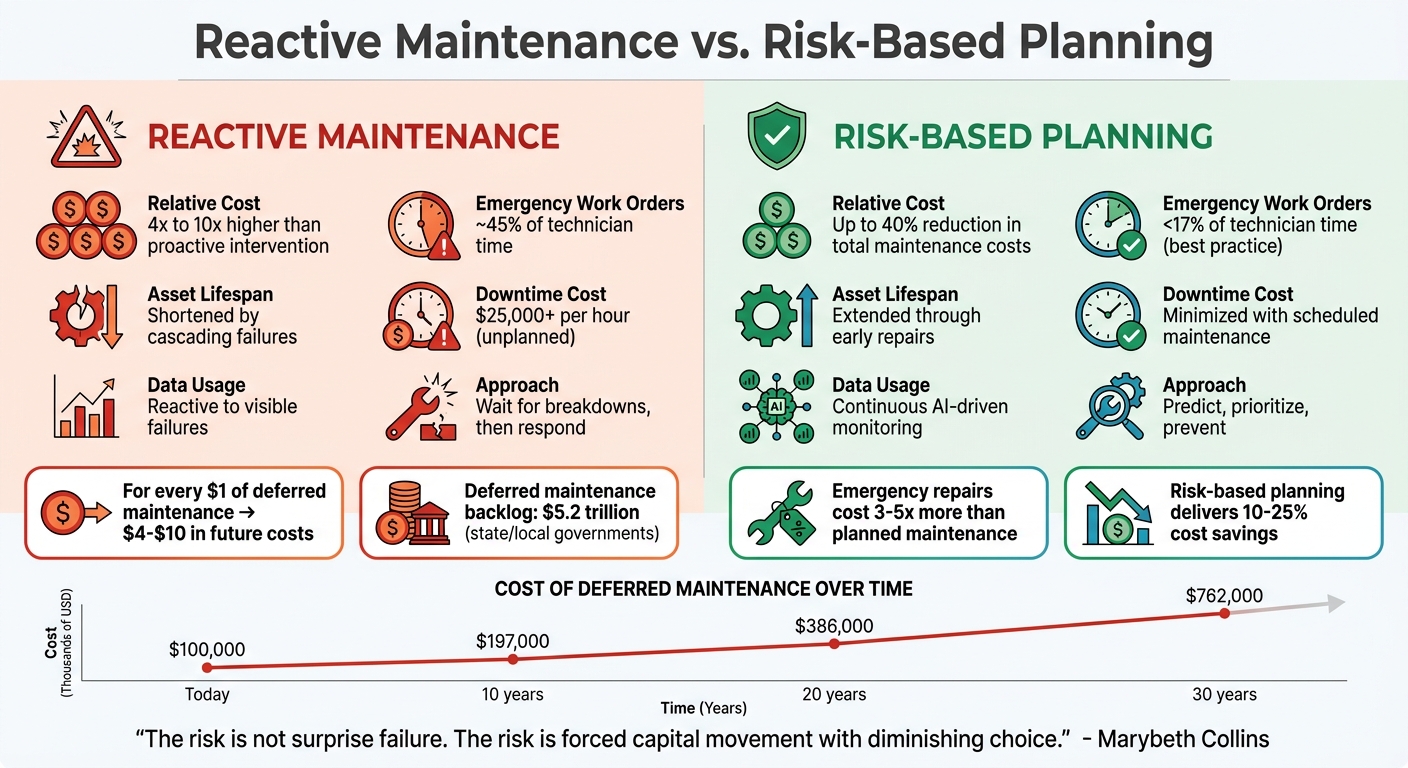
Reactief vs. risicogebaseerd infrastructuuronderhoud: Vergelijking van kosten en prestaties
Belangrijke meetgegevens voor vergelijking
Proactief onderhoud biedt duidelijke voordelen, en een vergelijking van de belangrijkste statistieken laat zien hoe reactief onderhoud tekortschiet wanneer het wordt afgezet tegen een op risico gebaseerde planning.
Het contrast tussen deze benaderingen is niet alleen theoretisch - het heeft een directe invloed op budgetten en operationele efficiëntie. Reactief onderhoud leidt vaak tot wat deskundigen noemen "niet-lineaire kapitaalkoppeling" - een domino-effect waarbij het falen van één verouderd systeem onmiddellijke, ongeplande reparaties in verwante systemen noodzakelijk maakt om de veiligheid en naleving te handhaven [17].
Het uitstellen van onderhoud heeft een hoge prijs. Voor elke $1 aan uitgesteld onderhoud kunnen de toekomstige kosten voor kapitaalvernieuwing met $4 toenemen - en als de indirecte kosten worden meegerekend, kan deze multiplicator wel tien keer zo groot worden. [17]. Federale gegevens schetsen een grimmig beeld: de uitgestelde onderhoudsverplichtingen zijn opgelopen met 1,900% over drie decennia, van $4 miljard in 1991 tot $80 miljard in FY22. [16]. Aan de andere kant kunnen proactieve detectie en interventie bespaar tot 40% op onderhoudskosten [16].
"Voor elke dollar aan uitgesteld onderhoud, stijgen de toekomstige kosten voor kapitaalvernieuwing met naar schatting vier dollar. Als de indirecte kosten worden meegerekend... kan de vermenigvuldigingsfactor vertienvoudigen."
- Marybeth Collins [17]
De operationele verschillen zijn net zo opvallend. Reactief onderhoud verbruikt 45% aan tijd van technicus op reacties in noodsituaties, vergeleken met minder dan 17% onder risicogebaseerde planning [18]. Ongeplande stilstand kan meer dan $25.000 per uur [18], en noodreparaties zijn meestal 3 tot 5 keer duurder dan gepland preventief onderhoud [18]. Op risico gebaseerde planning vervangt giswerk door objectieve scoresystemen die prioriteit geven aan veiligheid, het belang van activa en de kosten van vertragingen. [18]. Deze statistieken laten zien waarom het aannemen van risicogebaseerde strategieën essentieel is voor effectief kapitaalbeheer.
| Metrisch | Reactief onderhoud | Op risico gebaseerde planning |
|---|---|---|
| Relatieve kosten | 4x tot 10x hoger dan proactief ingrijpen [16][17] | Tot 40% minder totale onderhoudskosten [16] |
| Werkopdrachten voor noodgevallen | ~45% technicus tijd [18] | <17% (streefcijfer voor beste praktijk) [18] |
| Levensduur van activa | Verkort door cascadestoringen [17] | Verlengd tot begin reparaties [7] |
| Kosten uitvaltijd | $25.000+ per uur (ongepland) [18] | Geminimaliseerd met gepland onderhoud [18] |
| Gegevensgebruik | Reactief op zichtbare storingen [7] | Continue AI-gestuurde bewaking [7] |
De overstap van reactieve naar risicogebaseerde planning gaat niet alleen over het vermijden van noodsituaties - het gaat over het nemen van controle over de toewijzing van kapitaal. Zoals Marybeth Collins treffend opmerkte:
"Het risico is niet een verrassingsfiasco. Het risico is gedwongen kapitaalverkeer met afnemende keuzemogelijkheden."
- Marybeth Collins [17]
Deze vergelijking onderstreept het belang van proactieve, risicogebaseerde strategieën om verborgen kosten te verminderen en een veerkrachtigere infrastructuur op te bouwen.
Conclusie: Planning voor een veerkrachtige infrastructuur
Het uitstellen van onderhoud is geen kostenbesparende maatregel - het is een financiële last die in de loop der tijd exponentieel groeit. Als u bijvoorbeeld vandaag een reparatie van $100.000 uitstelt, kan dit binnen 30 jaar uitgroeien tot een uitgave van $762.000. [2]. In de hele V.S. heeft de achterstand in uitgesteld onderhoud voor staats- en lokale overheden een duizelingwekkende $5,2 biljoen bereikt. [2], met federale activa die meer dan $370 miljard aan uitgestelde verplichtingen toevoegen vanaf het fiscale jaar 2024 [17]. Reactieve onderhoudsstrategieën zijn duidelijk niet langer houdbaar.
Een slimmere aanpak houdt in risicogebaseerde planning, waarmee enorme uitdagingen op het gebied van uitgesteld onderhoud worden omgezet in beheersbare taken. Deze methode werkt door de impact van vertragingen te kwantificeren, onderling verbonden risico's te identificeren en reparaties te prioriteren op basis van veiligheidsoverwegingen en potentiële cascoschade. [2]. Preventief onderhoud heeft keer op keer bewezen een kosteneffectieve strategie te zijn, die in de toekomst aanzienlijke kosten bespaart. [2][17].
"Het samengestelde percentage van 7% is geen natuurwet - het is het gevolg van uitstel van onderhoud, en het stopt op het moment dat de preventieve investering begint." - Oxmaint [2]
Hulpmiddelen zoals Oxen en Simeo™ maken deze verschuiving gemakkelijker door ruwe vermogensgegevens om te zetten in uitvoerbare investeringsplannen. Met meer dan 10.000 eigen verouderingsmodellen en 30.000+ onderhoudsregels Het platform is al meer dan 20 jaar ontwikkeld en helpt organisaties om weloverwogen beslissingen te nemen over waar, wanneer en hoeveel te investeren. Dit gebeurt allemaal terwijl het binnen het budget blijft en de energie- en CO2-reductiedoelstellingen worden nageleefd. Organisaties die risicogebaseerde planning toepassen, zien vaak 10–25% kostenbesparingen op doelgerichte onderhoudsgebieden, terwijl de levensduur van hun bedrijfsmiddelen wordt verlengd en de duurzaamheidsdoelstellingen worden nagestreefd.
FAQs
Hoe beslissen agentschappen wat ze het eerst moeten repareren?
Bureaus hanteren reparatieprioriteiten door middel van goed georganiseerde processen waarin urgentie, veiligheidsaspecten en de mogelijke impact op de werkzaamheden worden afgewogen. Hulpmiddelen zoals AI-scoringsystemen helpen bij het rangschikken van reparaties door factoren zoals veiligheidsrisico's en het belang van specifieke bedrijfsmiddelen te analyseren. Door gebruik te maken van datagestuurde technieken - zoals voorspellende analyses en conditiebeoordelingen - kunnen instanties de meest dringende reparaties in kaart brengen. Deze vooruitstrevende aanpak minimaliseert niet alleen de veiligheidsrisico's en operationele stilstand, maar helpt ook om de kosten effectief te beheren terwijl er binnen krappe budgetten wordt gewerkt.
Welke gegevens hebt u nodig om met risicogebaseerd onderhoud te beginnen?
Om te beginnen met risicogebaseerd onderhoud hebt u een solide basis van gedetailleerde gegevens over de staat en prestaties van uw bedrijfsmiddelen nodig. Dit betekent dat u informatie moet verzamelen zoals inspectieresultaten (denk aan structurele beoordelingen, materiaaltoestanden en veiligheidsnaleving) om potentiële zwakke plekken aan te wijzen. Historische onderhoudsgegevens zijn ook belangrijk - deze helpen u om patronen in de levenscyclus te begrijpen en trends in de loop van de tijd te ontdekken.
Maar dat is nog niet alles. U wilt ook rekening houden met gegevens over gebruik van activa, milieuomstandighedenen operationele spanningen. Deze details spelen een grote rol bij het voorspellen van de levensduur van een bedrijfsmiddel en bij het bepalen welke onderdelen het eerst aandacht nodig hebben. Als uw gegevens grondig en betrouwbaar zijn, kunt u uw middelen effectiever toewijzen en dure storingen voorkomen.
Hoe kunnen upgrades zowel kosten als CO2 besparen?
Het moderniseren van oudere infrastructuur biedt een dubbel voordeel: lagere kosten en een lagere CO2-uitstoot. Door de efficiëntie te verbeteren en de levensduur van bedrijfsmiddelen te verlengen, kunnen deze updates de kosten na verloop van tijd aanzienlijk verlagen. Het gebruik van moderne materialen en de implementatie van voorspellend onderhoud helpt dure storingen te voorkomen en minimaliseert de noodzaak voor noodreparaties.
Energie-efficiënte systemen spelen ook een belangrijke rol door het stroomverbruik te verlagen en de uitstoot van broeikasgassen te verminderen. Dit sluit aan bij bredere milieudoelstellingen. Investeren in duurzame technologieën zorgt niet alleen voor veerkrachtige en kosteneffectieve systemen, maar garandeert ook een consistente servicekwaliteit terwijl de totale CO2-voetafdruk kleiner wordt.
Verwante Blog Berichten
- Verouderde infrastructuur in Europa: prioriteiten stellen bij vernieuwing binnen budgettaire beperkingen
- 10 rode vlaggen die aangeven dat uw portefeuille met verouderende activa onderbelegd is
- Aanpassing aan klimaatverandering voor verouderende activa: Waar eerst investeren
- Financieringsuitdagingen: Innovatieve oplossingen om verouderde infrastructuur nieuw leven in te blazen