







De Richtlijn Energieprestaties van Gebouwen (EPBD) is transforming how properties in the EU are managed. By May 29, 2026, asset owners must comply with stricter energy efficiency standards, including mandatory upgrades for poorly performing buildings, implementing Building Automation and Control Systems (BACS), and meeting Zero-Emission Building (ZEB) criteria for new constructions. Key deadlines and requirements include:
- All buildings must align with Minimum Energy Performance Standards (MEPS) to avoid penalties, reduced property values, or restrictions on sales and leases.
- New public buildings must meet ZEB standards by January 1, 2028, and all new buildings by January 1, 2030.
- Fossil fuel heating systems are being phased out, with subsidies already ended as of January 1, 2025.
Non-compliance risks include fines, limited financing options, and "brown discounts" that lower property values. Tools like Oxand Simeo™ can help streamline compliance by offering data-driven investment plans and automated reporting. Start early to avoid delays, as large-scale renovations can take years to complete.
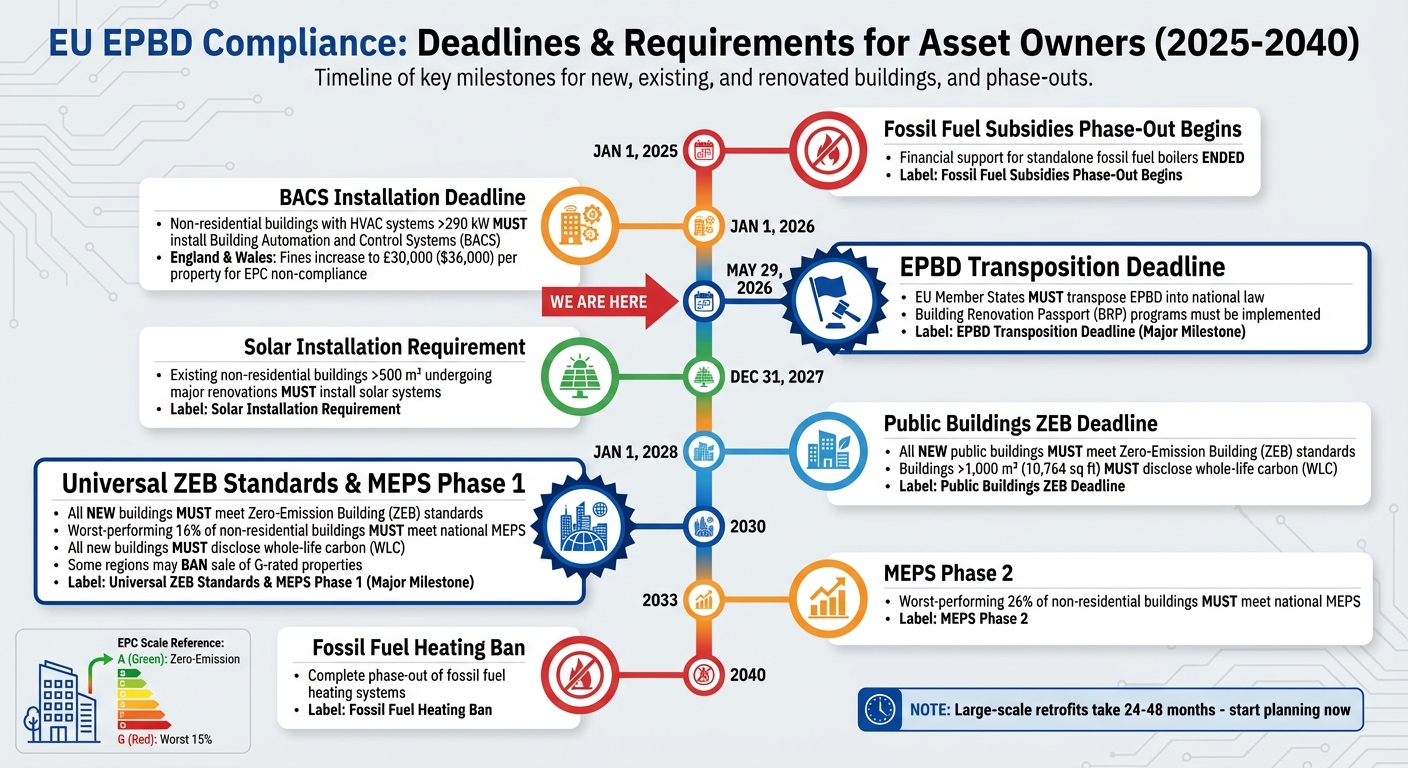
EPBD 2026 Compliance Timeline and Key Deadlines for EU Asset Owners
Richtlijn Energieprestaties van Gebouwen (EPBD) explained – whole-life carbon requirements
sbb-itb-5be7949
What the Revised EPBD Means for Asset Owners
The updated EPBD moves energy performance targets for asset management from optional to mandatory. Asset owners now face the urgent task of evaluating, planning, and upgrading their buildings to meet these new benchmarks.
The directive focuses on three main areas: energy performance standards for existing buildings, zero-emission requirements for new construction, and the inclusion of renewable energy sources. Non-residential property owners must prioritize upgrades for the least efficient buildings, while residential properties are expected to meet national average energy reduction targets. While the shift from individual building mandates to portfolio-wide goals provides some leeway, the overarching requirements remain firm. These adjustments are guided by clearly outlined objectives that underpin the directive.
Main Goals of the EPBD
The directive aims to ensure zero-emission standards for new buildings, significant upgrades to poorly performing properties, and the complete elimination of fossil fuel heating systems by 2040 [1].
For new construction, all buildings must meet zero-emission criteria by January 1, 2030, with public buildings facing an earlier deadline of January 1, 2028 [9]. A zero-emission building is defined as one with high energy efficiency, where nearly all energy comes from renewable sources either on-site or nearby.
Renovation goals follow a phased timeline. Non-residential buildings must meet specific energy performance benchmarks, while residential portfolios are required to achieve reductions in primary energy consumption at the national level [7].
Financial support for standalone fossil fuel boilers ends on January 1, 2025, and fossil fuel heating systems are set to be fully phased out by 2040 [1].
To support these objectives, the directive employs compliance tools like MEPS and enhanced EPCs.
Minimum Energy Performance Standards (MEPS) and EPC Requirements
MEPS are the enforcement tools that ensure renovation targets are met, setting minimum energy performance levels that buildings must achieve by specific deadlines. Energy Performance Certificates (EPCs), once primarily informational, now play a central role in compliance.
Under the revised directive, EPCs act as the primary indicator of compliance. As Andrei Vladimir Litiu, Executive Director of the EPB Center, legt uit:
"The EPC becomes the ‘checkpoint’ to demonstrate compliance. Without an improved EPC, an owner cannot legally continue to use or transact a building that falls below the standard" [10].
The EU has introduced a unified A–G EPC scale across Member States. Class A is reserved for zero-emission buildings, while Class G represents the worst-performing 15% of a country’s building stock. For non-residential buildings, MEPS are triggered by events such as sales, rentals, or major renovations [7]. Residential property owners, however, are given more flexibility, with a focus on achieving overall national energy reduction goals.
Building Renovation Passports and Renewable Energy Integration
Building Renovation Passports (BRPs) provide a detailed, step-by-step plan to help asset owners meet portfolio-level energy benchmarks. These passports outline strategic renovation roadmaps, ensuring upgrades are cost-effective and aligned with zero-emission targets [8]. Aangezien de BUILD UP Editorial Team notes:
"Renovation passports have the unique potential to translate high-level policy goals into building-specific action plans, helping owners and professionals answer the question of what sequence of improvements will achieve the required performance by 2030 or 2035" [8].
BRPs are also designed to prevent "lock-in" effects, where poorly planned early upgrades – like installing an oversized heat pump without first improving insulation – could limit future improvements. By organizing renovations in the correct sequence, BRPs help maximize energy efficiency and reduce long-term costs.
Member States must implement national BRP programs by May 29, 2026 [8]. While BRPs are often voluntary, some countries may require them at key moments, such as property sales. Additionally, under Annex VIII of the revised EPBD, BRPs must include estimates of how much renewable energy a building can generate and use after renovations.
Renewable energy integration is another core aspect of the directive. New buildings must be designed to accommodate solar installations, while existing non-residential buildings larger than 500 m² (about 5,380 square feet) undergoing major renovations must install solar systems by December 31, 2027 [9]. This ties building upgrades directly to increased on-site renewable energy generation.
Risks of Non-Compliance After the Transposition Deadline
Starting May 29, 2026, asset owners who fail to align with EPBD requirements could face far-reaching consequences. These extend beyond fines to include restricted funding opportunities, reduced property values, and operational challenges that may disrupt transactions or daily business activities.
Financial Penalties and Limited Access to Capital
Each EU Member State will impose its own penalties for non-compliance, with the directive requiring these measures to be "effective, proportionate, and dissuasive" [13]. For instance, in England and Wales, fines for failing to meet minimum EPC standards will rise to £30,000 (about $36,000) per property starting January 2026 [14].
Beyond fines, non-compliance can cut off access to green financing, public subsidies, and tax breaks. Financial institutions are increasingly tying lending conditions to building performance, which means non-compliant properties might face higher loan interest rates or even lose eligibility for EU-taxonomie-aligned loans [11][6][3]. Adding to the financial pressure, subsidies for standalone fossil fuel boilers were phased out as of January 1, 2025 [1][12].
These financial burdens can lead to broader market devaluation and operational setbacks for property owners.
Property Value Declines and Operational Setbacks
The impact of non-compliance extends to the value of assets and their operational viability.
Non-compliant buildings often experience a "brown discount", where their market value drops as they lag behind compliant properties [15]. For example, residential properties with top-tier EPC ratings can command a price premium of about 25% compared to poorly rated equivalents in some European markets [15]. Properties unable to meet Zero-Emission Building standards or Minimum Energy Performance Standards risk becoming "stranded assets" – essentially unlettable or unsellable due to regulatory constraints [16][17].
Some regions may go further by banning the rental of office buildings rated below energy class C or the sale of G-rated properties after 2030 [6]. This can create significant operational hurdles, such as being unable to renew operating licenses, finalize property transactions, or attract tenants [3].
For non-residential buildings with HVAC systems exceeding 290 kW (approximately 985,000 BTU/hr), failing to install a Building Automation and Control System by January 1, 2026, adds another layer of cost through mandatory manual inspections [6][3]. Als BlueBMS zoals het wordt uitgedrukt:
"Legacy systems become liabilities, and modern EU EPBD 2026 requirements BMS (Building Management Systems) become the baseline for legal operation in the commercial sector." [3]
Additionally, audit failures, missing Energy Performance Certificates, or incomplete Building Renovation Passports can lead to halted construction permits and delays in major renovations [18][12]. With regulatory scrutiny tightening across Member States, these issues are likely to escalate, creating even greater challenges for asset owners.
How to Align Asset Portfolios with EPBD Requirements
The updated EPBD regulations require asset owners to take proactive steps to ensure their portfolios meet the new standards. Here’s how you can establish a baseline, prioritize investments, and create renovation plans to both reduce risk and cut carbon emissions.
Conducting Energy Audits and Portfolio Assessments
Start by verifying and updating the EPCs for all properties, ensuring they adhere to the unified A–G scale. This standardization allows for accurate comparisons and helps identify the worst-performing 16% of non-residential buildings – key targets for renovation by 2030 [6].
Focus on HVAC systems during audits. Properties with HVAC systems exceeding 290 kW must install BACS by January 1, 2026 [6]. For properties without BACS, periodic manual inspections are mandatory.
Beyond operational energy, evaluate the whole-life carbon (WLC) impact for new constructions and major renovations. This includes assessing the carbon embedded in building materials and the energy used during operations [19]. For buildings larger than 10,764 square feet (1,000 m²), WLC disclosure will be required starting January 1, 2028, with all new buildings following by 2030 [19].
Paul Astle, Building Decarbonisation Lead at Ramboll, highlights the urgency:
"2030 sounds far away, but it’s not. With the changes required across the industry, we need to act now to build the literacy, data, and design capacity for whole-life carbon compliance." [19]
Additionally, address any gaps in energy consumption data. Missing data can impact property valuations and hinder accurate decarbonization planning [20].
Once you’ve established accurate baselines, you can move forward with investment plans that reduce risks and align with carbon reduction goals.
Developing Risk-Based, Carbon-Aligned Investment Plans
Using the updated assessments, evaluate each asset’s compliance risks. Properties rated "G" or "F" are especially vulnerable to becoming unrentable or unsellable as standards tighten [6][20].
To address these risks, use Renovation Passports. These digital tools provide a step-by-step guide for upgrades that meet MEPS and prevent assets from becoming stranded. By planning renovations sequentially, you can avoid inefficiencies. For instance, improving the building envelope first reduces heating demand, enabling the installation of smaller, more efficient systems [8].
Keep track of key compliance deadlines to align your renovation schedule:
| Building Type | Vereiste | Deadline |
|---|---|---|
| Non-residential (>290 kW HVAC) | Install BACS | January 1, 2026 [6] |
| Worst-performing 16% (non-residential) | Meet national MEPS | By 2030 [6] |
| All new public buildings | Meet ZEB standards | January 1, 2028 [6][19] |
| All new buildings | Meet ZEB standards | January 1, 2030 [6][19] |
| Worst-performing 26% (non-residential) | Meet national MEPS | By 2033 [6] |
Since fossil fuel heating subsidies ended on January 1, 2025 [6], shift investments to heat pumps, hybrid systems, and renewable energy sources to secure green financing.
Creating Renovation Roadmaps for Compliance
A renovation roadmap translates audits and assessments into actionable steps. A thorough roadmap should include quantified metrics for each intervention, such as projected energy savings, reductions in greenhouse gas emissions, energy bill savings, and the anticipated EPC class post-renovation [8]. This level of detail helps justify investments to stakeholders and ensures regulatory compliance.
Plan renovations around key lifecycle events like tenant turnover or system upgrades [8][7]. For example, replacing a roof offers an opportunity to add insulation or prepare for solar installations, aligning with future mandates [4].
Incorporate broader sustainability considerations into your roadmap. Include measures for product circularity, indoor environmental quality (IEQ), health and comfort improvements, and climate resilience [8]. These factors are becoming increasingly important for property values and tenant satisfaction.
One example is the Slava Raškaj Education Centre in Croatia, which combined seismic strengthening with energy efficiency upgrades, significantly cutting energy costs while improving indoor air quality [2].
Finally, tie your renovation roadmap to available financial resources. Identify funding schemes, technical assistance programs, and advisory services at both national and EU levels to support your projects [8].
Gebruik Oxand Simeo™ to Optimize Asset Investment Plans

Oxand Simeo™ takes audit data and turns it into precise, risk-focused investment strategies. By connecting detailed energy assessments to strategic asset management, it aligns perfectly with EPBD requirements.
Core Features of Oxand Simeo™ for EPBD Compliance
Oxand Simeo™ leverages 10.000 eigen verouderings- en energiewetten en 30.000 onderhoudsacties to predict how building components will age and consume energy over time[21]. This approach shifts the focus from age-based replacements to prioritizing actions based on risk.
Het platform Module Energieprestaties en vermindering van koolstofvoetafdruk calculates energy (kWh) and greenhouse gas savings for every planned maintenance or modernization project[21]. This gives you a clear picture of which investments will help you hit MEPS targets. For instance, one public sector client saved €4 million in energy costs across 66 buildings during the first budget cycle while cutting their maintenance backlog by 27%[21].
Met automated compliance reporting, Simeo™ simplifies audit preparation. You can export EPBD and ISO 55000-ready reports instantly, reducing audit preparation time by up to 70%[21]. This frees up your team to focus on executing plans rather than dealing with documentation.
De Scenario Simulator is another standout feature. It allows you to test and compare investment plans under various constraints – like budget, risk, energy performance, and carbon emissions – all at once[21]. You can easily adjust costs and timelines by dragging and dropping actions, keeping your plans adaptable to changing priorities or field conditions. Most users are able to launch multi-year scenarios within two weeks[21].
"We turned to Oxand because we needed a tool that would provide us with a predictive – not just corrective – view and help us manage our investments more effectively. Oxand stood out for its risk management capabilities." – Head of Budget and Asset Valuation Department, In’li[22]
These features highlight how Oxand Simeo™ provides a clear and data-driven way to compare pre- and post-EPBD planning methods.
Scenario Comparison: Pre- vs. Post-EPBD Planning
Here’s a side-by-side look at how traditional methods stack up against Oxand Simeo™ for EPBD compliance:
| Functie | Traditionele methoden | Planning van kapitaalinvesteringen met Oxand Simeo™ |
|---|---|---|
| Gegevensverzameling | Manual surveys and fragmented spreadsheets | Mobile app (Simeo Go) and automated APIs |
| Onderhoudsstrategie | Age-based replacement and reactive repairs | AI-powered aging models and risk-based prioritization |
| Budgeting | Static audits with limited long-term visibility | Multi-year CAPEX/OPEX vision with scenario-based planning |
| Naleving | Manual reporting, hard-to-justify investments | One-click export of audit-ready compliance data (EPBD/ISO 55000) |
| Duurzaamheid | Minimal insight into carbon trajectories | Integrated energy and carbon metrics for every action |
This table makes it clear: Oxand Simeo™ combines detailed data with strategic planning, making it possible to reduce your total cost of ownership by up to 30%[21][22]. By aligning your investment strategy with regulatory goals, you can avoid penalties, preserve asset value, and secure green financing opportunities.
Conclusion: Preparing for the EPBD 2026 Deadline
The May 29, 2026, deadline is approaching faster than many realize. Considering that large-scale retrofits often take 24 to 48 months to plan and execute, starting early is critical to meet the initial compliance requirements by 2030. Buildings play a major role in energy consumption and greenhouse gas emissions, and properties with the poorest energy performance will face mandatory upgrades by 2030[6][5].
"If you wait for every complexity to be ironed out before taking action, you risk falling further behind." – Ciaran O’Leary, Head of Sustainability, Catalyst[23]
This pressing timeline highlights the importance of acting now. Begin with a thorough audit of your building portfolio. Focus on identifying properties with low energy efficiency – often those with the lowest EPC grades – as these will need attention first. For facilities with HVAC systems exceeding 290 kW, ensure Building Automation and Control Systems (BACS) are installed by January 1, 2026. At the same time, create phased renovation plans that align with your carbon reduction objectives[6][20]. Acting promptly also positions you to take advantage of green financing and subsidies, which are likely to diminish over time, especially since financial support for standalone fossil-fuel boilers ended in 2025[6][5].
A surge in renovation demand is expected, which could stretch the availability of skilled labor, technical experts, and materials. Partnering with the right teams early on can help mitigate risks like "brown discounts" or stranded assets, while also preserving property value and tenant interest[6][20].
Taking these steps not only ensures compliance with EPBD regulations but also aligns your investments with broader carbon reduction goals. Tools like Oxand Simeo™ can simplify this process by transforming complex asset data into actionable, risk-focused investment plans. With features such as automated compliance reporting, scenario analysis, and integrated energy metrics, platforms like this can help you meet EPBD requirements while potentially lowering ownership costs by up to 30%. Early action is key to protecting your assets and securing a sustainable future.
FAQs
Does the May 29, 2026, deadline mean my buildings must already be upgraded?
No, the May 29, 2026, deadline doesn’t mean your buildings need to be upgraded by that date. Instead, it’s the deadline for incorporating the EPBD into national law. By then, renovation and compliance plans should already be in motion to align with the directive’s requirements.
Which assets in my portfolio should I fix first to avoid becoming “stranded”?
Focusing on assets that carry high environmental and carbon risks is crucial, particularly those that are energy-inefficient, lack proper insulation, or have significant embodied carbon. These types of properties are the most susceptible to stricter regulations and mandatory performance benchmarks.
To address these vulnerabilities, consider prioritizing upgrades such as improving insulation, optimizing HVAC systems, and cutting down embodied carbon. These measures not only help ensure compliance with evolving standards but also reduce risks and support broader carbon reduction objectives.
What should I do now if my building needs BACS or solar to stay compliant?
To get ready for EPBD compliance, begin by reviewing your building’s current systems to see if they align with the standards for Building Automation and Control Systems (BACS) or solar energy requirements. Consider implementing upgrades like BACS to improve energy efficiency and assess your building’s potential for solar energy use. Refer to official guidelines and collaborate with professionals to develop cost-effective solutions that meet compliance standards ahead of the May 29, 2026, deadline.
Verwante Blog Berichten
- Net-Zero bereiken in vastgoedportefeuilles: van doelstellingen naar investeringsplannen
- EU-taxonomie, EPBD en groene decreten: wat deze betekenen voor uw investeringsplan voor activa
- Hoe ISO 55001 u helpt te voldoen aan de EU-infrastructuur- en bouwvoorschriften
- Verouderde infrastructuur koolstofvrij maken: Belangrijkste uitdagingen en investeringsstrategieën