







Buildings in the EU account for 40% of energy use and 33% of greenhouse gas emissions, making their decarbonization essential to meet the "Fit for 55" goal of a 55% emissions reduction by 2030. However, with 75% of buildings being energy inefficient and renovation rates stuck at 1% annually, the EU faces a $160 billion yearly investment gap. To address this, three major funding mechanisms are being utilized:
- Cohesion Funds: Focused on regional energy renovations, with $31.2 billion allocated between 2021-2027 for projects like insulation, heating upgrades, and renewable energy installations.
- ETS2 Revenues: Starting in 2028, this carbon pricing system for heating fuels will generate funds for climate projects, including building retrofits.
- Social Climate Fund (SCF): Launching in 2026, it will provide $93.1 billion through 2032 to help vulnerable households and small businesses manage rising energy costs while investing in efficiency upgrades.
Each funding source targets specific areas of decarbonization, offers distinct timelines, and has unique eligibility criteria, ensuring a multi-pronged approach to reducing emissions. Up next: how to access these funds and align with EU climate goals.
From Ambition to Delivery Scaling Europe’s Clean Energy Projects
sbb-itb-5be7949
Cohesion Funds for Building Retrofits
Cohesion Funds are a key European Union (EU) initiative designed to reduce regional inequalities while advancing climate neutrality. Between 2021 and 2027, the EU has allocated $21.5 billion (€20 billion) specifically for energy renovations and efficiency improvements. With additional contributions from member states, this total rises to $31.2 billion (€29 billion) [7].
The funds are divided into three main areas: $11.4 billion (€10.6 billion) for public infrastructure, $7 billion (€6.5 billion) for residential housing, and $3.1 billion (€2.9 billion) for businesses [7]. Administered through 175 programs across the EU, these funds are managed at national or regional levels [7]. Eligible projects include upgrades like insulation, heating systems, district energy connections, renewable energy installations, and energy-efficient lighting systems [7].
Approximately 75% of the funding is tied to projects that can achieve at least 30% savings in primary energy use or reductions in greenhouse gas emissions for public buildings [7]. Overall, the initiative aims to renovate 723,000 homes and upgrade 355 million square feet (33 million m²) of public infrastructure across the EU [7].
Eligibility Requirements for Cohesion Funds
The allocation of cohesion funding varies by country, reflecting regional development priorities. Poland leads the list with $4.7 billion (€4.4 billion), followed by Spain at $2.4 billion (€2.2 billion), Italy at $1.6 billion (€1.5 billion), and Portugal at $1.5 billion (€1.4 billion) [7]. Some countries, like Ireland, dedicate up to 26% of their cohesion funds to renovation projects, while others allocate less [7].
To qualify for funding, projects must align with the EU’s sustainability goals and each country’s National Energy and Climate Plans (NECPs). For housing renovations, 65% of the funds are earmarked for projects meeting minimum energy savings thresholds, while this requirement increases to 78% for public infrastructure [7]. The updated Richtlijn Energieprestaties van Gebouwen (EPBD) prioritizes funding for the most energy-inefficient buildings and for vulnerable households, ensuring resources are directed where they are needed most [8].
Applications are submitted through national or regional portals, with one-stop shops available to provide technical, administrative, and financial guidance [8]. Applicants must include Energy Performance Certificates (EPCs) to document current energy use and projected savings – these will become mandatory or deeply integrated by May 2026 [8].
Case Studies of Cohesion Fund Projects
Two examples showcase how cohesion funds are making a difference in both public and residential sectors.
De Kindergarten Ptuj project in Slovenia highlights the benefits for public infrastructure. Through the European Cohesion Fund, 85% of the costs for energy renovations across seven kindergarten buildings were covered [9]. This project demonstrates how public institutions can achieve significant energy savings without straining local budgets.
In the residential sector, the Reljkovićeva 2 project in Croatia illustrates the application of cohesion funds to multi-family housing. Supported by Interreg Europe, which is financed by the European Regional Development Fund (ERDF), this initiative tackled the complexities of coordinating and financing retrofits in multi-apartment buildings [10]. These examples provide valuable insights for municipalities and property owners planning similar energy-efficient renovations.
ETS2 Revenues for Building Decarbonization
De EU Emissions Trading System 2 (ETS2) introduces carbon pricing for buildings and road transport, creating a funding source for decarbonization projects. Unlike the original ETS1, this system places responsibility on fuel suppliers, requiring them to purchase and surrender allowances for the emissions generated by the fuels they sell [12]. All allowances are auctioned, generating revenue specifically for climate initiatives [12].
Half of the auction proceeds go to the Social Climate Fund, while the other half is distributed to EU Member States for climate and social programs [11]. Member States must dedicate 100% of their ETS2 revenues to climate-related and social measures, such as retrofitting buildings and transitioning to cleaner energy sources [11].
To jumpstart investments before the system’s full launch in January 2028, the Europese Investeringsbank (EIB) and the European Commission have set up a €3 billion frontloading facility (roughly $3.2 billion) [6].
"With the EIB ETS2 Frontloading Facility, €3 billion are made available to Member States to support low and middle income households in the clean transition. The aim is to accelerate the deployment of solutions that reduce energy and transport bills, such as heat pumps and EV schemes." – Wopke Hoekstra, Commissioner for Climate, Net-Zero and Clean Growth [6]
A price stability mechanism is also in place: if allowance prices exceed €45 (about $48.30) per ton during the first three years, additional allowances will be released to stabilize costs [12]. The ETS2 cap aims to cut emissions by 42% by 2030 compared to 2005 levels [13]. These revenues are designed to support targeted investments, as detailed below.
How ETS2 Revenues Are Distributed
Member States receive ETS2 auction revenues based on verified emissions within their territories. In 2024, the existing EU ETS generated close to €39 billion (approximately $41.9 billion) in auction revenue, showcasing the financial impact of carbon pricing systems [13].
Key areas for ETS2 revenue allocation include:
- Installing heat pumps
- Improving building insulation and airtightness
- Electrification projects
- Expanding renewable district heating networks [2]
The focus is on "structural measures" that address energy inefficiency at its core rather than providing short-term fixes.
Several countries are already using ETS revenues effectively. Lithuania, for example, funded deep retrofits for residential buildings, achieving at least a 40% reduction in heat consumption. In France, around €2.3 billion (roughly $2.5 billion) was allocated to improve energy efficiency for low-income households. Denmark has directed ETS funds toward biogas upgrades and offshore wind projects to decarbonize its heating sector [14].
By January 2025, fuel suppliers will need to acquire permits and report emissions. Starting in 2028, they must surrender allowances annually to cover the prior year’s emissions [12].
Using ETS2 Funds in Long-Term Investment Plans
The structured use of ETS2 revenues supports long-term investments aligned with national climate goals. Projects must adhere to National Social Climate Plans, which Member States submit to the European Commission. These plans are integrated with National Energy and Climate Plans and future national building renovation strategies [5].
A practical framework for these investments is the Avoid-Shift-Improve (ASI) model:
- Avoid energy waste through better insulation and airtightness.
- Shift from fossil fuels to cleaner alternatives like heat pumps or district heating.
- Improve existing systems with smart controls and high-efficiency appliances [2].
The €3 billion EIB ETS2 Frontloading Facility allows immediate action on cleaner heating and cooling systems, particularly benefiting low- and middle-income households before ETS2 revenues start flowing in 2028 [6].
All projects funded by ETS2 must display the EU label and the text "(co-)Funded by the European Union Emissions Trading System" on communication materials, websites, and physical sites to ensure transparency and public awareness [14].
ETS2 revenues are vital for achieving EU decarbonization goals. The Social Climate Fund, largely supported by ETS2, is projected to mobilize at least €86.7 billion (around $93.1 billion) between 2026 and 2032, including 25% national co-financing [13].
The Social Climate Fund for Vulnerable Communities
The introduction of ETS2 is expected to raise heating fuel costs, making it harder for low-income households to manage expenses. That’s where the Social Climate Fund (SCF) steps in, aiming to lower building emissions while shielding vulnerable communities from these price hikes, which begin in January 2028. The SCF redistributes ETS2 revenues to help those most affected.
The fund focuses on vulnerable groups – households, small businesses, and transport users – who are hit hardest by rising fuel and heating expenses. In 2023, over 10% of Europeans couldn’t afford to keep their homes warm, with some low-income families spending over 10% of their budgets on heating [3][16]. Between 2026 and 2032, the SCF will channel billions of dollars into these communities, with an added 25% contribution from national governments [16].
What makes the SCF stand out is its proactive approach. By starting in 2026 – two years before ETS2’s price changes – funds can be invested early to reduce energy demand. This allows households to install heat pumps, improve insulation, and adopt solar energy well before the full impact of higher heating costs is felt.
"The Social Climate Fund is a first of a kind instrument, as it brings together the climate and social perspective, encouraging simultaneously a reduction in emissions, as well as the alleviation of energy and transport poverty." – Alice Giro, Policy Officer, DG CLIMA [4]
Public support for this initiative is strong. Nine out of ten Europeans favor financial aid for energy efficiency in homes, and 88% support a green transition that ensures no one is left behind [16].
Grants for Social Housing Decarbonization
Social housing projects play a key role in the SCF’s strategy, as they cater to those most at risk of energy poverty. The fund prioritizes upgrades to affordable housing, focusing on long-term improvements like insulation, heat pumps, and solar panels [16][19].
While up to 37.5% of a Social Climate Plan’s budget can go toward temporary income support, the majority of funds must be used for lasting changes that reduce energy consumption and emissions [3][17]. For instance, renovating the least efficient 10% of buildings could cut emissions from buildings by about 20% [3].
In December 2025, Sweden became the first country to have its Social Climate Plan approved, unlocking $537 million (around €500 million) to support its clean energy transition. Sweden will begin receiving payments in 2026, ahead of ETS2’s implementation. By early 2026, several other countries, including Latvia, Lithuania, Malta, and the Netherlands, had submitted their plans for review [2][16].
To ensure accountability, the SCF uses a performance-based funding model. Funds are released only when countries meet specific milestones outlined in their Social Climate Plans. This system, inspired by the Recovery and Resilience Facility, ensures that the money is used effectively.
Local governments are also required to participate in public consultations to make sure national plans address local housing needs. Additionally, up to 2.5% of SCF funds can be allocated for technical assistance, such as setting up one-stop shops to help low-income residents apply for renovation grants [2][4][17].
Eligibility Criteria Focused on Equity
The SCF is designed to ensure that resources reach those who need them most. Member States must identify vulnerable groups and submit detailed Social Climate Plans to the European Commission by June 30, 2025 [16][17].
Vulnerable households are defined as those experiencing energy poverty or with lower-middle incomes that are significantly affected by ETS2 costs but lack the means to invest in energy efficiency [19]. To make sure aid targets the right people, Member States are encouraged to use means-tested support, as universal programs may not reach the most at-risk groups [3].
Governments can use data like utility bill arrears, postal codes, and tax records to pinpoint eligible households, especially in rural areas where heating and transport costs tend to be higher [3][17]. This targeted approach also helps bridge the rural-urban divide.
All SCF-funded projects must comply with the "Do No Significant Harm" (DNSH) principle, ensuring that they don’t negatively impact other environmental goals [17][18]. Additionally, projects must align with broader strategies like National Building Renovation Plans and updated National Energy and Climate Plans to support 2030 climate goals.
For context, under an ETS2 price of $64.40 (about €60) per ton of CO₂, annual heating costs for a household using a coal boiler could rise by $376 (roughly €350), while gas boiler users might see an increase of $174 (around €162) [3]. The SCF’s eligibility criteria directly address these financial pressures, ensuring that households most affected by ETS2 can transition to cleaner, more cost-effective heating solutions.
Comparing the 3 Funding Mechanisms
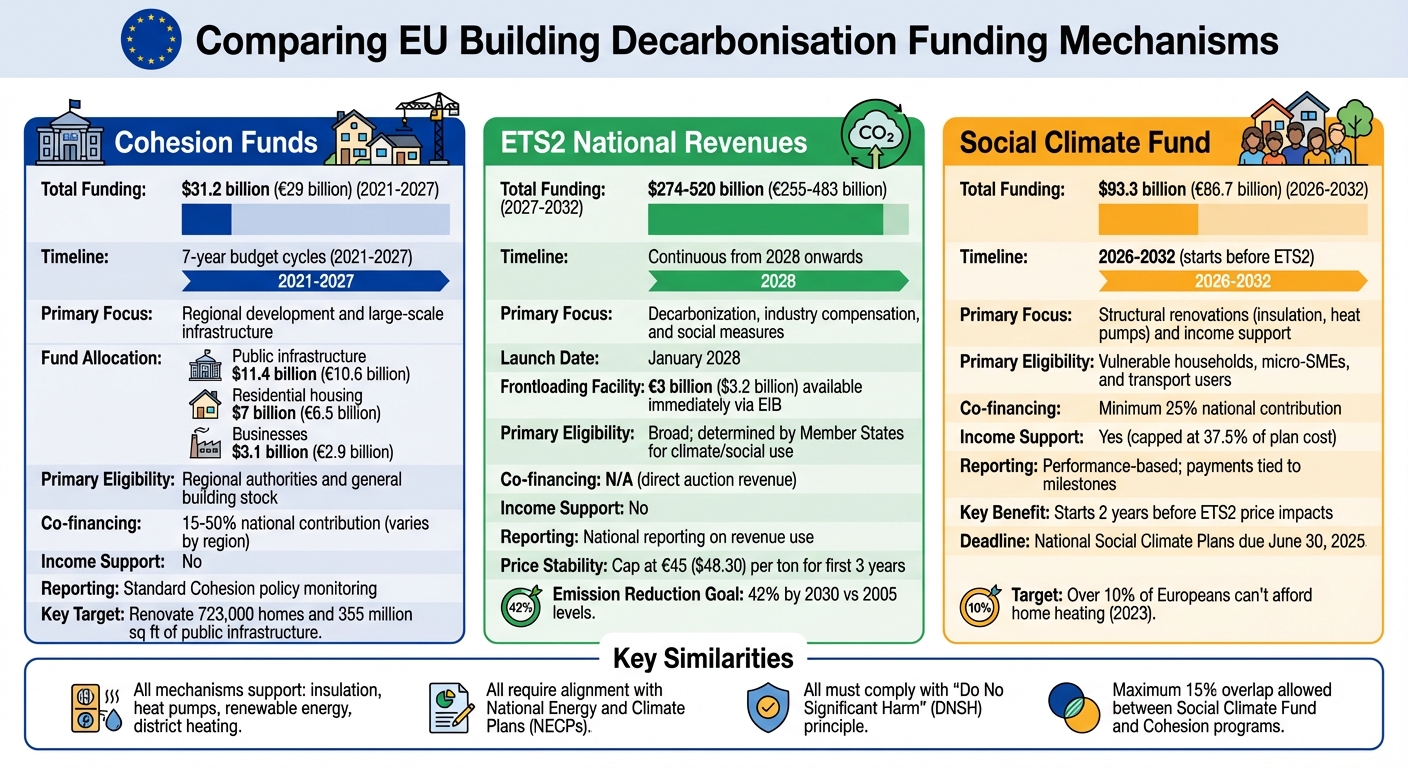
EU Building Decarbonisation Funding Mechanisms Comparison: Cohesion Funds, ETS2, and Social Climate Fund
Looking at the three funding mechanisms side by side, it’s clear they each play a distinct role in supporting decarbonization efforts while working together as part of a broader strategy. Here’s a quick recap of their focus areas:
- Cohesion Funds: These target regional development and large-scale infrastructure, with specific allocations for improving energy performance in regions [1][8].
- ETS2 National Revenues: Expected to generate between $274 billion and $520 billion (€255 billion to €483 billion) from 2027 to 2032, this funding pool allows flexibility for climate initiatives and social programs [3].
- The Social Climate Fund: With at least $93.3 billion (€86.7 billion) available from 2026 to 2032, this fund is aimed at helping vulnerable households manage rising heating costs [2][15].
Timing Matters
The rollout schedules for these mechanisms are staggered. The Social Climate Fund kicks off in 2026, giving low-income families a head start to invest in energy-saving upgrades, like insulation or heat pumps, before the ETS2 begins in January 2028. Meanwhile, Cohesion Funds operate on seven-year cycles, and ETS2 revenues will be available continuously starting in 2028 [1][2].
Co-Financing Rules
Each mechanism comes with its own co-financing requirements:
- The Social Climate Fund requires national governments to contribute at least 25%.
- Cohesion Funds have variable national co-financing rates, typically between 15% and 50%, depending on the region [2][15].
- ETS2 revenues, on the other hand, don’t have strict co-financing rules since they come directly from carbon auction proceeds. However, only 15% of Social Climate Plan investments can overlap with Cohesion policy programs [15].
Key Features at a Glance
Here’s a comparison table to break down the requirements and priorities of each funding source:
| Functie | Cohesion Funds | ETS2 National Revenues | Social Climate Fund |
|---|---|---|---|
| Primary Eligibility | Regional authorities and general building stock [1] | Broad; determined by Member States for climate/social use [2] | Vulnerable households, micro-SMEs, and transport users [2][3] |
| Funding Priorities | Regional development, energy efficiency, and infrastructure [1] | Decarbonization, industry compensation, and social measures [2][3] | Structural renovations (insulation, heat pumps) and income support [2] |
| Co-financing Rule | Varies by region (typically 15% to 50% national) [15] | N/A (direct auction revenue) | Minimum 25% national co-financing [2][15] |
| Rapportage | Standard Cohesion policy monitoring | National reporting on revenue use (often less stringent) [1] | Performance-based; payments tied to SCP milestones [3] |
| Timeline | 7-year budget cycles (e.g., 2021–2027) [1] | Continuous from 2028 onwards [2] | 2026–2032 (pre-funding begins before ETS2) [2][15] |
| Income Support Allowed | Geen | Geen | Yes (capped at 37.5% of plan cost) [2][3] |
These mechanisms provide a blend of flexibility, targeted support, and long-term planning, making them essential tools for advancing decarbonization goals. Up next, we’ll dive into how to apply for these funds to simplify your project planning process.
How to Apply for EU Decarbonisation Funds
Now that we’ve covered the funding mechanisms, let’s dive into the application process. Applying for EU decarbonisation funds requires careful planning and preparation. With energy efficiency investment needs in the EU exceeding €370 billion (roughly $398 billion) annually, and public funding covering only about 15% of these needs, securing funding is a critical step for project success[8][20].
Preparing Energy Audits and Documentation
Before applying, it’s important to establish your building’s energy baseline. Start with obtaining an Energy Performance Certificate (EPC), which provides a snapshot of your building’s current efficiency levels. By May 2026, national databases on energy performance will be operational across the EU, simplifying access to essential building data and metrics for applications[8].
Another key tool is the Renovation Passport, which offers a step-by-step plan for achieving deep renovations. These renovations aim for energy savings of 60% or more – an area with huge potential since currently, only 0.2% of residential renovations in the EU qualify as deep renovations[1]. Additionally, prepare calculations showing greenhouse gas reductions if you’re applying for funds derived from ETS revenues[21].
For assistance, programs like ELENA (European Local ENergy Assistance) and the InvestEU Advisory Hub can guide you through technical studies and energy audits. Their support ensures your documentation meets the strict standards required by funding authorities.
With these documents in order, the next step is submitting your application through the appropriate national portal.
Submitting Applications Through National Portals
Each EU country has its own portal for submitting energy efficiency grant applications. These portals are typically managed by national or regional authorities, especially for funds like the Cohesion Funds and the Social Climate Fund. Below is a list of some of the key national portals:
| Land | National Renovation and Funding Portals |
|---|---|
| Frankrijk | france-renov.gouv.fr |
| Ireland | seai.ie/grants/home-energy-grants |
| Germany | energiewechsel.de |
| Italy | pnpe2.enea.it |
| Nederland | verbeterjehuis.nl |
| Spain | mivau.gob.es |
| Sweden | energimyndigheten.se |
| Poland | czystepowietrze.gov.pl |
To simplify the process, one-stop shops are being set up across the EU. These advisory services provide a centralized resource for technical, administrative, and financial guidance. For example, platforms like France’s "France Rénov’" or Ireland’s "SEAI" let you check if your project qualifies for grants, loans, or tax credits before diving into the technical documentation.
For the Social Climate Fund, Member States must submit Social Climate Plans (SCPs) by June 2025. Sweden, for instance, had its €500 million Social Climate Plan approved in December 2025, allowing it to access funds to support vulnerable households during the clean energy transition. The Social Climate Fund will begin operations in 2026[16].
Meeting Compliance and Reporting Requirements
Once your application is submitted, staying compliant and on schedule becomes crucial. Projects must prioritize energy efficiency over new energy generation investments. If you’re applying for funds linked to the Social Climate Fund or the Recovery and Resilience Facility, structure your timeline around clear, trackable milestones. Payments are often tied to performance results, with funds released only after milestones outlined in National Social Climate Plans are achieved[4][16].
Ensure your project aligns with National Energy and Climate Plans (NECPs) and upcoming national building renovation plans. From 2028, the ETS2 system will start incorporating carbon costs into fuel prices, making strategies like improved insulation, heat pump installations, and smart controls essential for demonstrating long-term cost-effectiveness.
"National Building Renovation Plans… help allocate public funding optimally, channel private and public investment into the necessary transformation, and establish predictable renovation pipelines."
– European Commission[8]
If you’re working on Social Climate Fund projects, participating in mandatory public consultations with local and regional authorities is essential. This step ensures your project aligns with National Social Climate Plans and meets both technical and equity-focused criteria.
Using Oxand Simeo™ to Optimize Fund Allocation
After securing funding through ETS2, Cohesion, or the Social Climate Fund, the next challenge is ensuring those resources are allocated effectively. At this point, data-driven planning becomes essential. For example, Italy’s Superbonus program struggled with poor targeting, leading to costs exceeding $129 billion while covering only 4% of building renovations[1]. To avoid such inefficiencies, it’s critical to select projects carefully, ensuring they align with both technical and regulatory standards. Oxand Simeo™ offers advanced tools to streamline this process.
Simulating Carbon Reduction Pathways
Oxand Simeo™ allows users to model various carbon reduction scenarios before committing funds. Its Energy Performance and Carbon Footprint Reduction Module calculates the energy savings (in kilowatt-hours) and greenhouse gas reductions for each renovation action, ranking projects based on measurable carbon impact.
The platform’s scenario simulator also evaluates investment plans under different ETS2 carbon price scenarios. For instance, carbon prices could range from $64 per ton (€60) to as high as $322 per ton (€300) if decarbonization efforts falter[1][3]. At $64 per ton, homeowners with a standard gas boiler could see annual costs rise by $174 (€162), while those using coal boilers might face an increase of $376 (€350)[3]. These simulations can help prioritize projects like switching from coal to heat pumps, which maximize savings for vulnerable households eligible for Social Climate Fund grants.
Additionally, the platform incorporates social equity data – such as postal codes and income levels – to ensure funds are directed toward communities most affected by energy poverty[3]. For example, a public sector client achieved $4.3 million (€4 million) in energy savings across 66 buildings within a single budget cycle by using this targeted approach[22].
Once the highest-impact projects are identified, the next step is translating these insights into actionable, compliant investment plans.
Creating EU-Compliant Investment Plans
After prioritizing projects, Oxand Simeo™ simplifies the creation of EU-compliant documentation. The platform generates investment plans aligned with ISO 55001 standards and produces audit-ready reports directly from simulation data, cutting audit preparation time by 70%[22][23]. This feature is crucial for accessing performance-based funding, where payments are tied to milestones outlined in National Social Climate Plans.
Oxand Simeo™ also creates detailed audit trails, linking each investment decision to specific risks, costs, and carbon reduction targets. For Social Climate Fund applications – which require detailed National Social Climate Plans by June 2025[3] – this ensures you can quickly produce the evidence-based documentation demanded by funding authorities. Organizations typically launch multi-year scenarios within two weeks[22][23], making it easier to meet tight deadlines. This approach ensures every funded project aligns with EU building decarbonization goals and satisfies performance-based funding requirements.
Conclusie
A unified strategy is essential for addressing the challenges of financing building decarbonization. By combining Cohesion Funds for regional infrastructure, ETS2 revenues for market-driven climate initiatives, and the Social Climate Fund to protect vulnerable households, Europe can work toward closing the estimated $165 billion annual investment gap required to meet 2030 climate goals [1]. A focus on deep renovations in inefficient buildings is critical, as these efforts alone could reduce emissions by 20% [3].
Time is of the essence. Delays could lead to ETS2 carbon prices skyrocketing to $215–$322 per ton – well above the European Commission’s target of $48–$65 per ton [1]. Such price increases would disproportionately affect households already struggling with energy costs, potentially sparking political resistance. The Europees Milieuagentschap highlights the importance of a broader policy framework, stating:
"Significant emission reductions will only be achieved if ETS2 is combined with a broader, coherent EU and national climate policy mix" [2].
Deadlines are tight: National Social Climate Plans must be submitted by June 30, 2025, with funding tied to specific milestones [2][16]. Without proper planning tools, organizations risk repeating past mistakes and missing critical targets.
This is where data-driven solutions like Oxand Simeo™ come into play. The platform enables organizations to simulate carbon reduction scenarios, prioritize impactful projects, and quickly generate EU-compliant documentation. For example, one public sector client saved $4.3 million in energy costs across 66 buildings within a single budget cycle by adopting this approach [22]. By integrating social equity data – such as income levels and postal codes – Oxand Simeo™ ensures that funding reaches the communities most affected by energy poverty [3]. This method ties smart investment strategies to tangible, measurable outcomes.
The roadmap is clear: combining strategic funding streams with advanced planning tools can transform Europe’s building stock. Organizations that act now – aligning national plans, targeting vulnerable populations, and utilizing technical solutions – can meet regulatory demands while delivering meaningful benefits like reduced energy costs, cleaner air, and a fairer energy transition for all. Through this alignment, stakeholders can achieve a balanced and effective energy shift that addresses both compliance and community needs.
FAQs
Which EU fund fits my building retrofit project best?
The Social Climate Fund is a strong choice for building retrofit projects centered on decarbonization and aligned with EU climate goals. This fund is designed to support efforts to cut emissions and improve energy efficiency in buildings. Additionally, it works alongside co-financing from member states, making it a collaborative financial tool.
What’s more, the Social Climate Fund can be paired with other EU funding sources, such as Cohesion Funds. This flexibility allows project planners to maximize resources and focus on reducing carbon footprints effectively.
What documents do I need to apply for these funds?
To apply for Cohesion Funds, ETS2 revenues, or the Social Climate Fund, here’s what you’ll usually need:
- A well-prepared project proposal focused on building decarbonization of energy efficiency improvements.
- A national Social Climate Plan or another relevant strategic document.
- Proof that you’ve conducted stakeholder consultations.
- Financial records detailing budget allocation and projected costs.
- Documentation confirming your eligibility.
Be sure to review the specific application guidelines for precise details and requirements.
Can I combine Cohesion Funds, ETS2 money, and the Social Climate Fund?
You can use Cohesion Funds, ETS2 revenues, and the Social Climate Fund together to support building decarbonization initiatives. Here’s how they align:
- De Social Climate Fund permits up to 25% co-financing from national budgets.
- Tot 15% of investments from Social Climate Plans can be integrated with Cohesion policy programs.
These funding sources are designed to complement each other, making it easier to implement projects focused on energy efficiency, building renovations, and reducing carbon emissions.