







Most ESG goals fail because they lack funding and accountability. To bridge this gap, you need to connect ESG objectives with data-driven asset investment planning. Here’s what works:
- Tie ESG goals to measurable asset data. Build a centralized asset register with metrics like energy use, emissions, and governance practices.
- Use predictive models. Forecast asset aging, energy savings, and carbon reduction pathways using ROI voor voorspellend onderhoud models to prioritize impactful projects.
- Adopt multi-criteria frameworks. Evaluate projects based on financial, risk, and ESG performance to make informed decisions.
- Show ROI with audit-ready plans. Combine financial returns and ESG benefits into clear, ISO 55001-aligned proposals.
- Secure ESG-linked financing. Leverage green bonds or sustainability-linked loans tied to measurable KPIs.
The key is to treat ESG planning as a process rooted in data and financial alignment, turning ambitions into actionable, fundable programs.
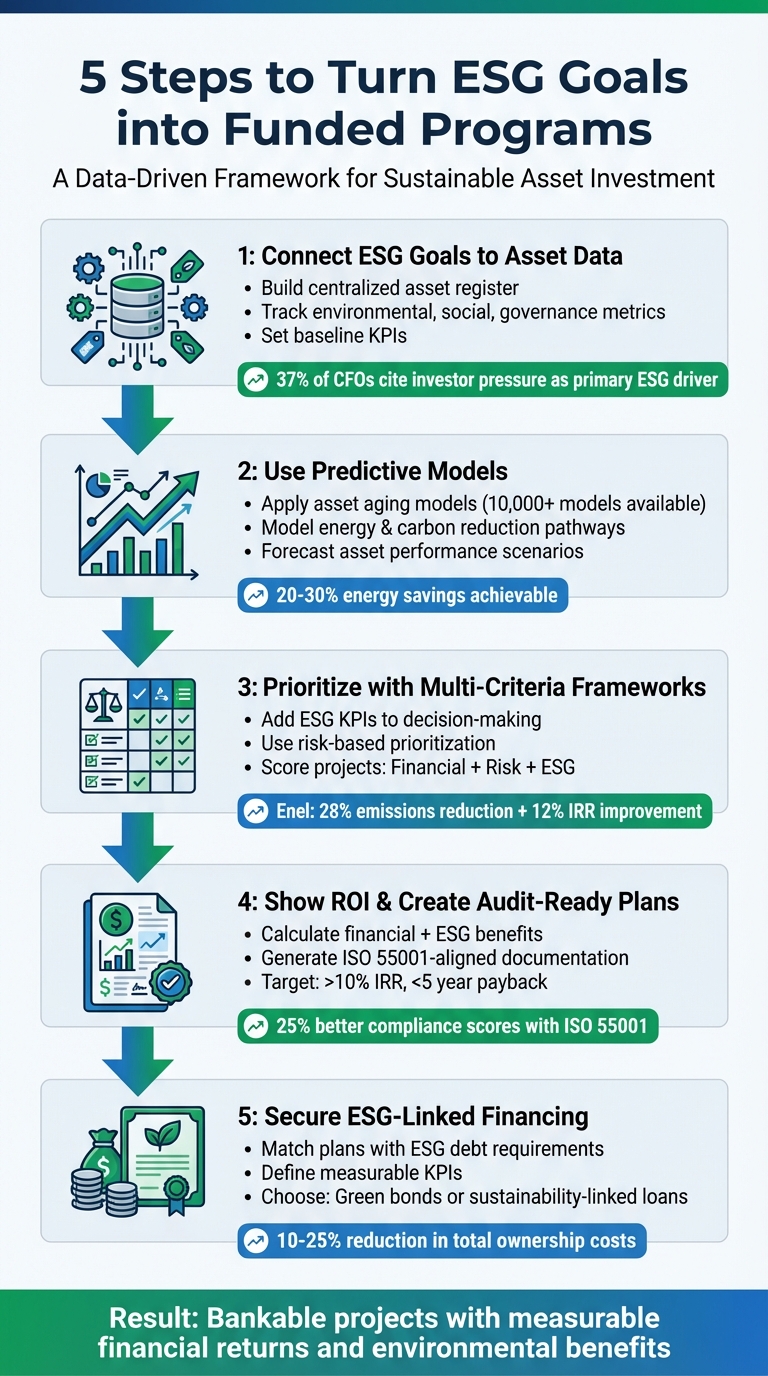
5-Step Framework for Turning ESG Targets into Fundable Investment Programs
Asset Management: From ESG Investing to Transition Finance
sbb-itb-5be7949
Step 1: Connect ESG Goals to Asset Data
ESG targets often fall short when they aren’t tied to actual asset performance. To make these goals actionable and fundable, you need to connect them directly to measurable data from your assets. This approach ensures investments are based on real risks and performance, setting the stage for meaningful, sustainable projects.
Een gecentraliseerd activaregister opzetten
Start by identifying the assets and metrics that are most critical to your operations. According to a Q1 2023 survey, 37% of CFOs cited investor pressure as the primary reason for improving ESG programs[6]. Focus on the performance indicators that influence asset risks and opportunities.
Create a unified asset register that includes both inventory and performance details. This should cover:
- Environmental data: Greenhouse gas emissions, energy use per square foot, water consumption, and waste generation.
- Social factors: Labor standards, employee health and safety, and community impact.
- Governance metrics: Board diversity, executive pay transparency, and anti-corruption policies[7].
Standardizing how you collect this data ensures it’s comparable across different sites and builds trust with investors. As Mark Zavodnyik, Director of ESG & Sustainability at Grant Thornton, explains:
"It’s important for asset managers to build a strong foundation when developing ESG programs anchored around issues truly relevant to their investments."[6]
Consistency is key – use standardized categories, units, and reporting periods. Tools like Simeo-inventaris can help centralize this data, streamlining it into investment planning models and avoiding the chaos of scattered spreadsheets.
Set Key ESG Metrics and Baselines
Once your centralized data is ready, establish clear baseline metrics to guide your funding decisions. For real estate portfolios, this might include tracking LEED certification, energy intensity (kWh per square foot annually), carbon footprint (tons CO₂e per year), and climate risks like flooding or heat exposure[7].
Since ESG data often lacks standard definitions, consistent data collection is essential. This is where having a dedicated team or individual makes a difference. Michael Patanella, National Managing Partner for Asset Management at Grant Thornton, suggests:
"a hybrid approach, where you have an internal ESG champion who can work with the outside provider."[6]
Verify your asset data before publicizing any ESG achievements. Accurate baselines not only enhance credibility but also support stronger funding opportunities. Keep in mind that 85% of millennial and Gen Z investors believe companies should influence environmental practices in the businesses they invest in[6]. They will scrutinize your data, so transparency is critical.
Here are some core metrics to use as benchmarks for prioritizing investments:
| ESG Category | Key Baseline Metrics for Asset Registers |
|---|---|
| Milieu | GHG emissions (Scope 1, 2, 3), energy consumption, water usage, waste generation |
| Sociaal | Labor standards compliance, employee health and safety records, community impact metrics |
| Bestuur | Board diversity ratios, executive compensation transparency, anti-corruption policies |
Step 2: Use Predictive Models for ESG-Aligned Scenarios
Once you’ve centralized your asset data, the next step is to forecast how your assets will perform under different strategies. Predictive modeling allows you to test scenarios before committing capital, helping you identify investments that can achieve both ESG goals and financial returns. This approach shifts your focus from reactive problem-solving to proactive, data-driven planning that aligns with budget and sustainability objectives. These models leverage your centralized data to help you prioritize investments effectively.
Apply Predictive Asset Aging Models
Using your consolidated asset data, predictive asset aging models transform raw information into actionable insights. Asset deterioration doesn’t follow a one-size-fits-all timeline – aging depends on factors like usage, environmental exposure, and maintenance history. These models simulate how assets degrade over time, predicting when failures might happen and analyzing the effects of various maintenance strategies on long-term performance.
Oxand‘s proprietary database, built over two decades, incorporates over 10,000 aging and performance models along with 30,000+ maintenance laws. By tapping into data from inspections, surveys, and condition assessments, these models use statistical methods to forecast asset behavior. This enables you to weigh options like immediate replacement versus deferring maintenance, backed by solid data.
For example, if you’re managing a portfolio of commercial buildings with aging roofs, predictive models can help you compare the impact of repairs, refurbishments, or full replacements. These insights allow you to evaluate costs, energy efficiency, carbon emissions, and compliance risks – making it easier to align your ESG goals with measurable risk reduction.
Model Energy and Carbon Reduction Pathways
In addition to aging forecasts, modeling energy and carbon reduction pathways helps align your asset strategy with decarbonization goals. Investors and regulators increasingly expect concrete, measurable plans for reducing emissions – not just broad commitments. Energy transition tools within asset planning platforms enable you to simulate interventions like LED lighting installations, improved building insulation, or heat pump adoption. These models calculate how each action affects your carbon footprint, expressed in tons of CO₂e per year.
"Over the long run, investors are going to be continually interested in what’s going on regarding climate risk; the energy transition; employee engagement and retention; and corporate governance."
- Mark Zavodnyik, Director, ESG & Sustainability at Grant Thornton[6]
This perspective highlights the importance of clear, measurable progress toward decarbonization, building on the standardized metrics established in Step 1.
When modeling carbon reduction pathways, focus on the ESG factors most relevant to your assets. For instance, energy use and emissions might be critical for a manufacturing facility, while water efficiency or waste management could be more relevant for a small office building[6][8]. Prioritizing material factors ensures you maximize both financial and environmental outcomes without overcomplicating your ESG strategy.
Step 3: Prioritize Investments with Multi-Criteria Frameworks
When resources are limited, selecting the right projects becomes critical to aligning your investments with ESG goals. Multi-criteria analysis (MCA) frameworks help make this process more objective by evaluating projects across various dimensions – like financial costs, risk reduction, carbon impact, and compliance requirements. By scoring and ranking projects based on these factors, MCA ensures you’re balancing all your organizational priorities effectively. This step builds on the predictive models and asset data established earlier.
Add ESG KPIs to Decision-Making
Start by identifying measurable ESG KPIs that align with your sustainability goals, as outlined in Step 1. Typical metrics include greenhouse gas reductions (measured in tons of CO₂e per year), energy savings (kWh), social impact indicators (e.g., job creation or improved accessibility), and governance metrics (like compliance audit success rates). These KPIs should follow the SMART framework – Specific, Measurable, Achievable, Relevant, and Time-bound – so you can track progress and demonstrate ROI effectively.
Integrate these ESG KPIs into a comprehensive evaluation framework alongside traditional cost and risk factors. Assign weights to each criterion to reflect their importance – balancing decarbonization, risk reduction, lifecycle cost, and compliance. Then, score each project on a scale of 1 to 10 for each criterion, multiply these scores by their respective weights, and calculate a final ranking.
For example, in 2022, Enel Green Power applied this method to prioritize $1.2 billion in renewable asset upgrades across 150 projects. They assigned a 45% weight to carbon savings, which led to a 28% emissions reduction and a 12% improvement in internal rate of return. This approach, directed by Asset Strategy Director Maria Rossi, proved highly effective[1].
Use Risk-Based Prioritization for ESG Outcomes
Risk-based frameworks take prioritization a step further by incorporating probabilities of failure and ESG consequences into the decision-making process. By leveraging asset data and predictive models, these frameworks combine technical and ESG factors for a more informed strategy. They assess the likelihood and severity of asset failures, factoring in potential ESG impacts like regulatory fines, carbon penalties, or service disruptions.
Hulpmiddelen zoals Oxand Simeo™ can simulate asset deterioration and failure probabilities under different budget scenarios. For instance, if your annual CAPEX is capped at $50 million, the platform can identify projects that maximize ESG and risk-adjusted value. This might mean prioritizing HVAC upgrades delivering 40% energy savings over roofing repairs that yield just 10%[2][3].
From 2021 to 2023, Thames Water in the UK used risk-based prioritization through Oxand Simeo™ to manage a $500 million CAPEX program while adhering to strict Ofwat regulations. By integrating ESG KPIs, such as leak reduction, with risk scores, they achieved an 18% drop in overall risk exposure and a 15% carbon reduction across their network, which serves 15 million customers[4]. This example highlights how risk-based frameworks not only protect assets but also drive sustainability progress within budget and regulatory limits.
Step 4: Show ROI and Create Audit-Ready Plans
Once you’ve prioritized risk-based projects, it’s time to turn those priorities into actionable, fundable initiatives. Using the data and predictive insights gathered earlier, you can demonstrate the financial and ESG (environmental, social, and governance) benefits of these investments. The goal here is to create proposals that clearly show both financial returns and ESG impacts while meeting regulatory and audit requirements. At this stage, your project list evolves into a well-supported proposal with transparent calculations and standardized reporting.
Calculate Financial and ESG Benefits
To show the value of your initiatives, use an ROI formula that combines financial returns with ESG benefits:
ROI = (Net Benefits – Investment Cost) / Investment Cost × 100
Here, net benefits should include both financial savings (like reduced energy and maintenance costs) and monetized ESG impacts (such as carbon reduction). For example, in the U.S., you can assign a shadow price of $50 per ton of CO₂ avoided to quantify environmental benefits in dollar terms.
Present your findings in a clear dashboard format, including metrics like NPV (netto contante waarde), IRR (intern rendement), and payback periods. Aiming for an IRR above 10% and a payback period under five years aligns with most corporate investment benchmarks. For instance, if you invest $10 million in energy-efficient HVAC systems, you might see $2 million in annual energy savings plus a reduction of 5,000 tons of CO₂ (valued at $250,000). This would result in a 27% ROI in the first year alone[1][5]. Incorporating lifecycle cost analysis can further highlight how ESG-focused investments reduce long-term operating expenses[9][4].
In Q3 2023, Duke Energy analyzed the ESG ROI of grid upgrades spanning 5,000 miles of transmission lines. Using IBM Maximo software and ISO 55001 standards, their Sustainability VP, Mark Johnson, demonstrated an 18% IRR and 1.5 million tons of CO₂ savings over a decade. This analysis helped secure $300 million in funding from the board[13].
These quantifiable benefits set the stage for creating audit-ready plans.
genereren ISO 55001-Aligned Documentation
To meet audit requirements, you’ll need a Strategic Asset Management Plan (SAMP) that ties every decision to data, methodologies, and clear objectives. ISO 55001 standards require detailed documentation, including asset registers, risk matrices, performance KPIs (like maintaining asset uptime above 95%), and continuous improvement processes. For ESG investments, sustainability metrics should be fully integrated into governance systems, ensuring traceability at every step[10][11].
Tools like Oxand Simeo™ simplify this process by automating the creation of ISO 55001-compliant reports. These reports include asset registers, risk assessments, and KPI dashboards, generating outputs in PDF or Excel formats with complete audit trails. For example, a $100 million infrastructure program might produce a 50-page plan documenting ESG compliance alongside a 12% IRR[4]. Such plans often include an executive summary, visual aids like Sankey diagrams for carbon flows, and appendices with detailed calculations. Tailor these presentations to your audience – focus on financial metrics for CFOs and ESG performance for sustainability-focused investors.
Organizations certified under ISO 55001 consistently outperform their peers, achieving 25% better compliance audit scores and a 12% higher ROI on capital projects, as reported by the Instituut voor Vermogensbeheer‘s 2024 benchmark study[12].
In 2024, Thames Water’s Asset Management Director, Jane Harlow, led the creation of ISO 55001-aligned ESG investment plans for over 20,000 assets. Using predictive modeling, they reduced carbon emissions by 28% (from 1.2 million to 860,000 tons CO₂e annually) and achieved $450 million in lifecycle savings over five years. This documentation was instrumental in securing $625 million in green bonds[14].
Step 5: Secure Funding Through ESG Debt Structures
Turning ESG goals into actionable investments requires more than just plans – it demands funding. By leveraging risk-based and predictive models, you can secure ESG-aligned financing that transforms your ambitions into tangible results. With audit-ready plans in place, the next step is to match your ESG program with the right financing structures and establish lender-approved performance indicators. As Umbrex zoals het wordt uitgedrukt:
"Decarbonization succeeds or fails in the finance function. Ambition becomes real only when it is translated into investment appraisals, capital budgets, operating plans, and portfolio choices."[15]
This process connects your asset performance with capital market needs, bridging the gap between plans and fully funded programs.
Match Plans with ESG Debt Requirements
There are two primary types of ESG debt structures: use-of-proceeds instruments (such as green bonds or loans) and sustainability-linked instruments. Here’s how they differ:
- Use-of-proceeds instruments: These require that funds be allocated exclusively to specific eligible projects. Examples include HVAC electrification, renewable energy installations, or transitioning vehicle fleets. To meet these requirements, you’ll need a solid internal system for categorizing and tracking how funds are used.
- Sustainability-linked instruments: These connect your interest rates to meeting enterprise-level ESG performance goals. For instance, if you hit carbon reduction or energy efficiency benchmarks, your borrowing costs decrease.
Choosing the right structure depends on your needs. If you have well-defined, eligible projects, use-of-proceeds instruments may work best. If you need more flexibility while maintaining accountability across your organization, sustainability-linked debt might be the better option.
No matter the structure, ensure your data systems are robust enough to handle external audits. This means demonstrating consistent measurement capabilities, setting clear rules for adjustments (like when acquiring or selling assets), and thoroughly documenting key metrics – such as energy consumption, fuel usage, or material processing – and their related emissions factors. As Umbrex advises:
"Practitioners should treat green finance as an extension of the capital plan and the reporting system, not as a marketing exercise."[15]
Define Measurable KPIs for Sustainable Financing
Once you’ve aligned your financing structure with your ESG program, the next step is setting measurable KPIs to satisfy both lenders and stakeholders. These KPIs need to clearly validate your ESG commitments. Here’s what to focus on:
- Voor use-of-proceeds instruments, prioritize allocation metrics like the percentage of proceeds deployed to eligible projects, the number of sites electrified, or the added renewable energy capacity (in megawatts).
- Voor sustainability-linked debt, performance-based KPIs could include metrics like CO₂e reduction by scope, energy intensity per square foot, or the percentage of your vehicle fleet converted to electric.
To get a full picture of your progress, combine financial and environmental KPIs. For example, track metrics like kWh saved alongside dollar savings or measure tons of CO₂e reduced along with avoided regulatory costs. Using foundational activity data – such as ton-miles transported or production volume – ensures your KPIs remain relevant and comparable, even as your business evolves.
Set targets that are specific, measurable, and within your control, as outlined in the earlier steps. For instance, committing to a 40% reduction in Scope 2 emissions over five years is achievable if you’ve already identified the electrification and renewable energy projects needed to hit that goal. Be sure to establish clear rules for handling changes, like adjusting baselines when acquiring new facilities. Tools like Oxand Simeo™ can help maintain this discipline by linking KPIs directly to your asset investment plan, ensuring every target ties back to funded projects with transparent calculations and audit trails.
Conclusion: Achieve ESG Goals Through Data-Driven Investment
Turning ESG goals into actionable, funded investment programs isn’t just about ambition – it’s about structured planning and execution. This guide’s five-step process lays out a practical approach: link ESG objectives to centralized asset data, use predictive models to forecast asset aging and carbon trajectories, prioritize investments with multi-criteria analysis, document ROI with ISO 55001-aligned methodologies, and secure funding through ESG-focused debt structures with measurable KPIs. This method transforms lofty sustainability promises into actionable, bankable projects that deliver both financial returns and environmental benefits.
The difference between plans that gather dust and those that secure funding lies in data-driven tools. Predictive models for asset aging and carbon reduction pathways allow precise forecasting – like achieving 20–30% energy savings in aging infrastructure – and provide quantified risks and impacts that resonate with stakeholders and lenders. For instance, showing how a specific CAPEX investment can cut carbon emissions by 15% while saving $5 million in deferred failures builds a compelling case for decision-makers[1].
The key is to treat ESG investment planning as a continuous, data-backed process rather than a one-off initiative. Tools such as Oxand Simeo™ make it possible to tie every KPI directly to funded projects, ensuring ESG goals are backed by transparent, data-driven calculations and specific asset interventions.
Bridging ESG objectives with financial incentives is what aligns stakeholders. When you can demonstrate clear ROI, present audit-ready plans, and adhere to standards like ISO 55001, you win the support of asset managers, finance teams, and external lenders. The result? A sustainable asset management strategy that not only meets regulatory demands but also reduces total ownership costs by 10–25%, all while achieving measurable carbon and energy reductions across your portfolio.
The journey begins with the data you already have. Build a centralized asset register, establish baselines, and use predictive models to map out actionable scenarios. The path from ESG goals to fully funded programs is straightforward – it just takes the right tools, solid data, and a commitment to making every decision count.
FAQs
What asset data do I need to fund ESG projects?
To support ESG projects, having access to detailed asset data is crucial. This includes condition scores, maintenance logs, failure historiesen performance analytics. Additionally, aligning with ISO 55001-normen and sustainability reporting demands precise information about asset conditions, operational history, and key metrics. Such data plays a vital role in langetermijnplanning, managing risks, and developing ESG investment programs that can attract funding.
How do predictive models pick the best ESG investments?
Predictive models play a key role in pinpointing the best ESG investments. By analyzing asset data, these models evaluate the return on investment (ROI) for strategies like predictive maintenance. They reveal how such approaches can cut costs, extend the lifespan of assets, and improve efficiency – all while supporting ESG goals like reducing risks and promoting sustainability. This information enables organizations to focus on projects that deliver the most significant ESG benefits alongside strong financial returns, ensuring their efforts align with long-term sustainability objectives.
Which KPIs work best for green bonds or ESG loans?
Effective KPIs for green bonds or ESG loans are all about tracking measurable outcomes in areas like environmental impact, social responsibility, and governance. For example, metrics like carbon emissions reduction, verbeteringen in energie-efficiëntieen water conservation efforts are critical for gauging environmental progress. On the social and governance side, factors such as stakeholder engagement, diversity initiativesen commitment to ethical practices come into play.
To ensure these metrics are meaningful and actionable, aligning them with established frameworks like ISO 55001 can help. This alignment supports transparent sustainability reporting and strengthens asset management practices.