







Organizations often lose time and money because maintenance, finance, and real estate teams work in isolation. This fragmented approach leads to wasted resources, delayed decisions, and higher costs. For example, unplanned maintenance can cost 3x more than planned repairs , even when predicting maintenance needs without IoT data, while emergency equipment replacements are 30–50% more expensive. A unified asset strategy solves these issues by centralizing data, improving communication, and aligning priorities across departments.
Wichtigste Erkenntnisse:
- 40–60% time savings: Integrated systems reduce administrative workloads.
- 15–25% cost reduction: Unified strategies cut operating expenses within two years.
- Better decision-making: Prädiktive Modelle and shared data prevent unnecessary repairs and delays.
- Energy and carbon goals: Coordinated efforts help meet sustainability targets and avoid penalties.
Asset Performance Management: Rethinking Asset Strategy Beyond Maintenance
sbb-itb-5be7949
Problems Created by Separate Asset Management Functions
When maintenance, finance, and real estate teams operate in silos, inefficiencies pile up. These gaps drain budgets, delay decisions, and increase risks. To fix the problem, it’s important to first understand the challenges.
Wasted Resources and Delayed Decisions
Fragmented systems mean duplicate work. For example, technicians log work orders, vendors submit invoices, facility managers update spreadsheets, and finance teams reconcile all of it – separately. This setup eats up 40–60% more time compared to integrated systems [3]. One education facility found they spent 847 hours annually – half a full-time employee’s workload – just reconciling maintenance data [3].
Another issue? Poor visibility between departments. Maintenance teams often spend money fixing assets that are about to be replaced, simply because they’re not informed about replacement plans [2]. Meanwhile, capital planners don’t realize which assets are still receiving maintenance investments.
Delays in decision-making make things worse. For example, 58% of education leaders reported deferring critical maintenance requests because they couldn’t prioritize them over other needs [1]. A big part of the problem lies in communication. Maintenance teams use terms like "asset criticality" and "deferred maintenance", while finance talks about ROI and budget variance. Without a shared language, confusion reigns.
"Without a shared planning framework, every capital need becomes a negotiation instead of a strategy." – Katie Gramajo, Senior Industry Marketing Manager, Brightly Software [1]
These misalignments lead to reactive responses, which are costly. Emergency repairs can cost 200% more than planned maintenance [7] [8]. Right now, maintenance teams deal with a 4:7 workload ratio, handling seven unplanned fixes for every four planned tasks [7].
Inaccurate Financial Forecasts
Disjointed systems don’t just waste time – they also lead to bad data. Nearly 70% of enterprise data goes unused because it’s trapped in disconnected silos [7]. This leaves finance teams guessing when they build budgets, lacking accurate information on asset conditions, failure risks, or lifecycle timelines.
Nehmen Sie Boston Public Schools, for instance. Before implementing a continuous facility condition assessment, they couldn’t justify capital needs during budget cycles. Their funding requests often lost out to other priorities. But after aligning asset data with budget planning in 2026, they reduced emergency repairs and allocated resources more effectively [1].
The gap between construction and operations is another major issue. If data isn’t integrated during the "turnover" phase, facility teams have to rebuild asset records from scratch, causing delays [5]. Orlando International Airport (MCI) tackled this problem in 2025 by implementing a BIM-FM-EAM Asset Data Standard. By integrating Building Information Modeling with their Maximo system, they cut implementation costs by 50% and avoided an 18+ month delay in setting up preventive maintenance [5].
Barriers to Carbon and Energy Goals
Separate operations also make it harder to meet energy and carbon reduction targets. Maintenance, finance, and real estate teams need to work together to fund energy upgrades, reduce utility costs, and maintain equipment. Without coordination, these initiatives stall.
The financial impact is huge. Deferred maintenance across federal assets more than doubled from $170 billion in 2017 to over $370 billion by 2024 [10]. For every $1 of deferred maintenance, future capital renewal costs increase by $4 – and when you factor in things like downtime and emergency costs, that multiplier can exceed 10x [10].
"Deferred maintenance becomes a capital risk not because individual assets age, but because capital requirements stop behaving independently." – Marybeth Collins, Environment+Energy Leader [10]
There’s also a growing risk of sustainability-linked lease termination. Tenants are increasingly willing to break leases if landlords fail to meet energy efficiency goals [9]. Without a unified strategy that ties maintenance, capital investments, and energy performance together, organizations risk losing tenants and falling short of regulatory requirements. These inefficiencies highlight the urgent need for a connected asset management approach.
Core Elements of a Unified Asset Strategy
To break down siloed operations, a unified asset strategy relies on three essential components. These elements bridge the gap between maintenance teams’ on-the-ground insights, finance teams’ budgeting needs, and real estate teams’ portfolio planning. Without this alignment, departments risk working in isolation, speaking different "languages", and making disconnected decisions.
Single Asset Data Repository
A centralized asset repository serves as the einzige Quelle der Wahrheit for all departments. It consolidates critical data – such as location, classification, condition scores, inspection results, and cost history – into one accessible system, eliminating scattered and inconsistent data sources [11].
This repository creates a shared framework for communication. Instead of merely converting technical metrics into financial terms, it supports a strategic decision-making process that helps executives prioritize investments based on risk and total cost of ownership [4][1].
"Ein vollständiges Anlageninventar bildet die Grundlage für Eigentümer, die Kosten und die Leistung von Anlagen im Laufe der Zeit zu verfolgen, um die richtige Entscheidung über den Lebenszyklus der Anlage zu treffen. - APPA [11]
Currently, 91% of organizations rely on asset management systems for preventive maintenance [1]. However, fragmented data remains a common challenge. To address this, all stakeholders must operate from the same dataset – whether they’re planning a multi-year capital budget or scheduling routine maintenance. Even simple data points, like installation dates, can act as a starting point for risk modeling when more detailed inspection data isn’t yet available [4].
Once this centralized data is in place, it becomes the backbone for predictive analysis – a critical next step.
Predictive Models for Asset Performance
Predictive modeling shifts organizations from reactive fixes to proactive maintenance. These models rely on sensor data, IoT inputs, and historical performance to predict when assets are likely to fail and what interventions are needed [2].
This approach allows finance teams to plan for time-phased cash flow, ensuring maintenance needs are forecasted and resources are allocated effectively across the portfolio [4][14]. It also prevents wasted spending, such as investing in repairs for assets that are already slated for replacement [2].
By leveraging predictive insights, organizations can transition to risk-based, multi-year investment planning for smarter capital decisions.
Risk-Based Multi-Year Investment Planning
Risk-based planning prioritizes capital spending by evaluating both the likelihood of asset failure and its potential impact. This method considers safety, reliability, and financial consequences to ensure limited budgets are directed toward the assets that pose the highest risks – not just the oldest ones [4].
Planning over a 3–5 year horizon allows organizations to test various budget scenarios. For instance, increasing the budget by 10% to refurbish high-risk units can lead to a 22% reduction in total cost of ownership im Laufe der Zeit [4]. On the flip side, delaying replacements could increase total costs by $4,3 Millionen over five years compared to maintaining a flat budget [4].
"Engineers talk failure modes, finance talks cash and risk, operations talk service levels. Without a common model, everyone is partially right – and collectively wrong." – Philippe Jetté, Product Manager, Asset Investment Planning, IBM [4]
Shifting from age-based replacement strategies to value-based prioritization ensures that capital decisions are data-driven, defensible, and aligned with organizational goals. Since operations, maintenance, and replacements account for 75–80% of an asset’s total cost over a 30–50 year lifecycle [6], this approach not only optimizes spending but also supports long-term asset management strategies.
5 Steps to Align Maintenance, Finance, and Real Estate
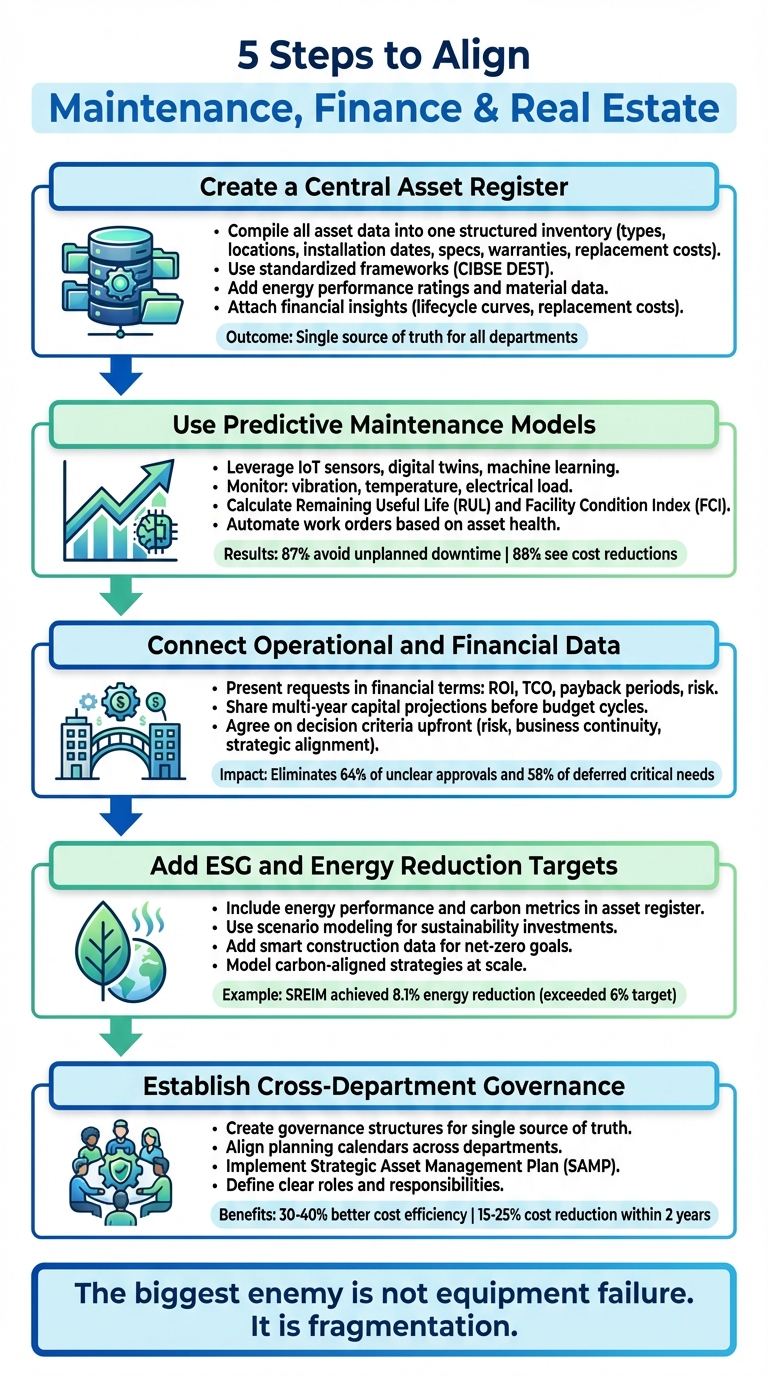
5 Steps to Align Maintenance, Finance and Real Estate Teams for Unified Asset Strategy
Crafting a unified asset strategy requires more than just a vision – it needs actionable steps that bring together maintenance, finance, and real estate teams. These five steps outline how to turn strategic ideas into everyday practices.
Step 1: Create a Central Asset Register
Start by compiling all asset data into one structured inventory. This should include details like asset types, locations, installation dates, manufacturer specs, warranties, and replacement costs across your portfolio [16]. Use standardized frameworks, such as CIBSE DE5T, to organize data into clear levels: Facility, Space, System, and Component [15].
From the beginning, incorporate metrics like energy performance ratings (EPC/DEC), air-tightness, and material data to support future decarbonization efforts [15]. Attach financial insights – such as lifecycle curves and replacement costs – to each asset, enabling predictive budgeting [16]. Tools wie Oxand Simeo™ Inventory can simplify this process by creating a centralized register with validated, standardized data to reduce errors.
This approach empowers maintenance teams to shift to data-driven decisions, finance teams to forecast 3–5 year capital needs, and real estate teams to use lifecycle data for accurate site valuations [15][16].
Step 2: Use Predictive Maintenance Models
Leverage IoT sensors, digital twins, and machine learning to monitor indicators like vibration, temperature, and electrical load [2][12]. These tools help calculate Remaining Useful Life (RUL) und Anlagenzustandsindex (FCI), allowing you to focus resources on the most critical assets [12][13].
Predictive maintenance moves organizations from reactive "fix-it-when-it-breaks" methods to proactive scheduling, cutting emergency repair costs and unplanned downtime [1][12]. It also gives finance teams a clear view of time-phased cash flows over several years, turning budget discussions into strategic planning [1]. Use automated rules within your Enterprise Asset Management (EAM) system to trigger work orders based on asset health indicators [2].
"By integrating APM and AIP systems, you can gain full visibility to the asset lifecycle and ensure alignment between your O&M and capital teams." – Copperleaf and SAP [2]
The benefits are clear: 87% of organizations using asset management systems for preventive maintenance report avoiding unplanned downtime, while 88% see cost reductions [1]. Standardize condition data collection through IoT devices and structured workflows to ensure consistency across your portfolio [13].
Step 3: Connect Operational and Financial Data
Bridge the gap between technical needs and financial decision-making by presenting capital requests in terms of ROI, Total Cost of Ownership (TCO), payback periods, and risk of failure [1]. This approach helps translate engineering priorities into metrics that resonate with finance teams.
Conduct condition assessments early, sharing multi-year capital projections before budget cycles begin. This proactive approach prevents emergency funding spikes and gives finance teams visibility into upcoming needs [1]. Agree on decision-making criteria – such as risk, business continuity, and strategic alignment – before requests reach finance, ensuring smoother prioritization [1].
"When facilities and finance share decision criteria upfront, budget conversations become capital planning, not negotiation." – Katie Gramajo, Senior Industry Marketing Manager, Brightly Software [1]
Currently, 64% of education leaders admit to approving facility requests they didn’t fully grasp, while 58% have deferred critical needs due to unclear priorities [1]. Aligning operational and financial data can eliminate these challenges and even integrate sustainability goals into the broader strategy.
Step 4: Add ESG and Energy Reduction Targets
Incorporate energy performance and carbon reduction goals into your asset strategy. Include these metrics in your asset register and use scenario modeling to understand how different investments impact long-term sustainability.
Nehmen Sie Schroder Real Estate Investment Management (SREIM) as an example: they surpassed their 6% energy reduction target with an 8.1% reduction over two years. This success came from using data insights and collaborating with property teams across their portfolio [15]. Adding "smart construction" data and sustainability metrics to your asset register can help meet net-zero goals and comply with environmental regulations like F-gas requirements and emissions-trading schemes [15].
Use investment planning platforms to model carbon-aligned strategies at scale, ensuring every capital decision supports both efficiency and decarbonization.
Step 5: Establish Cross-Department Governance
Turn budget discussions into collaborative planning by creating governance structures that integrate services, systems, processes, and data into a einzige Quelle der Wahrheit [3]. Align planning calendars across departments and implement a Strategischer Vermögensverwaltungsplan (SAMP) to translate organizational goals into actionable asset decisions [17].
Define clear roles within your asset management platform, ensuring everyone knows their responsibilities for workflows and data entry [18]. Organizations with Integrated Facilities Management (IFM) programs report 30–40% better cost efficiency per square foot compared to fragmented operations [3]. Consolidating facility management can cut operating costs by 15–25% within two years through streamlined systems and resource optimization [3].
"The biggest enemy is not equipment failure. It is fragmentation." – Infodeck Blog [3]
Software and Tools for Unified Asset Strategies
Technology is reshaping how organizations manage their assets by consolidating data, predicting future needs, and enabling smarter investment decisions. These tools bring together operational, financial, and environmental goals into a cohesive system. By replacing outdated spreadsheets with proaktive, risikobasierte Planung, they link maintenance schedules, financial forecasts, and environmental targets. Below are examples of tools that help operationalize a unified asset strategy.
Software für die Investitionsplanung
Plattformen wie Oxand Simeo™ are designed to centralize asset inventories, financial models, and predictive analytics into one system. Using over 10,000 proprietary aging and performance models alongside 30,000+ maintenance regulations, this software forecasts how assets age, fail, and consume energy over time [19][22]. By utilizing existing inspection data, surveys, and operational records, it enables precisely timed interventions, potentially cutting the total cost of ownership by up to 30% [19][21].
One public sector portfolio saw impressive results, including a 27% reduction in maintenance backlog und $4 million in energy savings across 66 buildings after just one budget cycle [19]. Additionally, the software generates ISO 55001-compliant, audit-ready reports, which can save up to 70% of the time typically spent on report preparation [19].
"We turned to Oxand because we needed a tool that would provide us with a predictive – not just corrective – view and help us manage our investments more effectively. Oxand stood out for its risk management capabilities." – Head of Budget and Asset Valuation Department [20]
These platforms integrate seamlessly with enterprise systems like SAP or Maximo through APIs, ensuring that investment plans remain aligned with real-time operational data [19]. Organizations can begin creating multi-year investment scenarios within just zwei Wochen of importing their existing data [19].
Digital Inspection and Data Collection Tools
Accurate field data collection plays a key role in maintaining a unified asset strategy. Tools like Simeo GO enable real-time, mobile data capture, ensuring that asset condition information is standardized and synced directly to centralized databases [19][23]. This eliminates the need for manual entry, making the process 50% schneller than traditional paper-based methods while reducing transcription errors [19].
These tools streamline data collection with guided workflows, photo documentation, and automated logs [23][24]. By feeding this data into analytics systems, they support predictive vs. reactive maintenance, helping teams identify potential issues before they lead to failures [23]. With a mobile-first approach, all stakeholders – maintenance teams, finance analysts, and real estate managers – can work from the same up-to-date information, eliminating discrepancies caused by outdated spreadsheets or conflicting reports.
Scenario Testing and Budget Optimization
Once data is centralized and field insights are collected, scenario testing tools allow organizations to refine their investment strategies. These tools simulate the impact of various budget decisions, maintenance schedules, and capital projects under real-world constraints. They evaluate outcomes against factors like risk tolerance, energy efficiency goals, and carbon reduction targets [19][20][21].
"We needed a tool that would allow us to consolidate the fragmented data we had and project it in a way that could be clearly presented to our elected officials, who are the decision-makers." – Chief Executive Officer (General Director of Services) [20]
With features like drag-and-drop planners, users can adjust investment timelines, compare CAPEX and OPEX trade-offs, and visualize results through interactive dashboards [19]. Financial teams can calculate ROI and payback periods, while environmental managers can track energy savings and CO₂ reductions for each proposed action [19]. These tools turn budget discussions into strategic planning sessions, providing decision-makers with clear, data-driven evidence [19][20].
Results of a Unified Asset Strategy
When organizations implement a unified asset strategy, the benefits become clear. These strategies help reduce costs, lower energy use, and build stronger relationships with stakeholders.
Lower Costs and Better ROI
By aligning asset management functions, organizations can cut maintenance costs by 10–30% through well-planned operations and maintenance programs[6]. Proactive planning eliminates the hefty 40–60% markup often tied to emergency repairs[25]. Predictive tools help avoid extra expenses like rush fees, overtime, and expedited parts.
Since operations and maintenance make up 75–80% of an asset’s total lifecycle costs[6], even small improvements can lead to big savings. For instance, targeted refurbishments can reduce total ownership costs by up to 22%[4]. Avoiding "stranded spend" – wasting money on assets already scheduled for replacement – further prevents unnecessary expenses[2].
"Alignment matters because unplanned, emergency repairs are consistently more expensive than proactive, scheduled investments." – Katie Gramajo, Senior Industry Marketing Manager, Brightly Software [1]
Data-driven decisions shift organizations from age-based asset replacements to risk-based strategies, ensuring funds go toward the most impactful assets first[4]. Translating technical needs into financial terms like ROI and total cost of ownership builds executive trust and makes budget approvals smoother. IoT-based asset tracking can cut unplanned downtime by 45–65%, while integrated analytics platforms deliver a 3–5x ROI over three years[25].
These financial efficiencies pave the way for broader operational improvements.
Measurable Energy and Carbon Reductions
A unified strategy also transforms sustainability goals into actionable results. Light to medium energy retrofits can deliver energy savings of 10–40%, translating into $0.49 to $1.94 per square foot in savings[27][28]. Aligning equipment upgrades with energy goals ensures every investment improves efficiency and reduces carbon emissions.
LEED-certified buildings in the U.S. typically enjoy rent premiums of 3–4% and higher occupancy rates[29]. Since 2021, energy-efficient commercial properties have delivered 5% higher total returns compared to less efficient ones[29]. Incorporating energy performance into asset planning also helps avoid "brown discounts", as up to 65% of office buildings risk losing value due to poor environmental performance by 2030[27][28].
Zum Beispiel, Standard Chartered, in partnership with JLL, achieved an 84% emissions reduction across more than 30 markets by implementing deep decarbonization measures. This success highlights the value of shifting from short-term budgets to 15–30-year lifecycle planning that factors in carbon and regulatory risks[27][28][30].
"The cheapest choice on a three-year budget horizon can be the worst when viewed over a 15-year lifecycle, especially once carbon and regulatory risks are taken into account." – Nextbitt Editorial Team [30]
Specific measures, like HVAC performance monitoring, offer potential energy savings of 35–50%[25]. Meanwhile, systematic lifecycle costing can save 5–15% in energy costs through better controls and commissioning[6]. These steps not only reduce operating expenses but also help meet stricter environmental regulations.
Greater Stakeholder Trust
Integrated asset data enables transparent, audit-ready investment plans that inspire confidence among boards, investors, and regulators. Prioritizing projects based on risk, lifecycle costs, and sustainability impact provides decision-makers with clear insights into how resources are allocated. For instance, 88% of organizations say that asset management systems for preventive maintenance directly lower costs[1], giving finance teams solid evidence to support their plans.
Automated audit trails reduce preparation time by 95%, allowing teams to focus on strategic initiatives[25]. A great example is Boston Public Schools, which used continuous facilities condition assessments to align asset data with budget timelines. This approach reduced emergency repairs and optimized resource use, enabling data-driven budget proposals that gained stakeholder support[1]. By shifting from reactive explanations to forward-thinking strategies, organizations build trust across all levels.
Schlussfolgerung
Breaking down silos between maintenance, finance, and real estate isn’t just a good idea – it’s a financial necessity. Operating in isolation wastes resources, slows down investments, and makes budget approvals more complex. Disjointed operations lead to heavy administrative workloads, and poor planning can send repair costs skyrocketing[3][26].
To address this, organizations should adopt a unified approach: a single source of truth for asset data, shared metrics like the Facility Condition Index (FCI), and synchronized planning calendars. These steps help secure multi-year capital projections well before budget season. When maintenance teams frame their technical needs in financial terms – like ROI, total cost of ownership, or business continuity risks – conversations shift from haggling over budgets to crafting strategic plans[1].
The tools and frameworks outlined in this guide, from predictive maintenance models to risk-based investment planning, provide a clear path forward. They help organizations transition from reactive, siloed operations to proactive, coordinated strategies. The rewards? Tangible improvements, including 10–30% reductions in maintenance costs and up to 65% less unplanned downtime[6][25].
Organizations that eliminate silos gain more than just financial savings. They extend the lifespan of their assets, meet environmental goals, and foster transparent, data-driven decision-making. This transparency builds trust with boards, investors, and regulators alike. By embracing these integrated strategies, organizations can achieve smarter infrastructure management and long-term asset planning. The only question left is: How soon can you begin?
FAQs
Where should we start if our asset data is scattered across teams?
To get started, bring all your asset data into one clear, unified view. Take stock of what data you already have, figure out where it’s stored, and determine how to connect it all. Implement a system that centralizes this information, standardizes its formats, and establishes clear protocols for sharing and storage. When operational, financial, and real estate data align seamlessly, it becomes much easier to make informed decisions and use resources more effectively.
Which shared KPIs best align maintenance, finance, and real estate?
To align the goals of maintenance, finance, and real estate teams, it’s crucial to focus on data-driven metrics that tie operational efficiency to financial performance. Some of the most impactful KPIs include:
- Total Cost of Ownership (TCO): Tracks the complete cost of an asset over its lifecycle, helping teams understand long-term financial impacts.
- Maintenance Cost Per Asset: Measures how much is spent on maintaining individual assets, revealing opportunities for cost control.
- Asset Condition and Performance Metrics: Offers insights into the current state and reliability of assets, ensuring they meet operational demands.
- Lifecycle Costs: Evaluates expenses from acquisition to disposal, aiding in smarter investment decisions.
- Predictive Maintenance Effectiveness: Assesses how well predictive models prevent failures, reducing downtime and unexpected costs.
By focusing on these KPIs, organizations can allocate resources more effectively, mitigate risks, and enhance ROI throughout an asset’s lifespan.
How do we prove ROI for predictive maintenance and multi-year planning?
Predictive maintenance and multi-year planning prove their worth by showing clear cost savings. These savings come from minimizing unplanned downtime, making better use of labor, and extending the lifespan of assets. In fact, these approaches often cut maintenance costs by 25–30% and can start delivering a positive return on investment (ROI) as soon as the first quarter after implementation.
Verwandte Blogbeiträge
- Vorausschauende Instandhaltung für das Asset Management (Infrastruktur und Immobilien) ist von entscheidender Bedeutung - nutzen Sie die Website die Website:https://theiam.org
- Dekarbonisierung alternder Infrastrukturen: Die größten Herausforderungen und Investitionsstrategien
- Veränderungsmanagement für die Vermögensanlageplanung: Finanzen, Betrieb und ESG auf eine Linie bringen
- Skalierung der Anlageninvestitionsplanung über mehrere Standorte und Regionen hinweg