







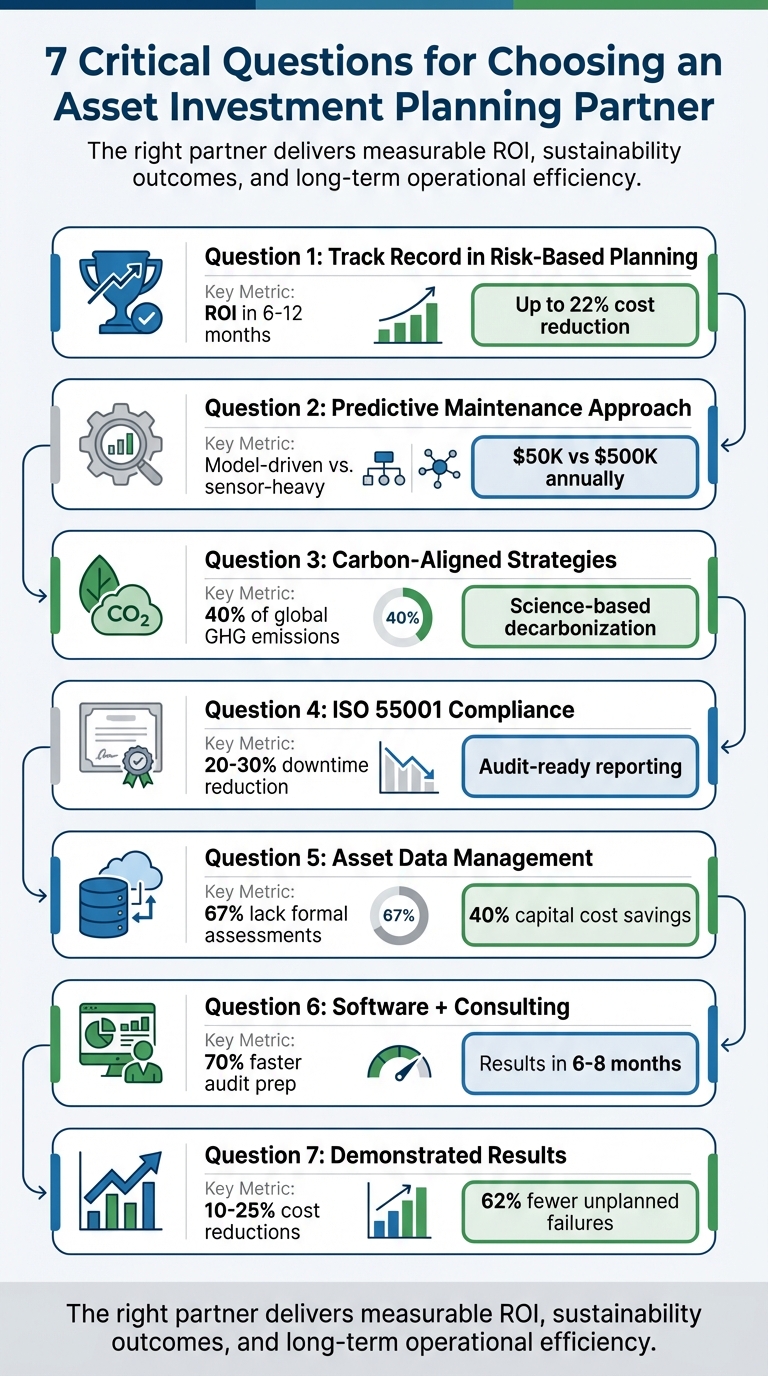
When selecting a partner for asset investment planning, the right choice can save you money, improve safety, and streamline operations. The article outlines seven critical questions to help you evaluate potential partners:
- What is their track record in risk-based planning? Look for proven results like ROI within 6–12 months or cost reductions of up to 22%.
- How do they approach predictive maintenance? Effective partners use model-driven methods over expensive sensors, cutting costs while maintaining accuracy.
- Can they deliver carbon-aligned strategies? Ensure they provide tools to meet emissions goals and regulatory compliance.
- Do they support ISO 55001 compliance? Audit-ready reporting and adherence to standards are key.
- How do they manage asset data? Centralized, accurate data is essential for informed decisions.
- Do they combine software with consulting? The best partners integrate advanced tools with expert advice.
- What results can they demonstrate? Ask for measurable outcomes in cost savings and operational improvements.
7 Questions to Ask When Choosing an Asset Investment Planning Partner
How To Tell Your Asset Investment Story
sbb-itb-5be7949
Question 1: What Is Their Track Record in Risk-Based Asset Investment Planning?
When evaluating a partner for risk-based asset investment planning, their track record speaks volumes. It’s not just about crunching numbers – it’s about delivering structured, defensible plans that shift organizations from reactive fixes to proactive, long-term strategies. Look for evidence that they can move beyond basic spreadsheets to advanced tools like probabilistic modeling and asset deterioration analysis, ensuring investments align with sustainable goals.
Take Endeavour Energy as an example. In March 2024, they overhauled their $6.7 billion (AUD) network investment process by adopting AI-powered analytics instead of spreadsheets. This shift allowed them to assess the impact of operations on ESG goals and evaluate asset end-of-life across their fleet. The result? Their FY25-29 proposal was approved by the Australian Energy Regulator on the first attempt – an improvement from their FY20-24 proposal, which initially faced rejection. This data-driven strategy saved thousands of hours in risk profile analysis and earned them the 2023 Consumer Engagement Award[2].
"Endeavour has lodged a high-quality proposal….There is evidence of an overall good standard in needs analysis, cost benefit approach, option analysis, and transparency in documentation." – Australian Energy Regulator[2]
A strong partner doesn’t just rely on asset age; they apply scientific aging laws and advanced risk models to calculate both the likelihood and consequences of failure. This method prioritizes investments based on value, not just age. Advanced platforms also allow for "what-if" scenario modeling, enabling organizations to quickly test alternative investment plans under various budget, risk, and service-level constraints[1][3].
Look for measurable outcomes as proof of their approach. For instance, organizations using risk-based planning often see a full ROI within 6 to 12 months. Some even achieve up to a 22% reduction in total cost of ownership by targeting high-risk units for refurbishment instead of following flat-budget, age-based replacement strategies[1][4]. These results set the standard for evaluating a partner’s ability to deliver tangible, data-driven outcomes.
The following sections will dive deeper into the technical and compliance factors critical to making an informed choice.
Question 2: How Do They Approach Predictive Maintenance for Aging Assets?
A reliable partner excels at accurately forecasting asset aging and potential failures without leaning too heavily on expensive sensor networks. Instead, they employ model-driven approaches grounded in scientific aging principles and historical data. This strategy is not only cost-effective but also scalable, making it ideal for managing large asset portfolios where sensor installation costs can quickly skyrocket into hundreds of thousands of dollars. By focusing on models rather than sensors, partners can provide practical insights that scale across extensive asset inventories.
These partners rely on physics-based models and statistical tools like Weibull curves to predict failures. By integrating historical failure data, they estimate an asset’s remaining useful life without the need for constant real-time sensor monitoring. For instance, managing a portfolio of bridges using a model-driven approach might cost around $50,000 annually, compared to $500,000 for full IoT sensor coverage, while achieving comparable prediction accuracy through periodic inspections[9][12]. An effective solution should include access to a vast library of aging laws – ideally 10,000+ proprietary models – to simulate asset degradation under various conditions[7][8].
Look for partners who can back up their claims with measurable outcomes, such as Mean Time Between Failures (MTBF) prediction error rates below 10%. Case studies should highlight results like a 30–50% reduction in unplanned downtime, achieved by applying maintenance principles like the bathtub curve for failure phases or Paris’ Law for fatigue crack growth. These insights enable a shift from time-based to condition-based maintenance strategies, optimizing intervention timing and resource allocation.
The standout benefit of a model-driven approach is its ability to scale without relying on a dense network of sensors. Leading partners combine physics-based laws with machine learning to detect anomalies using sparse data. Cloud-based simulations that manage 10,000+ assets at costs under $100 per asset annually offer a far more practical alternative to IoT solutions, which often exceed $1,000 per sensor. This approach avoids common pitfalls of sensor-heavy strategies, such as high upfront costs ($10,000–$50,000 per site), data overload, and sensor failures in harsh conditions.
To maximize efficiency, partners should extract critical data from existing Computerized Maintenance Management Systems (CMMS) and asset logs, complemented by non-invasive inspections. They should also demonstrate a clear return on investment (ROI), with avoided failures yielding a 3:1 ROI ratio and maintenance cost reductions of 15–40%[9][10][12]. Ask for audited examples, such as a 35% downtime reduction in aging water networks or a 25% ROI from avoiding $2 million in emergency HVAC repairs over five years by forecasting coil degradation proactively[12].
Question 3: Can They Deliver Carbon-Aligned and Energy Transition Strategies?
Sustainability isn’t just a buzzword – it’s a regulatory and financial priority. The built environment accounts for over 40% of global greenhouse gas (GHG) emissions, with operational CO₂ contributing 22% and embodied CO₂ adding another 15% to the mix[16]. Just like risk models are vital for effective maintenance, carbon-aligned strategies are key to mitigating long-term investment risks. A reliable partner should excel in energy performance modeling, CO₂ reduction forecasting, and aligning with science-based decarbonization goals. This approach ties seamlessly with the advanced maintenance strategies discussed earlier, creating a well-rounded asset management framework.
The ideal partner should leverage science-based carbon budgets aligned with 1.5°C or 2°C climate targets. Tools like CRREM can allocate global carbon budgets to individual assets based on factors such as country, building type, and climate zone[13]. Performance metrics should include declining carbon intensity (measured in kgCO₂e/sqft/yr) and energy intensity (kWh/sqft/yr) to ensure compliance with ever-changing regulations. Advanced platforms can even predict the "year of misalignment", identifying the point when an asset’s emissions are expected to exceed its allocated carbon budget[13].
Take, for example, a 2025 case study where a real estate company used a decarbonization planning platform to create detailed asset-level transition plans. These plans resonated with investors, demonstrating how the right partner can not only model energy and carbon trajectories but also provide actionable insights to meet both regulatory demands and investor expectations.
Tools and Data Used for CO₂ Modeling
Modern tools make manual audits a thing of the past. AI-driven, physics-based platforms trained on 950,000 energy simulations can save significant time and costs while maintaining high engineering standards[14]. These tools use proprietary aging and energy laws to project how asset degradation will affect energy use and emissions over time[8].
Localized data inputs are crucial. Tools should incorporate factors like heating and cooling degree days, real-time utility bill data, and grid decarbonization projections specific to your region[13][14]. These inputs help you evaluate different investment scenarios under carbon and energy constraints, identifying the most cost-efficient path to carbon neutrality[8]. Dynamic analytics, updated annually to reflect grid changes and equipment conditions, are far more effective than static reports.
Alignment with Decarbonization Requirements
Beyond technical capabilities, your partner should have a firm grasp of regulatory frameworks such as TCFD, SFDR, CSRD, and local Building Performance Standards[14][15]. They should also provide audit-ready reporting that integrates smoothly with ISO 55000 or GRESB, simplifying your ESG disclosure process[8].
Look for partners that offer multi-constraint optimization – balancing risk, cost, energy, and carbon goals simultaneously rather than treating sustainability as a separate objective[6][8]. Results speak louder than promises. For instance, achieving $4.3 million in energy savings across a 66-building portfolio within a single budget cycle or cutting maintenance backlogs by 27% while meeting decarbonization goals are tangible outcomes to seek[8]. Additionally, ask for analysis on "brown discount" risks and potential regulatory fines to understand the financial stakes of inaction[14].
Question 4: Do They Support ISO 55001 Compliance and Audit-Ready Reporting?
Having advanced risk and carbon models is great, but aligning them with ISO 55001 compliance takes your investment planning to the next level. ISO 55001, the global standard for asset management systems, ensures your practices align with strategic goals while standing up to audits. When choosing a partner, make sure they can deliver investment plans that not only meet ISO 55001 standards but also produce documentation that’s traceable, defensible, and ready for audits.
Look for partners who can demonstrate their expertise with real-world results. For instance, case studies have shown that applying ISO 55001 practices can cut unplanned downtime by 20–30% [12]. As one Chief Technical Officer put it:
"As asset leader, I’m aware of the need to challenge our practices and be at the top level of operation and maintenance practices. Within this context, we want as a first step to perform a Maturity Assessment of our Asset Management practices, in order in the future to get the ISO 55001 – Asset Management – Certification." [17]
This approach connects technical precision with operational clarity, which is key once you’ve established a solid risk and sustainability strategy.
Why Audit-Ready Reporting Matters
Audit-ready reporting isn’t just about ticking boxes – it’s about creating transparent, evidence-backed records that regulators can trust. This means having traceable decision logs and a clear method for prioritizing investments. For example, a municipal water utility used a scoring system to prioritize $50 million in pipe replacements. They weighted risk of failure (40%), carbon impact (30%), and cost-benefit (30%) to defer low-risk projects, saving 15% on capital spending while maintaining audit defensibility [12].
Modern tools should also allow you to run scenario simulations to test investment plans under different budget and climate conditions. Features like Monte Carlo simulations and sensitivity analysis can help you create reports with probabilistic outcomes. For example, you could demonstrate a 95% confidence level in meeting decarbonization targets [12].
Questions to Ask During Evaluation
When vetting potential partners, be on the lookout for red flags like missing certifications, reports that skip scenario simulations, or an over-reliance on generic templates. To dig deeper, ask questions like:
- "Can you walk us through a recent ISO 55001 audit your reports supported?"
- "What software do you use to ensure report traceability and scenario simulations?"
The best partners will back their answers with real client data and show you how their processes work [9][11].
Question 5: What Is Their Approach to Asset Data Management and Inventory?
Following the principles of ISO 55001 and audit-ready reporting, a precise asset inventory is essential for effective asset investment planning. Even the most advanced risk models or adherence to ISO 55001 standards can fall short without centralized asset data. Consider this: 67% of municipalities lack formal asset condition assessments [18]. This means many organizations are making multi-million-dollar decisions based on incomplete or fragmented information.
An effective partner should offer tools that centralize critical asset data – including location, condition, maintenance history, and risk profiles. This ensures that everyone, from field technicians to CFOs, has access to reliable and up-to-date information. By adopting condition-based replacement strategies instead of age-based ones, organizations could save an average of 40% in capital costs [18]. But this kind of efficiency is only possible if the data is accurate and trustworthy.
Building a Centralized Asset Inventory
When selecting a partner, look for those who utilize CMMS (Computerized Maintenance Management Systems) or CAFM (Computer-Aided Facility Management) systems as the backbone of asset data management [18][22]. These systems should support structured data hierarchies, enabling assets to be categorized consistently – from the facility level down to individual components [19][21]. For instance, a boiler in one building should be classified the same way as a boiler in another, making portfolio-wide analysis seamless.
Data accuracy is critical. This can be achieved through thorough initial verification, routine surveys, and strict change management processes [19]. Additionally, partners should ensure data portability using standards like COBie, so you’re not locked into a single platform [19]. As the Government Property Function emphasizes:
"Public sector organisations must be able to produce an asset register of all their FM assets and be aware of the condition and maintenance requirements of each asset" [19].
It’s also essential to confirm in your contract that you retain ownership of your asset data, regardless of who manages it [19]. A centralized inventory lays the groundwork for efficient, real-time inspections in the field.
Digital Tools for Inspections
Modern partners rely on mobile inspection apps that empower field teams to access asset data, conduct standardized inspections, and sync results to the cloud instantly. These tools often use a simple 1–5 condition rating scale (Excellent to Critical), converting observations into actionable insights [18]. Compared to traditional paper-based methods, digital tools can speed up field data collection by 50% [8].
Advanced features like 360-degree data capture, 3D visualization, GPS tagging, and photo documentation create comprehensive records that support well-informed investment decisions. These tools also integrate directly with existing EAM (Enterprise Asset Management) or CMMS platforms, automatically triggering maintenance work orders [20][23]. For example, Dean Jakubowsky, Building Operations Manager at Sydney Opera House, shared:
"The overall value we get from Arup Inspect is greater understanding and informed decision-making to best address our issues at hand, and for the future of the house" [23].
When evaluating potential partners, request a demonstration of their mobile inspection tools. Ensure they integrate seamlessly with your current systems. Accurate, centralized asset data is the foundation for predictive maintenance and optimized investment strategies.
Question 6: How Do They Combine Software and Consulting Services?
Effective asset planning thrives on the combination of advanced software and expert consulting. Together, they transform raw technical data into actionable, high-level investment strategies that decision-makers can confidently rely on. To get the most out of this approach, it’s crucial to first evaluate your organization’s current maturity level.
Start with a maturity assessment, such as an ISO 55001 audit or a SWOT analysis, to pinpoint weaknesses in your asset management practices [17]. Industry experts emphasize that this initial step is essential for challenging outdated methods and laying the groundwork for a solid asset management framework.
A strong governance structure is another key element. This involves setting up departmental frameworks, policies, and standard operating procedures (SOPs) aligned with ISO 55001, ISO 31000, and ISO 41000 standards [24]. While the software excels at predictive analytics, aging models, and automating documentation – drawing from over 10,000 models and 30,000 maintenance actions – consultants focus on aligning stakeholders and refining processes [8].
For example, consulting services can distill complex asset data into master plans ready for executive review, while the software streamlines audit trails, cutting ISO 55000 audit preparation time by as much as 70% [8]. In one case study, this approach led to a 27% reduction in maintenance backlog and $4 million in energy savings across 66 buildings within a single budget cycle [8].
Most organizations see noticeable improvements in reliability and cost management within 6–8 months [5]. A well-rounded partner will ensure seamless integration of consulting expertise and software, from initial data modeling and API connections with existing CMMS/ERP systems to ongoing scenario simulations and stakeholder reporting [8].
Question 7: What Results Can They Demonstrate in Cost and Sustainability Outcomes?
When choosing a partner to transform asset investment planning, it’s essential to find one who can deliver on both financial performance and sustainability goals. To gauge their capabilities, ask for concrete metrics. A reliable partner should provide documented evidence of cost reductions, carbon savings, and extended asset lifespans. For instance, look for partners who have achieved 10–25% cost reductions in specific maintenance areas and measurable improvements in energy efficiency across comparable portfolios [1]. These financial benefits often align with measurable environmental results.
Speed also matters. Partners who can deliver results within a single budget cycle demonstrate strategic effectiveness [7]. Take the example of a mid-sized university campus with 47 buildings. In February 2026, they launched an 18-month digital maintenance transformation. By integrating wireless vibration and thermal sensors into critical HVAC and electrical systems, they reduced unplanned failures by 62% and slashed emergency spending by $740,000 annually. This initiative achieved a 4.2:1 ROI and shifted their maintenance approach from 68% reactive to 68% planned [25].
"We succeeded because we started with the systems that hurt us most, proved value fast, and earned technician trust before scaling. The technology matters, but the sequencing matters more."
- Director of Facilities Operations, Case Study University [25]
Financial benefits are only part of the equation. A strong partner should also deliver clear, measurable sustainability outcomes. Beyond cost savings, they should model carbon-reduction pathways and energy savings within multi-year investment plans. This allows you to compare strategies under specific decarbonization and budget scenarios [5]. Organizations leveraging predictive models can achieve up to 30% lower total ownership costs while significantly cutting their carbon footprint [5].
Conclusion: Ensuring an Optimized and Sustainable Partnership
Choosing the right partner for asset investment planning goes beyond short-term gains – it’s about aligning with someone who can support your long-term financial goals and operational efficiency. The seven questions outlined earlier provide a solid framework to assess potential partners based on their expertise, ability to predict outcomes, alignment with carbon goals, compliance readiness, data management skills, integration capabilities, and proven success. These questions are designed to help you make an informed decision.
While the evaluation process might feel time-consuming, it’s an investment that pays off. Studies show that picking the right partner often takes longer than selecting an investment property, emphasizing the importance of prioritizing people over assets [26]. The best partners don’t just create plans – they deliver consistent returns and strategic benefits, backed by experienced teams and a history of success [26][12].
A strong partnership can completely change how you manage infrastructure. Instead of dealing with last-minute repairs or juggling fragmented budgets, you gain access to risk-based prioritization, multi-year CAPEX and OPEX planning, and compliance-ready documentation [9][10]. These are the tangible benefits of following the seven-question framework. Organizations that work with skilled and experienced partners often see real results, such as 10–25% cost savings and noticeable reductions in CO₂ emissions [1].
When making your final decision, consider a few key strategic factors. Look for a partner willing to co-invest or show "skin in the game" to ensure their goals align with yours [26]. Insist on clear terms regarding investment objectives, expected returns, and acceptable risks right from the start [10]. Beyond technical expertise, the right partner should also empower your team by sharing knowledge and providing training to ensure lasting success.
FAQs
What proof should a partner provide to show ROI?
A partner needs to show a clear return on investment (ROI) using measurable metrics like cost savings, risk reduction, and efficiency improvements. These metrics should come from predictive maintenance analytics and be integrated into your investment strategies. By focusing on clear and quantifiable outcomes, they can ensure their methods align with your objectives and deliver real, measurable benefits.
Do we need IoT sensors for predictive maintenance?
IoT sensors are a go-to choice for predictive maintenance. They allow for real-time monitoring of equipment, which helps reduce unexpected downtime and keeps machinery running longer. These sensors provide valuable insights that make maintenance more efficient and cost-effective, ensuring you’re ahead of potential issues before they turn into costly problems.
How do we keep our asset data accurate and portable?
To build reliable and shareable asset data, begin by creating a strong data foundation that aligns with ISO 55001 standards. Keep an updated and detailed asset register, ensuring consistency in key data points such as asset condition, lifecycle stages, and performance metrics. Implement centralized digital platforms to reduce data gaps and improve accessibility. Regular audits are crucial to maintaining accuracy, enabling better decision-making and smooth data sharing across your organization.
Related Blog Posts
- Asset Investment Planning 101: How to Decide What to Invest in, When and How Much
- ISO 55001 and Energy Cost Optimization
- Lessons Learned from ISO 55001 Implementations: What Successful Organisations Do Differently
- Change Management for Asset Investment Planning: Getting Finance, Operations and ESG on the Same Page