


How AI Can Help Prioritise Aging Infrastructure Renewal Under Budget Constraints
AI is transforming how infrastructure is managed, helping agencies shift from reactive fixes to smarter, data-driven planning. Here’s the core idea: by analyzing condition data, maintenance history, and risks, AI predicts failures and prioritizes repairs, saving money and reducing emergencies. For example:
- Cost Savings: Emergency repairs cost 3–9x more than planned maintenance. AI helps avoid these costly fixes.
- Improved Accuracy: Predictive models achieve up to 91% accuracy using historical data.
- Risk-Based Prioritization: AI ranks assets by failure risk and impact, ensuring funds are spent where they matter most.
- Data-Driven Decisions: AI turns raw data into actionable insights, justifying budgets with clear, objective evidence.
Cities like Fort Worth, Texas, have already seen results: a 30% performance boost and 50% savings in inspection costs. By using AI-powered tools, agencies can extend asset lifespans by 15–25% and cut unplanned failures by up to 50%. It all starts with building a centralized, structured data system to guide smarter investments.
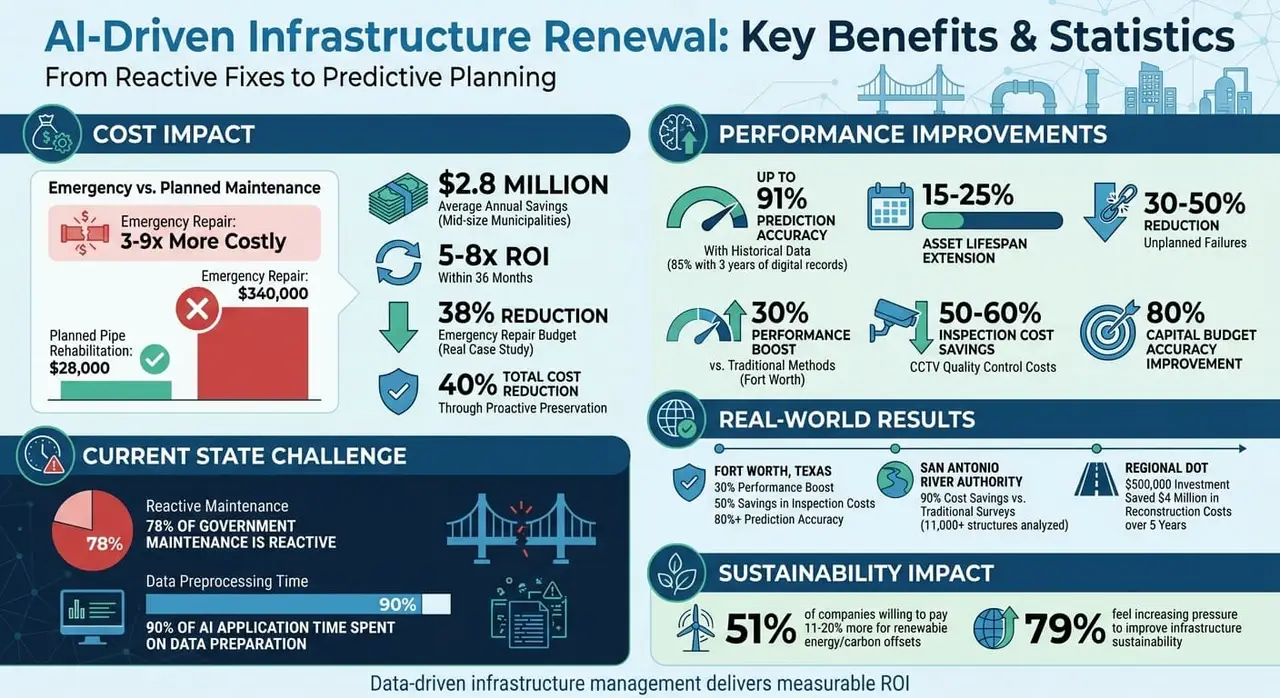
AI Infrastructure Management: Key Statistics and Cost Savings
REVOLUTIONIZING INFRASTRUCTURE MANAGEMENT WITH AI | EP 10
How AI Helps Prioritize Infrastructure Renewal
AI is changing the way we prioritize infrastructure projects. Instead of relying on older methods, machine learning dives into condition data, maintenance records, and environmental factors to predict when and how infrastructure might fail. This shift from reacting to problems to planning ahead helps agencies avoid costly emergencies and make better use of limited budgets.
One standout feature of AI is its ability to prioritize based on risk. It doesn’t just identify which assets are at risk; it ranks them by combining the likelihood of failure with the severity of its impact. For instance, a water main under a hospital access road would take priority over one beneath an empty field. This ensures that funds are directed where they’ll make the biggest difference.
Using Predictive Analytics to Model Asset Aging
Predictive analytics is like having a crystal ball for infrastructure. It uses historical maintenance data, material properties, and environmental factors – like soil conditions, traffic, and weather – to simulate how assets age over time [6][2]. Advanced techniques, such as deep learning, dig into these complex processes, capturing details that simpler models might miss [5].
What’s impressive is that AI doesn’t always need costly sensor networks, as predictive maintenance without IoT can still deliver significant value. By applying failure patterns from similar assets (a technique called transfer learning) and using historical data like age and material type, AI can deliver accurate predictions. With just three to five years of maintenance records, prediction accuracy can hit 85–91% [6][2].
Take Fort Worth, Texas, as an example. In 2023, the city adopted the “Smart Likelihood of Failure” (Smart LOF) platform for its Storm Drain Rehabilitation Program. Developed by Halff, this AI-powered tool used historical data to predict pipe conditions, achieving over 80% true positive results. Compared to older methods, this approach boosted performance by 30% and is on track to evaluate 40 miles of storm drains annually through 2025 [3].
“AI is not just about deploying cutting-edge models; it is about harnessing the power of data to bridge the knowledge gaps that have long existed in utility asset management.” – Matt Stahl, P.E., AI/Infrastructure Management Team Leader, Halff [3]
The benefits are clear. Cities using predictive maintenance report extending infrastructure life by 15–25% and cutting unplanned failures by 30–50% [6]. One municipality managing 1,400 miles of water mains used AI to rank pipe segments by failure risk. In just one year, they replaced 23 critical segments flagged by the system, reducing their emergency repair budget by 38% [2].
This kind of precise prediction naturally feeds into smarter budget planning.
Risk-Based Prioritization for Budget Allocation
AI doesn’t just evaluate risks; it helps agencies juggle multiple priorities – like risk, criticality, compliance, and costs – all at once [2]. This means decisions go beyond picking the oldest bridge or pipe. Instead, AI considers factors like traffic volume, emergency routes, and the consequences of failure.
For example, AI assigns failure probability scores using factors like material, age, soil conditions, pressure history, and weather. A 50-year-old water main serving a hospital might be prioritized over a newer pipe in a low-density area, even if the newer pipe shows some wear.
In fiscal year 2024, the San Antonio River Authority used AI to model flood risks for over 11,000 structures. By training the system with lidar and range scanning data, they saved 90% of the cost compared to traditional surveys. This allowed planners to better prioritize flood mitigation and capital improvements [3].
AI-powered tools have shown a 30% improvement in performance compared to older risk-based methods [3]. They also provide transparency. Tools like SHapley Additive exPlanations (SHAP) and tree-based models break down which factors – like pipe material or age – play the biggest role in failure predictions [3].
“The AI didn’t just predict failures – it funded the programme that prevents them.” – Director of Public Works, Municipal Government [2]
But AI doesn’t stop at managing risks. It also ties renewal strategies to sustainability goals.
Integrating Carbon Reduction and Energy Efficiency
AI brings sustainability into the picture by weaving carbon reduction and energy efficiency goals into infrastructure planning [2]. This means agencies can tackle aging infrastructure while also meeting environmental targets.
For instance, AI can monitor HVAC systems by analyzing vibration patterns, refrigerant pressure, and thermal scans. It spots early signs of issues like compressor wear or refrigerant leaks, enabling proactive fixes that prevent energy waste.
AI also factors in environmental conditions – like freeze-thaw cycles or soil moisture – to predict erosion or subsidence, aligning infrastructure plans with climate resilience [3]. By combining risk and sustainability data, AI ensures investments address both immediate needs and long-term environmental goals.
The financial argument is strong too. A recent survey found that 51% of companies are willing to pay 11–20% more for renewable energy or carbon offsets, and 79% feel increasing pressure to improve infrastructure sustainability compared to the previous year [7]. AI helps agencies focus these investments on assets where energy upgrades deliver the greatest financial and environmental return.
Building a Data Foundation for AI-Driven Planning
To make AI-driven planning effective in infrastructure renewal, you need a solid data foundation. Even the most advanced algorithms can’t compensate for gaps in naming, timestamps, or context without a centralized, structured asset inventory. A strong foundation ensures that condition signals, repair plans, and work orders all tie back to a single, reliable source of truth [9].
Here’s a striking fact: 90% of AI application time is spent on data pre-processing, leaving only 10% for actual modeling [3]. This means high-quality, structured data isn’t just helpful – it’s mandatory for meaningful AI analysis. Agencies that skip this step often find themselves stuck in a reactive “worst-first” cycle, constantly addressing failures instead of preventing them.
The benefits of centralized data are clear. For example, it enables the creation of an objective deterioration curve, which helps managers justify budgets based on hard data rather than political influence [1][8]. A Regional Department of Transportation proved this in March 2026, showing that a $500,000 investment in early pavement preservation saved $4 million in reconstruction costs just five years later. This was made possible by centralized Facility Condition Index (FCI) scores and digital condition tracking [1].
Creating a Centralized Asset Register
A centralized asset register consolidates all asset information into a single, reliable source. Every asset is assigned a stable, unique ID that aligns with field labels across engineering, maintenance, and Geographic Information System (GIS) systems. Without this consistency, AI can misinterpret asset histories, leading to unreliable predictions [9].
To build this register, focus on five key data categories:
- Asset identity: Unique IDs, GIS boundaries, material specifications, and installation dates.
- Condition data: FCI/PCI scores, sensor readings, and inspection photos.
- Maintenance history: Past work orders, repair records, and failure descriptions.
- Environmental context: Soil corrosivity, climate zones, and freeze-thaw cycles.
- Operational load: Traffic volume, tonnage, and pressure transients [1][2].
This structured inventory is critical for breaking the reactive maintenance cycle. Currently, 78% of government maintenance is reactive, which costs 3 to 9 times more than planned interventions [2]. By moving to proactive preservation, agencies can improve capital budget allocation accuracy by 80% and cut total costs by 40% [1].
“For years, our budget meetings were a shouting match over which district had the worst roads. Capital was allocated by political pressure, not structural need. Once we implemented digital condition tracking and centralized our FCI scores in a CMMS, the conversations changed completely.” – Commissioner of Public Works, Regional DOT [1]
Centralized data also simplifies compliance. For instance, it streamlines the generation of mandatory reports like the National Bridge Inventory (NBI), which are often required to secure federal funding [1]. Once assets are centrally registered, mobile tools can further enhance real-time data collection in the field.
Collecting Condition and Risk Data with Mobile Tools
Mobile tools make it easier to gather condition scores and risk data directly in the field. Instead of relying on paper forms or manual notes, field crews can use tablets to log standardized scores, GPS coordinates, and deficiency notes directly into the asset record [10][1].
These tools help standardize inspections by capturing timestamped, geotagged photos for every condition rating. This creates defensible documentation that AI models can use for training [11]. Additionally, mobile apps enforce data governance by requiring mandatory fields – crews can’t close a work order without entering critical details like asset ID, root cause, and labor hours [6].
The results speak for themselves. Municipalities that digitize maintenance history achieve 85% prediction accuracy after just three years of digital records [6]. This level of precision is unattainable without consistent, structured data collection.
Mobile tools are also essential for adapting to updated inspection standards. For example, bridge inspections are shifting from NBI to the Specifications for the National Bridge Inventory (SNBI), which demand more detailed digital data. Mobile apps ease this transition by guiding inspectors through standardized workflows [11].
Maintaining Data Quality and Governance
Maintaining data quality is crucial for long-term success. AI models are only as good as the data they’re fed, so consistency and accuracy are non-negotiable [3]. Without proper governance, data quality deteriorates, and AI predictions become unreliable.
Strong governance starts with mandatory fields and validation rules to ensure every work order includes essential details like asset ID, failure codes, and repair descriptions. Supervisor reviews add another layer of quality control, catching mistakes before they’re entered into the system [6].
Standardizing failure codes is another key step. Consistent coding across work orders and inspection logs allows AI to analyze degradation trends accurately [6][9]. Without this, the models can’t identify patterns or forecast failures.
Governance also requires auditability. This means documenting data fields, versioning models, and logging every AI-generated alert that leads to a work order [9]. This creates a closed loop where asset identity, condition signals, work orders, and post-work verification are all interconnected [9].
The City of Fort Worth provides a great example. From 2023 to 2025, it used the “Smart Likelihood of Failure” (Smart LOF) machine learning platform to predict pipe conditions. The AI system achieved 80% or better true positive rates and improved performance by 30% compared to previous methods. It also cut CCTV video quality control costs by 50–60% [3].
“AI earns its place when it reduces failures you care about, cuts the time to plan work, and lowers the risk of doing the wrong job on the wrong asset.” – Lumenalta [9]
Data quality should be treated as a reliability metric, focusing on completeness and timeliness [9]. These practices ensure agencies are prepared for more advanced AI-driven planning in the future.
Optimizing Multi-Year Investment Plans with Scenario Testing
Building a solid data foundation is just the first step. With AI-powered scenario testing, you can explore various budget and risk options before committing resources. Instead of sticking to a rigid five-year plan, you can run “what-if” simulations to see how different funding levels, performance goals, or policy changes impact long-term costs, risks, and overall network health [12][13]. This shifts infrastructure planning from a static process to a dynamic, data-driven approach.
The big advantage? Clear visibility into trade-offs. AI-powered Asset Investment Planning (AIP) connects asset condition and importance directly to financial risks, covering both operating expenses (OPEX) and capital expenditures (CAPEX) throughout an asset’s lifecycle [13]. For example, you can see how cutting near-term capital spending by 10% might save money now but lead to $4.3 million in extra costs over five years due to failures and emergency repairs. On the flip side, a targeted 10% increase in spending on high-risk assets could cut total ownership costs by 22% over time through strategic refurbishments [13].
Testing Different Budget and Risk Scenarios
With scenario modeling, you can compare funding levels and risk tolerances side by side. Adjust budget limits, tweak performance targets, or change policy rules, and the AI recalculates how these choices impact costs, risks, and asset conditions [12][13]. This helps answer critical questions like: What happens if federal funding is delayed? Which assets can safely be deferred? Where does deferred maintenance create the greatest long-term risk?
The AI also puts a financial value on risks. It calculates “end-of-life” risks – the likelihood and consequences of failure – and compares the lower, predictable cost of proactive maintenance to the higher, uncertain cost of asset replacement or catastrophic failure [13][14]. Optimization tools then recommend action plans, identifying whether assets should be run-to-fail, refurbished, or replaced to minimize total ownership costs [13].
“AIP is not a one-time prioritization meeting or an age-based replacement list. It’s a critical component of a planning funnel, connecting strategic long-term plans to tactical work planning and execution within a single integrated platform.” – Philippe Jetté, Product Manager for Asset Investment Planning at IBM [13]
This approach allows for quarterly portfolio recalibration based on real-time data, such as recent failures, work history, and updated asset conditions, instead of relying on static annual plans [13].
Balancing Financial and Sustainability Objectives
Modern infrastructure planning isn’t just about financial savings – it also needs to address carbon reduction and energy transition goals. AI integrates sustainability metrics directly into investment scenarios [13]. This means you can model how different renewal strategies impact energy use, carbon emissions, and lifecycle costs, aligning budget decisions with climate objectives.
For instance, scenario testing can determine whether upgrading to energy-efficient components now will reduce long-term operating costs enough to justify the higher upfront expense. By quantifying these trade-offs in dollar terms, AI makes it easier to justify sustainability-focused investments to boards, regulators, and taxpayers. This dual focus is becoming increasingly common, as 79% of organizations report growing pressure to improve infrastructure sustainability compared to the previous year [7].
Achieving Cost Reductions Through Optimization
AI-driven optimization isn’t just theoretical – it delivers real savings. Organizations typically see 10–25% cost reductions on targeted maintenance components, with some achieving even greater savings by optimizing schedules and bundling projects [13][14].
The secret lies in bundling similar work and coordinating investments across multiple years to take advantage of economies of scale [12][13]. Instead of handling failures one at a time, AI groups projects by location, asset type, or contractor availability. This reduces mobilization costs and improves resource efficiency, offering insights that are nearly impossible to achieve manually when managing thousands of assets across a complex portfolio.
“The central thesis of this paper is that the synthesis of modern machine learning, classic economic decision theory, and explainable AI can catalyze a paradigm shift from reactive to predictive, cost-optimized infrastructure management.” – Thomas Wiese, SUNY Empire State University [14]
These AI-driven, scenario-tested strategies pave the way for transparent, compliance-ready reporting.
Generating Compliance-Ready and Transparent Reports
AI systems excel at producing audit-ready documentation that aligns with standards like ISO 55001. They process data to create detailed reports, ensuring every decision is captured in an up-to-date audit trail. This trail includes supporting data and approval chains, making it easier to meet compliance requirements. By doing so, these systems close the gap between optimized investment planning and the need for real-time, transparent reporting.
Creating Transparent, Defensible Investment Plans
For stakeholders, understanding the logic behind AI-driven investment decisions is crucial. Techniques like SHAP (SHapley Additive exPlanations) help decode how models work, showing which factors – like deck condition, traffic volume, or asset age – drive prioritization. This transparency ensures that engineers and policymakers can confirm that recommendations align with established engineering principles [14].
“For an engineer or policymaker to trust a model’s recommendation to spend millions of dollars on a bridge intervention, they must understand why the model made that prediction.” – Thomas Wiese, SUNY Empire State University [14]
A real-world example comes from Fort Worth, Texas, where the city adopted Halff’s “Smart Likelihood of Failure” platform for its Storm Drain Rehabilitation Program in 2023. Using SHAP analysis, the platform achieved over 80% accuracy in predicting pipe conditions, justifying its use through the 2023–2025 program cycle [3]. AI-generated reports also include measurable metrics like health scores (ranging from 0 to 100), Remaining Useful Life (RUL) estimates, and lifecycle cost-benefit models. These replace guesswork with hard data, attaching lifecycle costs, insurance impacts, and risk assessments to every funding request [4].
Monitoring and Updating Plans Over Time
AI-driven tools not only improve budget prioritization but also enable continuous updates to keep plans relevant. Once plans are set, they can adapt to changing conditions through ongoing data analysis. As new information comes in, such as updated inspection results or environmental data, the AI recalculates risk scores and refreshes investment plans accordingly [3].
For instance, during fiscal year 2024, the San Antonio River Authority used a machine learning model to predict finished floor elevations for over 11,000 structures in 65 flood-prone areas. By incorporating lidar and range scanning data, the agency reduced costs by 90% compared to traditional surveys and built a reliable data foundation for future capital planning [3]. As new flood or inspection data becomes available, the model updates to refine priorities, ensuring plans remain aligned with actual risks.
This continuous refinement not only supports regulatory reviews and insurance evaluations but also ensures that plans evolve to meet shifting conditions and stakeholder needs [4].
Conclusion: Using AI for Better Infrastructure Planning
AI is changing the game for infrastructure planning, shifting the focus from scrambling to fix problems to preventing them in the first place. By analyzing historical data, condition assessments, and risk factors, AI tools help agencies target their investments using a risk-based approach for multi-year CAPEX planning where they’ll make the biggest difference. And the results speak for themselves: municipalities using predictive analytics have reported a 30–50% drop in emergency repairs, while AI-driven maintenance can stretch the lifespan of assets by 15–25% [6].
The financial benefits are hard to ignore. For mid-size municipalities, predictive maintenance delivers average annual savings of $2.8 million, with a typical return on investment (ROI) of 5–8x within 36 months of implementation [6]. Consider this: rehabilitating a pipe in a planned manner might cost $28,000, but if the same pipe fails unexpectedly, the emergency repair could climb to $340,000 due to secondary damages and emergency response costs [6]. Avoiding these crises ensures that every dollar spent goes further.
“Predictive analytics doesn’t eliminate the funding gap – but it maximizes the impact of every dollar by targeting investment where data proves it will prevent the costliest failures.” – Taylor, Oxmaint [6]
AI also supports broader goals like sustainability by reducing material waste and preventing premature replacement of assets. It enables smarter project coordination too – like syncing up pipe replacements with pavement planning to avoid digging up freshly paved roads [15]. This approach tackles both budget challenges and environmental concerns at the same time.
But it all starts with good data. Agencies that digitize their maintenance operations through work-order systems lay the groundwork for accurate AI models. With three years of digital maintenance history, these models can achieve 85% prediction accuracy [6]. By taking a data-driven approach, infrastructure owners gain the tools to create resilient, financially sound asset portfolios that stand the test of time.
FAQs
What data is needed to start using AI for asset renewal?
To start leveraging AI for asset renewal, gather data on asset conditions, maintenance history, failure patterns, inspection results, and factors like operational and environmental influences. This data allows AI tools to assess risks, forecast failures, and fine-tune renewal strategies with precision.
How does AI decide which assets to fix first?
AI uses tools like predictive analytics, risk-based decision-making, and optimization models to decide which assets need attention first. These tools sift through data such as asset condition, usage patterns, and external factors to anticipate failures and evaluate risks. By targeting assets that pose the greatest risk of failure or have the most significant impact, AI ensures budgets are spent wisely. This approach prioritizes critical repairs while keeping safety, costs, and long-term goals in check.
How can we prove ROI from AI under a tight budget?
Demonstrating the return on investment (ROI) for AI, even with limited resources, means showcasing how these tools save money, cut risks, and optimize resources. For example, AI can pinpoint critical areas needing maintenance, helping avoid unnecessary spending. With predictive maintenance and the ability to fill data gaps, AI helps prevent expensive failures and extends the life of assets. This makes it easier to justify AI investments by highlighting clear financial and operational gains, even when budgets are tight.