







National policies like the Inflation Reduction Act (IRA) and Infrastructure Investment and Jobs Act (IIJA) are reshaping how building owners and investors approach renovations. With billions in funding, tax incentives, and grants available, these policies make energy-efficient upgrades more financially attractive while aligning with national decarbonization goals. Key opportunities include:
- Section 179D Tax Deduction: Increased from $1.80 to $5.00 per square foot, with a focus on retrofits.
- "Braiding and Stacking" Incentives: Combine federal tax credits, state grants, and utility rebates to maximize savings.
- Compliance Risks: Non-compliance with policies like NYC’s Local Law 97 could lead to fines, reduced property value, and higher insurance premiums.
The article outlines a five-step framework to transform these policies into actionable investment strategies:
- Evaluate Your Portfolio: Build a complete asset inventory and align metrics with decarbonization goals.
- Create Multi-Year Plans: Use predictive models to balance risks, costs, and policy deadlines.
- Align with Carbon Goals: Prioritize renovations that deliver measurable energy and emissions reductions.
- Optimize Investments: Compare scenarios to maximize cost savings and compliance.
- Monitor and Ensure Compliance: Track performance and generate audit-ready reports.
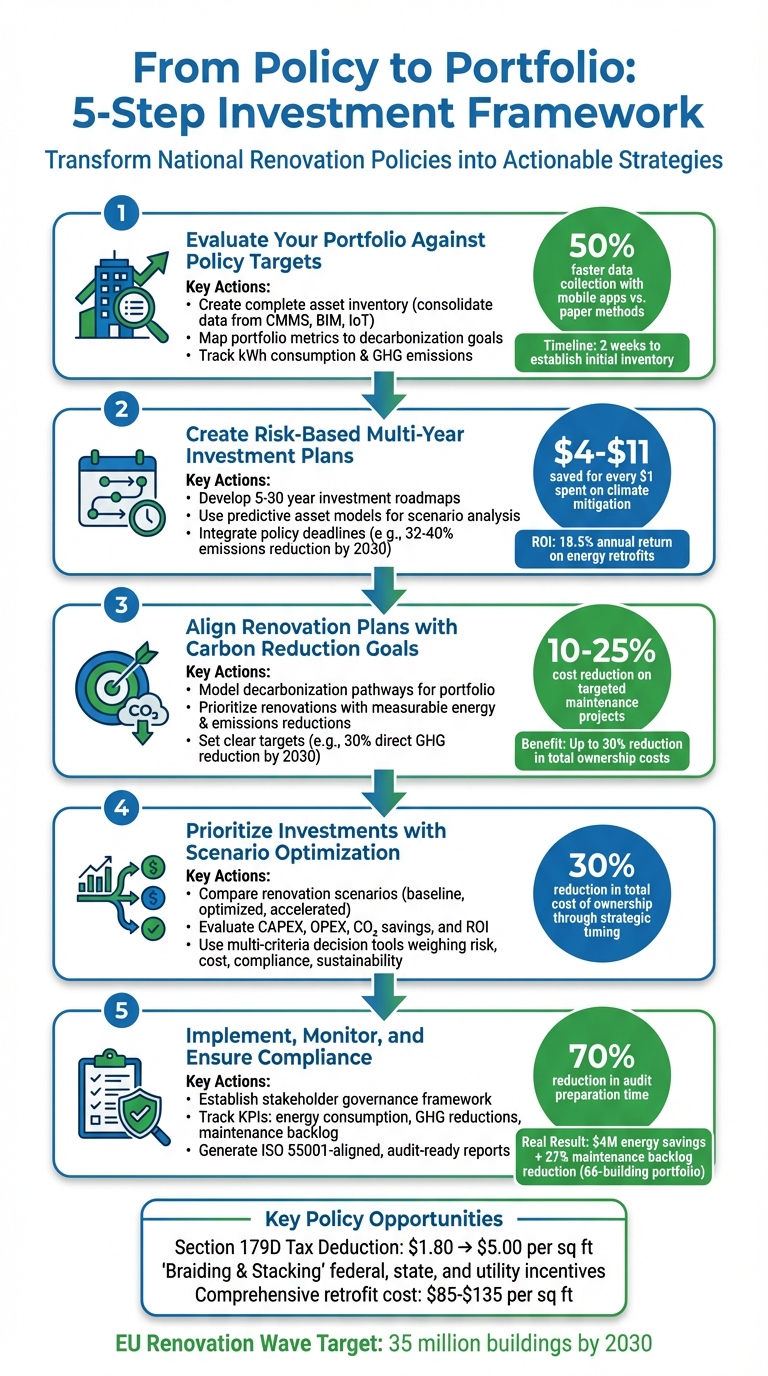
5-Step Framework to Transform National Building Renovation Policies into Investment Strategies
Step 1: Evaluate Your Building Portfolio Against Policy Targets
Create a Complete Asset Inventory
Building a solid renovation strategy starts with a complete and accurate asset inventory. Gather all relevant data from various sources like spreadsheets, CMMS exports (e.g., SAP, Maximo), BIM models, and IoT sensor feeds, and consolidate it into one centralized platform. Using mobile apps like Simeo Go can speed up data collection by as much as 50% compared to traditional paper-based methods [2]. These apps allow field teams to use standardized digital forms that automatically sync to the cloud, ensuring accuracy and efficiency.
The Department of Energy’s Commercial Building Energy Asset Scoring Tool offers a structured way to document details about building envelopes and essential systems, including heating, cooling, lighting, ventilation, and hot water [3]. To save time and focus on what matters most, create a "Priority Map" to identify key data points based on your building types and local climate zones before conducting field surveys [3].
With the right tools and a standardized process, most organizations can establish their initial asset inventory and develop multi-year investment scenarios within two weeks of importing existing data [2]. This centralized inventory acts as your "single source of truth", seamlessly feeding into investment planning models. Once this foundation is in place, you can begin aligning your portfolio metrics with national decarbonization goals.
Map Portfolio Metrics to National Decarbonization Goals
After completing your inventory, the next step is to align your data with decarbonization targets. Incorporate metrics like kWh consumption and greenhouse gas emissions into your database to model reduction pathways [2]. This helps you pinpoint which buildings are furthest from compliance and prioritize renovations that achieve the most significant carbon reductions within your budget.
Use a "decarbonization waterfall" framework to track progress through key areas: grid decarbonization, energy efficiency, renewable energy adoption, electrification, and offsets [5]. This structured approach helps guide risk-based investment decisions, ensuring you focus on upgrades that maximize both carbon and cost savings. Professional audits can further refine your strategy by benchmarking performance and identifying areas for improvement.
"Nearly 70% of office occupiers say they would either reject or reduce what they were willing to pay if a building does not have sustainable building features and operations." – RMI Report [4]
sbb-itb-5be7949
Step 2: Build Risk-Based Multi-Year Investment Plans
Create Long-Term Plans with Predictive Asset Models
Once you’ve completed your asset inventory, it’s time to craft a multi-year investment roadmap. These plans, typically spanning 5 to 30 years, should balance asset risks, energy performance, and policy deadlines. Predictive asset models can help by simulating how assets age, fail, and consume energy over time.
Start by establishing a business-as-usual (BAU) baseline. This will project your current trajectory and highlight the financial risks of inaction. From there, use scenario analyses to compare different pathways. For instance, assess the trade-offs between delaying a boiler replacement versus upgrading to a high-efficiency HVAC system. This can reveal how each option impacts compliance timelines and financial returns [11][8].
To strengthen your planning, incorporate models that quantify specific climate risks – like flooding or wind damage – and their financial consequences. These might include avoided downtime or reduced volatility in operating expenses. Studies show that every $1 spent on climate mitigation can save between $4 and $11 in avoided losses. Similarly, energy retrofits often deliver an 18.5% annual return [9]. Timing is also key – align energy-efficient upgrades with natural renovation cycles, such as scheduled maintenance or lease breaks, to spread costs and minimize disruptions [8].
Once you’ve built a risk-based investment schedule, the next step is to integrate policy milestones into your financial planning.
Integrate Policy Roadmaps into Financial Planning
With risk-based models in place, you can anchor your financial plan to key policy deadlines. These deadlines should align with your portfolio’s carbon reduction goals and serve as fixed milestones in your investment strategy. For example, federal agencies are targeting a 32% to 40% reduction in emissions by 2030, a timeline that mirrors compliance goals across many jurisdictions [1].
"For groups with a 2030 target, they’ve started to realise that it’s honestly not that far away. It’s really only one investment cycle." – Matt Clifford, Head of Sustainability & ESG, Cushman & Wakefield Asia Pacific [8]
To meet these deadlines, create a phased implementation roadmap. Set interim targets to stagger capital spending over time, avoiding large, sudden expenditures. Use centralized digital platforms to integrate energy ratings, consumption data, and maintenance schedules into a single dashboard. This will help you stay on track with milestones and deadlines.
Additionally, consider hold-versus-sell decisions as part of your strategy. For core assets in prime locations, where non-compliance costs are steep, invest immediately. On the other hand, for assets where retrofit costs approach current market value, divestment may be the better option. Keep in mind that comprehensive retrofits can cost between $85 and $135 per square foot [8].
Finally, use digital tools for scenario modeling and sensitivity analysis. These tools can refine retrofit combinations, identify key financial drivers, and transform vague ESG goals into actionable, clear investment strategies [10][11].
Step 3: Align Renovation Plans with Carbon Reduction Goals
Model Decarbonization Pathways for Your Portfolio
After creating a multi-year investment roadmap, the next step is to tie every renovation decision to specific, measurable carbon reduction outcomes. This means moving away from broad sustainability promises and instead setting clear emissions goals that align with national standards. For example, the Biden administration’s federal guidelines require at least 30% of federal buildings to reduce direct greenhouse gas emissions by 2030. Additionally, new federal construction projects must aim for a 90% emissions reduction between fiscal years 2025 and 2029 [12]. Even if you oversee private assets, these benchmarks highlight where market expectations and regulations are headed.
To create effective decarbonization pathways, you’ll need tools that can simulate both energy usage and carbon emissions across your portfolio. A tool like Oxand Simeo™ integrates energy and CO₂ metrics directly into your investment plans, allowing you to calculate the energy savings (in kWh) and greenhouse gas reductions for each proposed renovation [2]. By leveraging extensive datasets on building aging and energy regulations, these predictive models can forecast how your properties will perform over time. This helps identify which upgrades will move your portfolio closer to compliance with Minimum Energy Performance Standards (MEPS) [2][13].
For example, a public sector portfolio of 66 buildings used this type of modeling to save $4 million in energy costs within a single budget cycle [2]. You can simulate scenarios such as phasing out fossil fuel heating systems by 2030 or prioritizing building envelope improvements. These simulations help test your plans against budget constraints and regulatory deadlines, ensuring that your investments focus on high-impact projects rather than low-return efforts. This level of insight lays the groundwork for prioritizing renovations with the greatest potential for carbon reduction.
Maximize Carbon and Cost Savings Through Renovation
Once you’ve modeled your decarbonization pathways, the next step is to zero in on renovations that deliver the best balance of carbon and cost savings. Multi-criteria decision tools are invaluable here, as they help weigh competing priorities like emissions reduction, cost-effectiveness, regulatory compliance, and the condition of your assets. For instance, you might design a scoring system that assigns 40% weight to carbon reduction, 30% to cost per ton of CO₂ avoided, 20% to compliance urgency, and 10% to asset condition. This structured approach allows you to evaluate and rank renovation scenarios effectively.
Scenario modeling becomes critical for comparing options such as upgrading HVAC systems, installing renewable energy solutions, or improving building envelopes. Organizations using similar frameworks have achieved 10% to 25% cost reductions on targeted maintenance projects while cutting overall ownership costs by up to 30% [6][7]. By linking each renovation to measurable outcomes, you can secure stakeholder buy-in and ensure that your projects meet both financial and policy goals.
Step 4: Prioritize Investments with Scenario Optimization
Compare Renovation Scenarios and Their Outcomes
Once you’ve mapped out decarbonization pathways, the next step is to test investment strategies while considering practical constraints. This is where scenario modeling comes into play. By comparing different scenarios – baseline, optimized, and accelerated – you can evaluate metrics like CAPEX, OPEX, CO₂ savings, and ROI. For instance, a baseline scenario might reflect your current renovation pace, while an optimized scenario focuses on high-impact upgrades within your budget. An accelerated scenario, on the other hand, could front-load investments to meet ambitious 2030 decarbonization targets. All these scenarios align with the reduction and budget goals you’ve already established.
Running these simulations helps pinpoint the strategy that strikes the best balance between carbon reduction and cost-effectiveness. By timing interventions strategically and avoiding premature replacements, organizations have reported up to 30% reductions in total cost of ownership [2][6]. This structured approach ensures that the chosen renovation scenario aligns with both carbon and financial objectives, setting the stage for advanced decision-making.
Use Multi-Criteria Decision Tools
To refine your project prioritization even further, advanced decision tools come into play. Multi-criteria decision tools enhance scenario modeling by weighing multiple priorities at once. Instead of basing renovation decisions only on factors like asset age or condition, you can evaluate options against criteria such as risk exposure, lifecycle costs, regulatory compliance urgency, and sustainability outcomes. Tools like Oxand Simeo™ integrate these considerations directly into the planning process. With a database of over 10,000 proprietary aging and energy laws, these tools provide detailed forecasts of how your assets will perform over time [2].
"We turned to Oxand because we needed a tool that would provide us with a predictive – not just corrective – view and help us manage our investments more effectively." – Head of Budget and Asset Valuation, In’li [6]
Step 5: Implement, Monitor, and Ensure Compliance
Establish Stakeholder Governance for Plan Execution
To put your renovation strategy into action, start by creating a unified governance framework that spans all departments. Assign clear roles and responsibilities to ensure smooth execution. Field teams can utilize mobile tools for consistent on-site data collection and inspections, providing real-time updates to the asset inventory. Meanwhile, asset managers focus on crafting and defending multi-year investment plans based on risk and return on investment (ROI). Sustainability leads model CO₂ reduction pathways to align with EPBD and ESG goals, while compliance and quality assurance teams track regulatory KPIs and maintain documentation that’s ready for audits. At the same time, executives oversee capital allocation and decision-making at the board level, relying on evidence-based scenarios to guide their actions [2].
Using a "single source of truth" platform ensures all stakeholders share access to the same asset inventory and risk assessments [2]. This approach has delivered measurable results. For instance, an Asset Director managing a portfolio of 66 public sector buildings used Oxand Simeo™ to establish a structured governance framework. The result? A 27% reduction in the maintenance backlog and $4 million in energy savings in just one budget cycle [2]. Additionally, tools like role-based access control and Single Sign-On (SSO) enhance security, ensuring only authorized personnel can modify sensitive data or investment plans, safeguarding data integrity at every step [2].
Once governance structures are in place, the focus shifts to ongoing performance monitoring to ensure alignment with established benchmarks.
Track Performance Against Policy Benchmarks
Keep your progress on track by monitoring integrated KPIs that align with policy benchmarks. Key metrics to watch include energy consumption (kWh), greenhouse gas (GHG) reductions, risk mitigation, and maintenance backlog levels. These indicators should reflect the standards set by frameworks like the Energy Performance of Buildings Directive (EPBD) and National Energy and Climate Plans [14].
Modern asset management platforms make this process more efficient by enabling real-time digital inspections and leveraging AI models to predict when components are likely to degrade. This allows for timely interventions, shifting your focus from reactive to predictive maintenance. By addressing potential issues early, you maintain alignment with both operational goals and broader policy objectives.
Strong monitoring practices also pave the way for creating audit-ready reports that verify compliance.
Generate ISO 55001-Aligned and Audit-Ready Reports
Platforms like Oxand Simeo™ simplify compliance reporting by integrating ISO 55000 checklists and automatically generating audit trails from investment plans. This feature can cut preparation time by up to 70% [2]. The platform’s one-click export capability produces comprehensive compliance data and analytics dashboards, helping you address executive inquiries and meet regulatory requirements. With a centralized system of record that includes built-in data governance, ownership tracking, and completeness checks, you create a transparent and traceable decision-making history – exactly what auditors look for [7].
"Simeo integrates ISO 55000 checklists, automatically generates audit trails from investment plans and produces audit-ready reports, reducing preparation time by up to 70%." – Oxand [2]
The platform also prioritizes data security, using ISO 27001-certified infrastructure, AES-256 encryption, and TLS 1.3 protocols to protect sensitive information. By centralizing asset data and moving away from error-prone spreadsheets, you eliminate duplicate entries and maintain an unbroken audit trail. This is essential for demonstrating compliance with both national renovation policies and international asset management standards. Together, these steps ensure your renovation strategy remains aligned with evolving policy requirements and operational goals.
Conclusion: From Policy to Portfolio Success
Key Takeaways from Policy-Driven Investment Planning
Transforming national renovation policies into actionable investment strategies can be broken down into five practical steps: conducting a thorough asset inventory, aligning metrics with decarbonization goals, creating multi-year risk-based plans, evaluating and optimizing investment scenarios, and ensuring strong governance and compliance. These steps rely heavily on data-driven tools and predictive modeling, moving away from outdated methods like reactive repairs or static spreadsheets.
By adopting this approach, organizations can cut the total cost of ownership by up to 30% while meeting sustainability objectives [2][6]. Tools like mobile data collection speed up inspections, while automated reporting significantly reduces the time needed for audit preparation. Shifting from age-based replacements to AI-driven models allows asset owners to schedule interventions more precisely, avoiding costly emergencies and extending the lifespan of assets. With the EU Renovation Wave targeting the renovation of 35 million buildings by 2030 [14], this method is more than just smart – it’s essential. The measurable results pave the way for a transformative shift in how investments are planned and executed.
How Oxand Simeo™ Supports Renovation Strategies

Oxand Simeo™ brings asset data together and uses proprietary rules to predict degradation, costs, and energy performance [2][6]. The platform enables users to simulate and compare investment scenarios while considering real-world constraints like budget limits, risk tolerance, and carbon reduction targets. With its Dynamic Planner feature, renovation roadmaps can be updated continuously, adapting to changes in conditions or financial resources.
For example, In’li, a French residential real estate company, transitioned from reactive to predictive management by embedding energy performance goals directly into their investment planning tool [6]. Similarly, the Meuse Department streamlined scattered data to create clear, well-supported plans for elected officials [6]. Most organizations can start generating multi-year investment scenarios within two weeks of uploading their existing data [2]. By centralizing asset intelligence and producing ISO 55000-compliant reports with a single click, Oxand Simeo™ turns policy demands into actionable, well-supported investment strategies. This integrated approach ensures financial returns while meeting sustainability goals, bridging the gap between policy and practical execution.
FAQs
Which incentives can I combine for one retrofit project?
You can take advantage of federal incentives, such as those offered through the Inflation Reduction Act (IRA) and the Bipartisan Infrastructure Law (BIL), alongside programs from state governments or utility providers. By combining these resources, you can boost the benefits for your retrofit project while also meeting sustainability targets and making the most of available funding opportunities.
How do I decide which buildings to renovate first?
To determine which buildings should be renovated first, take a strategic approach that considers risks and aligns with your long-term objectives. Start by identifying buildings with high operational costs, significant emissions, or those nearing the end of their life cycles. Assess factors such as the building’s location, its occupancy type, and any relevant regulatory requirements. Focus on projects that offer the best return on investment, cut emissions, and increase the property’s value. Incorporate decarbonization strategies and asset management principles, such as those outlined in ISO 55001, to guide your decisions effectively.
What data do I need to start portfolio-level planning?
To kick off portfolio-level planning for building renovations and reducing carbon emissions, start by collecting key data:
- Current building conditions: Understand how your buildings are performing and pinpoint areas that could benefit from upgrades or retrofits.
- Asset inventory details: Gather specifics about your properties, such as building types, ages, and the energy systems in use.
- Regulatory requirements: Stay informed about policies and deadlines to ensure your plans align with compliance standards.
- Financial data: Review budgets, available incentives, and funding options to determine what’s financially viable.
- Performance metrics: Monitor energy consumption and carbon emissions to set benchmarks and measure progress effectively.
This foundational information sets the stage for informed decision-making and actionable strategies.
Related Blog Posts
- Achieving Net-Zero in Real Estate Portfolios: From Targets to Investment Plans
- EU Taxonomy, EPBD and Green Decrees: What They Mean for Your Asset Investment Plan
- Quick Wins for Sustainability: Low-Capex Actions That Prepare Your Portfolio for Bigger Moves
- Zero-Emission Buildings 2028 and 2030: How to Phase Your Investment Plan Now