







When budgets are tight, choosing the right sustainability projects can feel overwhelming. Here’s a quick guide to simplify the process:
- Start with Data: Build a complete inventory of your assets, including their aging infrastructure condition and lifecycle stage, energy use, and risks. This ensures decisions are based on facts, not guesswork.
- Use Metrics: Evaluate projects using measurable criteria like cost, ROI, carbon reduction, and risk. Tools like Benefit-Cost Ratio (BCR) and Marginal Abatement Cost (MAC) help identify the most efficient options.
- Simuleer scenario's: Test different budget scenarios (e.g., baseline, constrained, optimistic) to understand trade-offs and prioritize projects that align with both short-term needs and long-term goals.
- Align with Targets: Match projects to your carbon reduction goals and regulatory requirements by quantifying their expected CO₂ and energy savings.
- Alles documenteren: Keep audit-ready plans with clear decision logs, ensuring transparency and compliance.
This structured approach helps balance costs, risks, and outcomes, making it easier to prioritize impactful projects even with limited resources.
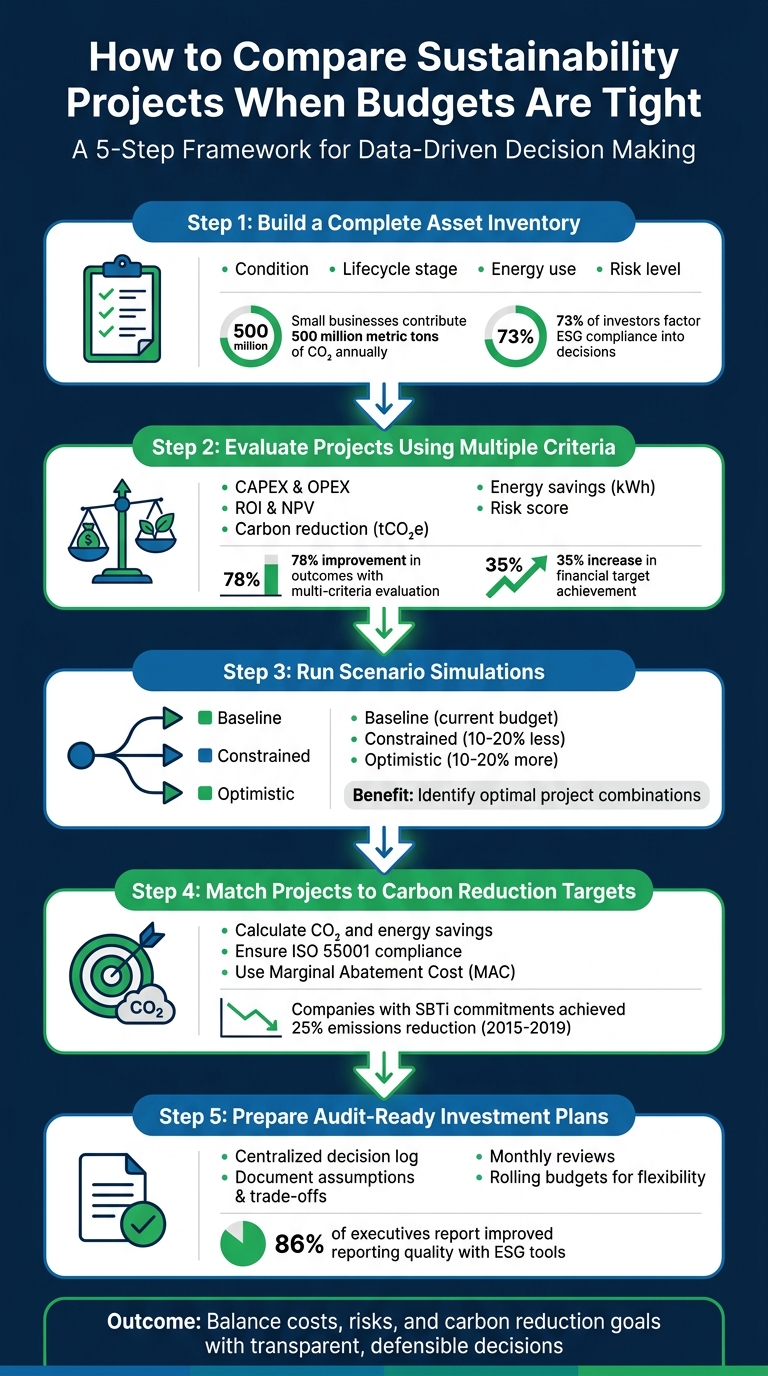
5-Step Framework for Comparing Sustainability Projects on Tight Budgets
What is a Project Prioritization Matrix? Selecting the Best Projects with Many Stakeholder Criteria
sbb-itb-5be7949
Step 1: Build a Complete Asset Inventory
Before diving into sustainability projects, you need a clear understanding of what assets you own and their current condition. Without this groundwork, decision-making becomes a guessing game. A thorough asset inventory provides the hard data needed for tools like Net Present Value (NPV), which helps prioritize limited capital for the most efficient projects [4]. This inventory lays the groundwork for a more structured and criteria-driven evaluation process in later steps.
In the U.S., small businesses alone contribute around half a billion metric tons of carbon emissions jaarlijks [4]. A complete asset inventory helps bridge the gap between abstract environmental goals and measurable outcomes. It establishes a baseline for your environmental impact, turning hard-to-quantify benefits – like energy savings or waste reduction – into actionable metrics [4].
"Sustainability initiatives pose a variety of valuation questions for firms of all sizes but can be particularly problematic for SMEs given the limited resources they can devote to capital budgeting decisions."
– Jeffrey F. Shields, Brad A. Bilsky, & Joyce M. Shelleman, Small Business Institute Journal [4]
This quote highlights the challenges faced by smaller organizations when allocating resources to sustainability efforts. With limited budgets, bad investments can be costly. A detailed asset inventory reduces these risks by enabling smarter decision-making and helping to avoid unexpected costs or underwhelming returns [4]. Additionally, with 73% of investors now factoring ESG compliance into their decisions [5], having accurate and audit-ready asset data is no longer optional – it’s a competitive edge.
Oxand Simeo™ Inventaris simplifies this process by creating a centralized asset register. This system tracks details like condition, criticality, and risk for each component, ensuring that sustainability comparisons are based on reliable, shareable data rather than scattered spreadsheets.
Identify Key Asset Data Points
To effectively compare projects, you need to capture specific data about each asset. Focus on these four key areas:
- Voorwaarde: Understand the current state of your assets.
- Levenscyclusfase: Know where each asset is in its lifespan.
- Energy use: Measure energy consumption for better efficiency planning.
- Risk level: Evaluate potential vulnerabilities or risks tied to each asset.
Beyond these basics, you’ll need additional environmental data to meet today’s reporting demands. This includes Scope 1, 2, and 3 greenhouse gas emissions [5][6]. Notably, Scope 3 often accounts for 80–95% of a company’s total carbon footprint [5]. Other important metrics include energy consumption, water security impacts, and deforestation risks [7][8].
Financial data is equally crucial. Track turnover, CapEx, and OpEx linked to sustainable activities to ensure budgets are allocated effectively [6]. For companies bound by specific regulations, this means documenting Taxonomy-aligned activities. For others, it’s about identifying resource-heavy assets and pinpointing projects with the best return on investment.
Risk and resilience metrics are another priority. Data on physical climate risks, transition risks, and dependencies on natural resources – like water or land – supports long-term planning [6]. Companies with Initiatief op basis van wetenschappelijke doelstellingen (SBTi) commitments reported an average emissions reduction of 25% between 2015 and 2019 [8], underscoring the value of tracking these metrics systematically to guide risk-based investments.
Set Up Standard Data Collection Processes
Consistency is key when collecting data; without it, comparing projects becomes unreliable. Variations in metrics, timeframes, or emission factors across sites can lead to confusion and inaccurate comparisons. Standardized processes ensure that all asset data is consistent and trustworthy.
Once you’ve identified the critical data points, implement uniform collection methods across your portfolio. Integrate data from finance (e.g., emissions purchases), HR (e.g., diversity metrics), and operations (e.g., energy and waste) into a single system. This eliminates duplicate entries and version control issues [5].
To further improve accuracy, use validation rules and standardized forms to catch errors, duplicates, or gaps in your data. For organizations facing climate disclosure mandates – such as California’s SB 253 or Australia’s Sustainability Reporting Standards – this level of standardization ensures compliance and creates an audit-ready data trail [5][6].
Oxand Simeo™-voorraad streamlines this process with tools like Simeo GO, a mobile app for conducting guided site inspections. The app supports offline use, allows for photos and comments, and enforces standardized scoring. Whether you’re assessing assets in New York or Los Angeles, today or next year, this approach ensures consistency. The result? A reliable asset database that transforms project comparisons from confusing to meaningful.
Finally, conduct a double materiality assessment. This means evaluating both how sustainability issues impact asset value (financial materiality) and how your assets affect the environment (impact materiality) [5][6]. This dual approach ensures you’re collecting data that meets compliance needs while also supporting strategic decisions.
Step 2: Evaluate Projects Using Multiple Criteria
Once you’ve mapped out all your assets, it’s time to compare projects based on cost, impact, and risk. For example, installing solar panels might require a hefty $250,000 upfront investment but provide long-term energy savings, while upgrading a boiler may cost $80,000, deliver immediate carbon reductions, but come with higher ongoing maintenance. Without a structured approach, these decisions can feel like subjective debates rather than objective, data-driven choices.
A multi-criteria evaluation framework can help. By balancing financial performance, environmental impact, and risk, you can make more informed decisions. This method has been shown to improve outcomes by 78% and increase financial target achievement by 35% [9]. Key metrics to consider include upfront costs (CAPEX), ongoing expenses (OPEX), return on investment (ROI), carbon reduction (measured in metric tons of CO₂, or tCO₂e), and energy savings (measured in kilowatt-hours, or kWh). Adding a risk score to account for uncertainties completes the picture, turning raw data into actionable investment strategies.
Financial metrics like Net Present Value (NPV) and Internal Rate of Return (IRR) are essential for evaluating profitability and growth [9]. For organizations with limited budgets, Marginal Abatement Cost (MAC) – calculated as the net present cost divided by cumulative carbon abatement – can help prioritize projects that deliver the most CO₂ reduction per dollar spent [1]. MAC is particularly useful when efficiency, not just total impact, is the priority.
To handle uncertainty, use confidence bands (low/base/high estimates) for both costs and carbon savings [1]. A project with high potential savings but low confidence might be riskier than one with modest but reliable results. Structured risk frameworks can reduce project delays and budget overruns by 85% [9]. Don’t forget operational constraints like staffing, contractor availability, and facility downtime, which can significantly impact project feasibility [1].
Platforms like Oxand Simeo™ simplify this process by automating multi-criteria evaluations. They let you compare projects using standardized metrics for financial performance, carbon abatement, and risk within a single interface. This ensures consistency in assumptions – like discount rates and emission factors – across departments [1].
Create a Weighted Scoring System
To refine comparisons further, assign weights to different criteria based on your organization’s priorities. Not all factors carry the same importance. For instance, if cash flow is tight, metrics like Payback Period or MAC might outweigh longer-term goals. On the other hand, if regulatory deadlines are a concern, compliance could take precedence.
Start by listing your evaluation criteria: initial cost, ROI, CO₂ reduction, energy savings, risk score, and any strategic factors like regulatory alignment or operational readiness. Assign percentage weights that total 100%. For example:
- A budget-focused organization might allocate 30% to ROI, 25% to MAC, 20% to risk score, 15% to carbon reduction, and 10% to strategic alignment.
- An organization with aggressive decarbonization goals might prioritize carbon reduction, flipping these weights.
Test your weighting system with real projects to ensure it produces logical rankings. If a high-risk, low-impact project scores higher than a proven energy saver, adjust the weights. Sensitivity analysis – testing different weight combinations – can help identify which projects consistently rank well regardless of assumptions [2].
Document your rationale for assigning weights in a decision log. This transparency can reduce internal disagreements and support external reporting requirements, such as those mandated by California’s SB 253 [5][6].
Compare Projects Using a Metrics Table
A metrics table turns abstract criteria into tangible comparisons, making trade-offs easy to spot. Here’s an example of how you might structure such a table:
| Project Name | Initial Cost ($) | ROI (%) | CO₂ Reduction (tons/year) | Energy Savings (kWh/year) | Risk Score (1–5) | Sustainability Score (1–100) |
|---|---|---|---|---|---|---|
| LED Lighting Retrofit | $45,000 | 22% | 18 | 125,000 | 1 | 78 |
| HVAC System Upgrade | $180,000 | 15% | 95 | 420,000 | 3 | 85 |
| Solar Panel Installation | $250,000 | 12% | 150 | 680,000 | 2 | 92 |
| Building Envelope Insulation | $95,000 | 18% | 42 | 210,000 | 2 | 72 |
| Boiler Replacement | $80,000 | 20% | 65 | 180,000 | 1 | 81 |
This table highlights trade-offs at a glance. The LED retrofit offers the best ROI and lowest risk but has limited carbon impact. Solar panels, while requiring a larger upfront investment, deliver the most significant carbon and energy savings. Meanwhile, the HVAC upgrade strikes a balance between impact, cost, and risk.
If your budget is tight, you might prioritize the LED retrofit and boiler replacement, which together cost $125,000. If additional funds become available, insulation could be added for $95,000, while larger projects like solar panels and HVAC upgrades might wait for future cycles.
The "Sustainability Score" is a weighted average of all criteria, reflecting your organization’s priorities [1]. A project might score highly if it excels in carbon reduction, even if its ROI is lower. Conversely, a project with strong financial returns but moderate environmental impact may score lower. This single metric simplifies comparisons across multiple dimensions.
However, numbers alone don’t tell the whole story. Operational constraints – like engineering capacity or contractor availability – may not appear in the table but can significantly affect project sequencing. Adding notes or extra columns for factors like downtime windows or alignment with planned upgrades can make your evaluations more comprehensive. Integrated dashboards can also help visualize deliverability alongside desirability.
Finally, maintain a reserve list of pre-evaluated projects. If supply chain issues delay a primary project, you can quickly reallocate funds to the next-ranked option without starting the evaluation process from scratch [1].
Step 3: Run Scenario Simulations to Optimize Your Budget
Now that you’ve set up your metrics, it’s time to refine your approach. By running simulations, you can align projects with both immediate needs and long-term goals. Forget static spreadsheets – dynamic "what-if" simulations can automate recalculations for ROI and carbon savings. Tools like Oxand Simeo™ let you compare multiple budget scenarios side-by-side, showing how each impacts financial performance, carbon reduction targets, and risk exposure over time (from 5 to 30 years).
Test Different Budget Scenarios
Using the asset evaluations and scoring from earlier steps, simulations can help uncover the most effective project combinations for your budget. Start by defining at least three scenarios:
- Uitgangssituatie: Your current approved budget.
- Constrained: A tighter budget with 10–20% less funding.
- Optimistic: A more flexible budget with 10–20% additional funding.
For each scenario, you’ll see which projects get funded, which are deferred, and how this affects overall ROI and sustainability goals. These simulations make trade-offs crystal clear by showing the benefit-to-cost ratio of each option [3].
Testing staggered timelines can also reveal opportunities to prioritize high-impact projects without exceeding annual budgets. As the NOAA Climate Resilience Toolkit wijst erop:
"Taking action to put an important and highly visible portion of your plan into effect may give you a ‘win’ that could attract additional resources."
Phased implementation not only stretches your current budget but also helps build a track record of success, which can lead to further funding opportunities.
Once you’ve weighed short-term trade-offs, shift your focus to projects that promise lasting value.
Prioritize Investments for Long-Term Returns
Quick wins are great, but scenario simulations also shine in pinpointing projects that deliver the most value over the long haul. Net Present Value (NPV) is a key metric here – it factors in the time value of money, ensuring you don’t overestimate the value of projects with delayed returns [4]. For example, a project with a 10-year payback might seem appealing, but NPV could show that a faster-returning project would provide more value over the same period.
When running these simulations, prioritize projects where the expected benefits – like reduced risk, increased resilience, or other co-benefits – outweigh the costs. Look for ways to sequence or bundle actions to maximize asset protection. It’s also smart to build flexibility into your plans. For instance, if supply chain issues delay a solar panel installation, having a backup project, such as additional insulation or a boiler upgrade, can help you stay on track with your annual carbon reduction goals without scrambling for last-minute solutions [3].
Step 4: Match Projects to Carbon Reduction Targets
Aligning your portfolio with carbon reduction targets goes beyond picking "green" projects. It’s about quantifying the expected CO₂ reductions for each investment, ensuring compliance with regulatory standards, and keeping everything within budget.
Meet Regulatory and ISO 55001 Normen
Regulatory compliance is non-negotiable. Projects that adhere to ISO 55001 asset management standards not only help reduce environmental impact but also boost organizational credibility. This credibility can lead to opportunities for additional funding. For instance, in January 2026, a major manufacturing company reduced CO₂ emissions by 15% by adopting energy-efficient technologies. Focusing on ISO 55001-compliant projects ensures your initiatives are well-documented, with clear criteria, assumptions, and trade-offs recorded in decision logs for transparency and accountability [1].
Once compliance is addressed, the next step is to quantify the environmental benefits of your projects.
Calculate Carbon and Energy Savings
Using the results of your scenario analysis, consistently calculate carbon and energy savings to evaluate project efficiency. A standardized approach is key. Start with the Marginal Abatement Cost (MAC) – the cost per ton of CO₂e reduced. This metric allows you to compare projects across different sites and business units, ensuring resources aren’t wasted on initiatives that may seem appealing but lack proper justification.
Create a structured intake table to capture critical project data, including site, cost, estimated reductions, timeline, and confidence levels. Standardize key assumptions like electricity emission factors, discount rates, and shadow carbon pricing to allow for quick scenario testing. Tools like Oxand Simeo™ sustainability modules can simplify this process. These modules model energy performance trajectories and carbon reduction pathways while calculating annualized energy savings, greenhouse gas reductions, net present value, and simple payback for each project.
When calculating savings, consider practical constraints like engineering capacity, contractor availability, or operational downtime. Build in monthly reviews to monitor progress. If a project underperforms – losing more than 20% of its projected abatement – reallocate resources to the next-best alternative.
Step 5: Prepare Audit-Ready Investment Plans
After completing your scenario simulations and ensuring carbon alignment, it’s time to finalize your strategy by developing audit-ready investment plans. This step is crucial – not just for compliance, but also for fostering trust and providing a clear defense for every sustainability-related investment.
Document Your Decision Process and Results
Keep a centralized decision log that captures the reasoning behind every approved or deferred project. This log should answer questions like: Why was one project prioritized over another? Include details such as the scenarios considered, key assumptions (like electricity emission factors or discount rates), and the specific selection criteria (e.g., "lowest marginal abatement cost within Q2 downtime window").
To ensure consistency, use templates with data validation. Tools like Microsoft Power BI can help you generate a decision log and dashboard in just a few days, offering real-time insights into resource allocation. For projects that didn’t get funding, clearly document the limiting factor – whether it’s budget constraints, engineering capacity, or contractor availability. This way, you’ll have a transparent audit trail.
Stay agile by establishing triggers for reallocating resources. For instance, if a project faces delays of more than 60 days or its expected abatement drops by 20% or more, move it to a watchlist. Redirect those resources to the next-best alternative from your pre-approved list. Continuously monitor execution signals like project phases (design, procurement, installation), spend-to-date, and updated abatement forecasts to ensure your plan stays aligned with long-term goals.
Review and Update Plans Regularly
Hold monthly reviews to identify and address issues early. A structured governance process every month helps keep decisions grounded in data rather than internal politics.
Consider replacing fixed annual budgets with rolling budgets. This approach allows for rapid adjustments in response to new government incentives or regulatory changes. Track both financial and non-financial metrics – such as cost savings, CO₂ reductions, and kilowatt-hours conserved – to give stakeholders a full picture of your performance. Research shows that 86% of global executives using ESG accounting tools report improvements in reporting quality and stakeholder communication [10].
For long-term projects, break them into smaller phases with clear deliverables. This method not only builds a track record of incremental successes but also attracts additional resources. Additionally, it demonstrates continuous progress to auditors. Don’t just document results – capture the reasoning behind decisions, including risks evaluated, challenges identified, and alternatives considered. This added context turns a basic spreadsheet into a comprehensive, audit-ready plan that showcases how your organization balances cost, risk, and sustainability goals.
Conclusie
Evaluating sustainability projects on a tight budget doesn’t have to feel overwhelming. By following the five-step framework detailed here, you can create a clear, logical process for comparing projects. It all starts with a solid, standardized asset inventory – laying the groundwork for data-driven decisions that balance costs, risks, and carbon reduction goals. This approach ties detailed asset evaluations to flexible budget simulations and carbon target alignment, making it easier to prioritize effectively.
Sustainability investments shouldn’t be seen as just a compliance requirement – they’re strategies to reduce risk. Deloitte’s research highlights this well:
"By investing in a more rigorous analysis upfront, governments can save significant resources when it comes time for infrastructure project execution" [11].
This insight applies across sectors. When you factor in potential repair or replacement costs, sustainability investments often prove their worth.
Oxen en Simeo™ simplifies the entire process by bringing all these steps together in one platform. With over 10,000 proprietary aging models and more than 30,000 maintenance laws refined over two decades, it simulates how assets age, consume energy, and impact carbon emissions over their lifecycle. The tool allows you to prioritize projects based on risk, lifecycle costs, and CO₂ impact, while also running "what-if" scenarios to fine-tune budget allocations. Everything happens in one secure system, ensuring decisions are traceable and audit-ready. Plus, it generates ISO 55001-compliant plans directly from your data, complete with defensible documentation for every choice you make.
FAQs
What’s the minimum asset data I need to compare projects?
To effectively compare projects, you need some key asset data, including estimated costs, expected energy savingsen potential carbon reduction impacts. This information is crucial for conducting a cost-benefit analysis, assessing long-term value, and balancing sustainability goals with budget limitations.
How do I pick weights for a project scoring model?
When deciding on weights for a project scoring model, it’s essential to use a structured method that aligns with both your financial targets and sustainability objectives. Start by standardizing the criteria you’ll evaluate – think ROI, koolstofverminderingen long-term value. Once you’ve defined these, assign weights to each based on their relative importance to your goals.
It’s also worth considering tools like marginal abatement cost modeling and factoring in capacity constraints to refine your approach. Engaging stakeholders in this process is key to ensuring the weights reflect shared priorities and collective goals. A transparent and well-organized framework not only simplifies decision-making but also makes your project prioritization process consistent and defensible.
Which budget scenarios should I simulate first?
Simulating different scenarios is a smart way to evaluate costs, benefits, and your team’s ability to carry out solutions. By carefully combining or sequencing projects, you can better safeguard assets while reducing potential risks. Bringing community groups into the conversation is also key – it helps build agreement and uncovers actions that have broad support. This method gives you a clear picture of both the financial and operational effects of various options before committing to a final plan.
Verwante Blog Berichten
- Koolstofgerichte investeringsplanning: hoe projecten prioriteren op basis van CO₂-reductie per euro
- Prioriteringsmodellen uitgelegd: risicomatrices, NPV, MCDA en wanneer deze te gebruiken
- Veranderingsbeheer voor vermogensbeheerplanning: Financiën, bedrijfsvoering en ESG op één lijn krijgen
- Slechtst presterende gebouwen: Hoe u investeringen in een portefeuille kunt identificeren, beoordelen en faseren