







America’s infrastructure is crumbling under the weight of deferred maintenance and climate change. Extreme weather events like heatwaves and flooding are accelerating wear and tear, cutting asset lifespans short by decades. The cost of waiting for failures is staggering – repairing after a disaster can cost up to 10 times more than Manutenzione predittiva e reattiva. By integrating climate-focused planning into budgets, governments and organizations can save billions annually, reduce risks, and extend the lifespan of critical infrastructure.
Punti di forza:
- $1.2 trillion in deferred maintenance backlogs is driving emergency repair costs higher.
- Climate stress shortens asset lifespans, with roads, bridges, and rail systems already failing prematurely.
- Preventive measures cost far less than emergency fixes ($120,000 vs. $2.5 million per event).
- Strumenti come ISO 55001 and platforms like Oxand Simeo™ help manage risks and secure federal funding.
- Proactive planning can reduce emergency costs by 65% and improve readiness by 80%.
Ignoring climate risks in infrastructure budgets leads to higher costs, sudden failures, and lost opportunities for federal funding. It’s time to act now and plan smarter.
Climate Change Risks to Aging Infrastructure
How Climate Change Shortens Asset Lifespans
Climate change is steadily wearing down infrastructure. Extreme heat, for example, causes metal bridge components to expand beyond their intended limits, while concrete roads can buckle under excessive temperatures. Studies indicate that even a modest 5% rise in average temperature can result in an additional 0.04 inches of rutting on road surfaces over their lifespan [3].
Rail systems face similar challenges. Under extreme heat, continuously welded tracks can buckle – referred to as "sun kinks" – forcing rail operators like Amtrak and Washington D.C.’s Metro to impose speed restrictions of 35 mph when rail temperatures hit 135°F [2]. Coastal infrastructure is also at risk. Rising sea levels and stronger storm surges are accelerating coastal erosion, which undermines the stability of roads and rail lines [2][3].
"Infrastructure health is similar to human health: If doctors detect problems such as tumors or cancer only in the later stages, it is often too late."
- Suyun Paul Ham, Associate Professor of Civil Engineering, University of Texas at Arlington [2]
These gradual but persistent damages are already contributing to infrastructure failures across the country.
The overall impact is staggering. Currently, 40% of U.S. roads are classified as being in poor or mediocre condition, while 7.5% of bridges are rated as poor [2]. Climate-related stress is accelerating the degradation of these assets, often cutting their lifespans short by decades. This not only increases the likelihood of sudden failures but also sets the stage for severe disruptions. Unless proactive measures are taken, climate-related infrastructure costs could soar into the hundreds of billions of dollars annually by the century’s end [3].
U.S. Infrastructure Failures Linked to Climate Impacts
As infrastructure weakens under prolonged climate stress, sudden breakdowns are becoming more frequent. The July 2024 collapse of New York City’s Third Avenue Bridge and the April 2023 flooding at Fort Lauderdale airport – both mentioned earlier – are just early examples of a growing trend of climate-driven crises.
During the summer of 2024, highways in Wisconsin and Washington state experienced widespread pavement buckling. The concrete expanded beyond what the joints could handle, creating hazardous conditions that required immediate repairs [2].
Even cutting-edge systems aren’t exempt. Two decades after Hurricane Katrina caused $150 billion in damages and claimed roughly 1,400 lives [4], the $14.4 billion flood protection system built in New Orleans is already under strain. Designed by the U.S. Army Corps of Engineers, the 200-mile network of levees and gates – including the massive 2-mile-long Lake Borgne Surge Barrier – was engineered to handle a 26-foot storm surge. Yet, due to land subsidence and rising sea levels, the system is sinking and may fail far sooner than anticipated [4].
sbb-itb-5be7949
Adapting Infrastructure for Climate Change: Strategies and Innovations by Public Agencies @infraday
Budget Pressures and the Cost of Doing Nothing
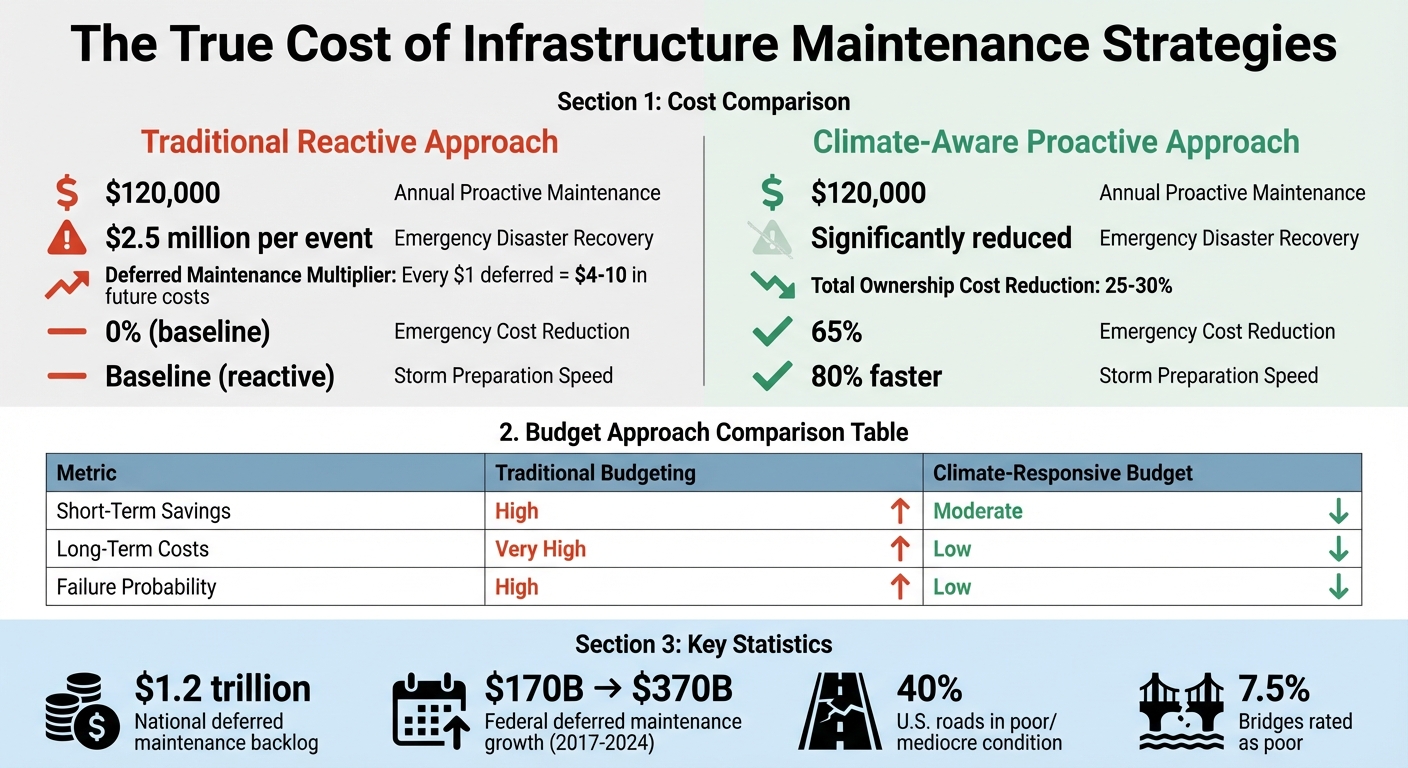
Cost Comparison: Proactive vs Reactive Infrastructure Maintenance
Aging infrastructure in the U.S. is putting enormous pressure on budgets. The national deferred maintenance backlog now stands at a staggering $1.2 trillion [5]. Within federal assets alone, deferred maintenance has more than doubled between 2017 and fiscal year 2024, jumping from $170 billion to over $370 billion [5]. This growing backlog sets the stage for emergency repairs, which are far more costly.
Here’s the kicker: for every $1 of maintenance deferred today, future capital renewal costs could rise by 4 to 10 times [5]. Take healthcare facilities as an example – over 50% of major mechanical, electrical, and plumbing systems have already outlived their expected lifespans [5]. These aging systems often fail suddenly, with their deterioration hidden until a crisis forces immediate action.
This issue ties into something called nonlinear capital coupling. Essentially, when one system fails, it can trigger a domino effect across interconnected systems. For instance, repairing an HVAC system might require simultaneous upgrades to electrical systems or structural modifications to meet current building codes [5].
"Deferred maintenance becomes a capital risk not because individual assets age, but because capital requirements stop behaving independently."
- Marybeth Collins [5]
This growing financial strain underscores the urgent need to rethink how budgets are allocated for infrastructure.
Traditional Budgeting vs. Climate-Aware Budgeting
Traditional budgeting operates under the assumption that infrastructure assets age independently and can be repaired one at a time. This approach focuses on short-term savings by spreading repairs across multiple budget cycles. While this method worked when infrastructure was newer and climate conditions were more predictable, it’s proving inadequate in today’s reality.
A climate-aware budgeting approach acknowledges that infrastructure systems are interconnected and that climate stressors accelerate their deterioration. Without adjustments, the total cost of maintaining U.S. infrastructure could climb into the hundreds of billions of dollars annually by the end of the century [3]. However, there’s good news: adopting reactive adaptation (repairing damage as it happens) can cut these costs by a factor of 10. Even better, proactive adaptation (investing in upgrades before damage occurs) could lower annual costs to the low tens of billions [3].
| Budget Approach | Short-Term Savings | Costi a lungo termine | Failure Probability |
|---|---|---|---|
| Traditional Budgeting | Alto | Very High | Alto |
| Climate-Responsive Budget | Moderato | Basso | Basso |
But this isn’t just about dollars and cents – it’s about control. Traditional budgeting often leads to what experts call "forced capital movement with diminishing choice" [5]. When systems fail unexpectedly, budget managers lose the ability to strategically prioritize projects, and funds are spent reactively instead of proactively.
Federal Funding for Climate Adaptation
To address these rising costs, federal programs are stepping in to support climate-resilient upgrades. Recent legislation, including the Legge sugli investimenti nelle infrastrutture e l'occupazione, has allocated billions toward modernizing outdated systems with climate considerations in mind. These programs acknowledge that climate change will significantly impact the Federal Government’s budget through both lost revenues and increased expenditures in the coming decades [6].
For infrastructure managers, this means there are now opportunities to secure federal funding for adaptation projects. By demonstrating how a project will reduce future costs, extend the lifespan of assets, and meet compliance requirements, managers can tap into grants and programs designed to mitigate long-term risks. This kind of planning aligns perfectly with the principles of climate-aware budgeting.
The rising costs of inaction make it clear: integrating climate adaptation into infrastructure planning is no longer optional – it’s essential.
Adding Climate Adaptation to Asset Management Frameworks
Infrastructure managers don’t need to start from scratch when addressing climate adaptation. The ISO 55001 standard, a globally recognized framework for asset management, offers a practical way to incorporate climate considerations into planning. The latest edition, published in July 2024, aligns with UN Sustainable Development Goal 13: Climate Action [8]. It provides a structured approach to managing risks, including those driven by climate change.
At its core, ISO 55001 emphasizes risk-based thinking. Organizations are tasked with identifying risks and opportunities that could hinder their asset management goals. This includes climate-related risks like faster asset deterioration, regulatory challenges, or missing sustainability targets. The standard also requires a clear understanding of external factors, such as changing weather patterns and evolving stakeholder expectations, including federal climate mandates [7]. One of the tools recommended is the Consequence × Likelihood matrix. This tool helps prioritize assets by factoring in environmental conditions and weather exposure for likelihood, while consequences consider impacts like environmental damage or reputational harm [7].
"In the context of asset management, risk has a specific and practical meaning. It is the effect of uncertainty on the achievement of asset management objectives."
- Sakthi Thangavelu, Senior Manager – Cyber Assurance, Glocert [7]
Organizations that have shifted from calendar-based maintenance to a "Climate-Ready" model – leveraging IoT sensors and AI for weather-based inspections – have seen impressive results. Emergency costs dropped by 65%, and storm preparation became 80% faster compared to reactive approaches [1]. These methods not only reduce risks but also improve budget efficiency by avoiding expensive last-minute repairs.
Utilizzo ISO 55001 for Climate-Resilient Planning
ISO 55001 encourages a shift in focus from short-term fixes to managing the Total Cost of Ownership (TCO) over an asset’s lifecycle. This approach takes into account acquisition costs, ongoing maintenance, and potential failure costs – calculated as the product of consequence and likelihood – over the asset’s lifespan [7]. With climate change accelerating infrastructure wear and tear at three times the historical rate [1], assets originally expected to last 30 years might now need replacement in just 10.
The standard also requires organizations to set measurable risk tolerance thresholds. For example, a policy might state: "No asset in Condition Grade 5 shall operate without a documented climate risk acceptance plan" [7]. This ensures proactive attention to high-risk scenarios. Maintaining a living risk register – regularly updated with asset conditions, incidents, and climate data – is another key requirement [7]. This register is essential for compliance audits, providing a clear link between climate risk assessments, maintenance strategies, and capital investment decisions. Such documentation is also critical for securing federal resilience grants, like FEMA’s Building Resilient Infrastructure and Communities (BRIC) program, which demands proof of active climate risk management [1].
Steps to Add Climate Adaptation to Asset Plans
To directly integrate climate risks into asset management, the following steps can be taken:
- Conduct Failure Mode and Effects Analysis (FMEA): This identifies specific climate-related failure mechanisms. For example, coastal infrastructure may face accelerated corrosion due to rising salinity, while extreme heat can cause asphalt to buckle. Pinpointing these vulnerabilities allows for targeted prevention strategies rather than relying on generic maintenance schedules [7][1].
- Standardize Condition Grading and Link to Investment: Use a 1–5 condition grading system to objectively assess asset risks and prioritize investments. A risk-cost ratio can guide resource allocation, ensuring funds are directed toward preventing high-impact failures. Automatic reviews can be triggered when assets reach critical degradation thresholds, focusing efforts where they are most needed [7].
- Automate Compliance Reporting: Integrate real-time weather data with asset management systems. When severe weather is predicted within 48 hours, the system can automatically activate high-priority checklists, such as testing generators or clearing storm drains. This ensures timely preventive actions and aligns with federal funding and compliance requirements [1].
| Climate Risk Urgency Level | Descrizione | Action Triggered |
|---|---|---|
| 5 – Critical Emergency | Imminent threat (e.g., flash flood) | Auto-dispatch emergency crews; facility lockdown [1] |
| 4 – Severe Warning | Extreme event within 48 hours | High-priority pre-storm checklists; generator testing [1] |
| 3 – Elevated Risk | Seasonal shift or moderate advisory | Clearing storm drains; checking HVAC coolant [1] |
| 2 – Long-Term Stress | Gradual degradation (e.g., freeze-thaw) | Flagged for next capital expenditure (CAPEX) review [1] |
| 1 – Normal Operations | Baseline environmental parameters | Daily IoT telemetry logging for historical modeling [1] |
Come Oxand Simeo™ Supports Climate-Resilient Infrastructure Planning
Tackling climate adaptation and implementing the ISO 55001 framework requires tools that simplify complex risk data into actionable steps. Oxand Simeo™ is designed to do just that. By combining predictive modeling with scenario testing, it helps infrastructure managers make informed budget decisions that factor in climate risks. It works with existing asset data and doesn’t depend on large IoT networks, making it accessible to a wide range of users. This aligns perfectly with a forward-thinking, cost-effective approach to managing climate challenges.
Predictive Models for Aging and Climate Effects
Oxand Simeo™ uses a robust database of over 10,000 aging models and 30,000 maintenance rules, built and refined over two decades, to simulate how climate factors affect asset performance. Its probabilistic modeling predicts how elements like extreme heat, moisture, or freeze-thaw cycles speed up wear and tear. For instance, a bridge deck designed with a specific lifespan in mind might deteriorate faster due to extreme temperature fluctuations. These insights allow managers to weigh the financial and operational risks of inaction against the benefits of timely, climate-adapted maintenance.
Scenario Testing for Risk and Decarbonization
The platform also offers scenario testing, letting users explore "what-if" situations with different budget and maintenance strategies. Managers can see how varying investment levels impact risk exposure, service quality, and CO₂ emissions over time. This feature highlights how proactive upgrades not only cut repair costs but also contribute to lowering emissions, offering a clear path toward climate-resilient infrastructure.
Showing ROI and Meeting Compliance Requirements
The latest ISO 55001:2024 update emphasizes the importance of addressing climate change in asset management. Specifically, it requires organizations to assess if climate change is relevant to their operations (Requirement 4.1) and to include climate-related risks in their planning (Requirement 6.1) [9]. Oxand Simeo™ simplifies compliance by generating audit-ready reports that quantify risk reduction, cost savings, and CO₂ impact. These reports meet stakeholder expectations outlined in the updated standard and pinpoint gaps in current plans. By documenting these outcomes, infrastructure managers can confidently present their climate-resilient strategies and demonstrate the value of their investment planning for the long haul.
Benefits of Climate-Aligned Investment Strategies
Investing in climate-aligned strategies can significantly reduce costs associated with emergencies. For instance, proactive maintenance costs around $120,000 annually, compared to the staggering $2.5 million often required for disaster recovery efforts [1]. Extreme weather accelerates wear and tear on infrastructure, shortening asset lifespans. By acting early, organizations can save money and avoid frequent replacements [1].
Another advantage is access to federal funding. Agencies like FEMA’s BRIC program and the PROTECT Formula encourage climate-conscious planning by requiring detailed risk assessments and digital records. A great example is the Minnesota Department of Transportation, which secured $115 million in PROTECT Formula funding. In 2023, the department allocated $500,000 to create a Resilience Improvement Plan, which not only secured $6.9 million for local projects but also established a framework to minimize climate risks [10].
Technology also plays a role. Automated weather APIs, for instance, can trigger pre-storm inspections and protective actions 48 to 72 hours before severe weather hits. This allows teams to prep backup systems, clear drainage paths, and deploy sandbags in time [1]. These measures don’t just reduce costs – they also enhance safety and preparedness.
Extending Asset Lifespans Through Preventive Planning
Preventive planning is another key component of climate-aligned strategies. By addressing early signs of degradation, organizations can extend the lifespan of their assets while improving safety [1]. Tools like thermal sensors, flood monitors, and inclinometers can detect issues such as concrete spalling or seal deterioration before they escalate into major problems. This enables maintenance teams to address concerns during scheduled downtime rather than reacting to failures [1].
Il City of Two Harbors, Minnesota, provides a compelling case study. After a destructive storm in 1999, the city invested $80,000 in green infrastructure, including flood control basins, streambank stabilization, and a rain garden. These investments paid off during the 2012 "Solstice Flood", which caused $100 million in regional damage – yet Two Harbors was largely unaffected. Similarly, in 2018, another storm inflicted $18.4 million in damage across the region, but the city’s proactive measures once again shielded it from major harm [11].
Balancing Costs, Risks, and Sustainability
Adapting to climate challenges often involves juggling financial constraints, risk management, and environmental considerations. Multi-criteria prioritization frameworks are useful for weighing these factors. They evaluate an asset’s vulnerability by analyzing its exposure to climate risks, current condition, and historical performance [10].
Green infrastructure offers a practical way to achieve this balance. These nature-based solutions are typically 15% to 80% less expensive than traditional systems made of concrete or metal and require less upkeep over time [11]. For example, the City of Las Cruces, New Mexico, collaborated with Adaptation International to address climate challenges. With a $400,000 investment funded by a Community Development Block Grant and city capital, they implemented green infrastructure in an underserved neighborhood. Projects included rainwater harvesting, curb cuts, bioswales, and pervious pavement to combat extreme heat and flash flooding [12].
"One of our biggest motivations to try and get ahead of the impacts of climate change is really a financial concern. To anticipate that is going to be less costly than trying to repair in a crisis situation."
- Gregory Federspiel, Town Administrator, Manchester-by-the-Sea [13]
Conclusion: Making Climate Resilience Part of Every Budget
Recovering from disasters after they strike can cost upwards of $2.5 million per event, while proactive maintenance averages just $120,000 annually [1]. With a staggering $1 trillion in repair backlogs, postponing action isn’t an option. Traditional maintenance schedules simply can’t keep pace when climate change accelerates infrastructure wear and tear at three times the historical rate [1]. This sharp contrast in costs highlights the urgency for a forward-thinking, data-driven approach.
By incorporating climate resilience into budgeting, organizations can spend smarter – reducing emergency expenses and improving readiness for severe weather. Predictive tools and real-time data have proven to cut emergency costs by 65% and speed up storm preparation by 80% [1]. When climate data is integrated into ISO 55001 frameworks, the result is a 25% to 30% reduction in total ownership costs [14].
Ox e Simeo makes this shift achievable by unifying scattered asset data into one platform. This allows teams to simulate multi-year scenarios that balance costs, risks, and carbon impact. With 10,000+ predictive models e 30,000+ actionable recommendations, the platform enables a shift from reactive responses to strategic planning [14]. Whether it’s automating pre-storm workflows 48 to 72 hours before extreme weather or generating digital audit trails to secure federal grants like FEMA’s BRIC program, these tools make climate adaptation financially and operationally feasible.
The evidence is clear: prioritizing climate resilience is essential for managing infrastructure sustainably. Ignoring climate risks during budget planning is a missed chance to extend the lifespan of critical assets, cut emergency costs, and safeguard the communities that rely on them. The real question is: how quickly can you make climate adaptation a reality?
Domande frequenti
Where do I start adding climate adaptation to my infrastructure budget?
To protect your infrastructure from climate risks, start by identifying specific threats like flooding, heatwaves, or other extreme weather events. These risks can significantly impact your operations, so understanding them is crucial.
A helpful approach is to use established frameworks like ISO 55001, which can guide you in integrating resilience into your asset management strategies. Pair this with advanced tools, such as Sensori IoT, to enable predictive maintenance. These technologies allow you to anticipate issues before they escalate, saving time and resources in the long run.
It’s also worth exploring funding options to support these efforts. Look into federal climate adaptation programs that may offer financial assistance for resilience projects.
Here are a few key steps to get started:
- Conduct thorough risk assessments to understand vulnerabilities in your infrastructure.
- Update your plans with resilience strategies that address identified risks.
- Leverage available resources to ensure your strategies align with both your budget and regulatory requirements.
By taking these proactive measures, you can better prepare your infrastructure to withstand the challenges posed by a changing climate.
How can I quantify ROI for proactive climate-resilience investments?
To measure the return on investment (ROI) for climate-resilience efforts, start by comparing the expenses of adaptation strategies to the potential costs of damages they can prevent over the asset’s lifetime. Standards like ISO 55001 provide a structured way to evaluate risks and ROI by embedding climate considerations into asset management plans.
Using tools like analisi costi-benefici e modellazione dello scenario can make these benefits clearer. They help showcase advantages such as avoiding costly damages, minimizing downtime, and increasing the lifespan of assets. These insights guide smarter decisions that balance environmental responsibility, regulatory requirements, and financial limitations.
What documentation do I need to qualify for federal resilience funding?
To apply for federal resilience funding, make sure to submit your application via FEMA Grants Outcomes (FEMA GO) no later than July 23, 2026. Before you hit submit, double-check that your project aligns with the program’s specific requirements and criteria. Take the time to thoroughly review the program guidelines to ensure your application meets all compliance and eligibility standards.