








AI-driven predictive maintenance outperforms traditional methods in reducing downtime, cutting costs, and extending equipment lifespan. Here’s why:
- predictive vs reactive maintenance cost analysis: AI systems lower maintenance costs by 25–40%, compared to 10–18% for traditional methods.
- Downtime Reduction: AI reduces unplanned downtime by 35–50%, while traditional approaches only achieve 15–30%.
- Failure Prediction: AI provides 2–8 weeks of lead time to address issues, unlike fixed schedules that miss mid-cycle failures.
- ROI: AI delivers a 10:1 to 30:1 return on investment, versus ~5:1 for traditional methods.
When to Choose Each Approach:
- Use AI for critical assets with high downtime costs (>$50,000/hour) or replacement costs (>$150,000).
- Stick to time-based schedules for low-cost or less critical assets where failures are predictable.
For most businesses, combining both methods – AI for high-priority assets and fixed schedules for less critical ones – offers the best balance of cost and performance.
AI in Manufacturing: Predictive Maintenance for ROI & Uptime
sbb-itb-5be7949
How AI and Traditional Predictive Models Differ
Traditional maintenance models stick to fixed schedules, while AI-powered models rely on real-time condition data, such as vibrations, temperature changes, or irregular current patterns [9][6].
This difference is critical. Traditional preventive maintenance works well for predictable wear and tear but misses the mark on about 80% of random equipment failures [14]. Between scheduled checkups, machinery can experience unnoticed degradation. In contrast, AI models monitor equipment continuously, spotting potential issues 2–8 weeks before they lead to failure, catching 70–75% of unexpected breakdowns [9].
The data needs for these two approaches are worlds apart. Traditional models use basic information like equipment records, manufacturer-recommended service intervals, and manual logs [9][10]. AI models, however, demand a constant flow of high-volume data from IoT sensors – tracking metrics like vibration, temperature, pressure, and current draw – and require significant computing resources to process this data with advanced algorithms [9][6][1]. Cost differences are also stark: traditional systems cost $5,000–$25,000 annually, while AI systems involve upfront costs of $50,000–$200,000 (including $50–$500 per sensor) and monthly fees ranging from $500 to $5,000 [9][10]. These differences directly influence both the return on investment and the ability to manage maintenance risks effectively.
Traditional Models: Rules-Based and Simple
For non-critical equipment, traditional models rely on fixed schedules, like quarterly pump inspections or replacing filters every 500 hours. These schedules are based on manufacturer recommendations and historical averages rather than the equipment’s current condition [9][10].
The simplicity of this approach is its main advantage. Traditional models are easy to set up in a computerized maintenance management system (CMMS), often in just a few days [9]. There’s no need for additional sensors, data scientists, or complex algorithms [10].
But simplicity comes with limitations. Static schedules don’t adapt to changing conditions, varying workloads, or environmental factors. This rigidity often leads to waste: 30–40% of replaced parts still have significant life remaining [9]. A striking example comes from a manufacturing plant in Ohio. In March 2025, two identical centrifugal pumps were compared. One, on a traditional schedule, failed 11 days after its last inspection, costing $84,000 in emergency repairs and production losses. The other, monitored by AI sensors, flagged a bearing issue three weeks before failure, allowing a $3,200 repair that avoided downtime [6].
"Preventive maintenance is the ‘oil change’ of the industrial world… but it is blind to the actual condition of the machine." – Factory AI [14]
While traditional methods are straightforward, they fall short compared to the dynamic capabilities of AI-driven systems.
AI Models: Data-Driven and Adaptive
AI models shift the focus to real-time conditions instead of relying on past service logs. Using machine learning, these systems create unique performance baselines for each piece of equipment and analyze sensor data to detect anomalies [9][1].
One of the biggest strengths of AI models is their ability to learn and improve over time. With more data, their accuracy can reach 88–97% [9]. They excel at identifying subtle patterns – like a minor rise in bearing temperature combined with a specific vibration frequency – that could signal a failure weeks before it would be caught manually [7][1].
However, AI models are more complex. They require continuous data streams from IoT sensors and substantial computing power to run their advanced algorithms [10][14]. Historically, deploying these systems took 3–6 months and required ongoing oversight from data scientists. But the introduction of "no-code" platforms in 2026 has cut deployment time to as little as 14 days [14][15]. The results are impressive: AI systems can reduce unplanned downtime by 35–45% (compared to 15–20% for traditional methods) and lower annual maintenance costs per unit from $127,000 to $84,000 [9][10].
ROI Benefits of AI-Driven Predictive Models
Cost Reductions and Efficiency Gains
AI-driven predictive maintenance is transforming how organizations manage their assets, especially by reducing unnecessary part replacements. Traditional maintenance schedules often rely on fixed intervals, replacing parts whether they need it or not. In contrast, AI uses real-time data to signal when maintenance is truly required, avoiding waste [9].
The financial benefits are hard to ignore. Companies using AI for predictive maintenance have reported 25–40% lower overall maintenance costs compared to traditional reactive or preventive methods [4][1][2]. One major contributor to these savings is the ability to avoid emergency repairs. AI systems can identify potential issues 2–6 weeks before a failure occurs, allowing for planned repairs that are far less expensive than emergency fixes. Emergency labor and expedited shipping costs can be 3–5 times higher than planned maintenance [4][16].
Take Unilever‘s Indaiatuba factory in Brazil as an example. In May 2025, this facility, known as the largest laundry detergent plant globally, saved $2.3 million annually – a 45% reduction in maintenance costs. By leveraging Amazon SageMaker to analyze data from over 50,000 IoT sensors, the plant cut unplanned downtime from 8.2% to 4.9% and boosted Overall Equipment Effectiveness (OEE) from 72% to 92%. The initial $1.2 million investment paid off in just 6.5 months [19].
Labor efficiency also gets a significant boost. AI-driven scheduling eliminates unnecessary manual checks and redundant tasks, improving workforce productivity by 20–55% [5][2]. Beyond labor savings, well-maintained equipment operates more efficiently, reducing energy usage by 15–20% and cutting scrap and waste by up to 25% [5]. Most manufacturers recover their investment in AI systems within 6–14 months, with ROI ratios ranging from 10:1 to 30:1 [4][9][2].
These financial and efficiency gains go hand in hand with better operational reliability and longer equipment lifespans.
Less Downtime and Longer Asset Lifespans
Unplanned downtime is a major expense for manufacturers. On average, facilities lose $260,000 per hour during unplanned outages – a 50% increase since 2019 [3][4]. Across industries, unplanned downtime costs businesses $50 billion annually, much of it stemming from outdated maintenance strategies [9].
AI-driven systems significantly reduce these losses, cutting unplanned downtime by 35–50%, compared to just 15–20% for traditional approaches [4][5][9]. For example, in March 2026, Meridian Logistics implemented the FleetRabbit AI engine for its fleet of 250 vehicles. The system achieved 89% accuracy in predicting failures, offering 2–4 weeks of advance notice. This reduced emergency repairs by 62%, saving $1.4 million in downtime costs. Fleet availability jumped from 91.2% to 97.4%, delivering a 797% ROI with a payback period of just 41 days [17].
AI also extends the operational life of equipment. By addressing issues before they escalate, AI can add 20–40% to an asset’s lifespan [4][1][5]. In April 2026, a 310 MW hydroelectric station used AI to detect early signs of generator winding insulation degradation. This allowed for a planned 9-day outage instead of an emergency shutdown lasting 60–90 days, saving $2.2 million in replacement costs and extending the generator’s lifespan by 8–12 years [11].
"The financial ROI was clear within six months, but the operational transformation went deeper. Our maintenance culture shifted from reactive firefighting to planned precision interventions." – Robert Chen, Vice President of Operations, Integrated Steel Manufacturing [18]
AI-driven maintenance programs can prevent 70–75% of equipment breakdowns [4][5][16]. They also improve Mean Time Between Failures by 30–50% [1]. For high-value assets – where downtime costs exceed $50,000 per hour or replacement costs go beyond $150,000 – the advantages of AI are undeniable [9].
Traditional Predictive Models: Where They Work and Where They Don’t
Best for Simpler Environments
Traditional preventive maintenance still holds its ground in facilities where assets are less critical and their wear patterns are predictable. This approach works well for equipment with consistent wear-and-tear patterns, like filters, belts, and light bulbs that degrade in a steady, age-related manner [14].
For assets with annual maintenance costs under $80,000 or downtime costs below $5,000 per hour, sticking to fixed-interval schedules is often more cost-efficient than investing in advanced sensors or AI systems [9]. For instance, Tier C assets, such as small motors and air filters, are well-suited to calendar-based maintenance schedules. Similarly, Tier D assets, like office lighting or non-production HVAC systems, are often managed with a run-to-failure approach – where the cost of scheduled maintenance outweighs the expense of simply replacing the component when it fails [10].
This approach also shines in compliance-driven settings. Fire suppression systems, life safety equipment, and electrical panels must adhere to fixed-interval servicing to meet regulatory standards, making time-based maintenance a legal necessity [6][13]. However, while these fixed schedules ensure compliance, they may not adapt well to the unpredictable nature of dynamic operating environments.
"The question is not which strategy is better in theory. It is which strategy is right for each asset in your facility." – Oxmaint [6]
For facilities just beginning their digital journey, traditional preventive maintenance offers a stable starting point. It helps establish the structured data needed to eventually adopt more advanced methods [9]. The upfront costs are relatively low – ranging from $5,000 to $25,000 annually for tools like CMMS (Computerized Maintenance Management Systems) – and implementation is quick, often taking just days [10].
That said, while traditional models are effective in straightforward situations, they face notable limitations when it comes to accuracy and scalability.
Accuracy and Scalability Challenges
Although traditional maintenance strategies work well in predictable environments, their rigid scheduling becomes a problem in more dynamic settings. Fixed intervals (e.g., every six months or 500 hours) don’t reflect the actual condition of equipment, leading to unnecessary servicing of healthy components and missing unexpected failures between scheduled checks [9][10].
The numbers tell the story. Traditional preventive maintenance only reduces downtime by about 15–20% compared to reactive strategies, while AI-driven models can achieve reductions of 35–45% [9]. This is because nearly 80% of industrial failures occur randomly, not as a result of wear or age, which fixed schedules fail to predict [14].
Over-maintenance is another drawback. Around 30–40% of preventive maintenance tasks end up replacing parts that still have plenty of life left [9][13]. This "false work" inflates costs for parts and labor without boosting reliability. In heavy manufacturing, traditional maintenance costs average $127,000 per unit annually, far exceeding the $84,000 typically associated with AI-driven approaches [10]. Moreover, frequent and unnecessary interventions can lead to maintenance-induced failures, such as over-greasing or seal damage [14][20].
"Research shows that why preventive maintenance fails to prevent downtime is often due to the fact that 80% of industrial failures are random and not age-related." – Tim Cheung, CTO and Co-Founder, Factory AI [14]
Scalability is yet another hurdle. Traditional schedules rely on static manufacturer recommendations and historical data, requiring manual adjustments to account for changing conditions. For high-value assets – those costing over $150,000 to replace or with downtime costs exceeding $50,000 per hour – these models often fall short in delivering the precision needed to maximize maintenance ROI [9][10].
Direct ROI Comparison: AI vs. Traditional Models
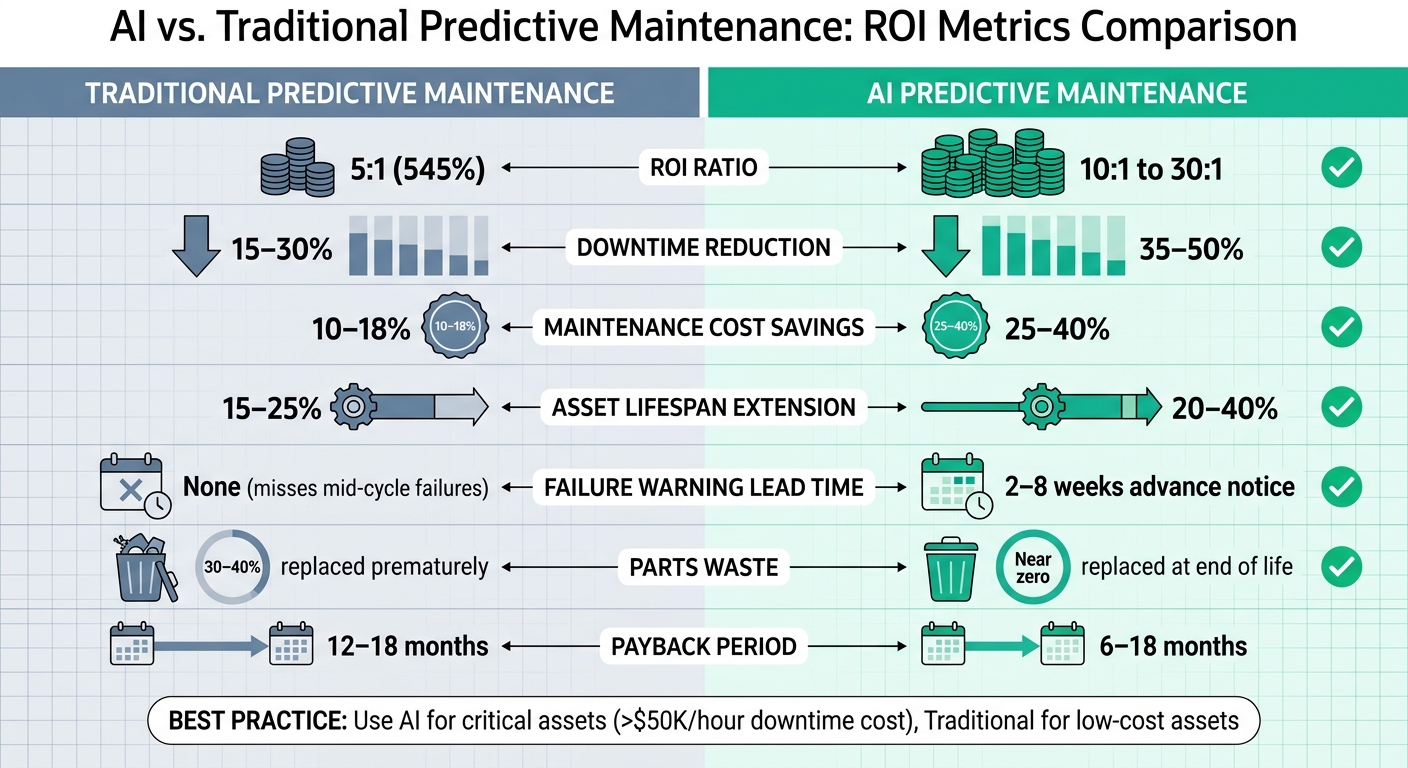
AI vs Traditional Predictive Maintenance ROI Comparison
ROI Metrics Comparison Table
When you stack AI-driven predictive maintenance against traditional time-based methods, the difference is clear: AI consistently delivers stronger results across all major ROI metrics. From cutting costs to extending asset lifespans, AI sets a new standard.
Here’s a side-by-side look at how the two approaches compare, based on actual performance data from 2026:
| Metric | Traditional Preventive (Time-Based) | AI Predictive (Condition-Based) |
|---|---|---|
| ROI Ratio | ~5:1 (545%) [12] | 10:1 to 30:1 [9][3] |
| Downtime Reduction | 15–30% [9][12] | 35–50% [3][1] |
| Maintenance Cost Savings | 10–18% [12][20] | 25–40% [4][13] |
| Asset Lifespan Extension | 15–25% [12] | 20–40% [9][3] |
| Failure Warning Lead Time | None (misses mid-cycle failures) [9] | 2–8 weeks (30–90 days) [8][13] |
| Parts Waste | 30–40% (replaced prematurely) [9][13] | Near zero (replaced at end of life) [13] |
| Payback Period | 12–18 months [12] | 6–18 months [9][3] |
These numbers highlight the substantial gap between the two methods. But what do these metrics look like in real-world scenarios?
In January 2026, ENGIE, a global energy company, shifted from time-based schedules to AI-driven condition monitoring. The result? They saved $870,000 annually across 10,000 connected assets [12]. Similarly, a 480 MW combined-cycle gas turbine using AI heat rate modeling spotted compressor fouling six weeks ahead of a planned wash. This early detection boosted output by 8.4 MW and slashed fuel costs by $680,000 [11].
The impact is even more striking in high-pressure situations. A 620 MW coal-fired plant avoided a costly 19-day emergency shutdown by catching a steam turbine bearing failure in Week 3 through AI monitoring. Instead, they scheduled a 38-hour outage, saving an estimated $1.84 million [11].
"The first bearing anomaly the system caught on Unit 3 would have been a $1.8 million emergency shutdown. We paid for the entire platform in one alert." – VP of Plant Operations, Combined-Cycle Gas Plant [13]
AI goes beyond incremental improvements. It fundamentally changes how assets are managed, reshaping the predictive maintenance ROI and the economics of maintenance in the process.
The Oxand Advantage: Model-Driven Predictive Technology
Traditional preventive measures and AI-driven solutions have become the norm for asset management. However, model-driven predictive technology offers a compelling alternative, delivering impressive ROI without the need for costly sensor networks or lengthy training periods. This is where Oxand Simeo™ stands out – leveraging probabilistic aging models and risk-based planning to achieve results without the hefty expenses of IoT infrastructure.
While AI systems often require $50–$500 per asset for sensor hardware and a 30–90 day training period to establish baselines [9], Oxand Simeo™ takes a different route. It uses existing data – such as inspection records, condition surveys, and historical performance metrics – alongside over 10,000 proprietary aging models and 30,000 maintenance laws developed over two decades. This approach allows the platform to simulate asset deterioration, potential failures, and energy consumption across their lifecycles. The result? Planning that takes days instead of months, paving the way for informed, risk-based decisions.
The platform aligns with ISO 55001 standards, ensuring that investment decisions are rooted in risk assessment. Oxand Simeo™ uses a "Consequence × Likelihood" matrix to prioritize projects based on actual risk, rather than outdated spending habits or rigid schedules.
How Oxand Simeo™ Outshines AI and Traditional Models

Oxand Simeo™ doesn’t just save money – it redefines how organizations approach long-term asset planning. By addressing inefficiencies like premature replacements and emergency failures (which can consume 30–40% of traditional maintenance budgets [9]), the platform delivers 10–25% cost reductions on targeted components.
It creates multi-year CAPEX and OPEX plans, typically spanning 5 to 30 years, that balance financial constraints, service requirements, and sustainability goals. Instead of reacting to failures or sticking to fixed schedules, Oxand Simeo™ provides a clear, data-driven roadmap for prioritizing investments and scheduling interventions. For infrastructure concession holders, this often means extending the lifecycle of critical components, delaying interventions by years, and achieving up to a 25% cost reduction on specific items.
Since Oxand Simeo™ operates independently of sensors, it scales effortlessly across entire portfolios. Whether managing HVAC systems or bridges, the same methodology applies, eliminating the complexity of integrating thousands of IoT devices.
Client Results and Applications
Oxand Simeo™ proves its value across three key phases for infrastructure concession holders:
- Tender Phase: Risk-based investment scenarios and lifecycle cost analyses optimize concession offers.
- Operational Phase: Maintenance costs are reduced by 10–15%, while asset lifespans are extended.
- Concession End: Maintenance accruals align with actual needs, avoiding unnecessary over-maintenance.
The platform also benefits cities, healthcare networks, and social housing providers by offering a centralized view of their portfolios. It tracks conditions, risks, costs, energy use, and carbon emissions in one place. The "what if" scenario simulation tool allows decision-makers to test various options – comparing budget levels, service targets, and sustainability goals – before committing resources. This shifts budget discussions from subjective debates to evidence-based decisions.
With growing pressure to meet energy and decarbonization regulations, Oxand Simeo™’s sustainability module is a game-changer. It models energy performance trajectories and carbon reduction pathways at the portfolio level, showing how investment choices affect CO₂ emissions and energy consumption. This empowers asset owners to create carbon-aligned investment plans that balance financial and environmental goals – all without needing additional tools or consultants. By aligning maintenance investments with actual asset risks, Oxand Simeo™ delivers measurable ROI while addressing modern sustainability challenges.
Conclusion: Selecting the Right Approach for Better Maintenance ROI
The key to improving maintenance ROI lies in aligning your strategy with your specific assets and objectives. For equipment with predictable wear patterns and low downtime costs (under $5,000 per hour), traditional preventive maintenance remains a practical and cost-efficient choice [9][10]. On the other hand, AI-driven predictive maintenance is ideal for mission-critical assets where failure costs exceed $50,000 per hour or replacement costs are above $150,000 [9].
A hybrid approach is becoming increasingly popular. By 2026, 66% of manufacturers are expected to adopt this model [9]. This involves using AI for the top 10–20% of critical assets (Tier A), which often account for around 80% of total risk and downtime costs, while sticking to traditional methods for less critical equipment (Tiers B and C) [10]. With AI reducing downtime by 35–45% on critical systems, this approach balances advanced analytics with the straightforwardness of traditional schedules, delivering better ROI while managing risks effectively.
"The question is not which is better – it is how to implement both in the right sequence, on the right assets, at the right cost."
– OxMaint Reliability Engineering Manager [21]
When segmenting assets based on their importance, it’s crucial to choose the right model for each category. For AI deployment, having at least 12 months of maintenance history is essential to train the models effectively. These models typically need 30–90 days to reach optimal accuracy [6][21][9]. If your organization lacks sufficient historical data, starting with traditional preventive maintenance can help establish a solid foundation. Once reliable records are in place, AI analytics can be introduced. Notably, traditional methods can be implemented within days [9][21].
To evaluate whether an asset justifies the investment in AI, calculate your "cost of save" using this formula:
(Annual Unplanned Breakdown Cost × 35%) – Implementation Cost [3].
For mid-size facilities managing 50–200 critical assets, the initial investment typically ranges between $50,000 and $200,000. With 95% of organizations reporting positive returns from AI adoption [3][9], and ROI ratios between 10:1 and 30:1 within 12–18 months [3][9][10], the financial benefits are clear when applied to the right assets.
FAQs
What data do I need before starting AI predictive maintenance?
To get started with AI predictive maintenance, begin by collecting key data about your asset. This includes information on downtime costs, maintenance expenses, and the asset’s overall condition. Make sure to incorporate real-time sensor data along with historical failure records. These details are essential for evaluating ROI and creating precise models, leading to smarter decisions and enhanced asset performance.
How do I decide which assets are worth monitoring with AI?
When deciding where to focus your efforts, target assets that have a significant impact on operational costs and risks. For instance, prioritize critical equipment like turbines or pumps that are often linked to high downtime and maintenance expenses. These types of assets typically carry steep failure costs, making them prime candidates for predictive monitoring.
The goal is to identify equipment where predictive insights can make a real difference – whether by reducing downtime, cutting costs, or addressing safety and environmental concerns. On the flip side, avoid investing resources in monitoring low-priority assets or those with failure modes that occur too quickly for predictive tools to provide meaningful benefits.
How can I estimate payback for an AI maintenance program?
To figure out the payback period for an AI maintenance program, start by calculating how much you’ll save by cutting unplanned downtime and maintenance costs. Here’s an example: if downtime costs your business $1 million per year and AI can cut that by 50%, you’d be saving $500,000 annually. Divide your initial investment by these yearly savings to estimate how quickly you’ll recoup your costs. For a more precise projection, use ROI models that align with your specific assets and operational costs.