

Sustainable Investment Planning for Social Housing Portfolios
Social housing providers face three major hurdles: aging buildings, tight budgets, and increasing pressure to cut carbon emissions. The solution? Smart investment planning that balances costs, resident needs, and environmental goals. This approach shifts the focus from short-term fixes to long-term value, ensuring upgrades improve building performance, reduce emissions, and enhance residents’ quality of life.
Key Takeaways:
- Buildings contribute 37% of global CO2 emissions, making housing a critical area for carbon reduction.
- 75% of U.S. social housing units are energy-inefficient, increasing maintenance costs and utility bills for low-income residents.
- Prioritizing investments based on carbon savings, lifecycle costs, and resident impact can maximize results.
Practical Solutions:
- Use whole-life value assessments to evaluate costs over the building’s lifecycle, including energy and carbon impacts.
- Build a centralized asset register with data on building conditions, energy performance, and maintenance history.
- Leverage predictive models to forecast asset aging and energy use, helping target the most urgent upgrades.
- Align projects with regulatory frameworks and funding opportunities like Massachusetts’ Climate Ready Housing program.
By integrating data, predictive tools, and clear investment criteria, housing providers can address immediate needs while planning for a low-carbon future. This method ensures limited budgets deliver maximum impact, benefiting both residents and the planet.
Core Principles of Sustainable Investment Planning
Effective sustainable investment planning bridges financial decisions with environmental and social priorities. In social housing, this means looking beyond temporary fixes and considering the full lifecycle of assets.
Whole-Life Value Assessment
Traditional capital planning often prioritizes upfront costs, but whole-life value assessment takes a broader view. It factors in initial capital expenditures (CAPEX), ongoing operational costs (OPEX), energy expenses, and the carbon footprint over an asset’s lifecycle [2].
A key component of this approach is carbon accounting, which includes embodied carbon – the emissions tied to materials and construction. In standard buildings, embodied carbon might account for 20% of total emissions, but in high-efficiency buildings, it can rise to as much as 90% [3].
Timing also plays a critical role. Researchers emphasize:
“Carbon reductions today are worth more than the same carbon decrease in the future.” [3]
This means acting early, even with less-than-perfect solutions, often creates more environmental value than waiting for the ideal upgrade. A thorough cost analysis like this lays the groundwork for integrating ESG considerations into investment decisions.
Key ESG Dimensions for Social Housing
In practice, ESG principles guide decisions that directly impact both residents and building performance. The table below highlights how these dimensions translate into actionable investment considerations:
| ESG Dimension | What It Means in Practice | How It’s Measured |
|---|---|---|
| Environmental | Energy efficiency upgrades, carbon reduction | kWh per sq ft, CO₂ per dollar invested, energy label rating |
| Social | Resident health, thermal comfort, affordability | Energy poverty index, maintenance frequency, accessibility |
| Governance | Regulatory compliance, audit readiness | ISO 55001 status, audit trail completeness |
The social aspect often gets overlooked in traditional planning. For low-income residents, a poorly insulated apartment isn’t just uncomfortable – it adds financial strain. Investments that lower heating and cooling costs directly address affordability, underscoring how social and environmental benefits often go hand in hand [1].
Translating ESG Goals into Investment Criteria
To turn ESG goals into action, clear investment criteria are essential. This means defining measurable metrics, like CO₂ reduction per dollar spent or energy savings per square foot, to prioritize projects. For example, envelope retrofits – such as insulation and window upgrades – frequently deliver greater carbon savings than electrification alone in many U.S. grid scenarios [3].
Another critical layer is risk-based prioritization, which identifies assets most likely to fail or underperform. Combining this with impact-driven criteria creates a balanced framework that addresses immediate needs while ensuring long-term sustainability [2].
The Meuse Department provides a real-world example of why structured planning is crucial:
“We needed a tool that would allow us to consolidate the fragmented data we had and project it in a way that could be clearly presented to our elected officials, who are the decision-makers.” – Chief Executive Officer, Meuse Department [2]
Without clear criteria, even the best ESG intentions can get lost in budget discussions. With them, investment decisions become transparent, defensible, and aligned with long-term goals for portfolio resilience and sustainability.
Data-Driven Foundations for Carbon-Aligned Planning
To align investments with carbon targets and avoid waste, having reliable and unified data is non-negotiable. Building on earlier discussions about whole-life value assessments and ESG goals, these strategies lay the groundwork for effective carbon-aligned planning.
Building a Centralized Asset Register
A centralized asset register serves as the cornerstone of any carbon-focused investment strategy. By consolidating details like building conditions, energy performance, maintenance history, and component-level specifics into one inventory, planners gain a complete picture of their assets.
The best registers pull data from multiple sources. Think energy performance certificates (EPCs), utility meter readings, maintenance records from platforms like SAP or Maximo, and even LiDAR-based 3D building models. A tiered approach works well: start with internal databases, use EPCs next, and rely on building archetypes only when necessary [6].
Take Islington Council in London as an example. In 2021, they created an asset register for 33,300 dwellings across 4,500 buildings using the “3DStock” method. By linking Unique Property Reference Numbers (UPRNs) with LiDAR data, EPCs, and their Northgate software database, they analyzed six retrofit packages for each dwelling [6].
Field teams play a key role in keeping the register up to date. Tools like Oxand’s Simeo GO app allow on-site staff to update asset conditions during inspections, cutting the time spent by 50% compared to paper-based methods [5]. Once the register is set, predictive models can transform raw data into actionable insights even without real-time IoT sensors.
Using Predictive Models for Asset Aging and Energy Use
Predictive models take reliable data and turn it into foresight by simulating how assets age and forecasting when interventions will be needed. For instance, Oxand Simeo™ uses 10,000 proprietary aging and energy laws and 30,000 maintenance actions to predict asset deterioration and energy use at a granular, component level [5]. This detailed approach helps identify specific units at risk, allowing for targeted, cost-effective fixes instead of blanket replacements over a decade.
Energy and carbon simulations are integral to this process. These tools estimate the kWh and greenhouse gas (GHG) reductions tied to specific retrofits, such as insulation, heat pumps, or rooftop solar. This lets planners assess options based on actual carbon impact, not just upfront costs. For example, Islington’s modeling revealed that a 70% emissions reduction by 2030 was feasible, with heat pumps emerging as the primary solution to replace natural gas across their portfolio [6].
“We turned to Oxand because we needed a tool that would provide us with a predictive – not just corrective – view and help us manage our investments more effectively.” – Head of Budget and Asset Valuation Department, In’li [2]
Leveraging Existing Maintenance and Energy Data
Historical maintenance and energy data can refine investment decisions when paired with predictive models. Many housing providers already have a wealth of useful data – work orders, utility bills, inspection reports, and maintenance logs – that can pinpoint underperforming buildings or components nearing the end of their life.
By integrating this data into aging models and carbon-efficiency frameworks, planners can identify emissions hotspots and prioritize them for retrofits. Ranking projects by CO₂ reduction per dollar spent ensures that budgets are directed toward the most impactful interventions [4].
The payoff can be substantial. One public sector portfolio manager used Oxand Simeo™ to optimize 66 buildings by leveraging existing data, cutting their maintenance backlog by 27% and saving $4 million in energy costs within a single budget cycle [5].
Investment Planning Under Budget Constraints
When budgets are tight, the challenge lies in deciding where to allocate funds most effectively. With reliable asset data and predictive models in place, prioritizing spending becomes a balancing act of addressing immediate needs while planning for long-term goals.
Risk-Based Prioritization Frameworks
A risk-based approach shifts the focus from simply fixing what’s broken to addressing what matters most. This method ranks projects by evaluating asset vulnerability, energy performance, and carbon impact within the constraints of the available budget. Using Multi-Criteria Analysis (MCA), projects can be scored based on factors like technical condition, energy efficiency, resident outcomes, and operating costs. This ensures that investments are directed toward critical systems rather than low-risk assets.
One effective metric to incorporate is CO₂ reduction per dollar spent, which helps maximize the impact of decarbonization efforts. Organizations that adopt risk-based investment strategies often see maintenance cost reductions of 25% or more [2], with noticeable budget efficiencies emerging within 6 to 12 months [2][4].
“Energy efficiency measures are increasingly framed as instruments of social policy, rather than purely technical solutions.” – Lucia Della Spina, Mediterranea University of Reggio Calabria [1]
Another important consideration is the sequence of work. For instance, upgrading insulation before replacing a heating system avoids the risk of installing oversized equipment, which can lead to unnecessary expenses. Mathematical models that map repair interdependencies can help prevent such costly mistakes [8].
By using these prioritization methods, organizations can build a strong foundation for exploring different investment scenarios.
Scenario Planning and Optimization
Once priorities are established, scenario planning allows teams to identify the best investment path. This involves modeling various options – such as a fabric-only retrofit versus a comprehensive upgrade with heat pumps and solar PV – and comparing their costs, carbon reductions, and risks before making decisions.
Tools like Oxand Simeo™ enhance this process with scenario simulation and optimization features. These tools allow planners to test different budget allocations over 5- to 30-year periods to find the most cost-effective way to reduce carbon emissions within financial constraints [7].
Here’s a four-step process to guide scenario planning:
- Gap analysis: Assess the difference between current and target energy performance across the portfolio.
- Carbon footprinting: Establish a baseline for current and projected emissions.
- Strategy scoping: Compare operational savings with the embodied carbon of retrofitting versus new construction.
- Scenario optimization: Identify the most cost-effective approach based on carbon savings and practical management considerations [7].
A great example of this approach comes from the London Borough of Islington. In 2021, the Council studied 33,300 dwellings across 4,500 buildings and modeled six retrofit packages. They discovered that fabric-only measures reduced gas use by just 13% on average, while combining heat pumps with solar PV could achieve a 70% emissions reduction by 2030 [6]. This kind of detailed scenario analysis turns broad sustainability goals into actionable, fundable plans.
Integrating Carbon Targets into Investment Decisions
To ensure alignment with climate goals, carbon and energy metrics should be embedded directly into the investment planning process. This means evaluating every capital expenditure (CAPEX) decision based on its contribution to portfolio-level decarbonization targets. By doing so, organizations can connect individual projects, like replacing a boiler, to their overall emissions reduction strategy.
Calculating the carbon payback period – the time it takes for operational savings to offset the embodied carbon cost – can also highlight the long-term sustainability of retrofits. Even seemingly costly upgrades may prove to be the smarter choice when viewed through this lens [7].
Compliance and Regulatory Alignment in the U.S.
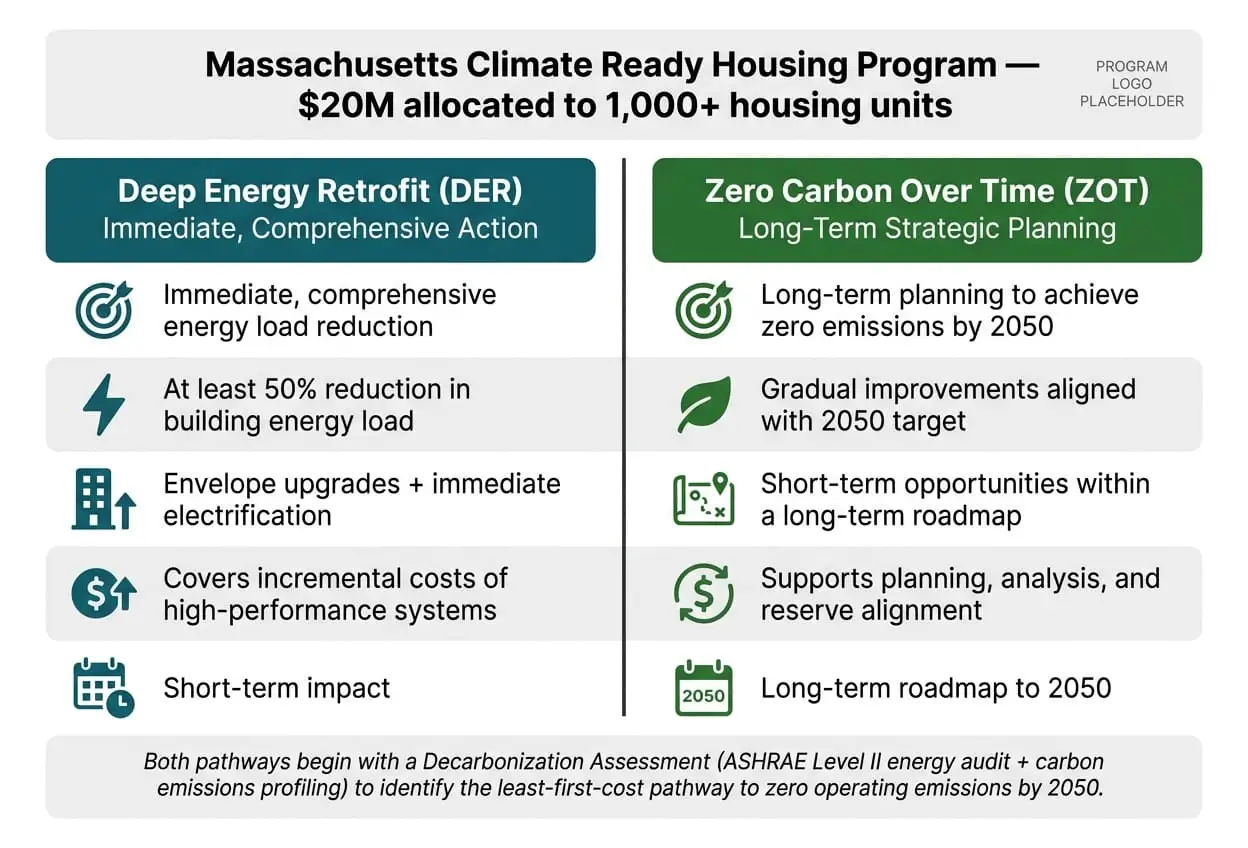
Deep Energy Retrofit vs. Zero Carbon Over Time: U.S. Social Housing Funding Pathways
Integrating carbon targets into investment strategies is just one piece of the puzzle. Social housing providers in the U.S. must also tackle a maze of regulations, funding opportunities, and institutional demands – all while ensuring compliance with as little administrative strain as possible.
Key U.S. Regulations and Funding Programs
State-level programs like the Massachusetts Climate Ready Housing initiative are designed to incentivize providers who present a clear, data-driven plan for reducing carbon emissions. This program focuses on impactful energy retrofits in affordable multifamily housing. For instance, recent funding rounds allocated $20 million to upgrade energy systems in over 1,000 housing units statewide [9].
There are two main funding pathways available to providers, each tailored to different timelines and goals:
| Feature | Deep Energy Retrofit (DER) | Zero Carbon Over Time (ZOT) |
|---|---|---|
| Primary Goal | Immediate, comprehensive energy load reduction | Long-term planning to achieve zero emissions by 2050 |
| Energy Reduction | At least 50% reduction in building energy load | Gradual improvements aligned with a 2050 target |
| Scope | Includes envelope upgrades and immediate electrification | Focuses on short-term opportunities within a long-term roadmap |
| Funding Focus | Covers incremental costs of high-performance systems | Supports planning, analysis, and reserve alignment |
The process starts with a Decarbonization Assessment, which is essentially an ASHRAE Level II energy audit expanded to include carbon emissions profiling. This assessment identifies the most cost-effective path to achieve zero operating emissions by 2050. As explained by LISC Massachusetts:
“A Decarbonization Assessment follows the basic parameters of an ASHRAE II energy audit, but also includes an assessment of the property’s current carbon emissions profile and makes recommendations related to the least-first-cost pathway to zero operating emissions by 2050.” [9]
These funding frameworks establish a foundation for broader institutional expectations that influence sustainable investment strategies.
How Institutional ESG Expectations Shape Planning
In addition to government programs, institutional lenders and investors are setting higher standards for climate risk transparency. Organizations like Fannie Mae and Freddie Mac have integrated energy efficiency and sustainability requirements into their affordable housing financing products. Similarly, mission-focused lenders are increasingly looking for borrowers to present forward-thinking sustainability strategies rather than just meeting current compliance benchmarks.
In this context, how providers manage and report their portfolios plays a critical role in securing capital. Those with multi-year, carbon-conscious investment plans are more likely to access favorable financing terms. Beyond meeting regulatory requirements, maintaining transparency through detailed, audit-ready reporting is essential.
Generating Audit-Ready Reports with Oxand Simeo™
Centralizing asset data simplifies the demanding reporting process required for regulatory and lender compliance. Extracting data manually from spreadsheets, logs, and bills can be both tedious and error-prone. Oxand Simeo™ offers a solution by producing ISO 55001-aligned, audit-ready reports directly from asset and investment data. By integrating maintenance condition data, energy performance trends, and CAPEX scenarios into a single platform, providers can generate consistent, traceable reports for state funding applications, lender reviews, or board presentations with ease.
Conclusion: Building a Stronger Case for Sustainable Social Housing Investment
Long-term, portfolio-focused strategies consistently outperform short-term fixes. With the challenges of emissions and aging infrastructure in mind, housing authorities and portfolio managers must embrace structured, data-driven planning to tackle today’s financial and regulatory demands effectively.
Quality data fuels better decisions. By combining a centralized asset register with predictive aging models and energy performance metrics, planning becomes proactive rather than reactive. This approach can slash unplanned maintenance costs by 25% or more and reduce total ownership costs by up to 30% over time [2][5].
Data-driven prioritization ensures capital is allocated where it matters most. By evaluating projects based on factors like safety, resident vulnerability, regulatory compliance, and carbon impact, limited budgets can yield maximum results. Incorporating carbon reduction targets into annual plans turns sustainability goals into measurable achievements.
As the case for investment strengthens through improved data and risk assessments, regulatory and financial pressures further highlight the importance of a clear decarbonization strategy. Institutional lenders like Fannie Mae and Freddie Mac are already favoring providers with structured, evidence-based plans. Those who can present traceable data and audit-ready documentation are better positioned to secure competitive financing and funding opportunities.
To bring all these strategies together, Oxand Simeo™ offers a comprehensive solution. It consolidates asset and condition data, leverages science-backed aging models, runs simulations that account for real-world budget and carbon constraints, and produces ISO 55001-compliant reports. This enables boards, regulators, and lenders to make informed decisions – all within a single platform. As one asset director shared:
“Simeo reduced our maintenance backlog by 27% and enabled us to achieve $4 million in energy savings across 66 buildings during the first budget cycle.” [5]
This example highlights how data-driven planning can deliver consistent, measurable benefits.
FAQs
What data do I need to start a centralized asset register?
To build a centralized asset register, start by collecting and organizing data on seven essential attributes: material/type, location, condition, age, criticality, useful life, and economic value. Make sure the data adheres to the 5Cs standard: it should be complete, correct, current, consistent, and comprehensive.
Expand the register with details such as unique IDs, assigned maintenance responsibilities, risk assessments, lifecycle costs, and metrics related to energy use or emissions. Pull this information from sources like internal records, BIM models, and CMMS exports to create a well-rounded and reliable asset register.
How do I prioritize retrofit projects when budgets are tight?
When working with limited funds, it’s essential to move away from reactive repairs and adopt a data-driven, risk-based strategy. Start by creating a thorough asset inventory that tracks key details like condition, energy performance, and lifecycle stages. This database becomes the foundation for smarter decision-making.
Leverage predictive analytics to assign two key metrics to each asset:
- Health Score: Measures the likelihood of failure.
- Criticality Score: Assesses the impact of a potential failure.
With these scores in hand, you can rank projects based on risk level, cost, and their potential for reducing carbon emissions. Focus on initiatives that deliver the most significant financial and environmental benefits. To maximize savings, try to align retrofit efforts with scheduled maintenance whenever possible.
How can we prove carbon and cost ROI to funders and lenders?
To effectively showcase both carbon and cost returns on investment (ROI), it’s crucial to incorporate energy and carbon metrics into your long-term capital planning. Start by creating a comprehensive asset register. This should include details like asset condition, lifespan, associated emissions, and financial performance data.
From there, use predictive modeling to evaluate and prioritize projects. Focus on ranking them based on two key factors: carbon reduction achieved per dollar spent and overall financial return. This approach ensures decisions are backed by hard data.
By presenting stakeholders with clear, audit-ready evidence, you can demonstrate how investments align with budget constraints, risk management, and decarbonization objectives – all while building confidence in your strategy.
Related Blog Posts
- Achieving Net-Zero in Real Estate Portfolios: From Targets to Investment Plans
- Carbon vs. Cost vs. Comfort: How to Make Better Building Investment Decisions
- How AI Can Support Decarbonisation Investment Planning Across Building Portfolios
- Social Housing Renovation in Europe: Building an Investment Plan Around Funding, Carbon and Affordability