

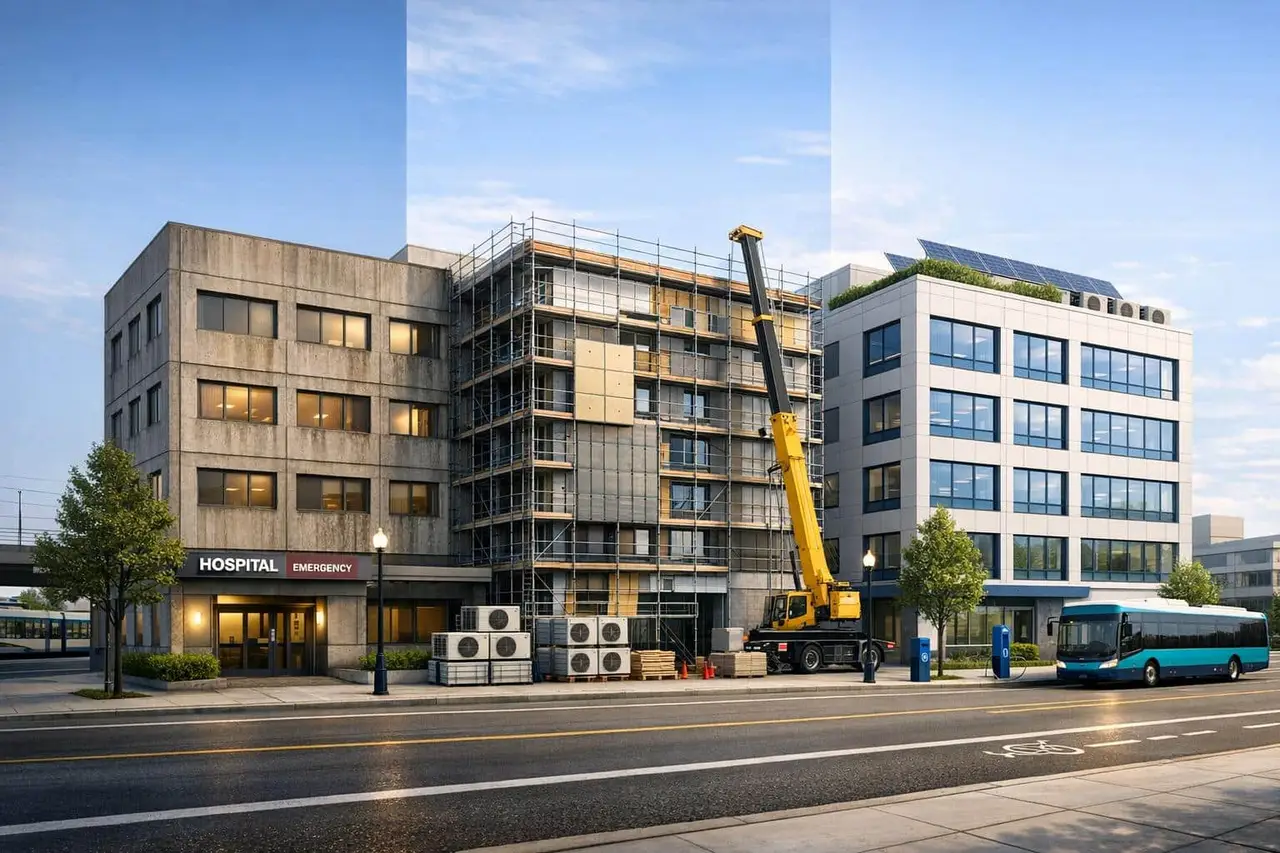
What Makes Aging Infrastructure Portfolios Harder to Decarbonise - and What to Do About It
Aging infrastructure in the U.S. poses a major challenge for reducing carbon emissions. Many buildings, built before modern energy standards, consume far more energy than newer structures. With 70–80% of 2050’s building stock already standing today, retrofitting old systems is more critical than building new ones. However, outdated designs, limited budgets, and physical constraints make upgrades difficult.
Key takeaways:
- Older buildings emit 2–3 times more CO₂ per square foot than modern ones.
- Financial and structural barriers often lead to “like-for-like” replacements, locking in high emissions for decades.
- Tools like predictive asset management and lifecycle cost analysis can help prioritize upgrades and align them with existing maintenance schedules.
The solution lies in identifying the highest-emitting assets, starting with low-cost fixes, and integrating decarbonization into planned upgrades to maximize efficiency and minimize costs.
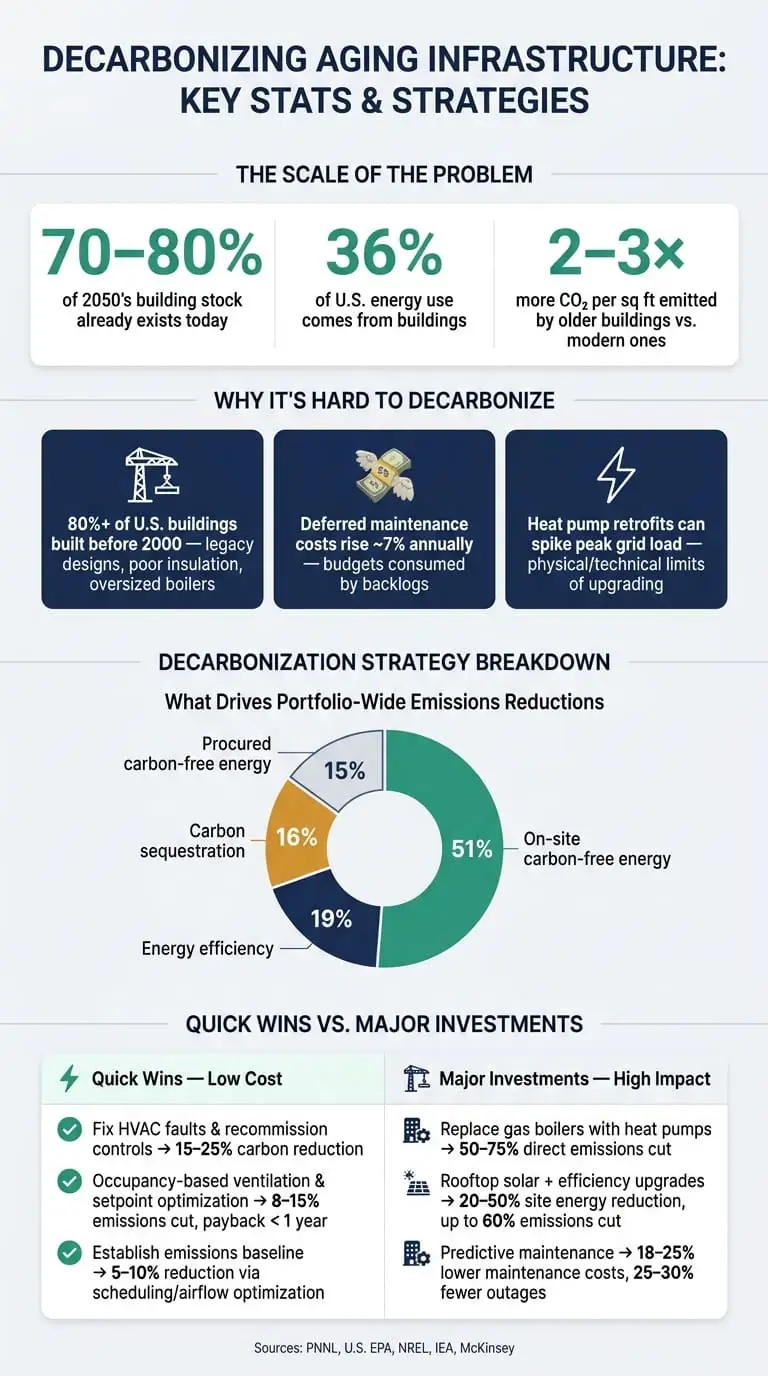
Decarbonizing Aging Infrastructure: Key Stats & Strategies
Why Aging Infrastructure Portfolios Are Harder to Decarbonize
Legacy Designs and High Energy Use
Many older buildings were constructed during a time when energy costs were low, leading to design choices like poorly insulated concrete walls, oversized boilers running on natural gas or oil, and single-pane windows. These outdated designs contribute to significant energy consumption. In fact, commercial and residential buildings in the U.S. are responsible for 36% of energy use, 35% of carbon emissions, and 75% of electricity demand. The most energy-intensive sectors include healthcare, grocery stores, and food service operations [3].
Physical and Technical Limits of Retrofitting
Upgrading older buildings often comes with substantial challenges. For example, replacing outdated steam heating systems with modern heat pumps requires extensive re-piping, electrical system upgrades, and interior modifications. Limited rooftop space for solar panels and increased peak grid demand further complicate these efforts [4].
Take Singapore’s high-density public housing as an example: research shows that rooftop solar panels could only offset a small portion of the emissions reductions needed [4]. Similarly, a study in Kiel, Germany, revealed that while retrofitting with heat pumps reduced energy use intensity by 66%, it also caused significant spikes in peak grid load [4].
“Retrofit decisions become harder – not because solutions are unavailable, but because buildings differ widely in readiness, data quality, and operational constraints.” – Schneider Electric [2]
Another hurdle is the lack of reliable data. Many older building portfolios lack comprehensive performance records, making it difficult to assess which upgrades would deliver the best carbon reduction for the investment – or even identify assets that fail to meet compliance standards.
Budget Pressures and Competing Priorities
Tight budgets add another layer of difficulty. Capital funds are often allocated to urgent safety and compliance repairs, such as fixing a failing roof or replacing a fire suppression system. These immediate needs naturally take precedence over decarbonization projects.
Deferred maintenance only worsens the situation. Industry benchmarks suggest that delaying maintenance increases costs by about 7% annually [5]. With over 80% of U.S. buildings constructed before 2000 [5], much of the available capital is consumed by addressing a growing maintenance backlog, leaving little room for energy-efficient upgrades.
However, a more strategic approach can help. For instance, integrating electrification into scheduled capital replacement cycles – rather than treating it as a separate project – can yield significant results. A 2026 case study of a 480,000-square-foot campus in San Diego demonstrated this approach. By incorporating electrification into planned upgrades, the project achieved zero on-site greenhouse gas emissions, avoided 10,525 metric tons of CO₂, and saved $180,000 annually, all with just a 20% cost premium [6].
“By strategically integrating electrification into the planned replacement cycle… the project achieved the full decarbonization goal while avoiding a separate, disruptive, and capital-intensive retrofit in the future.” – Patrick Willette, Vice President of Construction, RAM Construction [6]
These obstacles highlight the importance of targeted, risk-based strategies to effectively allocate decarbonization investments for aging infrastructure portfolios.
Path to Deep Retrofits: Boosting Building Efficiency
Strategies for Decarbonizing Aging Infrastructure
Tackling the challenges of retrofitting aging infrastructure requires well-thought-out strategies aimed at reducing carbon emissions effectively.
Risk-Based Prioritization for Carbon Reduction
One effective approach is to rank assets by their carbon intensity and remaining useful life (RUL). This helps determine whether maintenance, retrofitting, or full replacement is the best course of action [7].
A frequently overlooked opportunity lies in addressing maintenance backlogs. Simple fixes – like repairing HVAC systems, recommissioning control systems, and properly configuring variable frequency drives (VFDs) – can deliver 15% to 25% operational carbon reduction with minimal financial investment [7].
“The fastest carbon reductions I have seen in the field come from fixing the maintenance backlog – HVAC faults running equipment at 70% efficiency, controls that were never recommissioned after a BAS upgrade… Getting the existing portfolio running as designed is frequently a 15 to 25% carbon reduction with near-zero capital spend.” – Rachel Ngozi, Director of Sustainable Buildings, Institutional Real Estate Portfolio [7]
Before diving into costly capital projects, it’s smart to start with operational adjustments like occupancy-based ventilation and setpoint optimization. These low-cost measures can cut emissions by 8% to 15% and often pay for themselves within a year. Once these quick wins are achieved, more significant investments – such as replacing outdated gas boilers with heat pumps – can be considered.
Lifecycle Cost Analysis for Better Decisions
Lifecycle cost analysis (LCCA) shifts the focus from upfront costs to the total cost of ownership. This includes factors like energy savings, maintenance, failure risks, and future carbon pricing [8].
Here’s why this matters: initial construction or equipment costs typically make up just 2% of total ownership costs over a 30-year span, while operations and maintenance account for 6% [8]. For older infrastructure, where energy and maintenance costs are already high, LCCA often shows that investing more upfront in efficient systems is the smarter financial choice.
A study from Pacific Northwest National Laboratory (PNNL) in December 2025 highlighted this point. The analysis of 16 infrastructure sites showed that a multi-criteria LCCA approach – considering carbon reduction, cost, resilience, and environmental justice – helped 11 sites cut 98% of emissions using on-site strategies alone. Interestingly, the study also found that building electrification increased emissions by 4.4% in certain scenarios, emphasizing the importance of tailoring LCCA to specific sites [9].
“LCCA provides a significantly better assessment of the long-term cost-effectiveness of a project than alternative economic methods that focus only on first costs or on operating-related costs in the short run.” – WBDG [8]
Incorporating sensitivity analysis into LCCA is also crucial. Changes in energy prices or discount rates can make marginal projects much more viable, especially as carbon pricing evolves.
Planning Decarbonization at the Portfolio Level
While individual building strategies are important, a portfolio-level approach ensures that decarbonization efforts are aligned and optimized across all assets. Without this coordination, isolated decisions can fail to add up to meaningful carbon reductions. Portfolio-level planning allows for sequencing interventions, aligning investments with natural replacement cycles, and evaluating trade-offs across different building types and locations [2].
To streamline this process, assets can be grouped into tiers based on the availability of data:
- Capital-intensive projects: For assets with detailed data.
- Optimization actions: Based on existing meter data.
- Basic measures: For assets with only limited information, like size and location.
This tiered approach ensures progress isn’t stalled by data limitations.
Research on portfolio-wide strategies highlights the importance of combining efforts. For instance, on-site carbon-free energy contributes 51% of emissions reductions, followed by energy efficiency (19%), carbon sequestration (16%), and procured carbon-free energy (15%) [9]. These findings make it clear that a mix of strategies works far better than relying on a single solution.
“The results present the case for comprehensive advanced planning at the portfolio level to prioritize investments that will balance the minimization of emissions and life cycle cost with the maximization of resilience and environmental justice benefits.” – PNNL [9]
Tools like Oxand Simeo™ can support this kind of planning by integrating risk prioritization, scenario modeling, and carbon-aligned investment strategies into one platform. This helps decision-makers compare budgets and sustainability outcomes before committing resources.
Tools and Technologies That Support Decarbonization
Predictive Asset Management and Maintenance
Predictive asset management helps optimize upgrades by aligning them with scheduled maintenance, ensuring maximum return on investment (ROI). By analyzing condition data, operating trends, and failure-risk models, it predicts when an asset might degrade or lose efficiency. This approach allows owners to combine carbon-reduction upgrades with planned maintenance, avoiding redundant interventions.
McKinsey reports that predictive maintenance can lower maintenance costs by 18–25%, reduce unplanned outages by 25–30%, and extend the lifespan of aging assets. [14] In industrial applications, it decreases downtime by 30–50% and boosts equipment longevity by 20–40%. [15] These improvements are critical for decarbonization, as they enhance efficiency and create opportunities for low-carbon upgrades during scheduled maintenance.
Take a wastewater utility, for example: by leveraging sensor data to predict pump wear, it could replace the pump with a high-efficiency motor and a variable-frequency drive in a single step. This would cut both downtime and energy consumption. Key factors for this process include asset age, failure history, energy use, operational patterns, and maintenance backlogs. [10][12]
For portfolios where installing IoT hardware isn’t feasible, tools like Oxand Simeo™ provide a model-based solution. Using over 10,000 aging-performance models and 30,000 maintenance actions, it forecasts asset behavior without relying on extensive sensor networks. [1] This makes it particularly useful for older infrastructure where retrofitting every asset would be impractical or too costly.
Scenario Modeling to Balance Costs and Carbon Goals
Once asset conditions are forecasted, scenario modeling tools help compare strategies – such as doing nothing, repairing, replacing, or retrofitting with electrification – over a 10- to 30-year timeline. These tools provide insights into emissions, lifecycle costs, risks, and payback periods. [11][13]
Deloitte estimates that integrated scenario analysis can reduce overall decarbonization costs by 15–25% by optimizing interventions across an entire portfolio instead of addressing assets individually. [16] For instance, while a low-cost repair might seem appealing initially, it could lead to higher emissions and more expensive reinvestments later. Scenario modeling makes such tradeoffs clear before decisions are made.
Oxand Simeo™ is designed to facilitate this type of planning. In’li, a major residential real estate portfolio, used the platform to transition from reactive to predictive asset management, incorporating energy performance goals into their investment strategy. As their Head of Budget and Asset Valuation Department explained:
“We turned to Oxand because we needed a tool that would provide us with a predictive – not just corrective – view and help us manage our investments more effectively. Oxand stood out for its risk management capabilities.” [1]
Integrating Renewables and Electrification
After identifying optimal upgrade paths, the next step is preparing older assets for renewable energy and electrification. While these changes significantly reduce emissions, they often require preliminary upgrades to address constraints like outdated electrical panels, undersized service entrances, poor insulation, or limited space. [10][12]
Start with smaller steps like improving controls, load management, and energy efficiency before tackling full fuel-switching projects. For example, upgrading building controls and insulation first can pave the way for replacing gas-fired heating with electric heat pumps, once the electrical capacity is expanded. This phased approach minimizes disruption and financial strain while enabling larger investments.
The U.S. EPA highlights that replacing fossil-fuel boilers with high-efficiency electric heat pumps can cut direct onsite emissions by 50–75%, with additional reductions as the grid becomes cleaner. [18] Similarly, the NREL found that combining rooftop solar with efficiency upgrades in U.S. commercial buildings can reduce site energy use by 20–50% and emissions by up to 60%, depending on the climate.
The International Energy Agency (IEA) stresses the urgency of retrofitting: over 80% of the electricity demand by 2030 will rely on existing power plants and infrastructure. [17] This makes upgrading older assets for renewable energy and electrification not just a smart investment – it’s essential for hitting near-term climate targets.
Building a Roadmap for Lower-Carbon Infrastructure
Tackling the challenge of decarbonizing aging infrastructure requires careful planning and a phased, multi-year approach. The most effective roadmaps start with establishing a baseline, setting achievable targets, securing early wins, and aligning major investments with existing capital budgets to ensure the process remains financially viable. The first and most critical step is laying down a solid baseline.
This begins with collecting accurate emissions data from utilities, fuel sources, and system performance metrics. Once the baseline is set, immediate steps like optimizing energy use – through measures such as equipment scheduling and balancing airflow – can reduce emissions by 5–10%. These quick wins not only cut emissions but also generate cost savings that can be reinvested in electrification efforts. As Brad Harriman, Project Manager at EH&E, explains:
“Energy optimization is the lowest-cost, highest impact first step towards decarbonization.” [20]
The cost of inaction can be steep. For example, the University of Washington faces escalating penalties for carbon emissions, starting with $4 million in 2023 and rising to $15 million by 2029. To address this, the university implemented a five-part Energy Renewal Plan. This initiative is transitioning its aging steam system to a low-temperature hot water network powered by heat pump technology. The goal? To eliminate 93% of greenhouse gas emissions from its central power plant. So far, these efforts have already reduced campus-wide emissions by 12% [21].
To make meaningful progress, a data-driven strategy is essential. Tools like risk-based prioritization, lifecycle cost analysis, and scenario modeling can transform decision-making. Instead of relying on guesswork, these methods help prioritize investments strategically, addressing the technical and budgetary challenges that often hinder the decarbonization of older infrastructure. Integrated data platforms can further streamline this process by consolidating aging models, energy performance data, and carbon-focused scenarios into a unified framework. This allows decision-makers to evaluate trade-offs across hundreds of assets simultaneously, ensuring every dollar is spent wisely.
Flexibility is key to any roadmap. Technologies like green hydrogen and advanced grid storage could significantly alter the landscape over the next 10–30 years. Regular reviews ensure that strategies remain adaptable, even as new solutions emerge. Maryam Golnaraghi, Director of Climate Change & Environment at the Geneva Association, highlights the stakes:
“Failure to incorporate resilience at the design stage increases the risk of stranded or uninsurable assets.” [19]
A well-thought-out roadmap takes these risks into account from the very beginning, ensuring both resilience and adaptability over time.
FAQs
Where should I start decarbonizing an older building portfolio?
Begin by addressing energy demand and timing upgrades strategically with major events like equipment replacements or system updates. Take a close look at each building’s current state to pinpoint opportunities that are both cost-efficient and minimally disruptive. Incorporate lifecycle expense planning and risk assessments to prioritize investments that offer the greatest impact on reducing carbon emissions while staying within financial constraints. These focused steps lay the groundwork for advancing decarbonization efforts throughout your portfolio.
How do I prioritize retrofits when budget and data are limited?
When working with a tight budget and limited data, it’s important to focus on the essentials – like minimizing risks or boosting performance. Start by involving stakeholders to uncover the most impactful opportunities. Their input can help pinpoint where resources will make the biggest difference.
Use clear design standards to steer your decision-making process. Begin with projects that deliver substantial benefits for a relatively low cost. As more data becomes available, you can fine-tune your priorities and adjust your plan accordingly.
Resources like retrofit manuals can also be incredibly helpful. They can simplify the planning process and ensure your resources are allocated efficiently.
When does electrification make emissions worse, and how can I avoid it?
Electrification has the potential to inadvertently increase emissions when the electricity grid depends largely on fossil fuels. To prevent this, it’s important to align electrification initiatives with the transition to cleaner energy sources on the grid. Supporting the growth of renewable energy and planning upgrades to match advancements in renewable technologies can make a big difference. Timing these efforts thoughtfully ensures that electrification contributes to reducing emissions rather than adding to them.
Related Blog Posts
- Achieving Net-Zero in Real Estate Portfolios: From Targets to Investment Plans
- Decarbonising Aging Infrastructure: Top Challenges and Investment Strategies
- National Building Renovation Plans: How to Turn Policy into a Portfolio Investment Strategy
- Worst-Performing Buildings: How to Identify, Triage and Phase Investments Across a Portfolio