

Predictive Maintenance for Buildings: Where Analytics Deliver the Fastest Payback
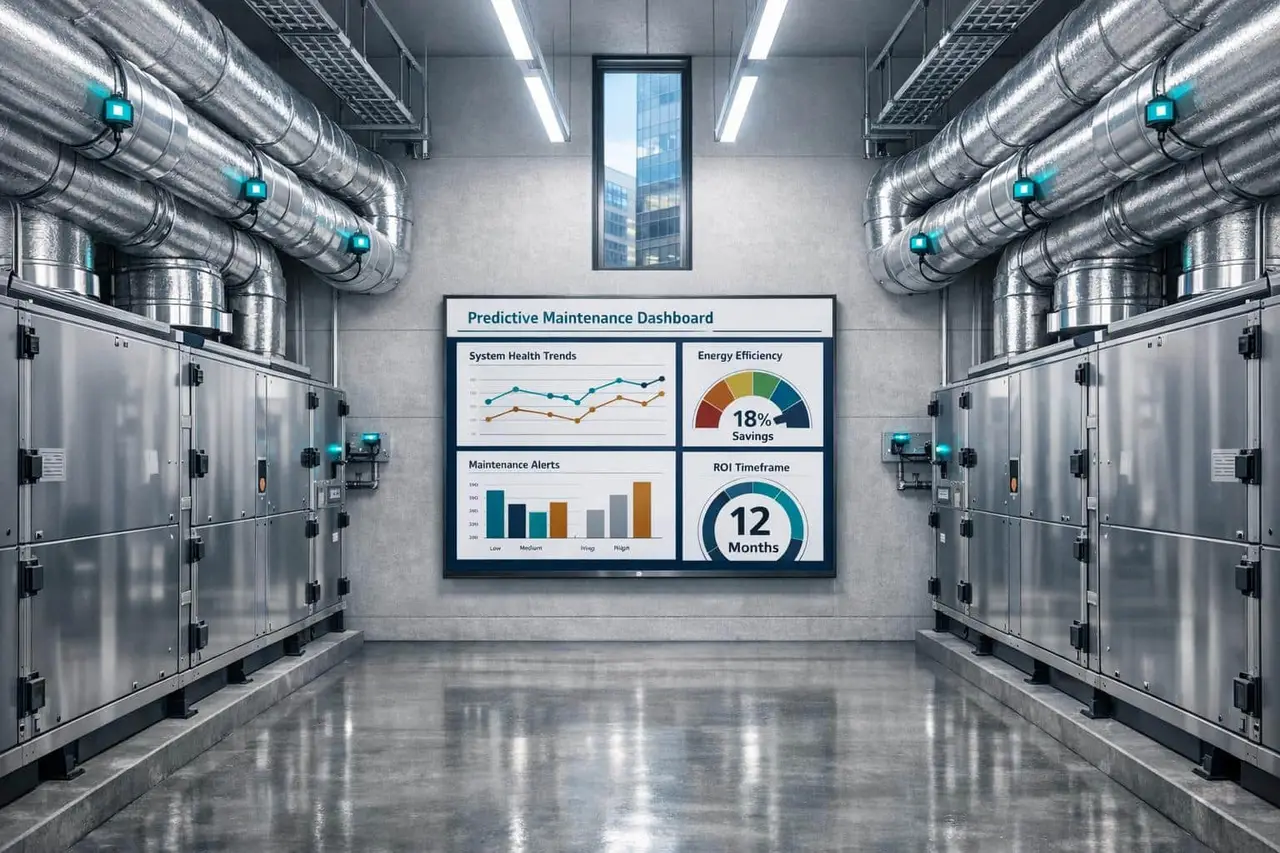
Predictive maintenance (PdM) is transforming how buildings are managed by using IoT sensors, AI, and historical data to predict equipment failures weeks in advance. This approach saves money, reduces downtime, and optimizes energy use compared to reactive or fixed-schedule maintenance. Key insights:
- Cost Savings: Addressing issues early can cut repair costs by up to 80% and reduce unplanned downtime by 82%.
- Energy Efficiency: Early intervention on HVAC systems can improve energy efficiency by 10–20%.
- ROI: Most programs deliver a 10:1 return on investment, with payback periods of 8–14 months.
- Key Focus Areas: HVAC systems, elevators, and building envelopes are the best starting points for PdM programs.
Webinar: Data Analytics & Predictive Maintenance in HVAC Systems
Financial Impact and ROI of Predictive Maintenance in Buildings
Predictive Maintenance ROI by Building Type: Payback Periods & Cost Savings
Key Financial Benefits of Predictive Maintenance
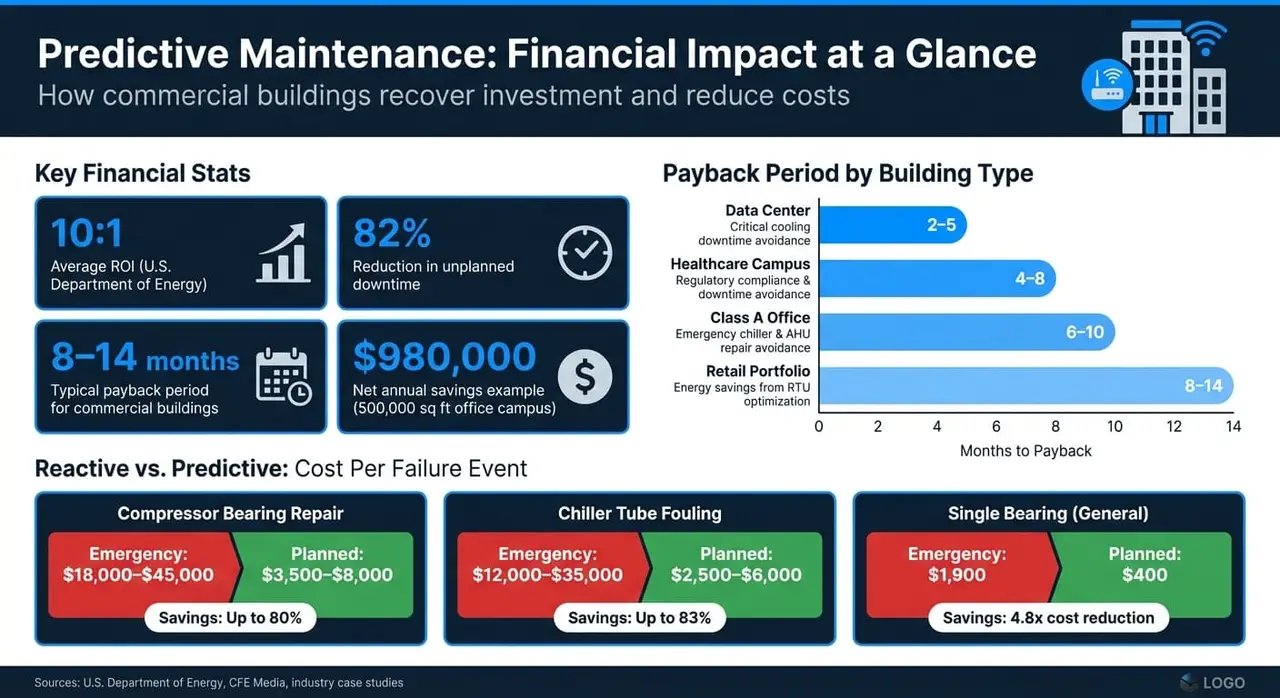
Predictive maintenance can significantly cut repair costs compared to emergency fixes. For instance, replacing a bearing during scheduled maintenance costs about $400, but the same repair during an emergency jumps to $1,900 – a hefty 4.8x increase, not including extra fees [10]. Beyond repair costs, predictive analytics tackle energy inefficiencies. Equipment like compressors with worn seals or clogged coils can lose up to 40% efficiency, while AI-monitored buildings often reduce energy consumption by 10–20% by addressing issues early [6]. Additionally, transitioning from age-based equipment estimates to condition-based data enhances capital planning, slashing unplanned capital expenditures by up to 62% [7].
“The most common error I see in HVAC maintenance ROI presentations to ownership is undervaluing the CapEx deferral component. A maintenance program that extends a chiller’s operating life from 20 to 23 years… defers that capital outlay by three years, which has a present value calculation that typically adds 15–20% to the stated savings.” – Anita Krishnamurthy, Head of Facility Finance Strategy, CFE Media Advisory Board [14]
ROI Benchmarks and Payback Periods
Predictive maintenance delivers impressive financial returns. According to the U.S. Department of Energy, the average ROI for these programs is 10:1 [11][12], and 95% of organizations report positive returns [11][13]. For commercial buildings, payback periods usually range between 8 and 14 months, with 27% of adopters recovering their investment within the first year [11][13].
One standout example: a 500,000-square-foot office campus cut its annual maintenance costs by 35% – from $2.8 million to $1.82 million – and achieved payback in just 2.2 months on a $178,000 investment. This led to net annual savings of $980,000. Reactive work orders dropped from 41% to 14%, and a single predictive alert on a 250-ton chiller cost $4,100 to fix, avoiding a potential $34,000 emergency repair [16].
Payback periods vary depending on building type:
| Building Type | Payback Period | ROI Driver |
|---|---|---|
| Data Center | 2–5 months | Critical cooling downtime avoidance [14] |
| Healthcare Campus | 4–8 months | Regulatory compliance and downtime avoidance [14] |
| Class A Office | 6–10 months | Emergency repair avoidance for chillers and AHUs [14] |
| Retail Portfolio | 8–14 months | Energy savings from RTU optimization [14] |
These figures underscore the value of prioritizing assets based on risk and financial return.
Risk-Based Investment Planning and Decision-Making
Using detailed ROI data allows for smarter, risk-focused decisions, improving capital planning and asset prioritization. Predictive maintenance programs thrive on risk-based prioritization, calculating each asset’s risk by combining the likelihood of failure (informed by AI health scores) with the potential impact (repair costs, downtime, tenant disruptions) [3][7]. Tools like Oxand Simeo™ enhance this by integrating probabilistic aging models with multi-year CAPEX and OPEX planning. These models use condition data, inspection records, and historical trends to simulate asset wear over time, enabling decision-makers to test various investment scenarios before committing funds. This approach reduces budget variances from 40–60% to just 8–12% and boosts board approval rates for CapEx requests from 35% to 88% when decisions are based on condition scores rather than age [7].
“Predictive maintenance is not a technology decision. It is a capital allocation decision with a quantifiable return.” – Laura Zindel, Director of Assurance, Wiss [13]
Building Systems with the Fastest Predictive Maintenance Payback
Predictive analytics offer quick and impactful returns in three key areas: HVAC and central plant equipment, elevators, and the building envelope. These systems are prime examples of how focusing on high-impact assets can maximize returns. By prioritizing resources here, facilities can significantly reduce costs and improve operational efficiency.
HVAC and Central Plant Equipment
HVAC systems are the biggest opportunity for predictive maintenance in commercial buildings. They account for 40–60% of total energy use and represent the largest portion of maintenance budgets [15][6][17]. This combination of high energy consumption and costly failures makes them ideal for intervention before issues escalate.
For example, identifying compressor bearing problems 3–6 weeks early can cut repair costs from $18,000–$45,000 down to $3,500–$8,000 – a savings of up to 80% [2]. Similarly, chiller tube fouling, detectable 3–8 weeks in advance through temperature monitoring, reduces costs from $12,000–$35,000 to $2,500–$6,000 with planned maintenance [2]. Importantly, 71% of HVAC failures produce sensor warnings 7–21 days before a shutdown [3], meaning the data to act is often already available.
A real-world example highlights the potential: A property management firm with a 2-million-square-foot portfolio implemented predictive analytics across 186 HVAC units. Over 14 months, they saw a 38% drop in maintenance costs, a 71% reduction in emergency shutdowns, and $1.44 million in annual savings [18].
“The commercial building teams that are winning are the ones that stopped treating these as three separate systems and started treating them as one pipeline: sensor detects, AI predicts, CMMS executes.” – James Connelly, PE, CMRP [1]
Next, let’s look at how elevators also benefit from predictive maintenance.
Elevators and Vertical Transportation
While elevator failures are less frequent, they come with high costs. Emergency repairs average $15,000 or more, and major breakdowns – including parts, labor, and tenant disruption – can exceed $80,000 [1]. Predictive maintenance is particularly effective here, as 76% of elevator failures are caused by component wear that vibration analysis can detect weeks in advance [19].
Critical areas to monitor include door operator motors, traction sheave vibration, and brake pad thickness. For instance, monitoring motor current can detect roller wear or misalignment 3–4 weeks before passenger entrapment risks arise [19]. With AI providing 3–7 weeks of lead time for most elevator issues, facilities can schedule repairs during off-peak hours, avoiding costly emergency callouts and reducing liability risks.
Finally, the building envelope offers another area where early detection can save significant costs.
Building Envelope and Roofing
Failures in roofs and facades often go unnoticed until major damage occurs. Water intrusion, for instance, can lead to expensive mold remediation and structural repairs. Predictive maintenance combats this by using sensors to detect structural fatigue, facade movement, and early-stage water infiltration before visible damage appears [9][19].
The financial benefit here lies in extending asset lifespans. For example, a roof that might need replacement at year 18 can often last until year 22 or beyond with targeted interventions. This deferral adds substantial value, especially across a large portfolio. Additionally, monitoring pressure and moisture in plumbing systems embedded within the envelope can prevent pump failures, which can cost $8,000–$40,000 per event if left unaddressed [1].
| Building System | AI Lead Time | Avoided Failure Cost (per event) |
|---|---|---|
| HVAC (Chillers/AHUs) | 2–8 weeks | $5,000–$45,000 [1] |
| Elevators | 3–7 weeks | $15,000–$80,000 [1] |
| Building Envelope/Plumbing | 2–5 weeks | $8,000–$40,000 [1] |
Analytics and Data Foundations for Predictive Maintenance
Monitoring systems is just one part of the equation; the other crucial piece involves building a strong data infrastructure.
Condition Monitoring and Anomaly Detection
Many commercial buildings already have a wealth of data stored in their Building Management Systems (BMS). By tapping into this existing setup using standard protocols like BACnet, Modbus, or OPC-UA, facilities teams can initiate condition monitoring without the need for immediate hardware upgrades.
Dynamic baselines take this a step further by learning an asset’s normal operating patterns under varying conditions. Unlike fixed thresholds (e.g., temperature >185°F), these baselines identify only meaningful deviations, significantly cutting down on false alarms. Over time, this builds trust among technicians. In fact, machine learning improves prediction accuracy from 74% at deployment to over 91% within a year [8].
When anomalies are detected, having them automatically generate prioritized CMMS work orders – complete with diagnostic details – ensures quick and precise responses.
But detecting current issues isn’t enough; predicting future failures is where the real value lies.
Probabilistic Aging Models and Risk-Based Planning
Probabilistic aging models go beyond real-time detection by forecasting how assets will perform in the future. These models use a mix of sensor data, historical maintenance records, and equipment age to estimate the remaining useful life (RUL) of components – not in vague terms, but in specific days or hours.
This approach shifts maintenance from a calendar-based schedule to one rooted in evidence, which can transform capital planning. For example, facilities using RUL data and asset health scores for CapEx proposals see an 88% approval rate, compared to 45–55% for requests based on estimates [21]. It’s far easier to justify a $200,000 chiller replacement when you have data showing a 73% chance of failure in the next 90 days, rather than relying on subjective opinions.
Oxand’s platform, Oxand Simeo™, takes this concept further. With over 10,000 aging and deterioration models developed over two decades, it uses probabilistic modeling to simulate how components age and fail – making this approach feasible even for buildings with limited IoT infrastructure.
Data Requirements for Predictive Analytics
Successful predictive maintenance depends on accurate, integrated data from multiple sources. This data supports both condition monitoring and probabilistic forecasting, driving the quick returns discussed throughout this article. Four key types of data are essential for a predictive maintenance program:
| Data Category | Examples | Purpose |
|---|---|---|
| Sensor / Real-Time | Vibration, temperature, pressure, current draw, flow rates | Detect anomalies and continuously track equipment condition |
| Operational | Runtimes, setpoints, load state, efficiency metrics | Provide context for interpreting sensor readings |
| Historical | 12+ months of CMMS work orders, past failures, parts replaced | Calibrate AI failure signatures to reflect site-specific patterns |
| Contextual | Weather data, occupancy schedules, equipment specifications | Enhance model accuracy by factoring in external variables |
Here’s a practical tip: start by standardizing your asset registry. Predictive models rely on clean, linked data. If the same chiller is listed under different names in work orders, the AI won’t be able to create a reliable failure signature. Linking standardized names to precise equipment specifications is a critical first step.
Finally, keep in mind that AI models need time to calibrate. Most platforms require a 30-day baseline period to establish a building’s normal operating signature. After this, prediction accuracies typically reach 85–93% [1]. This initial effort leads to long-term reliability improvements.
A Roadmap for Implementing Predictive Maintenance Programs
To make predictive maintenance a practical and cost-effective reality, start with a strong data foundation and focus on assets that offer the highest returns. By tailoring analytics to specific needs and scaling through targeted pilots, you can transform predictive analytics into actionable steps that reduce costs and improve building operations.
Prioritize High-Impact Assets First
Instead of monitoring every piece of equipment, concentrate on assets that have the biggest impact. Start by reviewing 12 months of CMMS work order data to identify equipment with the highest repair frequency and per-incident costs. Apply the 20/80 rule: about 20% of your assets likely account for 80% of downtime costs [22].
HVAC systems often top the list, as they generate the largest share of maintenance events in many facilities [2]. Interestingly, 71% of HVAC failures that lead to complete shutdowns show measurable warning signs in sensor data 7 to 21 days in advance [3]. With proper monitoring, these failures can often be avoided.
Beyond HVAC, focus on assets that meet three key criteria: they cause significant operational disruptions when they fail, their repair costs are high, and their failure produces clear and detectable signals. Equipment like motors, pumps, compressors, and chillers are excellent candidates because of their strong vibration and thermal signatures [5][9].
“The goal of predictive maintenance isn’t to predict every failure – it’s to prevent the failures that matter most. Focus on the 20% of assets causing 80% of downtime costs, and you’ll see returns in the first year.” – Dr. Jay Lee, Distinguished Professor [22]
Choose the Right Analytics Tools and Methods
The analytics approach you use should match the criticality of each asset. Older equipment with simple failure modes can benefit from rule-based monitoring, which triggers alerts when measurements exceed set thresholds [9]. For variable-load systems like HVAC, anomaly detection models can work effectively with just 30 to 60 days of normal operating data [22]. For your most critical assets, consider advanced methods like Remaining Useful Life (RUL) estimation, which justifies the investment by preventing costly failures.
Integration is more important than complexity. Even the most advanced model is useless if it doesn’t drive action. The best tools connect directly to your CMMS, automatically generating work orders when anomalies are detected [20][8]. Before investing in new sensors, check existing systems like BMS and SCADA – they often provide enough data to build a basic model [22]. This approach ensures alerts lead to actionable steps and sets the stage for an efficient pilot program.
Start with a Pilot, Then Scale
A small, focused pilot is the best way to build trust in the program and secure funding for a full rollout. Start with two or three high-impact assets, such as main chillers, primary boilers, or standby generators, and run the program for three to six months [1][4].
The goal of the pilot is to prove the concept with measurable results. Track how many failures are avoided, compare repair costs to the same period in the previous year, and document cases where issues were flagged before they escalated. Success with key assets will justify broader investment and lay the groundwork for full-scale implementation.
For instance, a 12-building commercial office portfolio shifted from calendar-based maintenance to a predictive approach. Within a year, unplanned failure events dropped from 94 to 17 – an 82% reduction – and annual maintenance costs fell from $2.4M to $1.72M [1]. By focusing on high-cost, detectable failures, they achieved rapid returns.
Once the pilot proves successful, expand the program step by step. Move from the initial pilot assets to all critical equipment like chillers, boilers, and pumps, and then to secondary systems such as air handling units and elevator motors. A full rollout typically takes 18 to 24 months, during which each avoided failure provides data to improve predictions [4].
“The commercial building teams that are winning are the ones that stopped treating these as three separate systems and started treating them as one pipeline: sensor detects, AI predicts, CMMS executes.” – James Connelly, PE, CMRP, Former VP Engineering, Global REIT [1]
Conclusion: Achieving Fast Payback with Predictive Maintenance
Predictive maintenance has proven to deliver tangible financial benefits for commercial building portfolios. By shifting away from reactive and calendar-based maintenance, facilities can lower total maintenance costs by 25–30%, reduce unplanned downtime by up to 82%, and see a full return on investment (ROI) within 8 to 14 months [2][6]. These impressive outcomes stem from condition-based, sensor-driven decision-making.
The advantages don’t stop at financial savings. Operational improvements also play a big role in boosting asset performance. Early detection of equipment degradation can extend its lifespan by 5 to 10 years [6]. For HVAC systems – responsible for 40–60% of a building’s energy consumption – predictive maintenance ensures they operate closer to their intended efficiency. Issues like coil fouling, refrigerant drift, and airflow imbalances are addressed before they escalate [1][6].
Predictive maintenance also brings precision to budget planning. By using condition scores and Remaining Useful Life (RUL) estimates, facilities can reduce budget variance from 40–60% to just 8–12% [7]. This kind of accuracy is crucial when presenting capital expenditure proposals to boards and investors.
“The question is not whether predictive AI delivers ROI – the data on that is clear at 5–10x investment. The question is whether your current sensor coverage and CMMS data quality are sufficient to start.” – Nikhil Krishnan, Director of Smart Building Technologies [2]
The good news? A complete overhaul isn’t necessary. Many buildings over 50,000 square feet already have 80% of the required sensors in place. Tools like Oxand Simeo™ leverage existing asset data, combining probabilistic aging models and risk-based planning to create multi-year investment strategies – even without widespread IoT coverage. The key is closing the loop: using condition data to schedule interventions before failures happen and applying those insights to guide smarter, long-term investment decisions across the portfolio.
FAQs
What’s the best first system to start predictive maintenance on?
HVAC systems are an ideal place to begin with predictive maintenance. These systems usually make up 40–60% of a building’s energy expenses, making them a critical focus for cost management. What’s more, sensor data from HVAC equipment often reveals early warning signs of potential failures 7–21 days in advance. This early detection can lead to lower costs, extended equipment life, and better overall efficiency in building operations.
Do I need to add new IoT sensors, or can I use my existing BMS data?
Your current Building Management System (BMS) data can be a powerful tool for predictive maintenance. AI models can analyze sensor data from your BMS to anticipate potential equipment failures before they occur. This approach lets you streamline maintenance efforts without needing to invest in extra IoT sensors, saving both time and resources.
How do I prove ROI from a predictive maintenance pilot to leadership?
To effectively show ROI to leadership, focus on measurable outcomes that resonate with their priorities, such as cost savings and operational gains. Here’s how you can do it:
- Set a Baseline: Start by documenting the current costs of failures, maintenance, and downtime. This gives you a clear starting point for comparison.
- Track Key Metrics: Monitor improvements like reduced unplanned downtime (typically 35–45%) and extended asset lifespans.
- Quantify Savings: Highlight the financial impact by calculating avoided costs from failures. For example, preventing a single chiller failure could save between $35,000 and $85,000.
- Frame in Financial Terms: Present the results in a way that aligns with leadership’s goals, focusing on measurable payback periods – ideally within 6 to 12 months.
By focusing on these steps, you can make a compelling case for ROI that speaks directly to what leadership values most.
Related Blog Posts
- Predictive Maintenance for Asset Management (Infrastructure and Real Estate) is critical – use the web site the web site:https://theiam.org
- Energy Savings and Emissions Reduction: The Hidden ROI of Predictive Maintenance
- How Predictive Maintenance Improves Service Levels for Occupants and Users
- Predictive Maintenance for Zero-Emission Building Pathways: Where ROI Appears First