

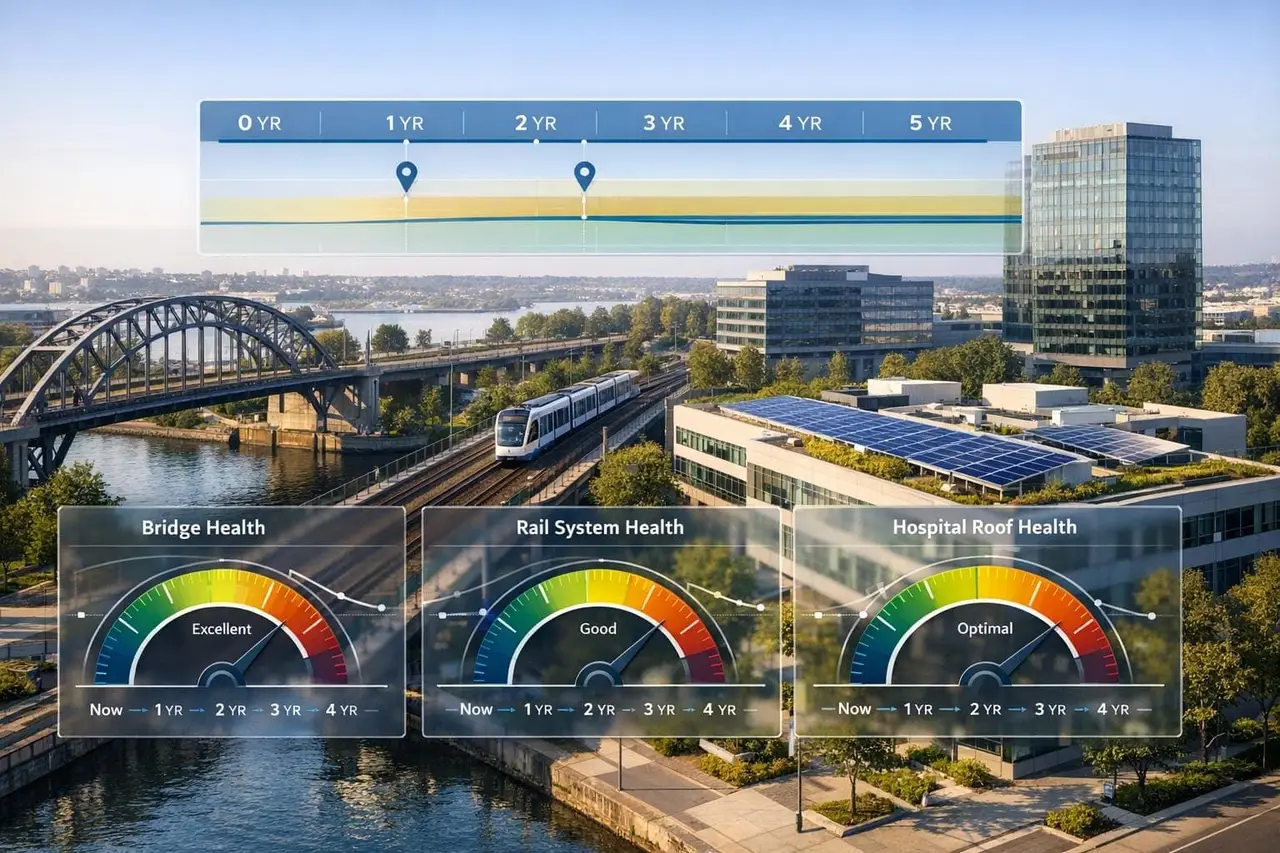
How Predictive Maintenance Supports Long-Term CAPEX Deferral Without Increasing Risk
Predictive maintenance (PdM) is a smarter way to manage aging assets and budgets. Instead of relying on fixed schedules or waiting for failures, PdM uses real-time data and AI to predict when maintenance is truly needed. This approach helps extend asset life, reduce emergency repairs, and avoid unnecessary replacements – all without increasing risk. Key takeaways include:
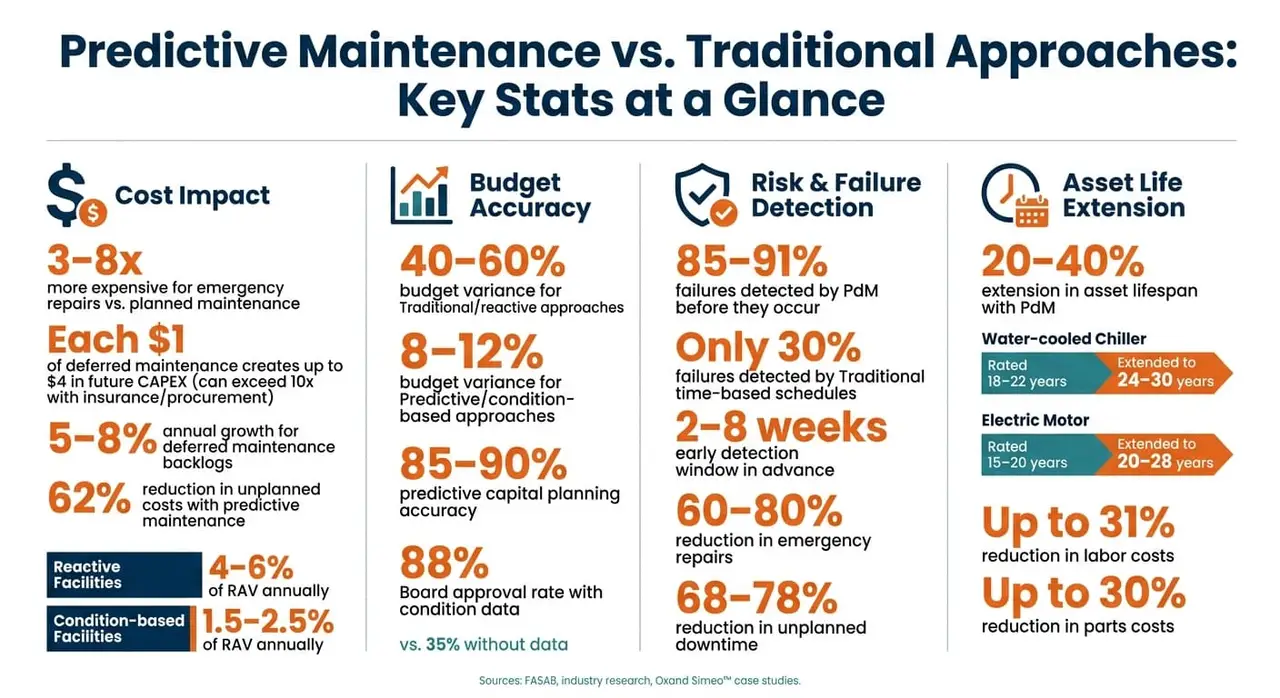
- Cost savings: Emergency repairs are 3–8x more expensive than planned maintenance. PdM reduces unplanned costs by 62%.
- Improved accuracy: Budget forecasts with PdM are 85–90% accurate, compared to 40–60% with traditional methods.
- Risk reduction: PdM identifies 85–91% of failures before they happen, cutting downtime by up to 78%.
- Longer asset life: Proactive interventions extend asset lifespan by 20–40%, delaying major capital expenses.
Platforms like Oxand Simeo™ simplify this process by turning data into actionable, long-term investment plans. With tools for risk analysis, multi-year forecasts, and scenario simulations, organizations can confidently defer CAPEX while maintaining reliability and safety.
Predictive vs. Reactive Maintenance: Cost & Risk by the Numbers
Risks of Deferred Maintenance and Outdated Approaches
Common Pitfalls of Deferred Maintenance
Delaying maintenance isn’t saving money – it’s creating a financial burden for the future. The U.S. Federal Accounting Standards Advisory Board (FASAB) defines deferred maintenance as:
“Deferred maintenance and repairs (DM&R) are maintenance and repairs that were not performed when they should have been or were scheduled to be and which are put off or delayed for a future period.” – FASAB [5]
The numbers paint a stark picture: for every $1 of deferred maintenance, future capital expenses can rise to $4 [3]. When emergency procurement and insurance impacts are factored in, this multiplier can soar beyond 10x [7]. Deferred maintenance backlogs don’t just sit idle – they grow by 5% to 8% annually [3].
Take a simple example: skipping a $400 lubrication task might seem minor, but it can lead to vibrations that stress nearby components. Within 18 months, that overlooked task could result in a $6,000 repair [3]. The table below shows how deferral costs escalate over time:
| Deferral Period | Cost Multiplier | What’s Happening |
|---|---|---|
| 0–6 Months | 1.0x | Minor part replacement; minimal disruption |
| 6–18 Months | 2.3x | Secondary wear; adjacent components stressed |
| 18–36 Months | 3.8x | System-level degradation; safety risks emerge |
| 36+ Months | 4.8x+ | Asset failure zone; full replacement likely |
The consequences go beyond financial strain. Deferred maintenance can shorten an asset’s lifespan by 30% to 40% and create a “firefighting” culture where over 60% of maintenance labor is spent responding to breakdowns instead of preventing them [3][4]. This reactive approach leaves little room for proactive strategies. Additionally, OSHA penalties for maintenance-related violations average $15,625 per infraction, and insurers often deny coverage for failures caused by neglected maintenance [3].
The takeaway? Deferred maintenance isn’t just expensive – it also increases risk and reduces operational efficiency. Smarter, data-driven strategies are essential to break this costly cycle.
Why Reactive and Preventive Approaches Fall Short
The financial toll of deferred maintenance reveals the flaws in both reactive and traditional preventive maintenance strategies. Facilities relying on reactive maintenance spend 4% to 6% of their Replacement Asset Value (RAV) annually. In contrast, top-performing facilities using condition-based maintenance spend just 1.5% to 2.5% [4][6]. Emergency labor costs 1.5x to 2x the standard rate, and expedited shipping for parts adds $275 to $690 per order. These costs quickly add up across a portfolio [6]. Yet, even with advancements, nearly half of all maintenance activities worldwide are still reactive as of 2026 [4].
Preventive maintenance offers some improvement but has its own challenges. Fixed schedules or manufacturer recommendations don’t account for the actual condition of assets. This “blind” maintenance approach leads to inefficiencies: replacing assets too early wastes resources, while degrading assets that aren’t addressed in time fail unexpectedly. Neither scenario supports modern goals for risk management or operational efficiency.
“Deferred maintenance becomes a capital risk not because individual assets age, but because capital requirements stop behaving independently.” – Marybeth Collins, Environment + Energy Leader [7]
Both reactive and traditional preventive strategies focus on individual assets and fixed schedules, ignoring the real-world factors – like usage patterns, local climate, and system interdependencies – that drive wear and tear. Years of neglect can create a “capital cliff”, where repairing one system (like HVAC) triggers unplanned upgrades to interconnected systems (like electrical or structural components) [7]. Proposals backed by condition data have an 88% approval rate from boards, compared to just 35% for decisions driven by intuition [1].
These limitations underscore the need for risk-based predictive maintenance to manage capital expenses effectively while minimizing operational risks.
Deferred Maintenance Is Becoming a Capital Risk
Core Principles of Risk-Based Predictive Maintenance
Risk-based predictive maintenance shifts the focus from traditional “fix-it-when-it-breaks” strategies to smarter, more targeted resource allocation. The approach zeroes in on assets that matter most, using a simple but powerful formula: Risk = Probability of Failure (PoF) × Consequence of Failure (CoF) [9]. This equation shapes every decision, from identifying critical assets to determining the timing of maintenance interventions.
“Not all assets are created equal, and they shouldn’t be treated equally.” – Tim Cheung, CTO and Co-Founder, Factory AI [9]
Failure Modeling and Asset Aging Simulations
Predictive maintenance relies on real-time data – like vibration, temperature, and pressure – paired with historical failure trends to calculate an asset’s Remaining Useful Life (RUL) [8][11]. This method moves beyond generic manufacturer estimates, offering a dynamic, data-driven health score on a 0–100 scale. The result? Near-real-time insights that enhance capital planning [8].
Here’s an example: A water-cooled chiller typically rated for 18 to 22 years can last 24 to 30 years with proactive interventions like early bearing replacements and refrigerant monitoring. Similarly, an electrical motor rated for 15 to 20 years can extend its lifespan to 20 to 28 years by tracking winding insulation and vibration [8]. These aren’t minor improvements – they represent years of deferred capital expenditures. Predictive maintenance identifies 85 to 91% of equipment failures before they happen, a massive leap from the 30% detection rate of traditional time-based schedules [11]. This precision lays a solid foundation for risk-based prioritization.
Risk Analysis and Prioritization
Research highlights a critical insight: 80% of facility risk is concentrated in just 20% of its assets [9]. Risk-based maintenance (RBM) leverages this principle, directing resources to the most critical assets – those whose failure would have the greatest operational, financial, or safety impact.
By scoring assets based on their failure likelihood and the consequences of those failures, organizations can prioritize their efforts. For example, high-stakes assets like a hospital’s HVAC system or a bridge’s bearings should receive predictive monitoring, even if they appear to be in good condition. Meanwhile, lower-impact assets can be managed with standard preventive schedules, allowing budgets and labor to focus where they’re needed most. A practical approach combines in-depth Reliability Centered Maintenance (RCM) for the top 5% of “extreme risk” assets with RBM for the broader portfolio [9]. This prioritization makes integrating risk insights into long-term strategies much more manageable.
Data-Driven Insights for Long-Term Planning
The combination of precise failure models and risk prioritization paves the way for smarter, data-driven capital planning.
“The core challenge… is not a lack of data… but the persistent difficulty of translating this vast repository of data into economically optimal, proactive decisions.” – Thomas Wiese, SUNY Empire State University [12]
Data-driven planning solves this challenge by aligning asset health scores with financial forecasts. This integration enables the creation of 5- to 30-year capital replacement schedules based on actual asset conditions [1][8]. The financial benefits are clear: predictive capital planning achieves 85% to 90% budget accuracy, compared to the 40% to 60% variance typical of reactive approaches [1]. Even more compelling, capital proposals backed by condition data and ROI analysis secure an 88% board approval rate, far outpacing the 35% approval rate for requests without data support [1]. These insights can be the difference between getting critical projects funded or seeing them delayed for yet another budget cycle.
How Oxand Simeo™ Supports CAPEX Deferral
Oxand Simeo™ turns raw asset data into practical, long-term investment strategies by pinpointing the ideal moments to address aging assets. Using principles of risk-based multi-year CAPEX planning, it transforms insights into actionable plans for deferring capital expenditures (CAPEX).
Asset Aging and Deterioration Models
Oxand Simeo™ relies on a vast database of 10,000 aging and energy performance laws and 30,000 maintenance actions and cost records to model how assets degrade over time [13]. By analyzing historical data, inspection reports, and condition assessments, it eliminates the need for additional sensors.
These models help determine the best time for maintenance or renewal, balancing risks and costs throughout an asset’s lifecycle. This approach shifts organizations from reactive emergency fixes to a predictive strategy that identifies potential vulnerabilities before they escalate into costly problems.
“We turned to Oxand because we needed a tool that would provide us with a predictive – not just corrective – view and help us manage our investments more effectively. Oxand stood out for its risk management capabilities.” – Head of Budget and Asset Valuation Department, In’li [13]
Risk-Based Multi-Year CAPEX and OPEX Planning
Using these aging simulations, Simeo™ converts condition data into rolling 5- to 30-year CAPEX and OPEX forecasts, far surpassing what reactive methods can achieve [13]. The platform factors in real-world constraints like budget limits, service-level requirements, risk thresholds, and decarbonization goals, ensuring plans are both feasible and effective.
Delaying maintenance without planning can significantly increase costs, with emergency repairs costing 4.8 times more than planned work [3]. Simeo™ helps organizations avoid these spikes by scheduling renewals at the optimal time – not too early to waste resources, and not too late to risk failures. By aligning maintenance schedules with financial cycles, asset managers can extend asset lifespans while minimizing risk.
“We needed a tool that would allow us to consolidate the fragmented data we had and project it in a way that could be presented to decision-makers.” – Chief Executive Officer, Meuse Department [13]
Scenario Simulation and Multi-Criteria Prioritization
Simeo™’s scenario simulation engine is a game-changer for asset planning. It allows users to test various budget scenarios and instantly see the impact on risk, service levels, and carbon reduction progress [13]. This feature makes it easier to present data-driven trade-offs to boards and finance committees, replacing guesswork with clear, visual comparisons.
The platform prioritizes projects based on factors like risk reduction, lifecycle cost, energy efficiency, and compliance. By ranking investments in this way, it generates actionable plans that typically deliver returns within 6 to 12 months [13]. This approach enables organizations to plan sustainably, deferring CAPEX while maintaining operational reliability and meeting long-term goals.
Measurable Outcomes and ROI Analysis
Predictive maintenance delivers clear financial and operational advantages.
Cost Savings from Predictive Maintenance
Building on risk-based maintenance principles, predictive strategies provide measurable financial and operational returns. These approaches help defer long-term capital expenditures (CAPEX) while cutting costs.
For instance, emergency repairs are 3 to 8 times more expensive than scheduled maintenance. Predictive maintenance not only eliminates many of these urgent repairs but also extends asset life by 20% to 40%. This reduces labor costs by up to 31% and parts expenses by as much as 30% [3][15][2].
Take the case of a 280,000 sq. ft. Class A office building: by implementing condition scoring across 847 assets, the building’s annual maintenance costs dropped from $487,000 to $307,000 – a $180,000 savings in just one year. The return on a $9,200 software investment was an impressive 19.6x [14]. Moreover, while reactive maintenance can lead to budget variances of 40% to 60%, predictive, condition-based forecasting narrows that variance to just 8% to 12% [1].
Risk Reduction Through Predictive Insights
Predictive maintenance isn’t just about saving money – it significantly reduces risks. Advanced monitoring tools, like vibration sensors and thermal imaging, can detect potential failures 2 to 8 weeks in advance. This early detection slashes emergency repairs by 60% to 80% and reduces unplanned downtime by 68% to 78% [3][16][17].
For example, a large utility avoided a forced outage, saving between $420,000 and $1.7 million, thanks to predictive monitoring [2].
“The shift from reactive to predictive maintenance fundamentally changed how we operate. Our technicians went from emergency responders to asset optimizers.” – Jennifer Martinez, Director of Facilities Operations, Apex Property Management [17]
Apex Property Management, managing 2.8 million sq. ft. of Class A office space, experienced a 78% reduction in equipment downtime and cut annual maintenance costs by 35% – from $1.2M to $780K – after adopting a predictive model [17].
Beyond cost and risk reductions, predictive maintenance also supports energy efficiency and sustainability goals.
CO₂ Reduction and Energy Efficiency Outcomes
Predictive maintenance plays a key role in reducing energy waste and promoting sustainability. For example, a 15-building office portfolio that implemented IoT monitoring and automated fault detection saw HVAC energy costs drop by 25%, saving $94,000 annually. Analysis revealed that 18% of the waste came from after-hours operation in unoccupied zones, while 30% was due to fault-driven overconsumption, such as refrigerant leaks [18].
On a larger scale, a 480 MW combined-cycle gas turbine plant transitioned from a fixed quarterly compressor washing schedule to a condition-based one. This shift improved the heat rate by 2.1%, reducing annual fuel costs by $680,000 [19]. Additionally, extending asset life through predictive maintenance minimizes the carbon footprint tied to manufacturing, shipping, and disposing of replacement equipment – helping companies meet ESG reporting goals [10].
Case Studies in Infrastructure and Buildings
Real-world examples highlight how predictive maintenance can transform highways, bridges, hospitals, and campuses by shifting aging assets from liabilities to planned investments. These cases demonstrate how addressing potential problems early can avoid costly emergency repairs.
Infrastructure Example: Highways and Bridges
In December 2025, a county managing 89 bridges used an AI-powered lifecycle management system to identify joint deterioration on Bridge #47 before it escalated. This proactive approach led to a $340,000 planned repair, sidestepping what could have been a $2.7 million emergency repair and an 18-month traffic detour [20].
Similarly, in February 2026, the Cascade State Department of Transportation, overseeing 1,840 bridges, transitioned from manual inspection workflows to a digital predictive maintenance platform. Within months, they reported $2.1 million in annual savings, reduced emergency repairs by 71%, and improved bridge safety ratings by 34%. Remarkably, they achieved full ROI in just 5 weeks [23].
This shift from fixed-cycle inspections to condition-based interventions plays a key role. Instead of servicing assets on a predetermined schedule, predictive models identify early signs of deterioration, allowing for timely and cost-effective repairs.
The same principles apply to building portfolios, as shown in the following hospital case studies.
Building Portfolio Example: Public Facilities and Hospitals
Healthcare facilities, where system failures can directly impact patient safety, illustrate the importance of predictive maintenance. In March 2026, a 400-bed regional medical center implemented IoT monitoring across three campuses. Just 38 days after deployment, the system flagged an impending HVAC failure in a surgical suite. The repair cost just $3,200, compared to an estimated $84,000 emergency repair if the issue had gone unnoticed [22].
“Before deployment, we had $340,000 in sensor hardware generating condition data that reached the maintenance schedule 11 days after the reading… That single intervention cost us $3,200 and saved the facility an estimated $84,000.” – Director of Facilities Engineering, 400-Bed Regional Medical Center [22]
By the end of the deployment, the medical center achieved 99.9% uptime for critical systems and saved $3.2 million annually [22]. In another case, a 500-bed acute care hospital switched from paper-based maintenance to an AI-powered platform, saving $1.8 million in the first year, recovering $480,000 in imaging revenue, and improving MRI suite availability by 23% [21].
These examples from both infrastructure and building portfolios demonstrate how predictive maintenance not only prevents costly emergencies but also ensures operational safety and efficiency.
Best Practices for Asset Investment Planning
When it comes to asset investment planning, the key is turning predictive maintenance data into actionable strategies that can defer capital expenditures (CAPEX). By connecting asset condition insights to budgeting, sustainability goals, and stakeholder priorities, organizations can make smarter, longer-term decisions.
Aligning Maintenance with Sustainability Goals
Predictive maintenance naturally aligns with environmental, social, and governance (ESG) objectives. By maintaining or replacing assets only when condition data supports it, organizations reduce waste and energy use. This approach leads to lower energy consumption and fewer emissions from well-maintained equipment [24].
To fully integrate decarbonization into planning, consider embedding these constraints into your models. A great example is In’li, a real estate organization that used Oxand Simeo™ to incorporate energy performance goals alongside risk management in their long-term planning. This shift from reactive to predictive decision-making allowed them to align investment timing with energy reduction targets [13].
However, achieving these sustainability benefits requires clear and consistent communication with stakeholders to ensure they understand the financial and environmental advantages.
Building Stakeholder Buy-In
Getting stakeholder approval for budgets based on technical insights requires translating risks into financial terms. The formula (Probability of Failure × Consequence) + Incurred Damage = Monetized Risk [25] is an effective way to communicate. By comparing this figure with the cost of immediate repairs, leadership can see the financial rationale for deferring or addressing maintenance.
Consider this: unmanaged deferred maintenance can lead to $4 in future capital expenditure for every $1 deferred, and emergency repairs are, on average, 4.8 times more expensive than planned interventions [3]. These numbers resonate in budget discussions.
The Meuse Department offers a practical example. Their CEO used Oxand Simeo™ to consolidate scattered asset data into a clear, budget-ready format for elected officials managing the budget:
“We needed a tool that would allow us to consolidate the fragmented data we had and project it in a way that could be clearly presented to our elected officials, who are the decision-makers.” – Chief Executive Officer, The Meuse Department [13]
Using Oxand Simeo™ for Data-Driven Investment Planning
Oxand Simeo™ simplifies the entire planning process, from assessing asset conditions to forecasting multi-year CAPEX needs. It eliminates the need for costly IoT sensor networks by leveraging a library of over 10,000 proprietary aging models and 30,000 maintenance laws, built through more than two decades of expertise [13].
Its scenario simulation tools are particularly valuable for managing complex portfolios. Teams can test various budget levels, service thresholds, and decarbonization targets side by side before committing to a plan. For example, LaGuardia Airport used Oxand’s framework to challenge traditional practices and align their operations with ISO 55001 standards [13]. Instead of relying on unstable annual budget estimates, they adopted a rolling 5-to-10-year CAPEX and OPEX forecast that updates dynamically as condition data evolves, offering a solid, audit-ready investment plan [3][13].
Conclusion: Key Takeaways
Predictive maintenance does more than tweak technical processes – it transforms how organizations manage their assets and control costs over time. At its core, the idea is simple: making decisions based on actual asset conditions consistently outperforms predictive vs reactive maintenance comparisons, both in terms of finances and operations.
The benefits are clear in the numbers. Emergency repairs, for example, cost an average of 4.8 times more than planned maintenance, while deferred upkeep only increases future capital expenses [3]. Transitioning to predictive strategies significantly narrows budget variances – from a typical range of 40–60% down to just 8–12% [1]. This kind of precision gives finance teams and asset managers the tools they need for reliable, multi-year planning. But the value isn’t just in the savings – it’s in the risk management. With a data-driven approach, managers can decide with confidence when to act and when it’s safe to delay, avoiding the fine line between smart planning and risky neglect.
Platforms like Oxand Simeo™ take this approach to the next level, using advanced tools to scale predictive maintenance. With a library of over 10,000 aging models and 30,000 maintenance laws, plus powerful scenario simulations, teams can test budget scenarios, service goals, and decarbonization targets before committing to a plan. These tools create rolling investment plans for anywhere from 5 to 30 years, updating dynamically as conditions change. The result? Flexible, data-backed strategies that align with long-term goals and are ready for presentation at the board level.
FAQs
How do I know it’s safe to defer CAPEX on an aging asset?
To delay capital expenditures (CAPEX) on aging assets safely, it’s crucial to evaluate the risks of failure and the potential costs of postponing maintenance. Tools like failure modeling and advanced analytics can use real-time data to predict these risks. By analyzing the asset’s current condition and reviewing historical failure trends, you can determine whether deferral might result in safety issues or significant operational disruptions. Leveraging data-driven insights allows for smarter decision-making, ensuring a balance between cost savings, safety, and maintaining reliable operations.
What data is needed to start predictive maintenance without new sensors?
To begin predictive maintenance without adding new sensors, you’ll need a few critical data points: baseline failure costs, savings from interventions, and failure timelines. These metrics are essential for assessing the ROI of predictive maintenance strategies, while also helping you plan and make informed decisions effectively.
How do I quantify the ROI of predictive maintenance for budget approval?
To measure the return on investment (ROI) for predictive maintenance, focus on clear, measurable savings and risk mitigation. Start by tracking key metrics like reduced unplanned downtime, longer equipment lifespan, and avoided failure costs. For instance, predictive maintenance often delivers impressive ROI ratios, sometimes as high as 10:1, along with 18% reductions in maintenance costs.
To build a strong case, calculate your annual savings in these areas and compare them to your investment. Use industry benchmarks and data specific to your assets to make the analysis more relevant and persuasive.