


Predictive Maintenance vs. Capital Renewal: How to Decide When Analytics Is Enough
When managing aging infrastructure, the choice between predictive maintenance and capital renewal depends on your goals, asset conditions, and budget constraints. Predictive maintenance uses real-time data to forecast failures and extend asset life, while capital renewal involves replacing or overhauling assets at the end of their lifecycle to restore functionality. Here’s how they compare:
- Predictive Maintenance: Reduces unplanned expenses by 62%, cuts downtime, and extends asset life by 15–25%. Best for critical, high-value equipment.
- Capital Renewal: Replaces assets when repairs are no longer cost-effective, reducing maintenance costs by 25–40% and improving efficiency. Ideal for aging systems nearing the end of their lifecycle.
Quick Comparison
| Criteria | Predictive Maintenance | Capital Renewal |
|---|---|---|
| Goal | Prevent failure, extend asset life | Replace or overhaul aging assets |
| Cost Type | Operational (OpEx) | Capital (CapEx) |
| Upfront Investment | Moderate ($200–$800 per sensor) | High (full replacement costs) |
| ROI Timeline | 12–18 months | Long-term |
| Best Use Cases | Critical, high-value, or unpredictable assets | Aging systems beyond repair |
To decide, assess asset criticality, calculate ROI, and use tools like Oxand Simeo™ to model scenarios and optimize decisions. Combining both strategies can balance costs and improve reliability.
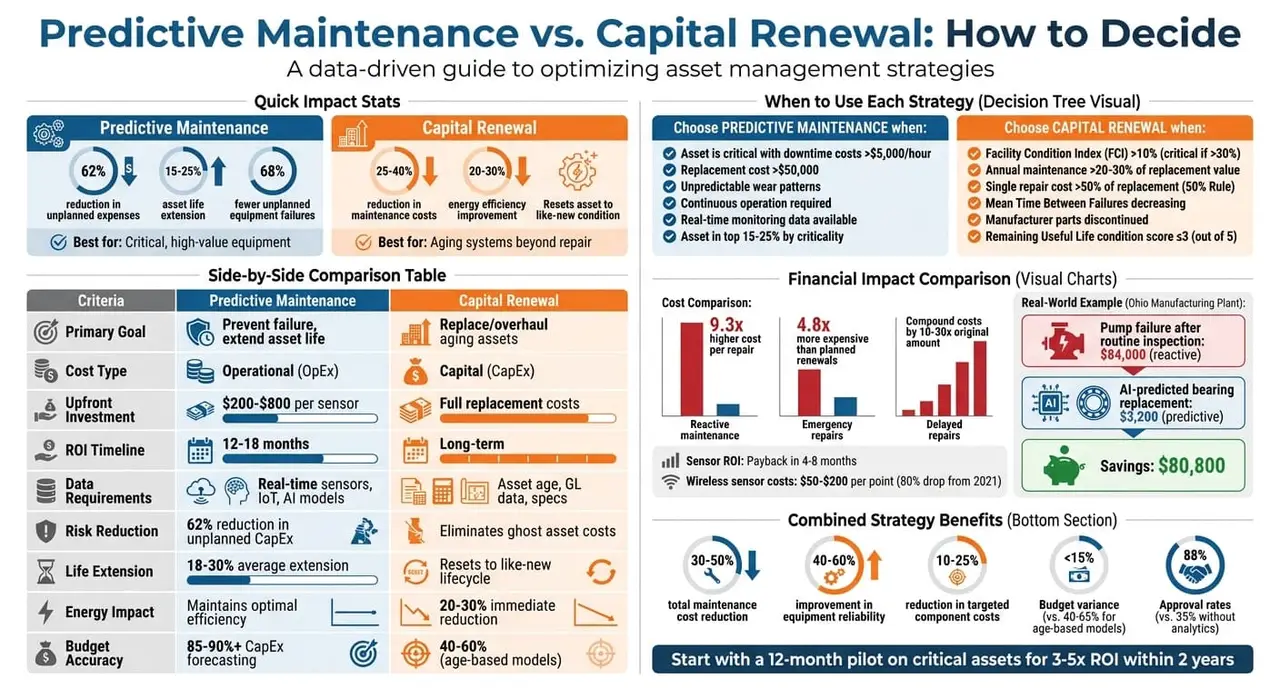
Predictive Maintenance vs Capital Renewal: Key Differences and Decision Criteria
What Is Predictive Maintenance?
How Predictive Maintenance Works
Predictive maintenance relies on real-time sensor data and AI-driven analytics to forecast when equipment is likely to fail. Unlike traditional methods that depend on fixed schedules or manufacturer guidelines, this approach tracks actual equipment performance through key variables like vibration, temperature, and pressure [6][9]. When these metrics exceed predefined thresholds, the system raises an alert – typically 2 to 8 weeks in advance [5].
The analytics process follows four stages: descriptive, diagnostic, predictive, and prescriptive [7]. By integrating IoT sensors, historical maintenance data, and machine learning models, predictive maintenance systems create a baseline of “normal” operating conditions for each piece of equipment [7][8].
“Data sitting in a dashboard waiting for an analyst to interpret it isn’t predictive maintenance. It’s data collection with extra steps.”
A real-world example illustrates the value of this approach. In March 2025, an Ohio manufacturing plant experienced a centrifugal pump failure just 11 days after a routine preventive inspection, incurring $84,000 in reactive repair costs. Meanwhile, another pump in the same facility – monitored by AI-powered vibration sensors – had its bearing replaced three weeks earlier, based on a predicted failure window. The repair cost? Just $3,200. This $80,800 difference underscores the importance of timely interventions [5].
Accurate predictions like these lead to major cost savings and improved equipment reliability.
Benefits of Predictive Maintenance
Predictive maintenance programs, built on data and analytics, deliver measurable results. Compared to preventive maintenance alone, they reduce costs by 8% to 12% and detect 85% to 91% of potential equipment failures before they happen. In contrast, traditional calendar-based maintenance catches only about 30% of issues [6][8][9]. Organizations implementing predictive maintenance report a 62% drop in unplanned capital expenditures and 68% fewer unplanned equipment failures within a year [1][5]. For HVAC systems, this approach can extend asset life by 18% to 22% [1].
In manufacturing, the difference is striking: reactive maintenance costs are 9.3 times higher per repair compared to facilities using predictive analytics [9]. The financial return is rapid – sensor investments typically pay for themselves in just 4 to 8 months [6]. Plus, advancements in technology have significantly reduced costs, with wireless sensors now priced between $50 and $200 per monitoring point – a sharp 80% drop from 2021 prices [6].
With these benefits, predictive maintenance has become a critical strategy for managing essential assets.
Best Scenarios for Predictive Maintenance
Predictive maintenance is especially effective for high-value or critical equipment where downtime costs exceed $5,000 per hour or replacement costs are over $50,000 [6][9]. It’s also ideal for machinery with unpredictable wear patterns, where fixed schedules might lead to over-maintenance or missed issues [10]. Assets in hard-to-reach or hazardous areas, or those operating continuously, gain significant advantages from predictive monitoring [6].
To maximize impact, focus on the top 15% to 25% of assets based on downtime costs [6][9]. For example, predictive monitoring can reduce water main breaks by 35% to 50% and cut bridge inspection costs by 40% to 65% [2][10]. In highway operations, predictive slope stabilization is 85% to 93% cheaper than addressing failures reactively [10]. The key is using sensors to detect early warning signs – such as changes in vibration, temperature, or pressure – weeks before a failure occurs. In some cases, warnings can be issued up to 12 weeks in advance [6].
This targeted approach ensures resources are allocated where they make the biggest difference.
What Is Capital Renewal?
How Capital Renewal Works
Capital renewal steps in when assets have aged to the point where routine maintenance no longer delivers consistent results. Unlike predictive maintenance, which aims to extend the life of equipment, capital renewal involves either a full replacement or a major overhaul. This process essentially resets an asset’s condition, restoring it to like-new performance or upgrading it entirely with newer technology. It’s a strategy reserved for assets in the “wear-out” phase, where ongoing repairs are no longer cost-effective or reliable [11][13].
To classify capital renewal projects, finance teams apply the BAR Test, which stands for Betterment (improving efficiency or performance), Adaptation (changing the asset’s use), or Restoration (returning a major component to like-new condition) [4]. These projects fall under Capital Expenditures (CapEx) rather than Operating Expenses (OpEx), often requiring careful, multi-year planning and resource management [11][13].
Cost thresholds often guide the decision to renew rather than repair. For example, the “50% Rule” suggests that if a repair costs more than half the price of a replacement, it’s time to renew [11]. Similarly, if annual maintenance expenses surpass 20% to 30% of the asset’s replacement value, continuing to repair becomes less about maintenance and more about subsidizing failure [11].
Capital renewal’s ability to restore performance and improve efficiency makes it a vital strategy for aging assets.
Benefits of Capital Renewal
Capital renewal offers several financial and operational advantages. For starters, it can lower annual maintenance costs by 25% to 40% by eliminating wasteful over-servicing and reducing the need for emergency repairs [4]. Additionally, replacing older equipment with modern alternatives often leads to energy savings, as newer models are typically 20% to 30% more efficient than those from a decade ago. This not only cuts operational costs but also reduces emissions [11][15].
Planned renewals also avoid the high premiums associated with reactive maintenance. Emergency repairs, on average, cost 4.8 times more than planned replacements [4][14]. For example, addressing a reactive roof failure at a large facility could run $1.39 million, whereas a planned replacement costs $1.2 million and allows for financial planning across multiple fiscal years [1]. Delaying necessary repairs can compound costs by 10 to 30 times the original amount, not to mention the added expense of emergency service premiums [13].
Organizations that use data-driven capital renewal strategies experience tighter financial control, with CapEx budget variances staying under 15%, compared to 40% to 65% for those relying on age-based models [4][14]. Furthermore, structured renewal programs can enhance property valuations during refinancing or sales, as they demonstrate responsible asset management [4].
These advantages highlight why capital renewal is essential when routine maintenance is no longer effective.
When Capital Renewal Is Required
Determining the right time for capital renewal depends on clear indicators that maintenance is no longer sufficient or safe. The Facility Condition Index (FCI) is a key metric: an FCI above 10% signals a need for significant investment, while anything over 30% indicates that major intervention or full replacement is critical [13].
Other signs include a shrinking Mean Time Between Failures (MTBF) despite increased preventive maintenance efforts, which suggests the asset has entered its wear-out phase [11]. Similarly, when technicians rely on refurbished parts due to discontinued manufacturer support, operational risks climb significantly [11]. The Remaining Useful Life (RUL) formula – calculated as Design Life minus Age minus Condition Adjustment Factor – helps identify assets with condition scores of 3 or below (on a 1–5 scale) as prime candidates for renewal [4][14].
Regulatory requirements can also drive renewal decisions. For instance, California’s Title 24 energy standards, effective January 1, 2026, mandate earlier renewal cycles for HVAC systems and building envelopes to meet stricter efficiency guidelines [13]. With California’s deferred maintenance backlog projected to hit $84 billion by 2026, delaying renewals will only worsen costs, which compound at 1.3 to 1.5 times for every year of inaction [4][14].
“When your CMMS reporting shows that the trailing 12-month maintenance cost exceeds 30% of the asset’s replacement value, you are no longer maintaining an asset; you are subsidizing a failure.”
Predictive Maintenance vs. Capital Renewal: Side-by-Side Comparison
Comparing Key Criteria
Deciding between predictive maintenance and capital renewal comes down to assessing how each strategy performs across various critical factors. The table below highlights the primary differences, helping you determine which option aligns better with your asset management needs.
| Criteria | Predictive Maintenance | Capital Renewal |
|---|---|---|
| Primary Goal | Prevent asset failure and extend its life | Replace an asset at the end of its economic life |
| Trigger | Based on real-time condition data and failure probability models | Determined by asset age, depreciation schedules, or reaching economic limits |
| Cost Type | Predominantly OpEx (sensors, analytics, and labor) | Primarily CapEx (one-time replacement costs) |
| Upfront Investment | Moderate ($200–$800 per monitored asset point for sensors) [17] | High (full replacement and installation costs) |
| ROI Timeline | Typically 12–18 months for critical systems [16] | Long-term, achieved through efficiency gains and improved uptime |
| Data Requirements | Real-time sensors, IoT feeds, and AI-driven models | General ledger data, asset age, and material specifications |
| Risk Reduction | Reduces unplanned capital events by 62% [1] | Eliminates maintenance costs tied to “ghost assets” |
| Life Extension | Extends asset life by 18% to 30% on average [1][17] | Resets the lifecycle to a like-new condition |
| Energy Impact | Maintains optimal energy efficiency | Cuts energy use by 20–30% immediately [11] |
| Budget Accuracy | Achieves 85% to 90%+ accuracy in CapEx budgeting [1] | Varies widely, often 40–60% in traditional age-based models |
| Sustainability | Avoids waste by delaying premature replacements | Reduces environmental footprint with high-efficiency upgrades |
This comparison reveals when each approach is most effective. Predictive maintenance is ideal for deferring major capital expenses while ensuring critical assets remain operational, particularly for high-value systems. On the other hand, capital renewal becomes the better choice when an asset reaches its economic limit – such as when annual maintenance costs exceed 20–30% of the replacement value or a single repair costs over 50% of a new unit [11].
The choice depends heavily on factors like data availability and the importance of the asset. Predictive maintenance proves its worth when real-time monitoring shows remaining useful life, offering a clear return on investment through longer service life and fewer unexpected repairs. However, if an asset’s Mean Time Between Failures continues to drop despite increased maintenance, capital renewal offers a stronger return through improved energy efficiency and reliability [11].
Understanding these differences helps allocate resources effectively between analytics-based maintenance and strategic replacements, laying the groundwork for a well-balanced asset investment strategy focused on both risk and ROI.
How to Decide Between Predictive Maintenance and Capital Renewal
Now that the differences are clear, the next step is figuring out which strategy – predictive maintenance or capital renewal – fits your asset portfolio’s needs best.
Assessing Risk and Asset Criticality
Start by ranking your assets based on the impact of their potential failure. Not all equipment deserves the same level of attention or investment. Consider factors like safety risks, downtime costs, and the effect on quality when evaluating assets [19][20].
A mission impact framework can help categorize assets based on their importance. For example, low-impact assets like redundant HVAC systems or non-critical lighting might be allowed to run to failure. On the other hand, high-impact assets, such as primary electrical systems or life-safety equipment, demand proactive maintenance [18].
To assess the condition of your assets, assign a score from 1 to 5, considering factors like age, repair history, and real-time inspection data [1]. Pair this with AI-driven failure probability models to estimate Remaining Useful Life (RUL). This approach makes it easier to identify assets nearing critical thresholds. Facilities that align their maintenance strategies with asset criticality often see 40–60% improvements in equipment reliability [19].
Once you’ve prioritized assets based on risk, the next step is to evaluate the financial and sustainability benefits of each approach.
Calculating ROI and Sustainability Impact
Compare the financial and environmental impacts of predictive maintenance versus capital renewal by calculating the Total Cost of Ownership (TCO). This should include direct costs, like labor and materials, as well as indirect costs, such as planned downtime and waste from over-maintenance [20]. A common formula for ROI is:
ROI (%) = [(Total Annual Financial Gain – Annual Cost of Investment) / Total Cost of Investment] x 100 [20].
Sustainability is another key factor. Predictive maintenance can reduce waste by avoiding premature replacements – many scheduled replacement programs discard components that still have 40% or more of their value [20]. Additionally, manufacturing facilities that adopt strategic maintenance programs report 25–35% lower total maintenance costs and a 60–80% reduction in unplanned downtime [19].
With these metrics in hand, you can model and refine your decisions to find the best approach.
Using Oxand Simeo™ to Model Scenarios and Optimize Decisions
Oxand Simeo™ builds on the analytics framework by using over 10,000 aging models and 30,000 maintenance laws to simulate asset degradation. It allows you to compare scenarios side-by-side and optimize decisions based on factors like risk, lifecycle cost, asset criticality, service levels, and CO₂ impact – all without relying entirely on IoT sensor networks.
For example, the platform can help you evaluate whether to adopt a predictive maintenance strategy for critical chillers or proceed with full asset replacement. It factors in budget limits, energy reduction goals, and carbon constraints. This approach is particularly useful for traditional infrastructure where sensor data may be limited or too expensive. Instead of waiting for real-time monitoring, Oxand Simeo™ uses probabilistic modeling and existing inspection data to create investment plans spanning 5–30 years. These plans are audit-ready and align with ISO 55001 standards. Clients typically achieve a 10–25% reduction in maintenance costs for targeted components, along with measurable CO₂ and energy savings across their portfolios.
Combining Predictive Maintenance and Capital Renewal
Bringing together predictive maintenance and capital renewal allows you to align the right strategy with the right asset. By using analytics, this approach helps balance maintenance spending while improving asset performance.
Matching Strategies to Asset Type and Criticality
Predictive maintenance works best for high-criticality rotating equipment such as pumps, motors, and compressors. These assets benefit from continuous monitoring since sensors can pick up on issues like vibration or temperature changes weeks before a failure occurs.
On the other hand, capital renewal is ideal for structural systems and equipment with fixed replacement schedules or nearing the end of their design life. Examples include fire suppression systems, electrical panels, and roofing. A useful guideline is the 50/75% rule: for critical production assets, consider capital renewal when repair costs reach 50% of the replacement value, and for non-critical assets, use a 75% threshold [14].
Using a mix of predictive and preventive strategies can cut total maintenance costs by 30–50% [12]. The key is segmentation – don’t apply a one-size-fits-all strategy. Instead, group assets by criticality, type, and condition, then assign the most efficient approach to each category.
Once these strategies are defined, move into a pilot phase to test and refine your plan.
Starting with Pilot Projects and Scaling Up
After matching strategies to your assets, kick off with focused pilot projects. For example, try a 12-month pilot on critical rotating equipment to see a quick return on investment (3–5x ROI within two years). Use this phase to gather baseline data, improve condition scoring, and confirm remaining useful life (RUL) estimates [5].
When the pilot delivers measurable results, scale up to other asset groups. Tools like Oxand Simeo™ simplify this process by letting you simulate different scenarios – such as accelerated renewal or deferred “stretch-and-patch” strategies. This helps you visualize how decisions will affect downtime, costs, and even carbon emissions before you finalize budgets. Plus, as new condition data and work orders come in, the platform dynamically updates your 5–30 year investment plan to keep it accurate and ready for audits.
Conclusion
Making decisions doesn’t have to be a guessing game. As shown, analytics replaces reactive strategies with precise, data-backed actions. By using tools like condition scoring, repair history analysis, and failure probability models, asset managers can pinpoint the best time to replace assets. This prevents wasting 20–40% of an asset’s remaining life through premature replacement and avoids emergency replacements that can cost 3–5 times more [1][3].
The key is tailoring your approach to the type and importance of each asset. For instance, predictive monitoring works well for critical rotating equipment, while structural systems nearing the end of their lifespan may need capital renewal. Combining these approaches leads to much better financial accuracy – achieving 85% budget precision compared to the 40–60% variance common with reactive planning [1].
Oxand Simeo™ takes raw data and transforms it into detailed, long-term investment plans spanning 5 to 30 years. The platform allows you to test scenarios like accelerated renewals, deferred maintenance, or hybrid strategies, showing how each option affects downtime, costs, and carbon emissions before you allocate budgets. As new condition data comes in, plans adjust automatically, ensuring forecasts remain accurate, audit-ready, and in sync with available funds. This efficient process sets the stage for a practical pilot program.
Kick off a 12-month pilot focusing on critical assets to see a return on investment of 3–5 times within two years [12]. With analytics as your foundation, you can extend asset lifespans by 18%, cut unplanned capital expenses by 62%, and increase capital proposal approval rates from 35% to 88% – all based on hard data, not intuition [1].
FAQs
What’s the fastest way to decide if an asset should be monitored or replaced?
The fastest way to make a decision is by using a data-driven approach to evaluate the asset’s condition, risk of failure, and associated costs. Tools like predictive analytics, which rely on real-time sensor data and failure models, can provide insights into when an asset might fail. If the data suggests that failure is near and replacing the asset would be cheaper than dealing with emergency repairs, replacement is the smarter choice. On the other hand, if monitoring shows the asset’s life can be extended, sticking with continued monitoring makes more sense.
How do I calculate total cost of ownership to compare predictive maintenance vs. renewal?
To figure out the total cost of ownership (TCO) when comparing predictive maintenance to asset renewal, you’ll need to look at every cost involved over the asset’s lifecycle. This includes:
- Initial costs: Purchase and installation expenses.
- Ongoing costs: Regular maintenance and operational expenses.
- Unexpected costs: Repairs or unplanned downtime.
- End-of-life costs: Replacement or disposal expenses.
But don’t stop there. Also account for the intangible benefits predictive maintenance might provide, like reducing risks, minimizing downtime, and extending the lifespan of your assets.
By adding up all these factors – both financial and strategic – you can better evaluate whether predictive maintenance delivers a cost advantage over simply replacing assets.
How can I start a small pilot and scale predictive maintenance across a portfolio?
To start, focus on pinpointing the assets that play a key role in operations and where predictive maintenance can deliver measurable returns. Install IoT sensors on these assets to gather real-time data, which can then be analyzed using an AI-powered maintenance platform to anticipate potential failures. Begin with a pilot program – monitor the results closely, adjust your approach as needed, and then expand the initiative to include additional assets. Keep an eye on metrics like decreased downtime and longer asset lifespans to assess the program’s effectiveness and inform decisions as you scale.
Related Blog Posts
- Predictive vs Reactive Maintenance: Cost Analysis Guide
- Predictive vs. Reactive Maintenance: Which Strategy Wins for Asset Investment Planning?
- How to Calculate the Real ROI of Predictive Maintenance (and Feed It into Your Investment Plan)
- From Data to Decisions: Turning Asset Analytics into CAPEX Savings