

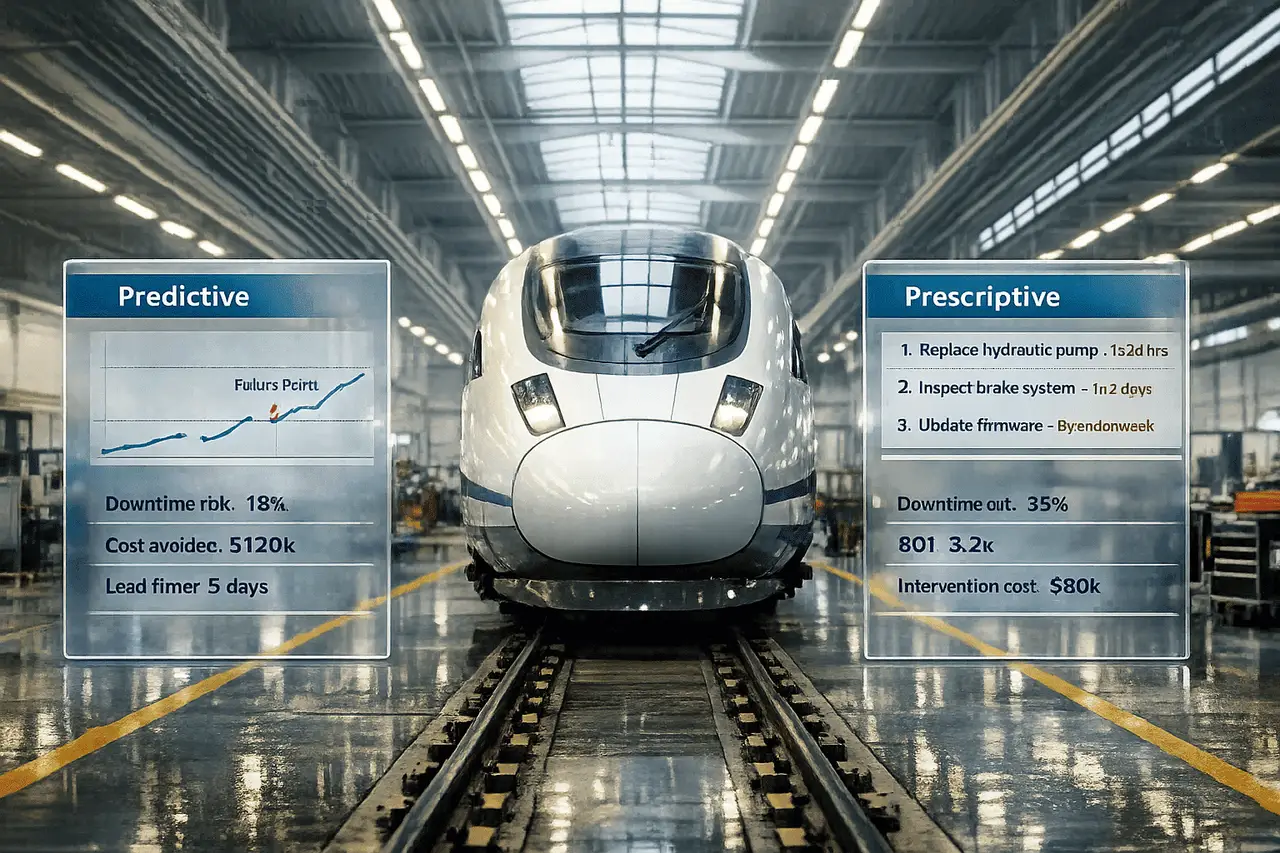
Prescriptive vs. Predictive Maintenance: Which One Creates More Financial Value?
Prescriptive and predictive maintenance are two advanced strategies for managing assets, each with distinct financial benefits. Predictive maintenance focuses on forecasting potential failures using sensor data and AI, while prescriptive maintenance goes further by offering actionable steps to address those predictions efficiently.
Key Insights:
- Predictive maintenance can reduce unplanned downtime by 30–50% and extend asset life by 20–40%.
- Prescriptive maintenance improves downtime reductions to 50–70% and extends asset life by 40–60%, while also cutting emergency repair costs and optimizing inventory.
- Prescriptive maintenance costs more upfront (3–4x predictive maintenance) but delivers higher ROI for critical assets.
Quick Takeaway: Start with predictive maintenance for less critical assets or limited budgets. Use prescriptive maintenance for high-value equipment where downtime is costly. A hybrid approach often works best for large portfolios.
Quick Comparison:
| Feature | Predictive Maintenance (PdM) | Prescriptive Maintenance (RxM) |
|---|---|---|
| Primary Output | Forecasts failures | Provides actionable steps |
| Downtime Reduction | 30–50% | 50–70% |
| Asset Life Extension | 20–40% | 40–60% |
| Implementation Cost | Lower ($50,000–$200,000) | Higher (3–4x PdM) |
| ROI Realization | 6–18 months | 10:1 to 30:1 long-term |
Each strategy plays a role in reducing costs and improving efficiency. The choice depends on your data quality, asset criticality, and budget.
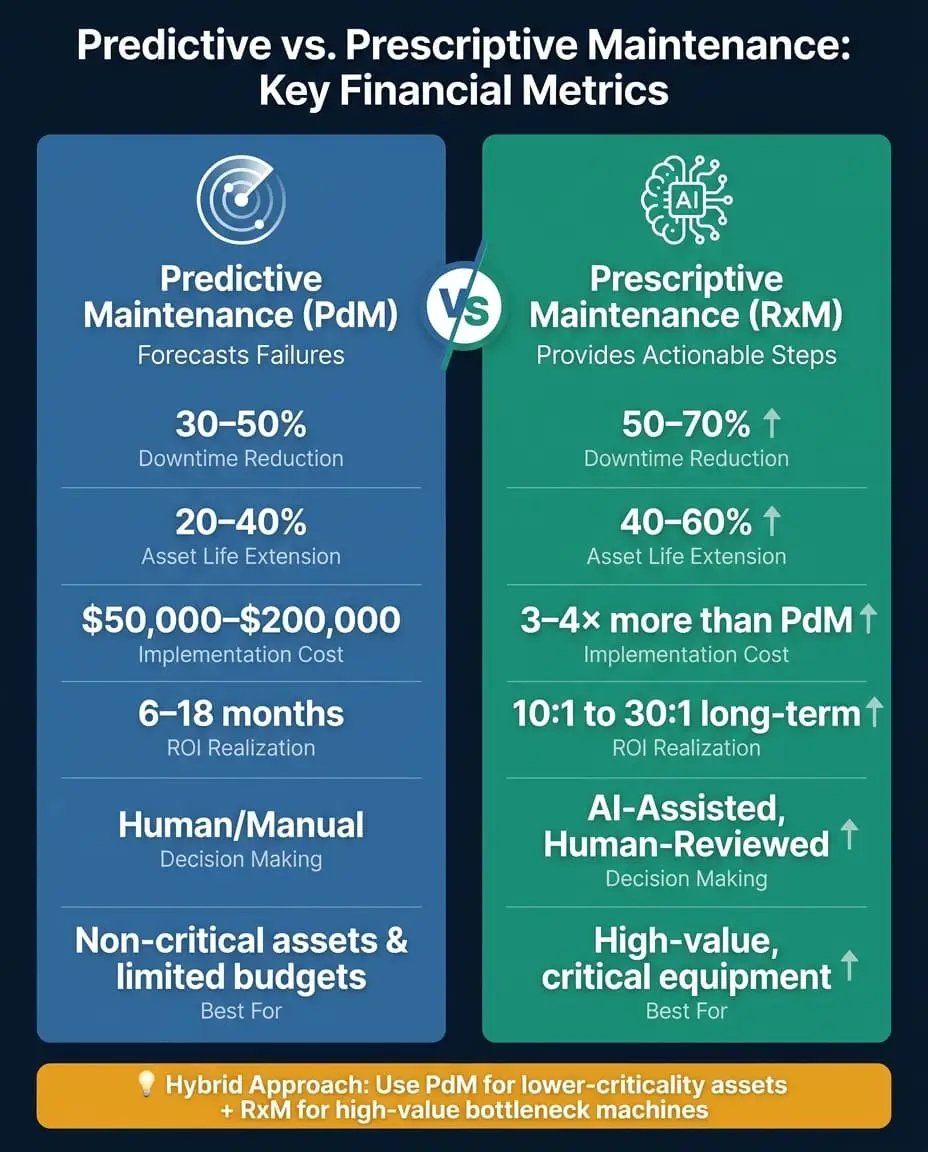
Predictive vs. Prescriptive Maintenance: Key Metrics Compared
Predictive Maintenance: How It Creates Financial Value
How Predictive Maintenance Works
Predictive Maintenance (PdM) shifts from fixed maintenance schedules to real-time monitoring. Sensors track critical asset conditions around the clock, and when data deviates from expected ranges, AI models alert managers anywhere from 1 to 8 weeks before a potential failure occurs [5]. This early warning system allows teams to schedule repairs in advance, avoiding the expense and chaos of emergency fixes.
Catching issues early – right down to the component level – makes all the difference. For instance, identifying a bearing on the brink of failure can prevent damage to larger systems like motors or compressors. This proactive approach helps avoid cascading failures, where a small problem spirals into a much bigger, costlier one [3].
The Financial Case for Predictive Maintenance
PdM turns real-time monitoring into measurable savings. The numbers speak for themselves: while a PdM intervention typically costs between $900 and $2,800, a reactive repair can range from $8,500 to $22,000 [1].
Take this example: in March 2025, an Ohio manufacturing plant compared the outcomes of two identical centrifugal pumps. One pump, maintained through quarterly preventive checks, failed just 11 days after its last inspection. The result? An $84,000 repair bill, including emergency parts and four days of lost production. Meanwhile, the second pump, equipped with AI-linked vibration sensors, had its bearing replaced three weeks before a predicted failure – at a cost of just $3,200. That’s a savings of $80,800 on a single piece of equipment [6].
The benefits extend beyond individual cases. Facilities using PdM report unplanned downtime as low as 0.8–1.5% of operating hours, compared to 3–5% with reactive strategies. Over three years, mature PdM programs can achieve a 680% return on investment (ROI). Sensor investments often pay off within 4 to 8 months, and equipment lifespan can stretch to 115–135% of its rated capacity [1].
What Predictive Maintenance Requires to Work
To achieve these financial benefits, certain operational foundations need to be in place. Here’s what PdM requires:
- Sensor infrastructure: Wireless vibration and temperature sensors cost between $500 and $5,000 per asset. A pilot program monitoring 5–10 critical machines can be launched for under $10,000 [4][5].
- A data baseline: AI models need 3 to 6 months of operating data to establish normal patterns. This ensures prediction accuracy, which typically ranges from 85–92% [7].
- Right asset selection: Focusing on the top 10–20% of critical assets – those where downtime costs exceed $5,000 per hour – delivers the highest returns [1][5].
A gradual transition is key. Jumping straight from reactive to predictive maintenance can reduce effectiveness. Establishing a preventive maintenance baseline first provides cleaner data for AI models, enabling more accurate predictions. This step-by-step approach ensures PdM delivers the expected ROI while extending asset life [1].
Prescriptive Maintenance: Where Additional Financial Value Comes From
How Prescriptive Maintenance Works
Prescriptive maintenance (RxM) provides a detailed, prioritized action plan outlining what needs to be done, when, how, and with what resources. This approach bridges the gap between receiving an alert and taking the correct action [8][9]. RxM operates through a three-layer framework: diagnostic, contextual decision-making, and continuous learning. Together, these layers not only detect anomalies but also incorporate operational data and improve recommendations over time [10]. Unlike systems that only provide alerts, RxM integrates key variables like production schedules, spare parts availability, technician resources, and energy costs to deliver actionable solutions [8][10].
“Prescriptive maintenance is the discipline of closing the [Decision Gap]. It is the difference between a weather forecast predicting rain and a navigation system automatically rerouting your car to avoid a storm-flooded road.” – Tim Cheung, CTO and Co-Founder, Factory AI [8]
This comprehensive approach lays the foundation for the financial advantages discussed below.
The Added Financial Value of Prescriptive Maintenance
RxM goes beyond cost savings by improving overall operational efficiency and long-term asset performance. While predictive maintenance (PdM) typically reduces unplanned costs by 15–25%, RxM achieves 25–40% optimization across maintenance, availability, and energy use [10]. For unplanned downtime, RxM improves reductions from the 30–50% range seen with predictive systems to 50–70% [12].
Managing MRO (maintenance, repair, and operations) inventory is another area where RxM shines. For example, if an algorithm predicts a component has 40 days of life remaining and shipping takes 5 days, the system places an order by day 30. This avoids emergency shipping costs and minimizes excess inventory [8]. By eliminating the 2.4x price premium often paid for urgent orders, RxM can cut emergency parts costs by 45% [13]. Additionally, teams using prescriptive AI experience a 40–60% reduction in Mean Time to Repair (MTTR). Diagnostic processes that once took 48–72 hours can now be completed in less than 4 hours [13]. These efficiencies are especially valuable in the U.S., where high labor costs make downtime particularly expensive.
RxM also extends asset life by dynamically adjusting operating parameters, such as reducing machine speed or load, safely adding an extra 10–20% lifespan compared to predictive maintenance [8]. Over time, these improvements can lead to a 25–35% reduction in total maintenance costs within the first year of full RxM implementation [13].
Despite these benefits, adopting RxM comes with its own set of challenges.
The Challenges of Adopting Prescriptive Maintenance
While RxM offers significant savings, its implementation costs are 3–4 times higher than PdM and require much more contextual data [12][10]. One of the biggest hurdles is integrating various systems, such as vibration sensors, inventory management platforms, and ERP data. Without proper data integration, 85% of maintenance recommendations fail to achieve optimal cost and time outcomes [11].
Another challenge is operator skepticism. When AI recommendations lack transparency, experienced workers may distrust them. To address this, many organizations use a phased “Shadow Mode” pilot. In this approach, the AI provides recommendations that humans evaluate and verify before full automation is implemented. This step helps build trust and ensures accuracy before scaling up [8][9].
Predictive vs. Prescriptive Maintenance: A Direct Comparison
Key Differences and When to Use Each Approach
The main difference between Predictive Maintenance (PdM) and Prescriptive Maintenance (RxM) lies in their outcomes. PdM focuses on identifying potential failures, while RxM offers specific, actionable steps – right down to the part and timing needed for a repair.
This difference has real-world implications: 67% of predictive maintenance alerts are ignored because they don’t provide enough actionable guidance [3]. Simply put, PdM raises awareness, but RxM drives action.
PdM is best suited for non-critical assets, where a failure might not cause significant disruption. On the other hand, RxM is ideal for high-value equipment, especially in scenarios where every hour of downtime could cost $250,000 or more [12].
“In 2026, nearly all of the top tier manufacturers are implementing a hybrid approach; using Predictive sensors for the majority of their plant and Prescriptive AI for the high value ‘bottleneck’ machines.” – Silk Team, Silk Commerce [12]
These differences don’t just affect operations – they translate into distinct financial outcomes.
Financial Outcomes: A Side-by-Side Comparison
The financial impact becomes clear when comparing key metrics for each approach:
| Performance Metric | Predictive Maintenance (PdM) | Prescriptive Maintenance (RxM) |
|---|---|---|
| Primary Output | Failure warning (alert) [12] | Actionable advice (instruction) [12] |
| Downtime Reduction | 30%–50% [12] | 50%–70% [12] |
| Asset Life Extension | 20%–40% [12] | 40%–60% [12] |
| Decision Making | Human/manual interpretation [12] | AI-assisted, human-reviewed [12] |
| ROI Realization | 6–18 months [12] | 10:1 to 30:1 long-term [12] |
| Implementation Cost | $50,000–$200,000 (mid-size facility) [12] | 3–4× more than PdM [12] |
| Implementation Complexity | Moderate [12] | High [12] |
RxM provides an additional 12–18% reduction in costs over PdM alone [13]. Avoiding just one major failure – ranging from $200,000 to $2,000,000 – can deliver a 10–20× ROI on the upfront investment in RxM [13]. While RxM requires a higher initial cost, the returns for critical assets make it a worthwhile choice.
These financial insights highlight how each method contributes to risk reduction and asset management strategies over time.
Risk Reduction and Long-Term Asset Planning
Beyond financial metrics, both PdM and RxM significantly influence risk management and long-term asset strategies. PdM helps detect issues before they escalate into major failures. RxM, however, goes further by addressing what Tim Cheung, CTO of Factory AI, calls the “Decision Gap” – the critical time between receiving an alert and taking the correct action [8]. Without closing this gap, even accurate predictions can lead to delays, missteps, or costly repairs.
Take this example: deferring a $340 bearing replacement could result in repair expenses climbing to $18,400 [3], a staggering 54× increase. RxM systems calculate the “cost of deferral” in real time, helping managers make informed decisions under pressure.
For long-term planning, RxM feeds asset health data into 5–10 year capital expenditure models, enabling condition-based replacements instead of relying on arbitrary timelines [13]. This shift – from age-based to condition-based planning – creates lasting financial benefits across an entire asset portfolio.
Conclusion: Picking the Right Maintenance Strategy for Your Portfolio
A Framework for Choosing Between Predictive and Prescriptive Maintenance
The best maintenance strategy depends on three key factors: the state of your data, the complexity of your portfolio, and your budget limitations.
If your organization struggles with scattered historical records, starting with predictive maintenance (PdM) makes sense. It helps stabilize capital and operational expenses (CAPEX/OPEX) while reducing total cost of ownership (TCO). On the other hand, if your team faces delays of more than 48 hours between receiving an alert and dispatching a work order – or if you’re managing thousands of assets across multiple locations – prescriptive maintenance (RxM) can bridge that gap. By cutting diagnosis time to under 4 hours, RxM can deliver an average 35% reduction in total maintenance costs [13].
For portfolios with a wide range of assets, a hybrid approach often works best. Predictive maintenance can handle lower-criticality assets, while prescriptive maintenance focuses on assets where unplanned downtime would have major consequences.
How Oxand Simeo™ Supports Strategy Implementation
Oxand Simeo™ provides powerful tools to help implement these strategies effectively. Designed to support both predictive and prescriptive approaches, the platform uses detailed aging models and maintenance data to simulate asset deterioration and estimate intervention costs – factoring in budget, risk, and decarbonization goals [2].
“We turned to Oxand because we needed a tool that would provide us with a predictive – not just corrective – view and help us manage our investments more effectively. Oxand stood out for its risk management capabilities.” – Head of Budget and Asset Valuation Department, In’li [2]
This allows decision-makers to test various maintenance scenarios before committing funds. By integrating asset health forecasts into 5–10 year CAPEX plans, Oxand Simeo™ replaces guesswork with condition-based planning.
Key Takeaways for U.S.-Based Decision-Makers
The numbers are clear: emergency repairs cost far more than planned interventions, and unplanned downtime costs U.S. industries around $260 billion annually [13]. Neither PdM nor RxM is a one-size-fits-all solution. The right choice depends on your specific assets, the quality of your data, and your risk tolerance.
Shifting away from reactive or age-based methods toward a condition-driven, financially sound approach is essential. Whether you begin with predictive models or jump straight into prescriptive AI, aligning your maintenance strategy with long-term financial and sustainability goals is key to protecting – and growing – the value of your portfolio. Use these insights to craft a strategy that ensures both resilience and growth.
Understanding The Difference Between Predictive & Prescriptive Maintenance | UpKeep
FAQs
How do I decide which assets should use predictive vs. prescriptive maintenance?
When deciding between predictive maintenance and prescriptive maintenance, it’s all about the importance of the asset and how intricate the operations are.
- Predictive maintenance is ideal for high-value, critical assets. These are the top 15-25% of assets that, if they fail, could lead to significant downtime and hefty expenses. It focuses on catching potential failures early to avoid disruptions.
- Prescriptive maintenance, on the other hand, is better suited for more complex operational setups. It goes a step further by creating actionable, cost-efficient work orders that consider factors like inventory, labor availability, and production schedules.
Choosing the right approach ensures smoother operations and better resource management.
What data and system integrations are required for prescriptive maintenance to work?
To make prescriptive maintenance work, you need to bring together critical data streams and systems. This means combining IIoT connectivity to gather real-time sensor data – like vibration, temperature, and pressure – with IT data, such as inventory levels, technician schedules, and production timelines.
A CMMS (Computerized Maintenance Management System) plays a crucial role by transforming AI-driven insights into actionable work orders. Additionally, using standardized failure codes and ranking asset criticality ensures AI can effectively learn from past repair data, paving the way for more precise recommendations.
How can I estimate ROI and payback for a hybrid PdM + RxM program?
To calculate the ROI and payback period for a hybrid predictive (PdM) and prescriptive (RxM) maintenance program, begin by evaluating your current expenses. This includes costs related to maintenance, downtime, labor, lost production, and emergency repairs. Then, apply the formula: (Total Savings – Total Costs) / Total Costs.
Hybrid programs blend predictive sensors, which provide visibility, with prescriptive AI to tackle critical issues. These programs often deliver impressive results, with ROI ranging from 10:1 to 30:1 and payback periods typically falling between 6 to 18 months.