


Context
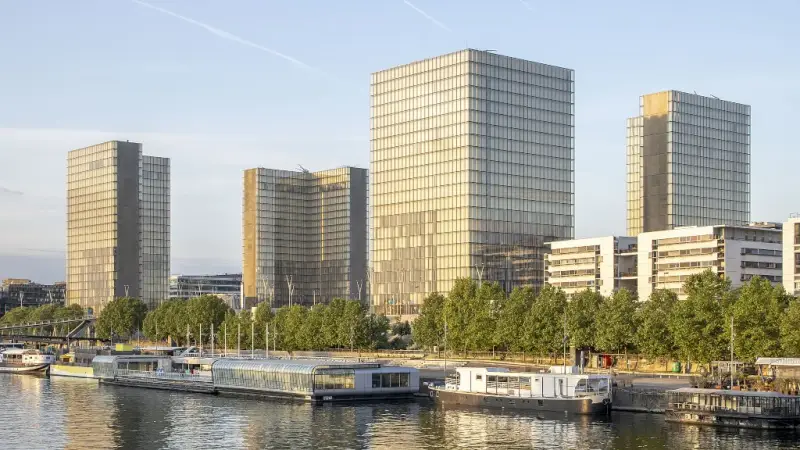
The François-Mitterrand site alone covers 350,000 m² — over 30,000 m² of collection stores, some 145,000 m² of reading rooms and public circulation, more than 60,000 m² of technical plant — behind which sit around 130 air-handling units, 14 MW of cooling capacity, seven substations, 73,000 lighting points and a building-management system of 265,000 points, the largest in Europe. In 2024 the BnF decided to equip that estate with a dedicated asset management platform. At this scale the questions had outgrown the method: how much risk the estate carries, which single investment plan to put in front of management and the supervising ministry, and how differentiated budget scenarios compare over fifteen years. In May 2026 the Senate's finance committee published its own assessment of the library's property policy, putting the renovation need of the François-Mitterrand site at around €530 million — some €200 million of which would become technical debt by 2030 if nothing were done — on an estate valued at close to €1.5 billion, the seventh largest held by an operator of the French State, and recommending that the State and the BnF agree a multi-year budget trajectory. That is the trajectory the library had already begun to build.
Our solution
- 01 Frame and mobilise Set up the steering committee and joint Oxand/BnF project leadership, and bring some 35 people from across the technical department into the project.
- 02 Structure the estate Digitise four sites into six databases aligned with the technical department's own organisation, from a management view of close to 2,000 components down to service-level views.
- 03 Parameterise the models Set condition, obsolescence, replacement costs, ageing laws and severity laws with each service, then run scenario tests to make the data reliable.
- 04 Hand over Train the teams and take the platform into service, with the estate live in November 2024.
What Oxand delivered
A strategy endorsed at the highest level
The BnF built its multi-year real-estate strategy (SPSI), endorsed by its supervising ministry and by the Senate.
Risk shared with decision-makers
Management and the supervising ministry now work from the same explicit view of the condition and risk carried by the estate.
Budgets prioritised by risk
Budgets are built by prioritising on risk, and differentiated scenarios compared side by side, to preserve a public service that safeguards the cultural heritage.
Renovation measured over time
The effect of renovation work is measured against the multi-year plan as it is delivered.
In their words
“Our spreadsheets gave us totals, never a picture of risk. With Simeo the wear and obsolescence of our equipment become visible and quantified: the investment we ask for is no longer an opinion, it is a demonstration.”
“For each budget level, Simeo shows what happens: what we maintain, what we defer, and the risk we accept — up to service interruption. The debate with our supervising ministry is no longer about opinions but about trajectories.”
“With Simeo we no longer talk technical: we talk probability and estate strategy. When much of the estate is nearing end of life, you do not know where the failure will come from — but you know it will come, and what it would cost.”
“Simeo let us carry the condition of our estate beyond the technical department: to general management, to our supervising ministry, as far as the Senate report. Today nobody can say they did not know.”
“A budget is argued over three years; an estate like ours is steered over thirty. We deliberately delayed our real-estate strategy plan by a year in order to build it on objective data — and it is now validated by our supervising ministry.”
Questions about this reference
Why did the Bibliothèque nationale de France adopt an asset management platform?
Because the questions its estate raised had outgrown the method available to answer them. At 350,000 m² on the François-Mitterrand site alone, the library needed to quantify the risk the estate carries, put a single investment plan in front of management and its supervising ministry, and compare differentiated budget scenarios over fifteen years.
How long did it take to digitise the BnF estate?
Nine months. The project was launched in February 2024 with digitisation as its target and the software went into service in November 2024.
Which BnF sites were modelled?
Four: the François-Mitterrand site broken down into five buildings (the four towers and the base), the recently renovated Richelieu site, the Centre technique du livre built in 1955, and the historic Bibliothèque de l'Arsenal.
What does the Senate report say about the BnF estate?
The Senate's finance committee published its assessment of the library's property policy in May 2026. It puts the renovation need of the François-Mitterrand site at around €530 million, of which some €200 million would become technical debt by 2030 if nothing were done, on an estate valued at close to €1.5 billion — the seventh largest held by an operator of the French State. Among its recommendations is that the State and the BnF agree a multi-year budget trajectory for the renovation, which is the exercise the library had already started on data modelled in Simeo.
What did the BnF obtain from the project?
A Schéma pluriannuel de stratégie immobilière (SPSI) validated by the library and its supervising ministry, a shared view of estate risk at management and ministry level, budgets prioritised by risk, and the ability to measure the effect of renovation work over time.