


Context
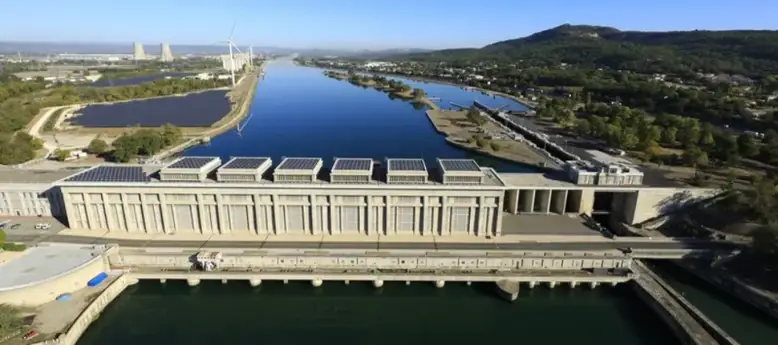
Created in 1933 and holder of the Rhône concession until 2041, CNR is France's leading producer of exclusively renewable energy, generating about a quarter of the country's hydroelectricity alongside its navigation and agricultural irrigation missions. Its published estate runs from Lyon to the Mediterranean: 19 dams, 45 hydroelectric plants, 19 locks and 330 kilometres of large-gauge navigable waterway, together with the bridges, lateral dykes, mooring structures and navigation markers that a river concession on that scale carries. Strategic planning for that estate was built on deep in-house engineering judgement, and CNR set out to take it a step further: to let the asset data speak, to quantify the renewal volume and phasing its estate requires, to test what its budget and operational constraints actually cost, and to build strategic plans that are both more agile and more robust.
Our solution
- 01 Take planning a step further Build on in-house engineering judgement by making the asset data speak, and identify where that data can be improved.
- 02 Quantify the unconstrained need Establish the volume and phasing of assets that would ideally be renewed with no constraints, which is what reveals whether a maintenance backlog exists.
- 03 Price the constraints Establish what can actually be renewed under a series of multi-criteria constraints, and where relaxing a constraint would pay.
- 04 Compare trajectories Project, simulate and challenge the possible medium- and long-term trajectories, with their impact on performance, risk and budget capacity made explicit.
What Oxand delivered
A quantified renewal need
The volume and phasing of renewal needed across the estate, established from asset ageing and open to challenge.
Constraints made visible
The cost of current budget and operational constraints, in renewal need and in overall performance, and the opportunities to change them.
Performance and risk anticipated
A clearer understanding of how each strategy affects performance and risk, and better-sized budgets through the blocking points it exposes.
More agile, more robust plans
Greater agility in building strategic plans, and greater robustness in the plans themselves.
In their words
“Expert opinion used to settle it. Today every investment decision is factual and quantified — and no one can reduce it to assumptions any more.”
“Twenty years of data lay dormant in our databases. Simeo turned it into investment plans — the best ones available under our real constraints.”
“Every asset has its maintenance debt, quantified. Every strategy has its impact, measured in performance and in risk. The whole trajectory of the estate becomes something we can steer.”
“Cut the budget? Fine — here is what that costs in 5, 10 and 20 years. Put quantified trajectories on the table and the conversation with executives and shareholders changes in kind.”
“At the end of the concession, the grantor will judge the condition of the estate. We simulate it today — and every decision, taken or refused, stays on the record. On the day we sit down with the State, everything is on the table.”
Questions about this reference
Why did CNR deploy Oxand Simeo?
To move strategic planning beyond expert judgement: to make its asset data speak, to know the volume and phasing of assets ideally to be renewed without constraints — which reveals whether a maintenance backlog exists — to know what can be renewed under multi-criteria constraints, and to project and challenge the best medium- and long-term trajectories.
Which questions does CNR answer with Simeo?
What renewal needs will arise over the coming years given asset ageing; what the impact on CNR's performance would be if renewal were carried out without constraints; what its current constraints cost in renewal need and overall performance; and which compromise scenario is best for renewing its assets.
What was the hardest part of the deployment?
Collecting and reconstituting the asset data set the simulations depend on. CNR describes that as its principal challenge.
What is CNR doing next with Simeo?
Keeping the asset-management loop alive — register, rating, strategic vision, strategic planning, operational planning — updating the database continuously to sharpen future simulations, building the rating grid for the main structures (dams, power plants, locks) with Oxand, and finalising the data set for Rhône dredging.