

Context
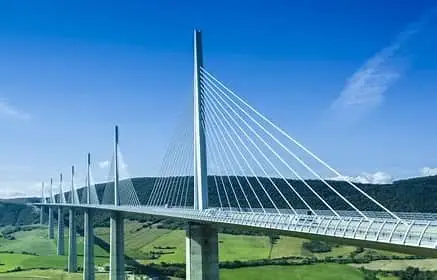
At 2,460 meters long and 245 meters high, the Millau Viaduct is the largest viaduct in France. Built in 2004, it features 154 stay cables and a deck weighing over 36,000 tons, making it a truly exceptional structure. The Millau Viaduct operating company is seeking a software solution to help build and justify its investment budget through to the end of the concession period. The objective is to meet the major challenges associated with maintaining the viaduct and its roadways over the long term.
Our solution
- 01 Structure and capitalize knowledge on the viaduct, the civil engineering structure, the toll station canopy, and the roadways on structures
- 02 Analyze and assess risks associated with the assets (safety, availability, durability, etc.) and create a risk map
- 03 Simulate various maintenance and investment scenarios
- 04 Train and support CEVM teams in using Oxand’s predictive methodology and software
What Oxand delivered
Predictive condition view
A predictive view of the condition and aging of the Millau Viaduct’s infrastructure
Infrastructure aging visibility
A predictive view of the condition and aging of the Millau Viaduct’s infrastructure
Watch the story
Questions about this reference
What makes the Millau Viaduct a particular maintenance case?
Its scale and singularity. At 2,460 metres long and 245 metres high, with 154 stay cables and a deck weighing over 36,000 tonnes, it is the largest viaduct in France — an exceptional structure with no comparable estate to benchmark against.
What did the operating company set out to do?
To build and justify its investment budget through to the end of the concession period, so that the long-term maintenance of the viaduct and its roadways is planned against that deadline rather than year by year.
What is covered by the asset knowledge?
The viaduct itself, the civil engineering structure, the toll station canopy and the roadways carried on the structure — the whole concession perimeter rather than the deck alone.
How is risk assessed on a structure like this?
Safety, availability and durability are assessed together and consolidated into a risk map, so that an intervention can be justified by the risk it removes rather than by the age of the component.
What stays with the operator after the engagement?
A predictive view of the condition and ageing of the infrastructure, and CEVM teams trained and supported in using the predictive method and the software themselves.