

Context
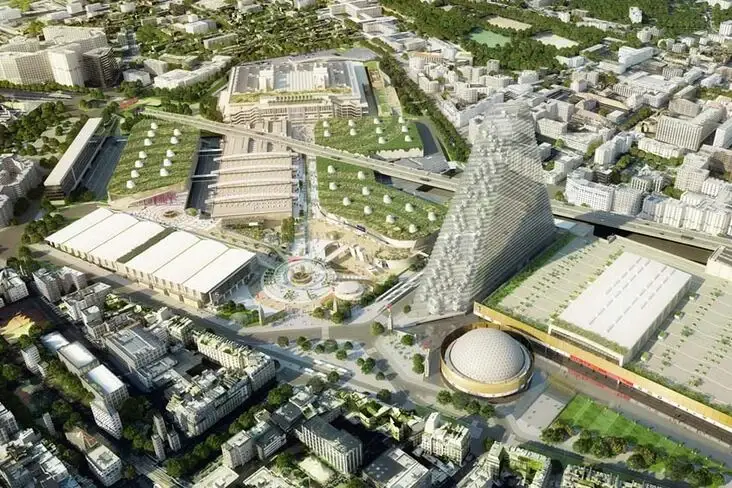
Viparis operates twelve of the Grand Paris region's leading venues — five congress centres, four exhibition parks and three exceptional sites — inside an Île-de-France exhibition and congress market of some 700,000 m² of commercialisable space. It hosts around 800 events, 45,000 exhibitors and 11 million visitors a year. Its technical and works department sits at the crossing of four stakes that the climate transition has sharpened: safety and health, financial value, commercial continuity and decarbonation. Restarting after Covid while preparing for the Olympic Games, across a portfolio spread over many sites and at contrasting stages of wear, the department set out to see the whole estate on one shared reference before arbitrating what to renew.
Our solution
- 01 One reference for the group Structure 8 sites and 32 buildings plus 5 outdoor areas into Viparis's own 15 technical domains and 88 component types, around 2,700 components in all, outdoor networks and car parks included.
- 02 Consolidate what was dispersed Bring files and expert knowledge together through workshops with the site teams, and train them on the method as it is built.
- 03 Calibrate the models Set ageing laws, maintenance actions and cost curves domain by domain, so the projection reflects how this estate actually wears.
- 04 Project and justify Project needs at 5, 10 and 15 years and price the investment paths under risk, energy and decarbonation constraints.
What Oxand delivered
One readable asset reference
A homogeneous group-wide reference and a consolidated inventory the site teams can read, rely on and keep current.
Trade-offs objectivated for the executive committee
Euro per kWh saved, return on investment and criticality made explicit, so planned investments can be checked for relevance and trade-offs justified inside the multi-year plans.
Trajectories at 5, 10 and 15 years
Projected needs feeding the CAPEX plans and the maintenance budgets, with energy performance built into the trajectory rather than bolted on.
Teams levelled up on the method
A shared way of qualifying equipment, with the site teams supported through entry, validation and prioritisation until they own it.
In their words
“What we do not measure, we can neither steer nor put a value on. An estate is not a fixed inheritance, it is a living asset to be developed with intent. Simeo helps us answer a simple but strategic question: where to invest, when, and why?”
“From the field to the executive committee: a technical value chain that can finally be read.”
“Towards an augmented approach, still steered by the teams.”
“The tool is only a lever: what makes the difference is structuring the data, mobilising the teams and being clear about the objectives.”
Questions about this reference
What does Viparis operate?
Twelve of the Grand Paris region's leading venues — five congress centres, four exhibition parks and three exceptional sites — hosting around 800 events, 45,000 exhibitors and 11 million visitors a year, inside an Île-de-France exhibition and congress market of some 700,000 m² of commercialisable space.
What is the scope of the Simeo deployment at Viparis?
Eight sites and 32 buildings plus five outdoor areas and car parks, broken down into Viparis's own 15 technical domains and 88 component types: around 2,700 components in all, including outdoor networks, roads and car parks.
What does Viparis use the projections for?
To take trade-offs to the executive committee on explicit grounds — euro per kWh saved, return on investment and criticality — and to build the CAPEX plans and maintenance budgets on projected needs at 5, 10 and 15 years, with energy performance inside the trajectory.
Why calibrate ageing laws domain by domain?
Because a venue estate wears unevenly: roofing, technical plant, outdoor networks and car parks each age on their own curve and carry their own cost of intervention. Calibrating domain by domain is what makes the projection specific to this estate rather than a generic average.
What comes next for Viparis?
A decarbonation module being integrated, mobile capture to keep field data reliable, and connections to the maintenance management system and the finance system so the same data is not entered twice.